





Executive Overview
In the rapidly evolving landscape of B2B sales and marketing, artificial intelligence has shifted from a novel experiment to core infrastructure. Yet, as companies race to deploy AI sales development representatives (AI SDRs) and automated outbound engines, a critical architectural debate has emerged: Should organizations rely entirely on commercial third-party platforms, or must they build bespoke internal tools to harness their proprietary data?
For SaaStr AI, the answer is neither exclusively "buy" nor "build"—it is a disciplined hybrid strategy.
While approximately 90% of SaaStr AI’s outbound volume continues to run through established, best-in-class commercial vendors—such as Monaco, Artisan, Agentforce, and Qualified—the organization recently developed a specialized internal prospecting tool within its proprietary platform, 10K. This bespoke engine handles hyper-targeted outreach for a carefully curated set of named accounts.
By marrying the scalable infrastructure of commercial outbound vendors (which expertly manage domain protection, deliverability, sequencing, and list hygiene) with an internal agent capable of pulling fragmented first-party data across disparate systems, SaaStr AI has unlocked a new paradigm of Account-Based Marketing (ABM).
The results are striking. By scaling hyper-personalized outreach—such as customized renewal decks and tailored sponsorship pitches—the company has expanded high-touch engagement exponentially. Where human bandwidth once limited custom decks to a handful of elite enterprise sponsors, AI-driven workflows now generate dozens of hyper-specific proposals. Smaller silver-tier sponsors, treated with the analytical depth typically reserved for multi-hundred-thousand-dollar accounts, are responding at unprecedented rates.
This article provides an in-depth look at SaaStr AI’s hybrid outbound architecture, exploring why commercial vendors still dominate volume operations, where off-the-shelf tools fall short regarding first-party data silos, and how organizations can construct their own internal enrichment pipelines without reinventing core delivery infrastructure.
Detailed Chronology: From Manual Friction to Agentic Workflows
To understand SaaStr AI’s current outbound configuration, one must examine the operational bottlenecks that forced a redesign of their renewal and prospecting processes.
Phase 1: The Bottleneck of Custom Account Management
Historically, high-touch account management at SaaStr followed a rigid, resource-constrained hierarchy. For major annual events and sponsorship renewals, the internal team possessed a wealth of rich, multi-channel data. They knew precisely how many executives a sponsor had sent to previous events, which leaders actively engaged with company newsletters, how many leads were generated during past sponsorships, and what historical conversion metrics looked like.
However, synthesizing this vast repository of data into actionable, bespoke collateral—such as custom review decks and data-backed pitch proposals—was intensely manual. Consequently, this elite tier of personalization was restricted to the top five diamond sponsors. The remaining cohort of silver and gold sponsors received generalized, templated follow-ups. Unsurprisingly, engagement and renewal rates among smaller sponsors lagged, limited entirely by human bandwidth constraints.
Phase 2: Building the Renewal Agent
The turning point arrived when the engineering and revenue teams at SaaStr built an automated renewal agent on top of the 10K platform. Conceptualized and deployed in roughly half a day—a feat detailed on Episode #013 of The Agents podcast—the system bridged the gap between isolated operational databases.
The agent was programmed to ingest:
- CRM Data: Contracts, historical spend, lifetime value (LTV), and account history stored in Salesforce.
- Engagement Logs: Email opens, Qualified chat transcripts, and Momentum call recordings.
- External and Un-synced Data: WordPress interactions, social media footprints, podcast archive telemetry, and Bizzabo event lead counts.
Once ingested, the agent synthesized this data into structured narratives and fed it through the Gamma API to automatically construct fully realized, visually polished custom presentation decks.
Phase 3: Scaling Personalization Across Tiers
The operational impact was immediate. Rather than producing five custom decks, the renewal agent successfully generated 20 to 30 highly tailored decks for a broader tier of sponsors.
Most notably, silver-tier sponsors—who typically contribute smaller check sizes and historically suffered the lowest renewal rates—began replying at significantly higher rates than their diamond counterparts. For a smaller organization, a $25,000 sponsorship commitment represents a major financial decision. Receiving a data-backed deck proving that SaaStr had tracked their exact return on investment transformed the customer relationship.
Phase 4: Expanding to New Logo Prospecting
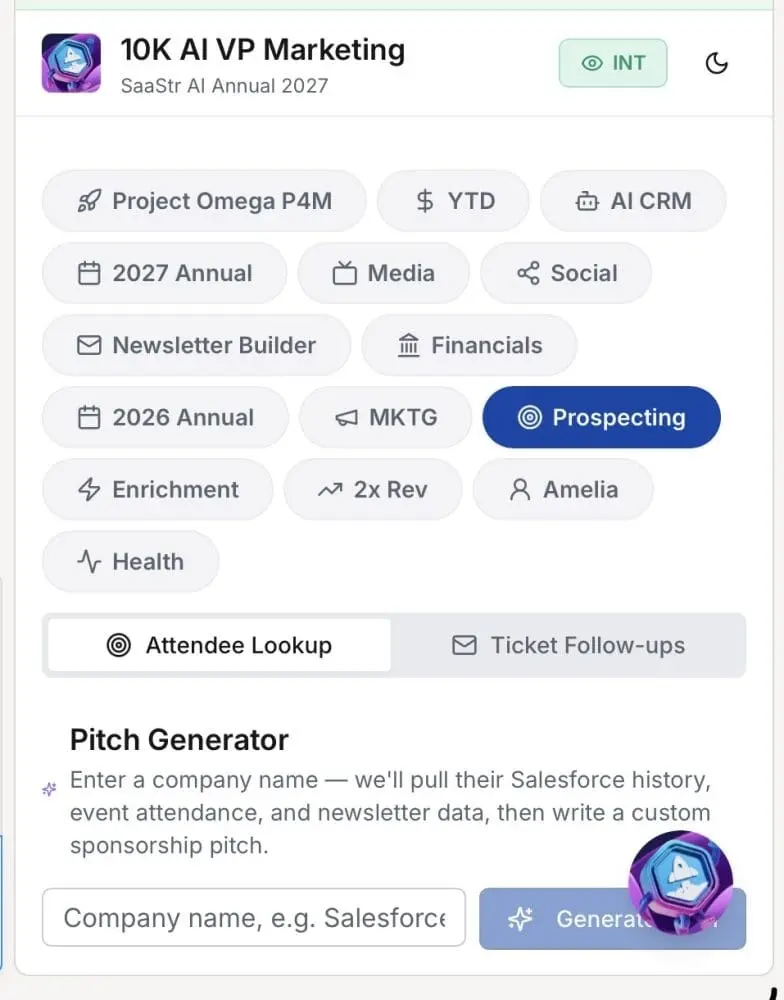
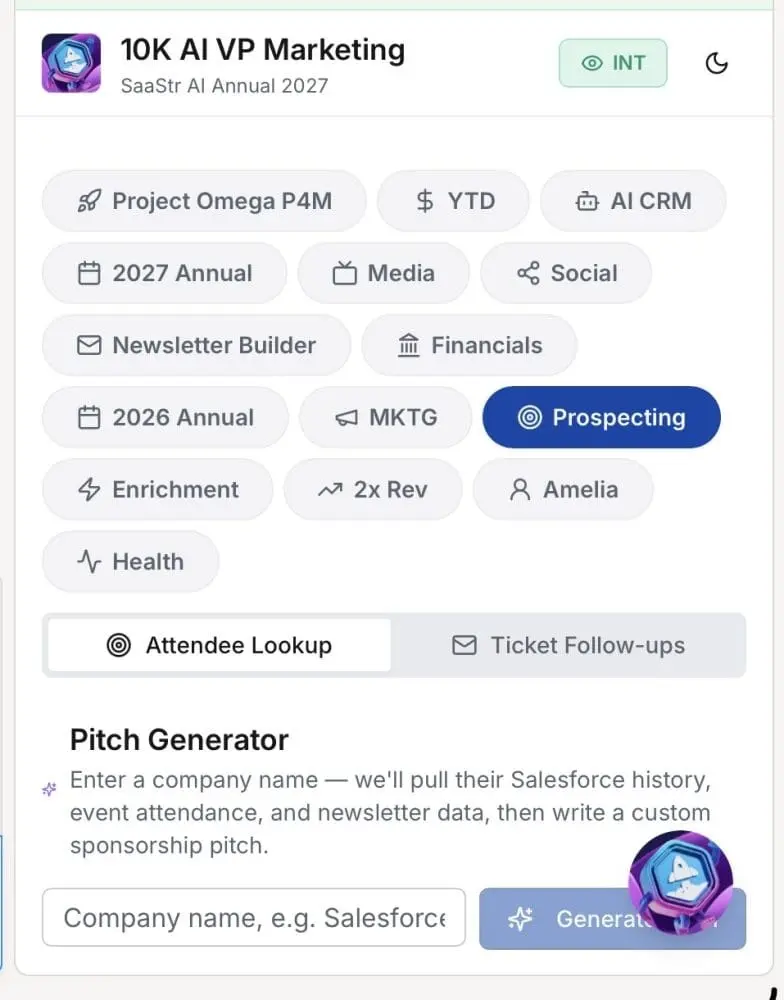
Encouraged by the success of the renewal agent, the team applied the exact same architectural philosophy to new logo acquisition. They built a dedicated prospecting tab inside the 10K platform featuring Attendee Lookups, Ticket Follow-ups, and an advanced Pitch Generator.
Today, when targeting a new enterprise sponsor, the system ingests the target company’s Salesforce history, past event attendance metrics, and newsletter engagement data. It then generates a hyper-personalized outreach pitch that highlights exact data points—such as historical team attendance and executive reading habits—turning cold outreach into warm, data-backed conversations.
Supporting Context & Metrics: Why Commercial Vendors Fall Short on Data Silos
While SaaStr AI’s internal tool solves the problem of deep personalization, the organization remains an aggressive consumer of commercial AI outbound tools for broad-scale campaigns. Understanding this division requires examining the mechanics of modern outbound infrastructure and the inherent limitations of third-party platforms.
The Case for Commercial Vendors in Volume Motion
Outbound execution at scale is an engineering minefield. Successful campaigns depend heavily on:
- Deliverability Infrastructure: Managing IP warm-ups, DNS records (SPF, DKIM, DMARC), and inbox placement algorithms.
- Domain Protection: Safeguarding corporate domains from being flagged as spam by major email providers.
- Sequencing and Reply Handling: Managing multi-touch cadences across email, phone, and social channels while parsing complex human replies.
- List Hygiene: Continuously scrubbing dead contacts, updating corporate titles, and verifying email addresses.
Platforms like Monaco, Artisan, Agentforce, and Qualified have invested years of engineering and processed interactions across thousands of enterprise customers to solve these exact problems. For SaaStr AI, which manages a database of approximately 450,000 contacts, attempting to rebuild native deliverability infrastructure from scratch would be an inefficient use of engineering talent. For high-volume motions, established vendors remain the undisputed choice.
The First-Party Data Gap
Despite their sophisticated natural language generation capabilities, commercial AI SDRs face a structural limitation: they suffer from data myopia.
A typical off-the-shelf AI outbound tool connects to a company’s CRM via standard API integration. It reads a fraction of available records—primarily basic contact details, account names, and rudimentary activity histories.
However, at an organization like SaaStr, critical intelligence about a target account lives across a fragmented ecosystem of at least six distinct software systems:
- Enterprise CRM platforms (Salesforce).
- Event management and ticketing engines (Bizzabo).
- Content management and publishing platforms (WordPress).
- Email marketing and newsletter distribution lists.
- Customer communication and chat transcripts (Qualified, Momentum).
- Proprietary media archives (Podcast telemetry and video hosting networks).
No commercial outbound vendor will build bespoke API connectors across all six proprietary systems for a single customer. Furthermore, as enterprise CRMs evolve their pricing and technical architectures—exemplified by Salesforce’s introduction of metered agent API calls via Flex Credits—deep, continuous CRM reads by third-party vendors will become increasingly cost-prohibitive. For instance, the 10K platform alone executes approximately 35,000 Salesforce API calls per day, a volume that would incur unsustainable overhead if routed through external intermediaries.
Official Statements and Operational Guardrails
Deploying autonomous agents to interact with high-value prospects and existing customers introduces significant brand risk. To mitigate these risks, SaaStr AI established strict operational guardrails derived from lessons learned during the deployment of their renewal agent.
1. Human-in-the-Loop Narrative Approval
Autonomous AI systems are exceptionally capable of generating copy, but they can occasionally misinterpret strategic positioning. During the rollout of the renewal agent, the system initially proposed a generic upsell narrative for a rapidly growing silver-tier sponsor: "You’re a silver sponsor; upgrade to gold."
Recognizing that the target company had recently emerged from stealth mode and experienced explosive growth, a human team member intervened. They redirected the agent to pitch a sophisticated three-tier option that included a newly launched media-plus-content package.
Fixing the narrative framework before the generation phase took only minutes. Editing a fully rendered, incorrect presentation deck would have consumed significantly more time. Consequently, SaaStr enforces a strict rule across all prospecting workflows: The agent proposes a narrative structure, but a human operator must review and approve it before any collateral is generated.
2. Tiered Touchpoint Architecture
When initiating contact with high-value accounts, blunt automation often backfires. SaaStr’s internal prospecting playbook dictates a specific cadence:
- The Initial Touch: The AI agent sends a concise, highly targeted introductory email designed purely to spark curiosity and elicit a reply. It avoids overwhelming the recipient with heavy attachments or exhaustive decks.
- The Follow-Up: A human sales professional handles the detailed follow-up, deploying the deep analytical insights and custom decks generated by the platform once initial interest has been confirmed.
As CEO Jason Lemkin noted in commentary surrounding the rollout:
"We couldn’t get that from third-party services. SaaStr wanted hyper-personalized outreach: the perfect email, the perfect deck. So they built it themselves. It just can’t, today, it can’t be bought."
Early performance data highlights the efficacy of this approach. Across initial deployments, the hybrid strategy contributed to thousands of active conversations, hundreds of verified meetings, and substantial efficiency multipliers across targeted account tiers.
Future Outlook: The Blueprint for Modern B2B Outbound
As the market matures, the dichotomy between buying off-the-shelf software and building internal tools will define the competitive advantage of elite revenue organizations.
SaaStr AI’s operational model offers a clear blueprint for the future of B2B prospecting:
- Commoditize the Volume: Delegate high-volume, low-context outbound tasks (such as cold list sequencing, deliverability management, and initial domain outreach) to specialized commercial vendors with robust infrastructure.
- In-House the Context: Build lightweight internal agents or workflow wrappers (leveraging tools like 10K) that can query proprietary data silos—spanning CRM records, event attendance, content consumption, and customer success logs—which commercial vendors cannot access.
- Enforce Human Governance: Implement strict "human-in-the-loop" approval gates for strategic narratives, ensuring that AI-generated pitches align with nuanced commercial relationships.
Ultimately, the future of sales development does not belong entirely to generic AI agents flooding inboxes with superficial praise. It belongs to organizations smart enough to combine industrial-strength delivery pipelines with deep, proprietary customer intelligence—delivering the right message, backed by verifiable data, to the exact accounts that matter most.