Executive Overview
The modern go-to-market (GTM) tech stack is undergoing a seismic shift. For years, B2B organizations have relied on a patchwork of software-as-a-service (SaaS) tools to manage outbound prospecting, customer relationship management (CRM), and email sequencing. However, the maturation of generative artificial intelligence (AI) and autonomous agents has forced a strategic reckoning. Companies are no longer asking if they should use AI, but how they should deploy it—specifically, whether to buy off-the-shelf vendor solutions or build proprietary, data-integrated internal systems.
SaaStr AI, operating at the bleeding edge of marketing and sales automation, has adopted a pragmatic, hybrid model that offers a blueprint for modern revenue operations. Rather than choosing an all-in or all-out approach, SaaStr leverages a robust suite of commercial AI vendors—including Monaco, Artisan, Salesforce Agentforce, and Qualified—to handle high-volume, top-of-funnel workflows. These external platforms excel at maintaining domain reputation, managing deliverability infrastructure, and executing complex sequencing across a sprawling 450,000-contact database.
Yet, SaaStr recognizes a fundamental limitation inherent to commercial vendors: they operate in silos, typically restricted to a fraction of a company’s enterprise data residing within a standard CRM. To bridge this gap, the company developed an internal, bespoke prospecting tool built on top of its AI VP of Marketing, 10K. This proprietary agent acts as an advanced intelligence engine, mining deeply fragmented, first-party data sources that never sync to Salesforce—ranging from proprietary event attendance logs and WordPress metrics to digital newsletter readership and historical podcast archives.
By coupling off-the-shelf commercial volume engines with an internal, hyper-contextual pitch and deck generator, SaaStr AI has redefined the boundaries of Account-Based Marketing (ABM). This article provides an exhaustive, investigative look into SaaStr’s hybrid GTM architecture, analyzing the operational mechanics, data integration challenges, strategic guardrails, and measurable impacts of blending commercial AI vendors with custom-built internal agents.
Detailed Chronology: The Evolution of SaaStr AI’s Outbound Architecture
To understand SaaStr AI’s current GTM posture, one must trace the chronological development of its automated outbound and renewal infrastructure. The strategy did not emerge overnight; it was forged through iterative experimentation, technical problem-solving, and a clear-eyed assessment of where third-party tools excel and where they inevitably fall short.
Phase 1: Heavy Reliance on Commercial Outbound Suites
In the early stages of scaling its AI-driven outbound operations, SaaStr deployed specialized vendors to manage different facets of the revenue pipeline.
- Monaco was brought in to spearhead cold outbound initiatives, establishing initial contact with cold prospects at scale.
- Artisan was integrated to manage warm outbound motions, capitalizing on lower-funnel interest and inbound signals.
- Salesforce Agentforce was deployed to execute win-back campaigns targeting churned or dormant accounts, immediately yielding remarkable results, including open rates soaring up to 72%.
- Qualified powered the inbound conversational agent, serving as a 24/7 digital concierge that successfully closed upwards of $2 million in pipeline value over a single year.
Collectively, these tools formed the backbone of SaaStr’s volume engine. However, as the organization’s proprietary database expanded to roughly 450,000 contacts, leadership faced a critical operational bottleneck: the sheer overhead required to maintain deliverability, manage list hygiene, handle complex replies, and protect domain health across standard vendor pipes. Rebuilding this foundational infrastructure in-house would have been a catastrophic misallocation of engineering resources. Consequently, leadership committed to a core tenet: For volume motions, a vendor runs it. Today, approximately 90% of SaaStr’s outbound volume continues to run through these trusted commercial partners.
Phase 2: The Breakthrough in Renewal Automation
Despite the success of volume vendors, SaaStr encountered a persistent friction point in high-value account management: the creation of custom renewal decks and pitch materials. Historically, resource constraints limited deep, hyper-customized pitch decks to the top five diamond-tier sponsors. The vast majority of mid-tier and silver sponsors received generic, templated follow-ups.
As detailed in Episode #013 of The Agents, this limitation spurred internal innovation. An internal engineer, Amelia, built a dedicated renewal agent on top of the 10K framework in approximately half a day. This agent was engineered to ingest both standard CRM data (contracts, historical LTV, email opens, Qualified chat transcripts, Momentum call summaries) and previously isolated first-party data sources (WordPress logs, social media engagement, podcast archives, and Bizzabo event lead counts). Leveraging the Gamma API, the agent automatically synthesized this disparate data into beautifully formatted, hyper-customized renewal decks.
The impact was immediate and profound. Instead of producing five manual custom decks, the renewal agent successfully generated 20 to 30 custom decks for a broader cohort of accounts. Most notably, silver sponsors—who historically represented smaller check sizes and the lowest renewal rates—responded at significantly higher rates than the enterprise-tier diamond sponsors. For a smaller company, a $25,000 sponsorship represents a major budgetary commitment; receiving a custom deck that meticulously tracked their exact event ROI signaled a level of partnership and attention previously reserved for Fortune 500 accounts.
Phase 3: Extending the Model to New Prospecting (The 10K Pitch Generator)
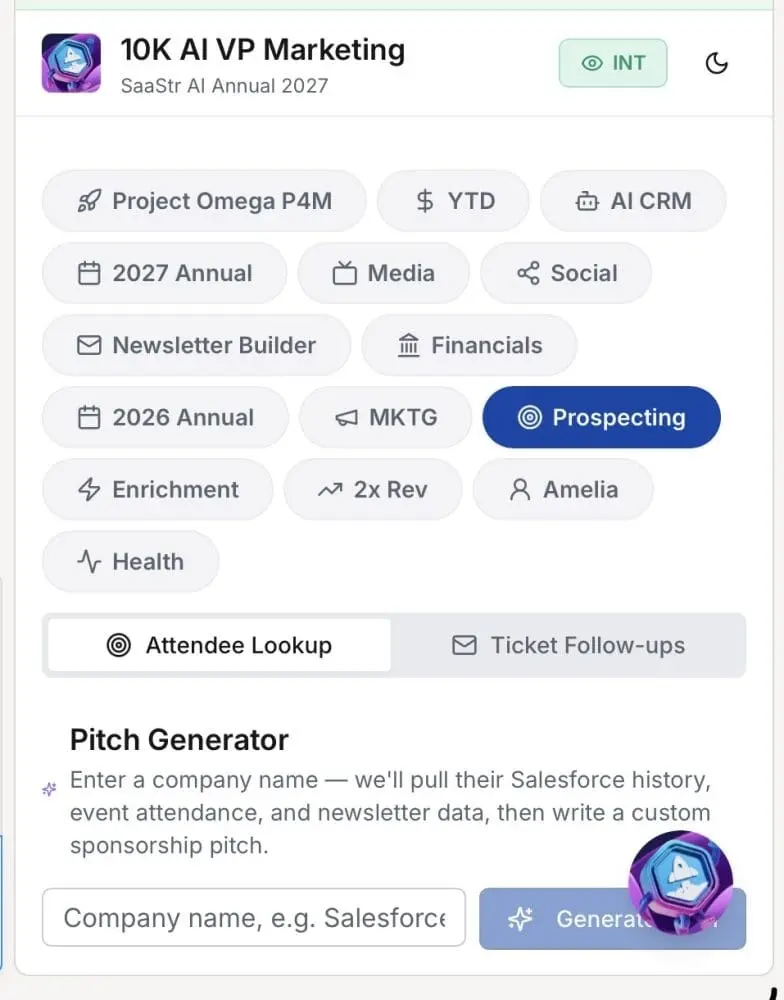
Emboldened by the success of the automated renewal agent, SaaStr leadership decided to apply the exact same architectural philosophy to net-new customer acquisition. Rather than abandoning vendors, they built an internal prospecting tool inside their AI VP of Marketing, 10K, to handle named, high-priority accounts.
The centerpiece of this internal tool is the Prospecting tab, which houses specialized modules such as Attendee Lookup, Ticket Follow-ups, and the advanced Pitch Generator. When targeting a prospective enterprise sponsor, an operator simply inputs the company name. The 10K agent instantly executes deep queries across Salesforce history, past event attendance records, and newsletter readership databases. It then synthesizes these data points into a tailored, data-backed sponsorship pitch.
Rather than sending a generic commercial pitch—such as "Companies like yours sponsor SaaStr to reach B2B executives"—the internal tool enables reps to dispatch hyper-specific outreach: "We noticed 14 executives from your team attended SaaStr Annual last year, three of your VP-level leaders regularly read our daily newsletter, and your brand captured 420 qualified leads during your last sponsorship cohort."
Supporting Context & Metrics: The Data Deficit and Operational ROI
The First-Party Data Chasm
The core thesis driving SaaStr AI’s hybrid model is rooted in a hard architectural truth: commercial AI SDRs and outbound vendors suffer from a severe data deficit.
A typical AI vendor connects to a customer’s CRM via standard APIs, ingesting basic contact details, account attributes, and limited activity logs. However, in a mature digital enterprise like SaaStr, critical business intelligence is fragmented across a vast ecosystem of tools. SaaStr’s institutional knowledge lives across at least six distinct, siloed platforms:
- CRM Platforms (Salesforce)
- Content Management & Publishing (WordPress)
- Event Management & Ticketing (Bizzabo / SaaStr Annual logs)
- Email & Newsletter Subscriptions (Proprietary broadcast databases)
- Conversational Intelligence & Chat (Qualified transcripts, Momentum call recordings)
- Media Archives (Podcast distribution and transcript databases)
No commercial outbound vendor can or will architect bespoke, multi-system data pipelines for a single customer. Furthermore, the economic realities of CRM integrations are shifting unfavorably. Major CRM providers like Salesforce have introduced metered API call models (such as Flex Credits), meaning that deep, continuous CRM reads by multiple third-party vendors will become increasingly cost-prohibitive. For context, SaaStr’s internal 10K agent alone executes approximately 35,000 Salesforce API calls daily—a volume that would trigger crippling fee structures if routed through multiple external vendor apps.
Quantitative Impact and Performance Metrics
The combination of commercial volume engines and internal, data-rich prospecting agents has unlocked extraordinary performance metrics for SaaStr AI. According to official data released by the company:
- Inbound Conversion: The Qualified inbound agent has consistently closed over $2 million in new business pipeline over a rolling twelve-month period.
- Engagement Rates: Automated win-back campaigns executed via Salesforce Agentforce have achieved staggering open rates of 72%.
- Pipeline Velocity & Scale: By deploying internal AI agents for high-value named accounts, SaaStr achieved 17,000 active conversations, booked over 600 targeted meetings, and drove a 2.1x increase in overall GTM efficiency compared to traditional manual or purely vendor-dependent outbound motions.
- Renewal Tier Surges: The shift from templated follow-ups to agent-generated custom decks drove unprecedented engagement among lower-tier sponsors, proving that hyper-personalization directly correlates with higher retention in price-sensitive customer segments.
Official Statements & Leadership Insights
The strategic rationale behind SaaStr’s hybrid architecture has been articulated directly by its leadership team, emphasizing the necessity of self-reliance when commercial software falls short of operational demands.
In an official commentary highlighting the deployment of proprietary agents, SaaStr CEO and founder Jason Lemkin underscored the impossibility of purchasing hyper-personalized capabilities off the shelf:
"We couldn’t get that from third-party services," says Jason Lemkin.
SaaStr wanted hyper-personalized outreach: the perfect email, the perfect deck. So they built it themselves. "It just can’t, today, it can’t be bought."
This sentiment captures the core dilemma facing modern revenue leaders. While commercial software vendors provide exceptional infrastructure for plumbing, deliverability, and broad-scale sequencing, they fundamentally lack access to the unique operational context that defines a company’s proprietary data ecosystem. By building custom wrappers and internal agents on top of foundational models, organizations can extract proprietary value that standardized software cannot replicate.
Future Outlook: The Blueprint for Hybrid GTM Architectures
As the generative AI landscape matures through 2026 and beyond, the artificial divide between "buying" and "building" enterprise software is dissolving. SaaStr AI’s hybrid model offers a clear preview of how forward-thinking revenue organizations will structure their tech stacks.
1. The Commoditization of Outbound Plumbing
In the near future, high-volume outbound plumbing—domain warming, DNS management, inbox rotation, multi-channel sequencing, and baseline email drafting—will be fully commoditized by commercial vendors. Attempting to build proprietary email-sending infrastructure will be viewed as an inefficient waste of engineering talent, much like hosting one’s own corporate email servers today. Organizations will plug into established utility vendors (such as Monaco, Artisan, and Agentforce) for all mass-market, top-of-funnel volume motions.
2. The Rise of Proprietary Agentic Wrappers
Conversely, competitive advantage in sales and marketing will increasingly depend on proprietary agentic layers that sit on top of internal, multi-system data warehouses. Companies will build customized AI agents—similar to SaaStr’s 10K—that ingest unstructured, cross-functional data from customer support logs, product telemetry, billing systems, and proprietary event histories. These internal agents will serve as intelligence engines, feeding hyper-contextualized insights into standard outbound sequences.
3. Strict Human-in-the-Loop Governance
SaaStr’s operational rules for its renewal and prospecting agents highlight an essential paradigm for future GTM deployments: Autonomous execution must be balanced with strict human governance.
- Rule One: The agent proposes strategic narratives and campaign frameworks, but a human operator must review and approve them before execution. Automated strategic missteps (such as pitching an upgrade to an enterprise account that requires a specialized retention play) are eliminated before generation occurs.
- Rule Two: Multi-touch progression replaces monolithic spam. The AI agent initiates contact with a concise, curiosity-generating hook, while deep, resource-heavy assets (such as custom gamma decks or comprehensive analytics reports) are delivered by human team members in follow-up touches upon confirmed engagement.
Summary of SaaStr AI’s Definitive Tech Stack Setup
For organizations evaluating their own revenue architecture, SaaStr’s proven configuration serves as the gold standard:
- Volume Outbound: Four trusted commercial vendors (Monaco, Artisan, Agentforce, Qualified) manage deliverability, sequencing, and top-of-funnel scale across hundreds of thousands of contacts.
- Named Account Prospecting & Renewals: A proprietary internal agent (10K) mines isolated first-party data sources across CRM, event logs, newsletter readership, and media archives to generate hyper-personalized pitches and custom decks.
- Human Oversight: Strategic narrative approval and deep asset delivery remain firmly under human control, ensuring brand alignment and maximum conversational relevance.
By embracing this dual-engine approach, SaaStr AI has proven that the future of outbound sales does not belong exclusively to off-the-shelf software vendors or internal engineering teams—it belongs to those who know precisely when to buy the infrastructure, and when to build the intelligence.