Executive Overview
In the rapidly evolving landscape of digital copyright enforcement, few battlegrounds have expanded with the sheer velocity of the mobile app ecosystem. The latest flashpoint centers on MovieBox, a massive pirate streaming application that has quietly amassed over 305 million downloads. Despite facing local regulatory crackdowns and drawing the ire of international copyright watchdogs, the application continues to thrive by embedding itself within the default software stack of some of the world’s fastest-growing smartphone markets.
The controversy has now escalated to the heart of the European Union. In formal submissions for the European Commission’s upcoming 2027 Counterfeit and Piracy Watch List, major rightsholders—including the Motion Picture Association (MPA) and the prominent French pay-TV conglomerate Canal+—have flagged MovieBox as an industrial-scale piracy operation.
What elevates this case from a standard illicit streaming takedown to a complex geopolitical and corporate dispute is the app’s primary distribution channel: the Palm Store. Preinstalled on millions of Tecno, Infinix, and itel smartphones, the Palm Store is owned and operated by Transsion, a major Chinese multinational mobile phone manufacturer that dominates the African mobile market. While rightsholders stop short of officially accusing Transsion of directly operating the pirate platform, Canal+’s regulatory filings allege deep technical, infrastructural, and corporate ties between MovieBox developers and the Transsion ecosystem.
As the European Commission prepares to review these submissions and invite responses from the implicated parties, the MovieBox saga highlights the profound challenges of policing intellectual property in an interconnected global digital economy, where hardware manufacturers, proprietary app stores, and anonymous app developers often operate within overlapping regulatory gray areas.
Detailed Chronology: From Regional Crackdown to Brussels Watchlist
The trajectory of MovieBox offers a masterclass in the resilience of modern pirate platforms. While the application and its associated web properties have operated under various guises for years, the current international regulatory crusade can be traced through a clear sequence of enforcement actions, domain migrations, and explosive user growth.

The Nigerian Crackdown and Domain Migration
The modern era of MovieBox scrutiny arguably began in earnest when Nigeria’s national copyright watchdog celebrated a major victory: the suspension of MovieBox.ng. At the time of the action, the regional streaming portal was pulling in tens of millions of visits per month, serving as a primary hub for unauthorized movies, television series, and live sporting events across West Africa.
For rightsholders, the takedown of the .ng domain was viewed as a textbook enforcement success. However, the operators of MovieBox demonstrated the hydra-headed nature of modern digital piracy. Almost as swiftly as the domain was seized, the service migrated its infrastructure to a new web address—moviebox.ph—ensuring uninterrupted service for web users. More importantly, its dedicated Android application remained entirely untouched by the local domain seizure, continuing to function seamlessly for millions of existing users while remaining openly accessible for new downloads.
Exploding Growth on the Palm Store
Rather than withering under the weight of regulatory pressure, MovieBox entered a period of staggering geometric expansion. Because the application’s distribution was heavily anchored to the Palm Store—the proprietary marketplace built into every Tecno, Infinix, and itel device—it bypassed traditional, highly scrutinized distribution channels like the Google Play Store.
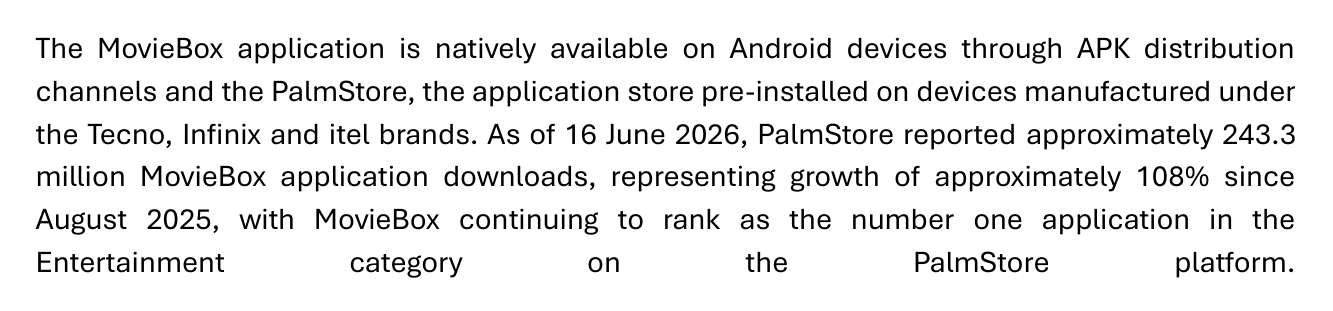
Data submitted to the European Commission by Canal+ maps this remarkable growth curve. According to the French pay-TV giant’s filings, Palm Store recorded approximately 243.3 million MovieBox application downloads as of June 16, 2026. This figure represented a breathtaking 108% increase in downloads in less than a year, measured against baseline data from August 2025. By mid-2026, MovieBox had successfully captured and maintained the coveted number-one spot in the Entertainment category on the Palm Store platform.
Yet, even those figures quickly became obsolete. By the time rightsholders and investigators compiled their final dossiers for Brussels, Palm Store listings revealed that total downloads had surged past 305.6 million. In a span of less than four months, the application had added more than 60 million new installs—a velocity of distribution that rivals legitimate, mainstream streaming applications backed by multi-million-dollar marketing budgets.

Supporting Context & Metrics: The Transsion Ecosystem and Market Dominance
To understand how a single pirate application can achieve hundreds of millions of installations without relying on mainstream Western app stores, one must examine the unique market dynamics of the mobile industry in the Global South, and particularly in Africa.
Transsion’s Market Hegemony
The core of the MovieBox distribution network is tied directly to Transsion, a Chinese smartphone manufacturer that has systematically captured vast market share across emerging economies. According to Transsion’s own corporate financial filings, the company—which manufactures the popular Tecno, Infinix, and itel brands—accounted for a staggering 61.5% of all mobile phone sales in Africa in 2024.
By preinstalling its proprietary app store, the Palm Store, directly onto these devices, Transsion created a closed-loop digital ecosystem. In a draft prospectus prepared for a planned public listing in Hong Kong, Transsion reported that the Palm Store commanded more than 180 million monthly active users on average throughout the preceding year.
Furthermore, the prospectus sheds light on the commercial mechanics of this ecosystem. Transsion revealed that the Palm Store typically generates revenue by charging third-party application developers based on the raw volume of installations processed through its distribution platform. While investigators have not publicly confirmed whether Transsion directly profited from the hundreds of millions of MovieBox installations via per-install fees, the structural alignment between the store’s monetization model and the app’s explosive growth introduces profound questions regarding corporate oversight and platform liability.
Content Offerings and Promotional Strategy
MovieBox does not attempt to conceal its infringing nature. A review of its current Palm Store listings and promotional materials reveals an unabashed offering of unauthorized copyrighted material.
The app’s official description explicitly promises users free access to premium entertainment and live sports. Promotional text highlights live streams for Europe’s top five domestic football leagues—a direct assault on the broadcast rights held by premium pay-TV operators. Furthermore, the app’s visual branding and promotional artwork brazenly utilize intellectual property belonging to major Hollywood studios, prominently featuring categories and characters from major franchises, including Marvel and Disney.
Official Statements & Allegations: The Dossiers from Canal+ and the MPA
The inclusion of MovieBox in submissions for the European Commission’s 2027 Counterfeit and Piracy Watch List marks a significant escalation in the war against mobile-based piracy. Both the Motion Picture Association (MPA) and Canal+ have filed detailed evidentiary dossiers, though their strategic focus and depth of accusation differ notably.
Canal+ Links the App to Transsion’s Infrastructure
While the MPA’s submission takes a broader view—noting simply that MovieBox is widely believed to be operated out of China—Canal+ goes significantly further by attempting to pierce the corporate veil surrounding the app’s developers and its primary distribution platform.
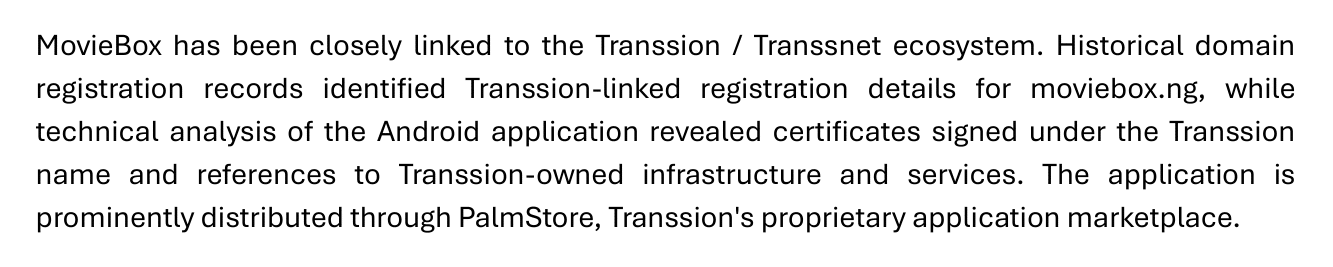
Canal+ asserts that MovieBox is not merely an independent tenant of the Palm Store, but rather an entity "closely linked to the Transsion / Transsnet ecosystem." To substantiate this claim, the French broadcaster’s submission points to a convergence of technical and administrative indicators:
- Domain Registration Trails: Historical WHOIS and domain registration records for moviebox.ng allegedly contained contact details and administrative markers directly tied to Transsion.
- Digital Signatures: Technical security analysis of the MovieBox Android application package (APK) revealed that the installation binaries were signed using digital certificates issued under the Transsion name.
- Infrastructure References: Code-level analysis of the app uncovered direct references to internal Transsion-owned infrastructure and auxiliary cloud services.
Additionally, Canal+ points to Excellent Innovation Limited, a registered Hong Kong corporation. Through cross-referencing domain registrations, SSL certificate authorities, developer attributions, and international trademark filings, Canal+ links this corporate entity directly to the operation of MovieBox. Notably, the Palm Store itself officially lists Excellent Innovation Limited as the designated developer of the application.

Canal+’s Commercial Stake in the Region
Canal+’s aggressive posture against MovieBox and its alleged enablers is far from purely altruistic. The French pay-TV behemoth holds a profound commercial interest in the African media market through its ownership stake in MultiChoice, the dominant pay-TV operator behind DStv. Because MultiChoice invests heavily in exclusive broadcasting rights for regional and international sports leagues, Hollywood cinema, and premium series across Africa, the unfettered, free distribution of identical content via MovieBox represents a direct and existential threat to its subscriber base and bottom line.
Future Outlook and Regulatory Implications
As the European Commission processes the submissions for its 2027 Counterfeit and Piracy Watch List, the MovieBox case stands as a pivotal test case for international digital governance.
The EU Watchlist Process
It is important to contextualize the nature of the European Commission’s Counterfeit and Piracy Watch List. Inclusion on the list does not constitute a formal legal finding of wrongdoing, nor does it carry immediate punitive sanctions or financial penalties. Instead, the watch list functions as a diplomatic and regulatory naming-and-shaming mechanism designed to encourage cooperative action between foreign operators, platform hosts, and national governments.
Crucially, the European Commission adheres to strict procedural fairness before finalizing its reports. The regulatory framework mandates that the Commission make reasonable efforts to contact all service providers and entities explicitly named in submissions. These entities are then formally invited to submit a written defense or response to the allegations leveled against them.
At the time of reporting, industry observers note that neither MovieBox nor Transsion has publicly responded to media inquiries regarding the specific allegations contained in the Canal+ and MPA dossiers. Copies of the comprehensive submissions have been made publicly available via independent researchers, ensuring that the transparency of the process matches the scale of the infringement.
Broader Industry Ramifications
The final iteration of the EU Counterfeit and Piracy Watch List is scheduled for publication in the spring of next year. Regardless of whether MovieBox ultimately secures a permanent spot on the list, the investigation has already exposed critical vulnerabilities in the oversight of preinstalled app stores on mobile devices manufactured for emerging markets.
For hardware manufacturers like Transsion, the mounting pressure from entities like Canal+ and the MPA forces a delicate reckoning. As hardware giants increasingly transition into software and service providers—monetizing their user bases through proprietary app marketplaces—they may find it increasingly difficult to distance themselves from the third-party applications distributed on their platforms.
Whether Brussels’ intervention will prompt a technical crackdown on MovieBox’s 300 million-strong user base remains to be seen. However, one reality is already clear: the era of operating massive, globally distributed pirate software networks under the radar of hardware manufacturers and international regulators is rapidly coming to an end.