Executive Overview
For business leaders evaluating artificial intelligence to handle customer support, the gap between vendor marketing claims and operational reality has long been a frustrating blind spot. Every enterprise software pitch promises near-total automation, effortless deployments, and flawless customer satisfaction scores. Yet, until recently, buyers had little choice other than relying on controlled product demonstrations, optimistic vendor case studies, or expensive sandbox environments that bear little resemblance to the chaotic nature of live digital commerce.
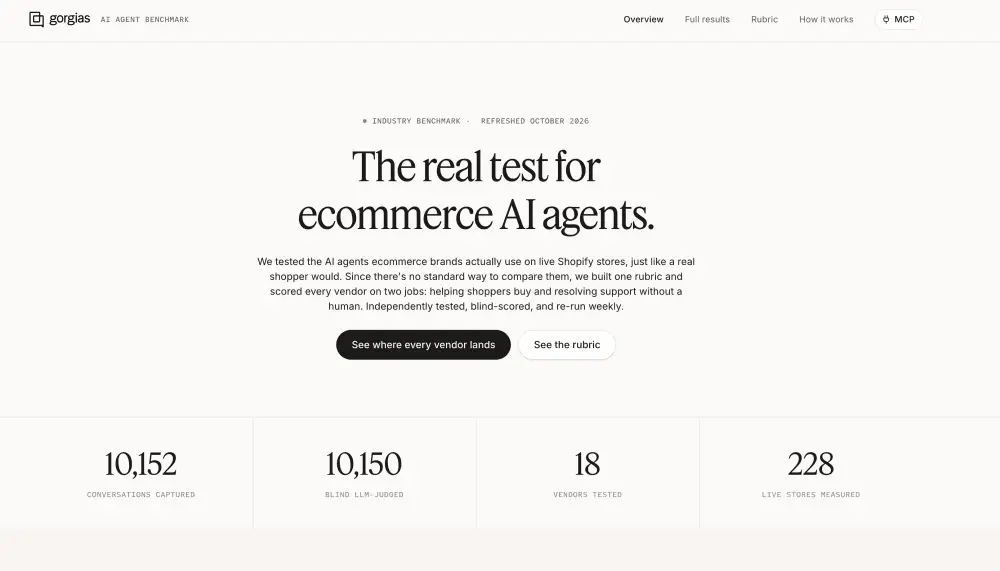
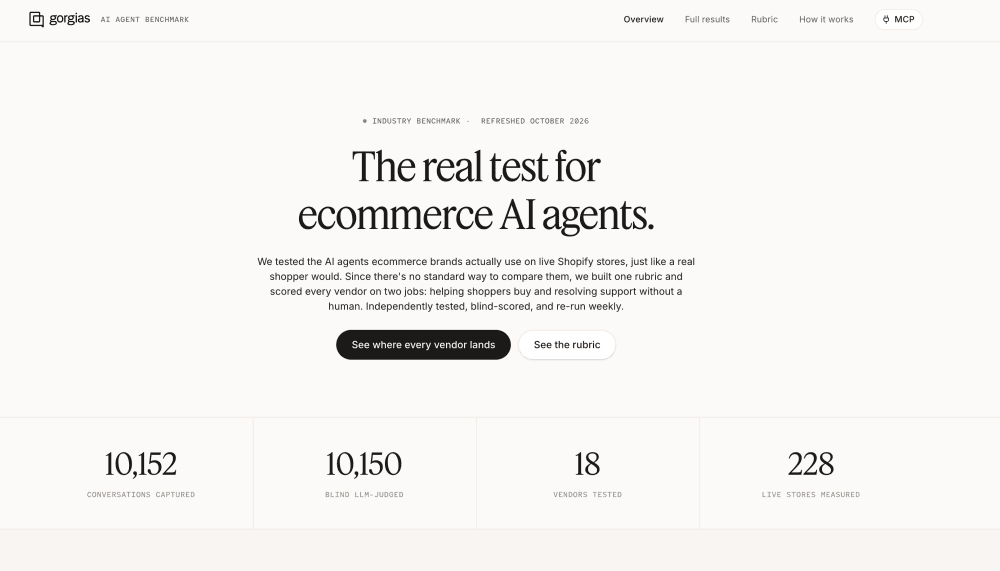
That opaque landscape has shifted dramatically. Gorgias, an e-commerce customer experience leader backed by the SaaStr Fund, has released a transparent, rigorous public benchmark testing 13 distinct AI agent vendors across 212 live, mid-market e-commerce storefronts. Rather than relying on simulated conversations or synthetic catalogs, this evaluation deployed identical customer inquiries to active online stores carrying real inventory. Every response was judged blind to the vendor against 26 binary checks, with factual claims regarding pricing, store policies, and stock-keeping units (SKUs) programmatically verified against the host store’s live databases.
The findings offer a sobering reality check for enterprise software buyers. The absolute best-performing AI agents fully resolve roughly 70% of customer conversations without human intervention. However, the typical vendor on the market resolves fewer than half. Even more eye-opening: native AI tools bundled within traditional, legacy helpdesks or email marketing suites—such as Zendesk, Intercom, and Klaviyo—fared among the weakest in the entire evaluation, topping out below 42% automation.
As executives increasingly look to AI to rein in support costs and scale operations, this benchmark provides a definitive roadmap. Success requires moving past inflated marketing numbers, demanding standardized metrics, and recognizing that true autonomous resolution requires rigorous guardrails, strict identity management, and continuous month-over-month oversight.
Detailed Chronology & Methodology: How the Benchmark Was Built
Understanding the weight of these findings requires examining how the evaluation was constructed. Historically, artificial intelligence evaluations have suffered from selection bias. Vendors handpick their best-performing client deployments for case studies, or evaluations take place in isolated, highly curated staging environments where edge cases are quietly smoothed over by human engineers behind the curtain.
To eliminate these variables, the Gorgias evaluation framework was designed around absolute neutrality and real-world friction. The methodology hinges on three core operational pillars:
- Live Production Environments: The evaluation bypassed sandboxes entirely. Agents were tested on 212 live, mid-market e-commerce stores actively processing transactions, handling real shipping delays, fluctuating inventory levels, and live discount codes.
- Standardized Inquiry Sets: Every vendor agent received the exact same stream of customer messages, ensuring a level playing field where no platform could benefit from easier incoming queries.
- Blind, Programmatic Judging: A standardized judging framework evaluated each response against 26 binary checks. Critical facts—such as item prices, return policies, and SKU availability—were verified programmatically directly against the live store data, leaving zero room for subjective bias.
Furthermore, the benchmark introduced an uncompromising definition of "resolved." In many customer-facing analytics dashboards provided by software vendors, an interaction is counted as automated if the AI issues a reply and 72 hours pass without a human agent stepping in—meaning a frustrated customer who gave up and walked away is falsely categorized as a "successful resolution."
The public benchmark flipped this script. A conversation was only marked as successfully automated if the AI handled it with absolute zero human touch, zero handoffs to a human representative, and zero deflection out of the channel. If an agent defaulted to phrases like "Email our support team" or directed the customer to a contact form, it was immediately scored as an unresolved failure. Because the auditor never explicitly asked for a human, every single escalation was the AI’s own decision, exposing its inability to complete the transaction autonomously.
Supporting Context & Metrics: The State of the Field
The numerical breakdown of the benchmark reveals a stark performance tiering across the market. When measuring the automation rate—defined as the share of engaged conversations the AI resolved with zero human involvement—the top five vendors clustered between 64% and 75% resolution. Meanwhile, the median vendor across the broader market managed a modest 48%.
Performance Tiers: Automation Meets Quality
Automation rate alone, however, can be deeply misleading. A high resolution rate paired with low response quality often creates a compounding operational hazard. If an AI agent hastily marks a ticket as "resolved" by providing a customer with an incorrect return window, that factual error inevitably triggers a secondary, frustrated follow-up contact from the customer. In effect, low-quality automation generates its own future ticket volume, driving up support costs rather than reducing them.
When plotting vendor performance across both automation and a 0–100 blind quality score, distinct groupings emerged:
- The Top-Tier Leaders (High Automation & High Quality): Vendors like Yuma, Decagon, and Gorgias cleared the benchmark’s rigorous hurdles, sustaining automation rates above 64% alongside strong quality scores.
- High Automation, Weak Answers: Certain platforms successfully closed a high volume of conversations, but their response quality lagged significantly behind. For instance, Ada closed a high volume of inquiries but scored 27 points lower on answer quality compared to the top tier.
- Strong Answers, Low Automation: Conversely, platforms like Sierra matched top-tier quality scores yet successfully resolved fewer than half of their incoming customer interactions, falling short on end-to-end execution.
The Problem with Legacy Ecosystems
One of the most consequential takeaways for enterprise budgeting is the underperformance of native AI solutions. Brands already paying substantial platform fees to Zendesk, Intercom, or Klaviyo often feel compelled to adopt the native AI add-ons bundled into those suites for the sake of convenience. Yet, the data demonstrates that none of these platforms exceeded 42% resolution in the benchmark. Relying on the AI bundled into an existing helpdesk tool routinely results in some of the lowest automation capabilities available on the market.
Topic Vulnerabilities: Where AI Fails
The benchmark also dissected performance by support category, illuminating a steep 28-point drop from the easiest conversation types to the hardest:
- Policy Inquiries: Questions answered directly from a static static policy page (such as shipping timelines or general FAQs) scored highest across the board.
- System-Dependent Inquiries: Questions requiring live backend system lookups or subjective judgment calls scored significantly lower.
Crucially, order tracking—historically the single largest ticket category for e-commerce brands—sat near the bottom of the performance list. Across the industry, only about a third of post-sale tracking and fulfillment conversations reached a clean, automated finish. The primary culprits behind these failures were rigid authentication walls, repeated, redundant demands for order numbers, endless clarification loops, and premature handoffs to human agents.
Volatility and Month-Over-Month Decline
Perhaps the most alarming discovery in the evaluation data is the trajectory of platform performance over time. When analyzing a subset of ten vendors with sufficient historical tracking data, nine out of ten vendors experienced a decline in automation rates over a four-week observation window.
Quality metrics followed the exact same downward trajectory, with nine out of ten platforms seeing their quality scores drop—including notable dips by Ada (-17 points), Zendesk (-15 points), Sierra (-14 points), and Gorgias (-12 points). Only a tiny minority of vendors managed incremental gains.
While the benchmark does not definitively isolate the root cause of these widespread declines, industry experts point to several likely culprits: underlying large language model (LLM) updates that inadvertently alter behavior, store configuration drift as merchants update their product catalogs, or evolving testing queries that challenge the agents more aggressively.
Regardless of the underlying trigger, the operational lesson for business leaders is unambiguous: The impressive resolution rate observed during a vendor pilot is rarely the rate you will experience sixty days into production. Continuous, scheduled re-testing of production AI agents is no longer optional; it is a fundamental requirement of modern IT governance.
Future Outlook: Strategic Recommendations for E-Commerce Leaders
As conversational AI matures from a speculative tech experiment into a core operational utility, e-commerce brands must approach vendor selection with clinical objectivity. Based on the rigorous data surfaced in the Gorgias benchmark, decision-makers should adopt a structured procurement and management playbook:
- Calibrate Financial Models Conservatively: Enterprise business cases should be built around a realistic ceiling of 65% to 70% resolution, and strictly when partnering with a top-five vendor. Brands deploying legacy bundled tools should plan for baseline automation rates between 20% and 42%.
- Demand Multi-Dimensional Proof: Never evaluate a vendor on automation rate alone. Shortlist partners based on the intersection of high automation and uncompromised response quality. Require vendors to provide verified performance data across identical testing rubrics.
- Audit Against Your Actual Ticket Mix: Because static policy questions artificially inflate overall success rates, map your brand’s specific historical ticket volume against the benchmark categories. If your business is inundated with "Where is my order?" inquiries, expect lower out-of-the-box automation until backend system integrations are deeply optimized.
- Scrutinize Pricing and Definitions: Understand precisely how a vendor defines a "resolved" ticket, especially when resolution serves as the primary billing unit (such as Gorgias AI Agent’s $0.90 per-resolution model). Ensure that customer drop-offs and forced channel deflections are never counted as successful automated resolutions.
- Institute Continuous Monitoring: Because performance metrics across the industry exhibit downward volatility over time, internal tech stacks must be audited monthly. Run recurring cold tests using fresh incognito sessions and real historical tickets to ensure your AI agents maintain their baseline efficacy long after the initial contract has been signed.
By stripping away the marketing veneer and anchoring purchasing decisions in empirical data, e-commerce executives can successfully harness AI customer agents to drive genuine operational efficiency without sacrificing customer trust.