Executive Overview
The artificial intelligence revolution promised a future where customer service is instantaneous, frictionless, and entirely automated. For e-commerce leaders evaluating modern AI agents, the pitch sounds utopian: plug in a large language model, let it ingest your product catalog, and watch as it autonomously resolves the vast majority of consumer queries—cutting support overhead to near-zero.
However, a groundbreaking new public evaluation framework developed by Gorgias, the $100M ARR e-commerce customer experience leader backed by SaaStr Fund, strips away the marketing gloss to reveal a more sobering reality.
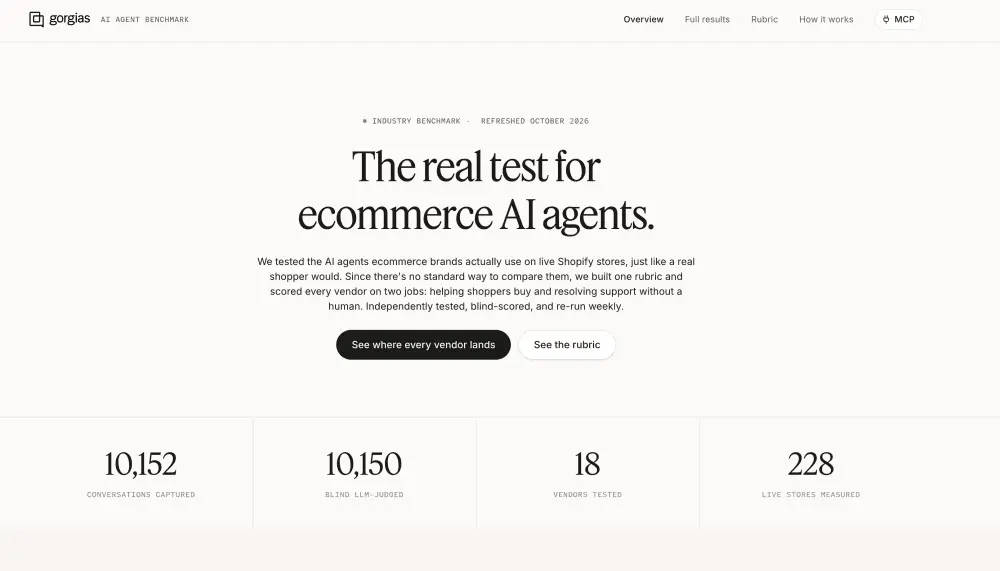
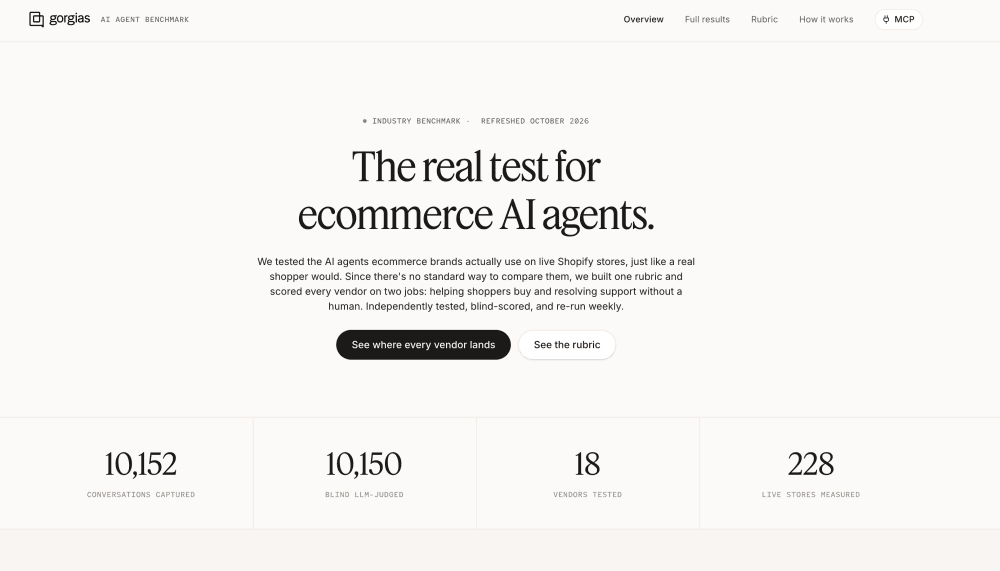
In what is arguably the most rigorous independent stress test of conversational AI to date, Gorgias published a public benchmark testing 13 leading AI vendor agents across 212 live, mid-market e-commerce stores. Critically, this evaluation avoided controlled sandboxes, synthetic product catalogs, and cherry-picked vendor demonstrations. Instead, it subjected competing agents to the messy, unpredictable friction of real-world retail inventories and live consumer traffic.
The findings deliver a vital reality check for enterprise tech stack planners. The absolute top-tier AI agents fully resolve roughly 70% of customer conversations without human intervention. Meanwhile, the typical vendor in the marketplace successfully handles under half. Perhaps most surprisingly for mainstream software buyers, the proprietary AI assistants bundled directly into legacy helpdesk platforms—such as Zendesk, Intercom, and Klaviyo—underperformed severely, with none cracking a 42% automation rate.
For business leaders building financial models around aggressive AI deflection rates, this benchmark provides an essential wake-up call. It establishes a new standard for evaluating software vendors, redefining what "resolved" truly means, and highlighting the precarious nature of maintaining automated performance over time.
Detailed Chronology: The Anatomy of the Gorgias Evaluation
The genesis of this benchmark emerged from a fundamental industry-wide problem: how to objectively measure the utility of generative AI agents in live operational environments. Historically, prospective buyers had to rely on vendor self-reporting, isolated pilot programs, or heavily managed test cases.
Recognizing the need for absolute transparency, Gorgias engineered a standardized testing pipeline designed to remove human bias and vendor interference.
Phase 1: Methodology and Execution
The benchmark deployed a systematic testing matrix across 212 live, mid-market e-commerce stores carrying actual inventory. To ensure a level playing field, every competing AI agent was fed identical consumer messages derived from real-world shopping scenarios.
To eliminate subjective grading, an independent automated judge scored each response blind to the vendor identity. The scoring system relied on 26 strict binary checks. Crucially, factual claims regarding product pricing, return policies, and specific Stock Keeping Units (SKUs) were verified programmatically against the live store database rather than evaluated on conversational tone alone.
Phase 2: Defining "Resolution"
One of the most revealing insights of the report is its strict definition of a successful interaction. In standard vendor reporting, a conversation is often classified as "automated" if the AI issues a response and the customer simply stops replying, or if the interaction relies on a soft deflection (e.g., "Please email our support team").
The Gorgias benchmark strictly defined a resolution as zero human touch. If an agent handed off the chat to a human representative, defaulted to a contact form, redirected the customer to an alternate channel, or forced an unresolved loop, the interaction was marked as a failure. The auditor never explicitly asked for a human agent; every escalation was the direct result of the AI’s inability to finish the job.
Phase 3: The Divergence of Metrics
As the multi-week evaluation progressed, clear performance tiers emerged among the 13 participating vendors. The top five performers achieved average automation rates ranging from 64% to 75%, with a combined average of roughly 70%. Conversely, the median vendor hovered at 48%, and the broader field—weighted by total conversation volume—sat at 46%.
This wide dispersion underscored a vital truth: not all AI agents are created equal, and bundling an AI tool into an existing software subscription does not guarantee operational efficacy.
Supporting Context & Metrics: Deep Dive into the Data
The exhaustive nature of the benchmark allows for granular analysis across multiple dimensions, including automation rates, response quality, latency, and specific support topics.
1. Automation vs. Quality: The Twin Pillars
Evaluating an AI agent purely on its ability to close tickets can be dangerously misleading. An agent that aggressively pushes users toward premature closures while providing incorrect policy information generates downstream friction—a phenomenon the benchmark terms "self-generated ticket volume." If an AI incorrectly quotes a return window, the resulting customer anger guarantees a second, more costly touchpoint.
The data mapped each vendor’s automation rate against a blind quality score graded from 0 to 100:
- Strong on Both Fronts: Vendors such as Yuma, Decagon, and Gorgias established themselves as the elite tier, successfully clearing both 64% automation and a quality score of 65.
- High Automation, Weak Answers: Certain platforms, like Ada, closed high volumes of conversations but suffered in qualitative accuracy, scoring significantly lower on the depth and correctness of their answers.
- Strong Answers, Low Automation: Conversely, enterprise players like Sierra tied for the highest quality scores in the industry but struggled to crack the 50% automation threshold, leaving the majority of operational burdens on human teams.
2. The Legacy Suite Underperformance
For enterprise software buyers, the most startling metric involves the incumbents. Platforms like Zendesk, Intercom, and Klaviyo—software suites that brands already pay millions to utilize—failed to break a 42% automation rate within the benchmark parameters. On this dataset, native AI features bundled into existing customer success platforms proved to be among the weakest options available on the market, suggesting that specialized, dedicated agent architectures currently outperform generic wrappers.
3. Topic-Specific Vulnerabilities
Support quality varied wildly depending on the nature of the consumer inquiry:
- Policy Queries (Highest Success): Questions answerable directly from static policy pages scored the highest across the board. The structured nature of FAQs allows LLMs to retrieve and summarize data with high fidelity.
- System-Lookup and Judgment Calls (Lowest Success): Transactions requiring dynamic database interactions—such as order tracking, shipping modifications, and damaged item claims—sat near the bottom of the performance list.
Notably, order tracking represents the single largest ticket category for most e-commerce brands. Across the industry, only about a third of post-sale tracking inquiries reached a successful autonomous conclusion. Furthermore, order tracking scored an alarming 17 points below general returns policy queries, highlighting the ongoing friction between static AI models and dynamic backend inventory systems.
4. Latency vs. Resolution
Speed proved to be a secondary factor in consumer satisfaction for post-purchase support. Mean times to a complete reply varied widely: Envive clocked in as the fastest vendor at a blistering 5.4 seconds (though it only achieved a 22% resolution rate), while Yuma operated as the slowest at 16.5 seconds (while capturing top-tier quality and a 71% resolution rate). The benchmark weighting model deliberately assigned 50% importance to automation, 40% to quality, and only 10% to speed—affirming that consumers prefer a slightly slower, accurate answer over a rapid, incorrect one.
5. The Degradation Phenomenon
Perhaps the most sobering discovery for long-term deployments was temporal decay. When tracking ten vendors with sufficient historical data over a four-week window, nine out of ten experienced declines in automation rates. Quality scores followed the exact same downward trajectory, with nine out of ten vendors losing ground. Whether driven by subtle model updates, shifting store configurations, or increasingly complex customer queries, the data proves that deployment performance is not static. What works in a pilot program may degrade within a month without rigorous oversight.
Official Statements and Industry Perspectives
The release of the Gorgias benchmark has ignited vibrant discussions across the Software-as-a-Service (SaaS) and e-commerce ecosystems, drawing reactions from founders, venture capitalists, and CX leaders.
Industry analysts emphasize that the benchmark establishes a long-overdue framework for accountability. Too often, artificial intelligence procurement has relied on marketing hype rather than empirical verification. By making the rubric, methodology, and raw transcripts entirely public, Gorgias has shifted the conversation from theoretical capabilities to proven, production-grade output.
Venture capital stakeholders, including backers from the SaaStr Fund ecosystem, point out that enterprise buyers must fundamentally adjust their financial forecasting. Because automated resolution is frequently tied directly to consumption-based billing models—such as Gorgias’s own pricing tier of $0.90 per resolved conversation—inflated vendor claims can severely distort budgetary projections. Procurement teams are strongly advised to secure clear, unambiguous definitions of billable resolutions in writing before signing enterprise agreements.
Furthermore, technical architects stress that agent failure is rarely a pure reflection of the underlying foundational model. Instead, failures are frequently rooted in poor onboarding, fragile authentication walls, rigid clarification loops, and overly aggressive safety guardrails configured by the brand itself. The data demonstrates that the exact same AI model can score brilliantly on one e-commerce storefront while failing entirely on another, placing significant responsibility on deployment engineering and continuous quality assurance.
Future Outlook: Navigating the AI Agent Landscape
As the e-commerce sector matures past the initial gold rush of generative AI adoption, the Gorgias benchmark signals a transition into an era of pragmatic consolidation and rigorous performance management.
For brands looking to deploy or optimize AI customer support agents over the coming years, several strategic imperatives are clear:
- Adopt Realistic Financial Modeling: Business cases should be built on conservative automation rates of 65% to 70% exclusively when utilizing top-tier specialized vendors. Buyers utilizing native features from legacy helpdesk suites should plan for a more modest 20% to 42% automation ceiling.
- Prioritize Holistic Evaluation: Procurement teams must evaluate automation and quality simultaneously. High resolution metrics mean little if low answer quality generates downstream ticket volume and damages brand equity.
- Audit Against Your Unique Ticket Mix: Because static policy questions easily outperform dynamic order tracking and fulfillment queries, brands must weigh benchmark data directly against their proprietary historical ticket distribution.
- Implement Continuous Monitoring: Given the proven tendency for agent performance to degrade over time—as evidenced by the four-week decline across nine out of ten benchmarked vendors—organizations must establish automated testing cadences. Deploying an AI agent is not a "set-and-forget" operational shift; it requires continuous auditing, prompt tuning, and system maintenance.
- Demand Total Transparency: Future software RFPs should require vendors to participate in standardized, un-sandboxed evaluations. By utilizing open evaluation rubrics, brands can run cold tests using their own historical customer queries to verify vendor claims before committing capital.
Ultimately, artificial intelligence has permanently transformed the landscape of customer experience, but it remains a tool requiring precise calibration. The Gorgias benchmark proves that while autonomous agents are powerful allies in reducing operational friction, human oversight, rigorous testing, and clear-eyed vendor assessment remain indispensable to e-commerce success.