






Executive Overview
In the rapidly evolving landscape of B2B sales automation, artificial intelligence promises a near-infinite scale of outreach. Yet, as organizations race to adopt AI-driven sales development representatives (SDRs) and outbound prospecting tools, a critical limitation has emerged: off-the-shelf software only sees a fraction of a company’s operational reality.
Most commercial AI tools connect to a central Customer Relationship Management (CRM) system—typically Salesforce—reading isolated fields such as contact details, basic account notes, and historical activity logs. However, for digital-first enterprises, the true story of a client or prospect is decentralized. It spans across event registration databases, newsletter subscriptions, content management systems, podcast archives, social media interactions, and localized billing systems.
SaaStr AI, a leading voice and platform in the software-as-a-service ecosystem, faces this exact architectural challenge. Managing a vast database exceeding 450,000 contacts, the organization relies heavily on a hybrid outbound strategy. Approximately 90% of its high-volume outbound operations are handled by proven third-party platforms—including Monaco, Artisan, Agentforce, and Qualified. These vendors excel at foundational tasks: domain protection, list hygiene, sequencing, reply handling, meeting booking, and safeguarding email deliverability.
Yet, for strategic, high-value named accounts, third-party software fundamentally lacks the contextual depth required to secure hyper-personalized engagement. To bridge this gap, SaaStr AI engineered its own proprietary prospecting module directly inside its internal system, 10K. Rather than sending generic, template-driven messages—such as "companies like yours sponsor SaaStr to reach B2B executives"—the internal tool mines deep first-party data. It synthesizes past event attendance counts, specific newsletter engagement metrics, historical CRM touchpoints, and custom audience metrics into an intelligent pitch generator.
This investigative report examines the strategic rationale behind SaaStr AI’s hybrid model, detailing why third-party infrastructure remains essential for volume, why commercial tools fall short on contextual data richness, how internal agents dramatically scale hyper-personalized renewal decks, and what the future holds for account-based marketing (ABM) automation.
Detailed Chronology: From Custom Renewals to Automated Prospecting
The genesis of SaaStr AI’s internal prospecting tool was not born in a traditional product roadmap meeting; it emerged out of an operational bottleneck in customer renewals.
Phase 1: The Renewal Bottleneck
Historically, preparing customized renewal presentations for high-value sponsors was a labor-intensive, human-driven process. SaaStr AI maintained a rigid tier system for its flagship events. Diamond sponsors—accounting for the largest financial commitments—received bespoke, highly polished custom decks detailing their return on investment, lead generation statistics, and historical engagement data.
However, lower-tier silver and gold sponsors largely received templated follow-ups. With limited human bandwidth, the team could only construct manual custom decks for roughly five elite accounts. This structural limitation created a persistent vulnerability: lower-tier sponsors, who often felt the financial weight of a $25,000 commitment far more acutely than a multi-million-dollar tech giant felt a $300,000 spend, experienced lower renewal rates. They lacked the tangible, data-backed proof that SaaStr was tracking their specific outcomes with equal diligence.
Phase 2: Building the Renewal Agent
To solve this challenge, the engineering and operational teams set out to automate the renewal process. Built in roughly half a day on top of the internal 10K platform, a custom renewal agent was deployed.
The agent was architected to ingest disparate data streams that had historically remained siloed:
- The Salesforce Pillar: Contracts, historical lifetime value (LTV), email open rates, Qualified chat histories, and Momentum call transcripts.
- The External Pillar: WordPress backend metrics, social media engagement signatures, podcast archive data, and Bizzabo lead acquisition counts.
Once ingested, the agent synthesized these data points and routed them through the Gamma API to automatically generate comprehensive, data-backed custom decks.
Phase 3: Scaling Customization and Unlocking Results
The deployment of the renewal agent transformed SaaStr AI’s retention metrics. Instead of generating five custom decks, the system successfully produced and distributed between 20 and 30 deeply customized decks for smaller sponsors.
The impact on engagement was immediate. Silver sponsors, historically the segment with the lowest renewal velocity, responded at rates exceeding even those of the Diamond tier. By receiving a personalized presentation proving that SaaStr had closely measured their event performance, smaller sponsors felt valued and understood.
Phase 4: Expanding into New-Logo Prospecting
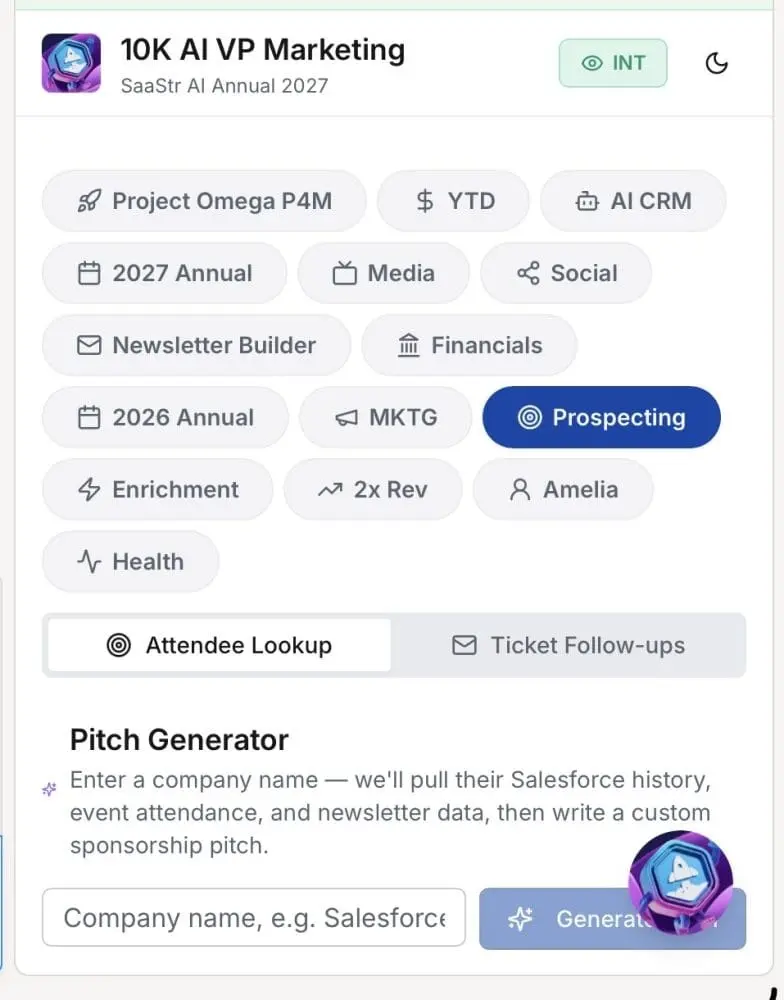
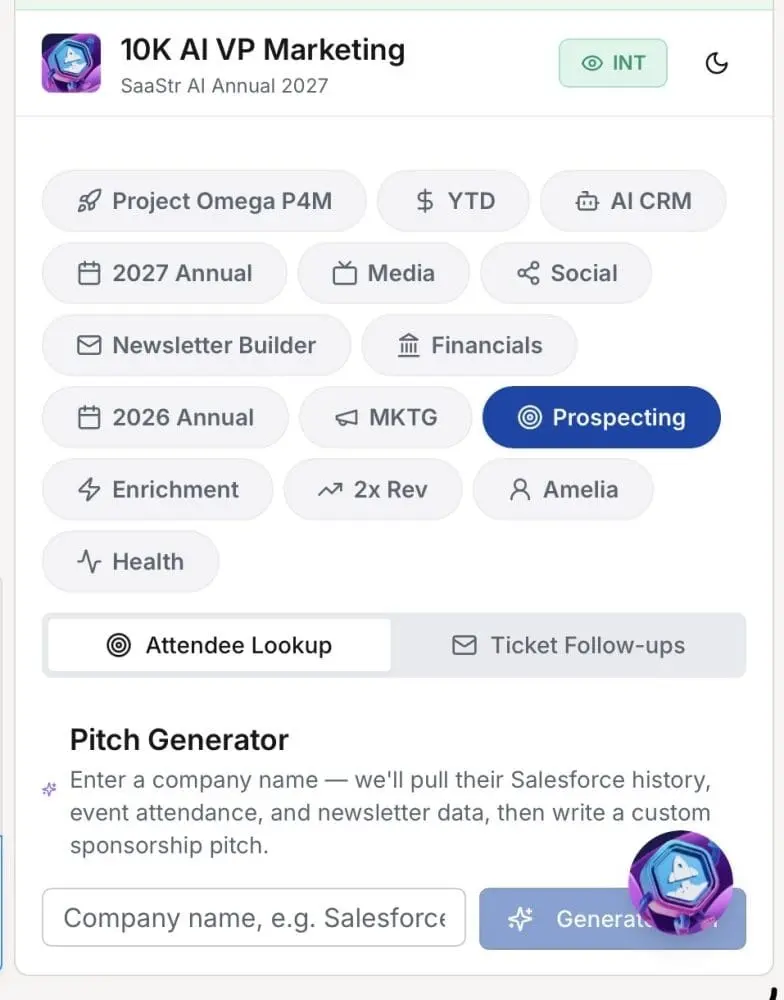
Buoyed by the success of the renewal agent, SaaStr AI applied the exact same architectural philosophy to new-logo acquisition. The internal 10K platform was expanded to include a dedicated Prospecting tab featuring an Attendee Lookup, Ticket Follow-ups, and a sophisticated Pitch Generator.
Instead of relying on commercial AI agents that only scrape web data or CRM fields, the internal tool queries internal first-party databases. When a sales representative inputs a target company name, 10K compiles its internal Salesforce history, past event attendance data, and proprietary newsletter engagement records to construct a hyper-specific outreach pitch.
Supporting Context & Metrics: The Architecture of a Hybrid Sales Engine
To understand why SaaStr AI maintains a bifurcated approach to outbound sales—utilizing external vendors for 90% of volume while deploying an internal tool for named accounts—one must examine the structural economics of modern sales tech stacks.
The Vendor Ecosystem: Why Volume Belongs to Third Parties
Scaling outbound volume is fundamentally an infrastructure and engineering challenge, not merely a copywriting exercise. Maintaining sender reputation, executing warm-up protocols, navigating inbox provider filters (Google, Microsoft, Yahoo), handling complex threading, and executing automated sequence rotations require years of specialized development.
Commercial platforms such as Monaco, Artisan, Agentforce, and Qualified have invested millions of dollars and accumulated thousands of enterprise customers to solve these deliverability and sequencing hurdles. For an organization like SaaStr AI, which manages a database of 450,000 contacts, attempting to rebuild core deliverability infrastructure from scratch would represent a severe misallocation of engineering talent.
Furthermore, external vendors provide essential operational safeguards:
- Domain Protection: Guarding company domain health against sudden blacklisting.
- List Hygiene: Automatically scrubbing invalid, bounced, or outdated email addresses.
- Reply Classification: Parsing inbound responses to identify positive interest, objections, or out-of-office notifications automatically.
Consequently, for broad-market volume motions, third-party vendors remain the undisputed operational standard.
The Data Deficit in Commercial AI Tools
Where commercial AI outbound tools encounter friction is at the intersection of CRM dependency and proprietary data isolation.
A standard AI sales development representative connects to a company’s CRM via API, parsing basic objects: contacts, accounts, and recent activity logs. However, at organizations operating complex digital ecosystems, vital intelligence resides across a multitude of disparate platforms. SaaStr AI’s operational footprint, for instance, spans at least six distinct data repositories:
- Salesforce CRM (Core pipeline and account history)
- WordPress Backend (Content interaction and web traffic signatures)
- Bizzabo Event Infrastructure (On-site check-ins, session attendance, and badge scans)
- Newsletter Subscriptions & Engagement Databases (Open rates, click-through behavior, and readership depth)
- Podcast & Media Archives (Consumption patterns of historical audio and video content)
- Customer Communication Channels (Qualified chats, Momentum call recordings, and support tickets)
No commercial outbound vendor will custom-wire their architecture into six proprietary systems for a single client. Moreover, economic pressures within the CRM landscape are compounding this challenge. Major platforms like Salesforce have announced structural shifts toward metering agent API calls via Flex Credits. With internal platforms like 10K already consuming approximately 35,000 Salesforce API calls daily, deep, continuous CRM reads executed by multiple third-party vendors would introduce prohibitive operational overhead and recurring API costs.
Comparative Metrics: Generic vs. Hyper-Personalized Outbound
| Metric / Dimension | Commercial Vendor Outbound (Volume) | Internal 10K Prospecting Tool (Named Accounts) |
|---|---|---|
| Primary Objective | High-volume touchpoints and top-of-funnel discovery | Deep account penetration and high-value conversion |
| Data Sources Utilized | CRM contacts, basic account fields, web scraping | Salesforce + Event Attendance + Newsletter Logs + Media Archives |
| Pitch Composition | Generic value propositions ("Companies like yours…") | Fact-specific validation ("X executives attended, Y read our newsletter…") |
| Volume Handled | ~90% of total outbound volume | ~10% of outbound (Strategic named accounts) |
| Verification Layer | Automated AI generation and dispatch | Mandatory human approval of proposed narrative |
Official Statements & Industry Insights
The philosophy underpinning SaaStr AI’s strategy highlights a broader truth about the current limitations of generative artificial intelligence in enterprise sales. Off-the-shelf software can generate grammatically pristine copy, but it cannot manufacture proprietary context that it has no legal or technical permission to access.
Reflecting on the motivations behind building the internal prospecting tool, CEO Jason Lemkin noted the impossibility of sourcing hyper-personalized intelligence through standard commercial channels:
"We couldn’t get that from third-party services. SaaStr wanted hyper-personalized outreach: the perfect email, the perfect deck. So we built it themselves. It just can’t, today, it can’t be bought."
This sentiment underscores a foundational shift in how tech-forward organizations view AI. Rather than replacing human strategy entirely with generic SaaS subscriptions, high-performing sales teams are treating AI as a programmable layer that sits directly on top of proprietary operational databases.
To maintain brand integrity and prevent automated hallucinations, SaaStr AI instituted two non-negotiable governance rules derived from the initial deployment of its renewal agent:
- Human-in-the-Loop Narrative Approval: An AI agent is never permitted to independently generate and dispatch a pitch without preliminary human review. For instance, during the testing of a silver sponsor renewal, the agent initially proposed a standard upgrade narrative: "You’re a silver sponsor, upgrade to gold." Because the account manager knew the company had recently emerged from stealth mode and scaled rapidly, they manually adjusted the narrative to present three tailored options, including a specialized media-plus-content tier. Catching and correcting the strategic narrative beforehand took minutes; editing a fully generated, multi-slide deck would have consumed hours.
- Staged Communication Sequencing: The initial outbound touchpoint must remain concise and conversational. Leading an introductory cold email with a heavy, data-laden pitch deck routinely depresses response rates. SaaStr AI discovered that a short, inquiry-driven first email consistently outperformed pitch-heavy alternatives. Initial replies serve as a diagnostic tool, revealing precisely what information the prospect values, allowing the human sales representative to follow up with a deeply customized presentation.
Future Outlook: The Evolution of AI-Driven Account-Based Marketing (ABM)
As artificial intelligence matures from a novelty copywriting assistant into an integrated operational infrastructure, the division between volume-based sales automation and account-based marketing (ABM) will become increasingly pronounced.
1. The Death of the Generic Cold Email
The proliferation of low-cost, high-volume AI outbound tools has triggered widespread inbox fatigue. Prospects are routinely inundated with synthetically generated emails that masquerade as personalized research—often utilizing superficial praise or fabricated commonalities. As buyer resistance hardens against generic automated outreach, response rates for unverified mass-outbound campaigns will continue to decline.
The future belongs to verifiable personalization. When an enterprise prospect receives an email or pitch deck from SaaStr AI detailing exactly how many engineers from their firm attended the previous year’s conference, which specific leadership articles their executives read, and what measurable pipeline outcomes resulted from their prior sponsorships, the outreach ceases to feel like a sales pitch. It transforms into an objective, data-backed business review. Every claim made by the 10K prospecting tool is factual, verifiable, and tied directly to first-party interactions.
2. The Rise of Proprietary AI Agents
Organizations will increasingly recognize that their most valuable competitive advantage is not their product alone, but the proprietary data generated by their community, customers, and operations. Relying on generic third-party sales tools that have zero visibility into internal engagement data leaves money on the table.
In response, mid-market and enterprise companies will follow SaaStr AI’s blueprint, developing lightweight internal agent wrappers or custom micro-applications on top of proprietary data lakes. These internal agents will serve as specialized force multipliers for Account Executives and enterprise sales teams, automating the tedious research phase of ABM while leaving high-volume transactional prospecting to battle-tested third-party vendors.
3. Conclusion: The Balanced Sales Stack of Tomorrow
SaaStr AI’s hybrid model offers a clear blueprint for modern revenue teams. Outbound strategy does not require an all-or-nothing approach.
By maintaining a pragmatic division of labor—utilizing specialized commercial vendors to protect domain reputation and drive 90% of high-volume prospecting, while deploying custom internal tooling for the top 10% of strategic named accounts—organizations can achieve the optimal balance of efficiency and conversion. In an era where AI can write anything, the winners will be those who use it to surface the exact truths their competitors cannot see.