









Executive Overview
In the shifting landscape of global digital piracy, illicit streaming applications have largely evolved from ad-riddled, fringe websites into polished, enterprise-grade software ecosystems. Few operations embody this transformation as vividly as MovieBox, an Android-based media streaming application that has quietly amassed over 305 million downloads.
The application, which brazenly promotes free access to copyrighted blockbusters, television series, and live sporting events—including Europe’s top-tier football leagues—has become an acute thorn in the side of international rightsholders.
The scale of MovieBox’s distribution has propelled it into the crosshairs of Brussels regulators. In formal submissions for the European Commission’s upcoming 2027 Counterfeit and Piracy Watch List, global heavyweight organizations—including the Motion Picture Association (MPA) and French pay-TV titan Canal+—have formally flagged MovieBox as a massive, industrial-scale piracy operation.
What separates MovieBox from garden-variety copyright infringement platforms, however, is its primary distribution vector: the Palm Store. This proprietary application marketplace comes preinstalled on millions of mobile devices manufactured by Transsion, a dominant Chinese smartphone conglomerate whose brands—Tecno, Infinix, and itel—command a staggering market share across the African continent.
While rightsholders document staggering download milestones and explosive growth, the entanglement stretches beyond passive hosting. Canal+ has presented evidence suggesting structural, technical, and historical ties linking the application’s infrastructure directly to the Transsion ecosystem. As European regulators prepare to review the submissions, the MovieBox controversy highlights the complex legal and commercial liabilities facing smartphone manufacturers whose preinstalled software ecosystems inadvertently—or by design—serve as fertile ground for digital piracy.

Detailed Chronology: From Regional Crackdown to Brussels Scrutiny
The trajectory of MovieBox illustrates the traditional "whack-a-mole" nature of modern intellectual property enforcement, where a targeted domain seizure merely forces an operation to pivot, often emerging stronger and more decentralized than before.
The Nigerian Crackdown and the Domain Pivot
The modern chapter of the MovieBox saga gained mainstream visibility in 2025, when copyright enforcement watchdogs in Nigeria celebrated a major victory: the suspension of MovieBox.ng. At the time, the regional piracy streaming domain was a juggernaut, drawing tens of millions of monthly visits from eager consumers looking to bypass subscription paywalls for premium content.
Rightsholders anticipated that crippling the dominant web portal would choke off the operation’s traffic. However, the operators behind MovieBox executed a textbook evasion strategy. Within a remarkably short window, the service migrated its web operations to a new domain, moviebox.ph, ensuring uninterrupted service for its web-based users.
More importantly, the migration did little to slow down the platform’s primary engine of user acquisition: its dedicated Android application. While regulatory bodies and local watchdogs focused their energies on closing down web domains, the MovieBox application remained freely accessible, safe from traditional web-blocking measures, and deeply embedded in the consumer hardware supply chain.
The Escalation to the European Commission
Recognizing that regional enforcement actions were insufficient to curb the application’s borderless growth, intellectual property coalitions escalated their campaign, taking the fight directly to the heart of the European Union.

In official filings submitted for the European Commission’s 2027 Counterfeit and Piracy Watch List, both the MPA and Canal+ detailed the systemic threat posed by MovieBox. The watch list—while not carrying immediate legal penalties or formal findings of wrongdoing—serves as a high-profile diplomatic and regulatory instrument. It is designed to name and shame persistent infringers, putting pressure on third-party operators, payment processors, infrastructure providers, and foreign governments to take decisive corrective action.
For Canal+, the fight against MovieBox is not merely abstract; it is deeply personal and commercial. The French pay-TV group exercises substantial ownership interests in MultiChoice, the dominant pay-TV provider operating behind the DStv brand across many of the exact same African markets where MovieBox thrives. For MultiChoice and Canal+, the unchecked distribution of free, high-definition streams of Hollywood blockbusters and live sports represents a direct, existential threat to subscriber acquisition and retention.
Supporting Context & Metrics: Analyzing the Numbers
To understand the sheer magnitude of the MovieBox phenomenon, one must examine the metrics presented in the regulatory filings—figures that illustrate an enterprise growing at an exponential, almost unprecedented rate.
Exploding Download Metrics
When the MPA and Canal+ compiled their initial documentation for the European Commission in mid-2025, the numbers were already alarming.
- August 2025: Initial estimates indicated that MovieBox had crossed the 243 million download milestone on the Palm Store alone.
- June 16, 2026: In a formal update submitted to European regulators, Canal+ noted that the download count had surged to approximately 243.3 million (accounting for a 108% growth surge in less than a year). Canal+ explicitly highlighted that MovieBox consistently held the coveted Number 1 position in the Entertainment category on the Palm Store platform.
- Fall 2026: The regulatory filings quickly lagged behind reality. At the time of writing, live checks of the Palm Store listing (com.community.oneroom) reveal an astonishing 305.6 million downloads—representing an explosive addition of over 60 million downloads in less than four months.
[MovieBox Download Trajectory]
August 2025:  ~243 Million Downloads
June 2026:    ~243.3 Million Downloads (Reported by Canal+)
Fall 2026:    305.6+ Million Downloads (Current Palm Store Metrics)
The Palm Store and the Transsion Monopoly
Crucial to MovieBox’s success is its distribution channel. The Palm Store is not a neutral, open-market alternative like the Google Play Store; it is a proprietary, closed app marketplace.
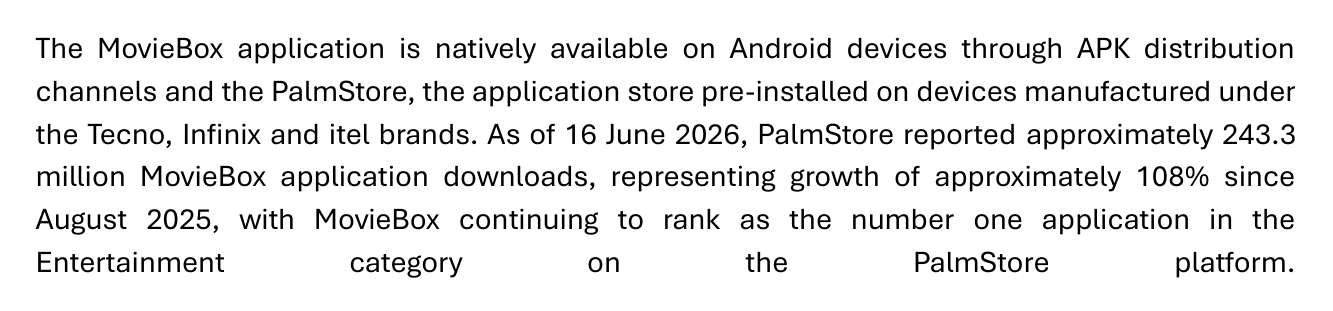
The Palm Store is preinstalled out-of-the-box on every smartphone produced by Transsion Holdings, a massive Chinese multinational consumer electronics company. According to Transsion’s own financial and corporate disclosures, the company captured an overwhelming 61.5% market share of all mobile phones sold in Africa in 2024. By dominating emerging markets across Africa, South Asia, and parts of the Middle East, Transsion has built a captive audience of hundreds of millions of mobile users.
In a draft prospectus filed for a planned Hong Kong stock exchange listing, Transsion explicitly detailed the mechanics of the Palm Store. The company reported having more than 180 million monthly active users on average during the previous year. Furthermore, the prospectus sheds light on the platform’s monetization strategy: Transsion typically extracts revenue from third-party developers based on the raw volume of application installations funneled through its distribution network. While concrete financial audits have not yet revealed whether Transsion directly profits from every single MovieBox installation, the sheer volume of 305 million downloads highlights a massive structural alignment between the app store’s reach and the pirate app’s growth.
Official Statements and Deep-Dive Investigations: The Transsion Link
While hosting a rogue application within an app marketplace does not automatically imply operational complicity on the part of the store owner, Canal+’s regulatory submission goes significantly further. The French broadcaster argues that the operational, technical, and historical ties between MovieBox and the Transsion ecosystem run deep.
The Canal+ Findings: Infrastructure and Certificates
In its detailed dossier submitted to Brussels, Canal+ outlines a series of technical anomalies that suggest an intimate relationship between the creators of MovieBox and the corporate infrastructure of Transsion:
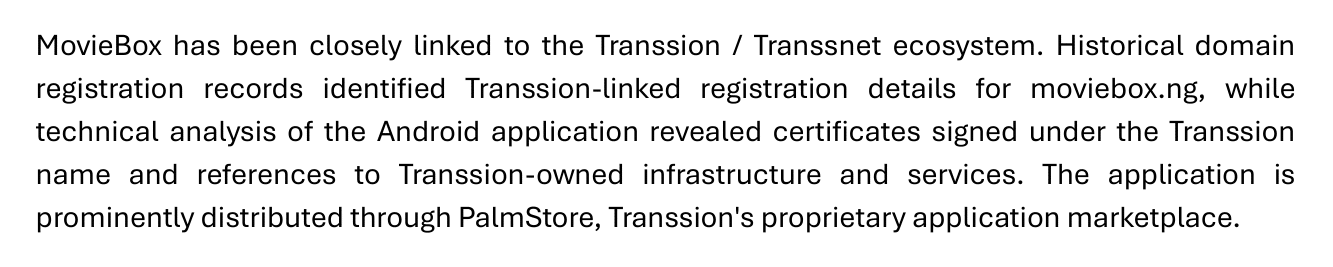
- Domain Registration Clues: Historical WHOIS and domain registration records for early MovieBox iterations (such as
moviebox.ng) revealed registration contact details explicitly linked to individuals or entities associated with Transsion. - Android Application Signatures: Technical reverse-engineering and security analysis of the MovieBox Android application package (APK) uncovered digital security certificates signed under the Transsion corporate name. Furthermore, the application code contained internal references pointing directly to Transsion-owned infrastructure and proprietary cloud services.
- Developer Attribution: Palm Store officially lists Excellent Innovation Limited—a Hong Kong-registered corporate entity—as the formal developer of MovieBox. Canal+’s dossier connects this entity directly to the app through a web of overlapping domain registrations, SSL certificate authorities, developer attributions, and localized trademark filings.
Canal+ stops short of officially accusing Transsion of directly owning or orchestrating the day-to-day operations of MovieBox. However, the evidence presented strongly implies that the application was developed and deployed with internal corporate resources, authorized technical credentials, or infrastructural backing from entities orbiting the Transsion and Transsnet ecosystem.

The MPA’s Perspective
In contrast to the detailed infrastructure audit provided by Canal+, the Motion Picture Association’s submission adopts a broader, more geopolitical lens. The Hollywood-backed trade group does not mention Transsion by name in its primary filing entry. Instead, the MPA summarizes MovieBox as a sophisticated, large-scale commercial piracy operation believed to be directed and managed out of mainland China, leveraging mobile-first distribution channels to target developing economies where traditional subscription models face high friction.
Future Outlook: What Happens Next in Brussels?
The inclusion of MovieBox in the submissions for the European Commission’s 2027 Counterfeit and Piracy Watch List initiates a formal, multi-step administrative procedure designed to ensure procedural fairness while ramping up diplomatic pressure on bad actors.
Due Process and Corporate Responses
Before the European Commission finalizes its Watch List, standard operating procedures dictate that accused service providers must be given an opportunity to defend themselves. As outlined in the Commission’s consultation guidelines:
"The Commission will also make reasonable efforts to contact the service providers reported in the submissions and invite them to respond in writing to the allegations made against them."
In alignment with journalistic standards, investigative inquiries were dispatched to representatives for both MovieBox and Transsion Holdings to secure comment regarding the serious allegations leveled in the Canal+ and MPA dossiers. At the time of publication, neither entity had issued a formal response.
The Significance of the Watch List
It is important to contextualize the weight of the European Commission’s Counterfeit and Piracy Watch List. Inclusion on the list does not constitute a formal legal finding of wrongdoing, nor does it carry immediate judicial penalties, asset freezes, or mandatory geo-blocking orders within EU member states.
Instead, the Watch List functions as a powerful soft-power instrument. It serves to:
- Publicly spotlight systemic enablers of digital piracy, compelling institutional investors and corporate partners to re-evaluate associations.
- Motivate foreign governments and domestic regulators to exercise tighter oversight over app stores, software development kits, and digital marketplaces operating within their jurisdictions.
- Encourage marketplace operators—such as Transsion and its Palm Store—to proactively audit, vet, and purge copyright-infringing software from their ecosystems to protect their corporate reputations and international expansion plans.
As the European Commission reviews the voluminous dossiers submitted by Canal+ and the MPA, the case of MovieBox stands as a watershed moment. It exposes the vulnerabilities inherent in closed-ecosystem app stores and underscores the reality that modern digital piracy is no longer confined to shady websites—it can be preloaded onto hundreds of millions of smartphones straight out of the box.