




Executive Overview
In the rapidly evolving landscape of digital discovery, traditional search engine optimization (SEO) is no longer the sole battleground for brand visibility. As consumers increasingly turn to artificial intelligence chatbots and generative search engines to answer their queries, a new paradigm of digital marketing has emerged. A comprehensive new study from SEO analytics platform SE Ranking reveals a critical strategic shift for modern brands: maintaining an active, robust presence on social media platforms is no longer just a community-building exercise—it is a vital catalyst for securing visibility in AI-generated search results.
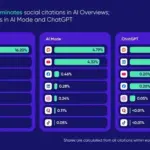
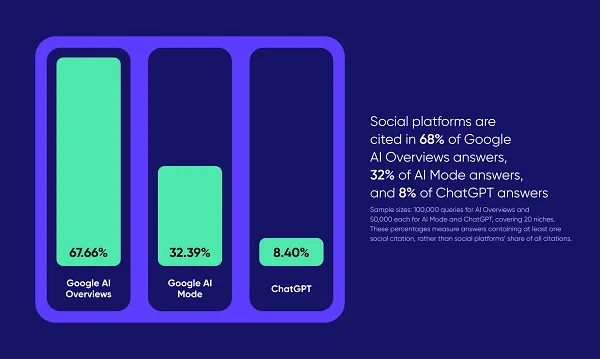
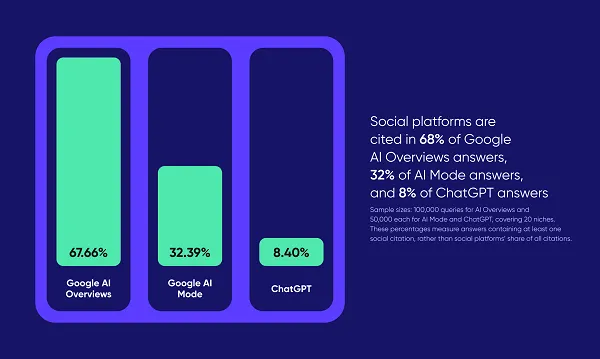
Analyzing 100,000 keywords across a diverse spectrum of brand niches, SE Ranking’s research uncovers how major AI engines—including Google’s AI Overviews, Google AI Mode, and OpenAI’s ChatGPT—source and cite external links. The findings are striking. Social media links are woven directly into the fabric of generative search responses, appearing in nearly 68% of Google AI Overviews, over 32% of Google AI Mode replies, and a notable portion of ChatGPT outputs.
However, the path to AI visibility is far from uniform. Different chatbots favor entirely different platforms, and the underlying algorithms are subject to sudden, unpredictable shifts. For digital marketers, brand strategists, and public relations professionals, this data signals the dawn of Generative Engine Optimization (GEO). Success in this new era requires moving beyond traditional website-centric SEO and adopting a diversified, platform-agnostic social media strategy that caters to the unique algorithmic appetites of each AI model.
Detailed Chronology and Study Methodology
To understand how AI platforms construct their answers and where they source their authority, the research team at SE Ranking embarked on an extensive empirical investigation.
The Scope of the Research
The study was designed to eliminate bias by analyzing a massive dataset of 100,000 keywords. These keywords spanned a wide array of commercial and informational brand niches, capturing both branded searches (queries explicitly mentioning a brand name) and non-branded searches (broad category or product queries).
By running these 100,000 queries simultaneously across Google’s traditional search ecosystem, Google’s AI-powered features, and OpenAI’s ChatGPT, the researchers were able to map out a comparative blueprint of how different search architectures prioritize external web sources.
Key Milestones in AI Sourcing Trends
While the SE Ranking study provides a sweeping snapshot of current AI citation patterns, the timeline of AI search behavior has been marked by rapid volatility throughout recent months:
- Early 2024: As generative search features like Google AI Overviews (formerly Search Generative Experience) rolled out globally, early digital audits showed a heavy reliance on traditional news outlets and authoritative domain-name-system (DNS) structures. However, user-generated content platforms quickly began capturing significant real estate.
- Early 2024 (Data Partnerships): Major tech companies began solidifying data-sharing agreements. Notably, Google established a commercial data-sharing partnership with Reddit, ensuring a steady, high-volume pipeline of community-driven content into Google’s search index and AI overviews.
- August 2024 (The ChatGPT-Reddit Shift): In a stark illustration of algorithmic volatility, industry tracking by Search Engine Land revealed a staggering 86.4% drop in Reddit citations within ChatGPT search results over a mere four-day period. This sudden decoupling highlighted the fragile nature of relying on single platforms for AI exposure.
- Late 2024 / SE Ranking Study Release: The latest data from SE Ranking quantified the omnipresence of social media across broader AI tools, proving that while individual platforms like ChatGPT may abruptly change their referencing habits, the broader ecosystem still heavily leans on social architecture.
Supporting Context and Metrics: Where Social Media Shines in AI
The core takeaway from SE Ranking’s investigation is that social media platforms act as primary trust signals for large language models (LLMs). Because LLMs are trained to prioritize human-centric, conversational, and peer-reviewed consensus data, social forums, video repositories, and professional networks frequently outrank corporate web pages in AI-generated answers.
Breakdown of AI Platform Citations
The study’s quantitative metrics reveal stark differences in how distinct AI tools utilize social media links:
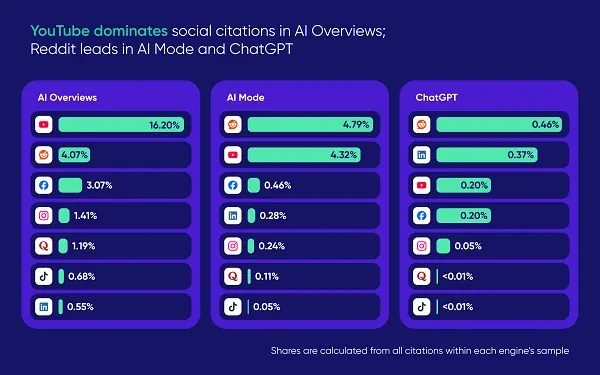
- Google AI Overviews (67.66%):
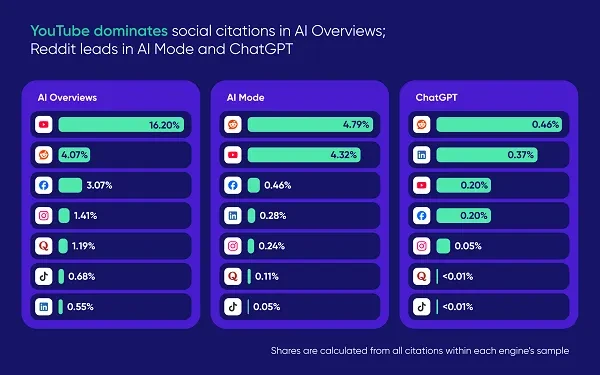
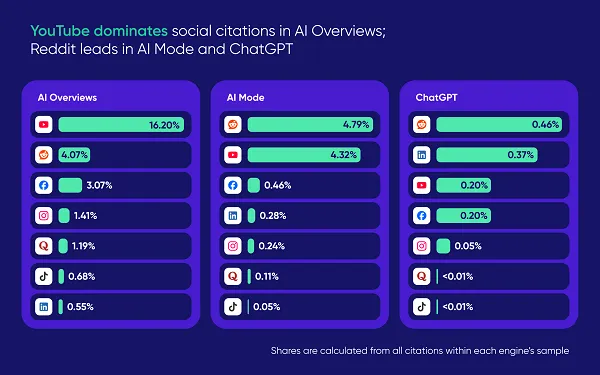
An overwhelming majority of Google’s AI-generated overview boxes incorporate links to social media platforms. Within this ecosystem, Google-owned YouTube reigns supreme as the single most commonly cited source. Because video transcripts, descriptions, and user engagement provide rich context, YouTube dominates informational and product-based queries alike. - Google AI Mode (32.39%):
In Google’s experimental or specialized AI search modes, social platform links appear in roughly one-third of responses. When looking specifically at query types within AI Mode, social media sources are referenced in 39.34% of branded query responses and a higher 48.58% of non-branded searches. For generic product research, platforms like Facebook, YouTube, and Reddit form the backbone of the AI’s recommendations. - ChatGPT (8.4%):
While ChatGPT incorporates social media links less frequently than Google’s ecosystem (appearing in 8.4% of answers), the platforms it does choose carry immense weight. Reddit and LinkedIn emerge as the top social channels referenced by OpenAI’s chatbot.
The Nuance of Platform Preferences
Despite Reddit’s prominence in overall generative search, the fine-grained data reveals interesting anomalies. For instance, specific platform citations (such as Reddit, LinkedIn, and Facebook) appear in fewer than 1% of ChatGPT answers for certain routine queries. This indicates that ChatGPT’s internal weighting system treats social media more selectively—pulling from professional networks like LinkedIn for B2B queries or niche subreddits for deep consumer reviews, rather than applying a broad brush.
Furthermore, the dramatic collapse of Reddit citations in ChatGPT in August 2024 underscores a pivotal vulnerability: AI citation pathways are not permanent. Unlike Google’s stable integration of Reddit—underpinned by multi-million-dollar data licensing agreements—ChatGPT’s access and willingness to cite open-web forums can fluctuate overnight based on policy adjustments, copyright concerns, or algorithmic updates.
Official Insights and Industry Analysis
The implications of the SE Ranking study stretch far beyond basic digital marketing metrics; they challenge the foundational theories of how brands establish authority online.
Industry experts emphasize that optimizing for AI search is fundamentally different from traditional SEO. For over two decades, search engine optimization was synonymous with Google optimization. Marketers mastered keyword density, backlink profiles, technical site speed, and schema markup to rank on the coveted first page of Google search engine results pages (SERPs).
However, AI chatbots do not rank web pages in a linear list. Instead, they synthesize information, reading across millions of data points to construct a singular, authoritative narrative. If an LLM cannot find independent, third-party validation of a brand—such as authentic customer discussions on Reddit, glowing video reviews on YouTube, professional discourse on LinkedIn, or active community engagement on Facebook—the AI is far less likely to recommend that brand to a user asking for product suggestions.
As SE Ranking’s data highlights, there is no one-size-fits-all approach to AI optimization. A B2B enterprise that ignores LinkedIn will find itself entirely invisible to a business executive asking ChatGPT for software recommendations. Conversely, a direct-to-consumer (D2C) brand that neglects YouTube and Reddit will miss out on the rich tapestry of consumer sentiment that Google’s AI Overviews rely on to build trust.
Future Outlook: Navigating the Era of Generative Engine Optimization (GEO)
As artificial intelligence continues to absorb a growing share of global search traffic, businesses must evolve their digital strategies to survive and thrive. The shift from traditional search engines to conversational AI agents marks the beginning of the Generative Engine Optimization (GEO) era.
What This Means for Brand Strategists
- Embrace a Multi-Platform Social Ecosystem: Brands can no longer afford to treat social media as a passive broadcast channel. Maintaining an active, highly engaged presence across YouTube, Reddit, LinkedIn, and Facebook is now a core SEO strategy. Every positive customer interaction, community discussion, and video tutorial serves as a potential training token and citation anchor for an AI model.
- Prepare for Algorithmic Volatility: As demonstrated by the sudden drop in ChatGPT’s Reddit citations, relying on a single third-party platform for AI exposure is inherently risky. A diversified digital footprint—combining owned media, earned media, and multi-channel social engagement—mitigates the impact of sudden algorithmic shifts by AI developers.
- Prioritize Authentic Brand Sentiment: AI chatbots are increasingly sophisticated at filtering out spam, corporate fluff, and self-promotional content. They favor organic, user-generated validation. Cultivating genuine brand advocacy among real users on review sites and social forums will increasingly dictate whether an AI recommends your product or your competitor’s.
Conclusion
The findings from SE Ranking deliver a clear, actionable mandate for the future of digital visibility. AI chatbots are fundamentally transforming how consumers discover products and services, and they are looking outward—toward the collective voice of the internet—to validate who is worth mentioning. By strategically integrating social media management into their broader search optimization frameworks, brands can secure their place in the generative answers of tomorrow.