DATELINE: Brussels / Sofia / Bucharest
Executive Overview
In what international security analysts are calling a dangerous and unprecedented escalation of the ongoing conflict in Eastern Europe, a coordinated series of sea and aerial drone attacks has targeted commercial shipping within the exclusive economic zones (EEZs) of NATO member states. For the first time since the full-scale Russian invasion of Ukraine began, civilian cargo vessels operating in internationally recognized maritime zones of NATO allies have been successfully struck, resulting in the sinking of two ships, severe damage to a third, multiple casualties, and a profound crisis regarding maritime security on the alliance’s eastern flank.
The attacks, which unfolded over a turbulent 48-hour window in early October, targeted vessels flagged under Togo, Palau, and Turkey. The strikes occurred within the maritime EEZs of Bulgaria and Romania—both sovereign NATO territories. The incidents have not only devastated commercial shipping lanes vital to global grain and commodity supplies but have also pushed the boundaries of modern hybrid warfare, forcing Western capitals to re-evaluate the vulnerabilities of maritime commerce in semi-enclosed seas adjacent to active warzones.
While European Union leadership has urged caution while forensic and naval investigations continue to establish the definitive origin of the munitions, Ukrainian authorities have categorically blamed Moscow. Preliminary findings from joint investigations conducted by Ukrainian intelligence and the Bulgarian Navy point to a sophisticated, combined assault utilizing long-range loitering munitions and unmanned surface vessels (USVs).
With at least two sailors confirmed dead, multiple mariners hospitalized with critical injuries, and others still unaccounted for, the international community faces mounting pressure to deter further infringements on freedom of navigation. This report provides a comprehensive examination of the timeline, the geopolitical fallout, the strategic implications for NATO, and the broader economic ramifications of this watershed maritime tragedy.
Detailed Chronology of Events
The escalation represents a rapid deterioration of safety conditions in the western Black Sea, a critical artery for international trade, particularly agricultural exports from Eastern Europe to global markets.
October 5: The Strike within Romania’s Exclusive Economic Zone
The crisis began on the morning of October 5, when maritime monitoring systems registered an explosion in the Romanian EEZ of the Black Sea. The target was the Royad Mammadov, a Turkish-owned cargo ship navigating international commercial corridors.
According to reports from regional media and European maritime agencies, the vessel was struck by an unidentified aerial drone. The impact triggered an immediate, catastrophic fire in the ship’s superstructure. Despite the crew’s desperate attempts to contain the blaze, the structural integrity of the Royad Mammadov was severely compromised, and the ship eventually took on water and sank.
A multinational rescue operation involving Romanian naval vessels and search-and-rescue helicopters was rapidly deployed to the coordinates. Out of its crew, 11 sailors were successfully pulled from the frigid waters and transported to medical facilities. However, the operation confirmed a tragic human toll: two crew members were killed in the blast and subsequent fire, while another remains unaccounted for, with search efforts gradually transitioning into recovery operations.
October 6: The Double Strike off the Coast of Bulgaria
Barely 24 hours after the disaster in Romanian waters, the violence shifted slightly further south, penetrating the exclusive economic zone of Bulgaria, approximately 80 miles (128 kilometers) off the coastline.
In a complex, multi-pronged assault, attackers deployed a combination of sea-based drones (unmanned surface vessels) and aerial loitering munitions against two separate merchant vessels:
- The Alfa Watan: A Togo-flagged cargo ship that took direct hits from multiple vectors. The structural damage was catastrophic, leading to a rapid sinking. At the time of reporting, the precise fate of the Alfa Watan’s entire crew remains unconfirmed, with rescue vessels combing the area for survivors amidst debris fields.
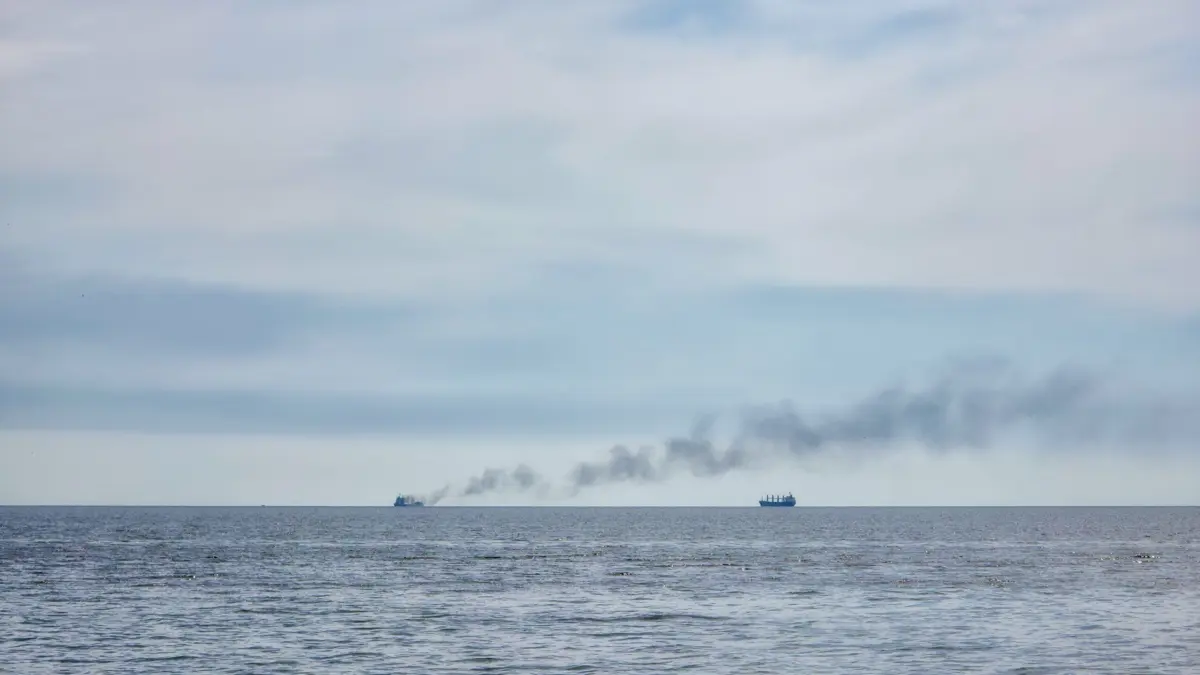
- The Able: A Palau-flagged cargo vessel targeted in the same synchronized barrage. While the ship did not sink immediately, it was engulfed in flames, leaving its crew stranded in a burning hulk miles from the nearest port.
A Bulgarian commercial ferry operating in the vicinity diverted its course to lead an emergency rescue operation. The ferry successfully evacuated all 18 crew members of the Able. Among the survivors, two mariners sustained severe, life-threatening injuries and were rushed via emergency medical evacuation helicopter to a specialized trauma hospital in the coastal city of Varna.
Supporting Context & Metrics: The Shifting Black Sea Theater
To understand the gravity of the October incidents, one must examine the broader strategic evolution of the Black Sea maritime theater since February 2022.
The Militarization of the Black Sea
Historically, the Black Sea has been a geopolitical flashpoint, bordered by six countries—Bulgaria, Georgia, Romania, Russia, Turkey, and Ukraine. Following the outbreak of the war, the maritime domain transformed into an active combat zone. Russia instituted a de facto naval blockade, targeting Ukrainian ports and attempting to sever Kyiv’s economic lifeline.
In response, Ukraine developed an asymmetrical naval warfare doctrine centered heavily on domestic innovations:
- Unmanned Surface Vessels (USVs): Low-profile, explosive-laden marine drones capable of traversing hundreds of miles to strike Russian warships of the Black Sea Fleet.
- Unmanned Aerial Vehicles (UAVs): Long-range drones utilized for reconnaissance and strike missions against naval infrastructure and logistics hubs in Crimea and southern Russia.
While Ukraine’s naval drone campaign has achieved remarkable tactical success—forcing the Russian Black Sea Fleet to relocate the majority of its high-value assets from occupied Sevastopol further east to Novorossiysk—the proliferation of autonomous and remote-controlled weaponry has introduced massive collateral risks to neutral commercial shipping.
The NATO EEZ Threshold
Until October 2025/2026, the implicit rules of engagement had largely spared the territorial waters and exclusive economic zones of NATO member states (specifically Romania, Bulgaria, and Turkey) from direct kinetic strikes. While drifting naval mines periodically broke loose and drifted into Romanian and Turkish waters—requiring continuous counter-mine sweeps by the Black Sea Naval Cooperation Task Group (BlackSEAFOR)—deliberate targeting of merchant vessels within NATO EEZs was unprecedented.
Exclusive Economic Zones do not constitute sovereign territorial waters (which extend 12 nautical miles from the coast), but under the United Nations Convention on the Law of the Sea (UNCLOS), coastal states hold sovereign rights over the exploration and use of marine resources, alongside responsibilities for environmental protection and maritime safety. The breach of these zones by lethal military drones represents a direct psychological and strategic challenge to NATO’s deterrence posture on its eastern flank.
Official Statements and Diplomatic Fallout
The unprecedented nature of the attacks has triggered intense diplomatic maneuvering, urgent security consultations among NATO allies, and sharply divergent assessments regarding responsibility.
European Union and NATO Reactions
European Commission President Ursula von der Leyen took to social media platform X (formerly Twitter) to express deep alarm over the sequence of events.
"Attacks on civilian shipping are increasingly concerning," von der Leyen wrote. "We stand in full solidarity with our Member States on the Eastern flank. Attacks on civilian shipping are unacceptable, and the circumstances of these incidents are still being established."
By exercising caution and avoiding an immediate, definitive attribution of blame, Brussels signaled a desire to let forensic naval experts complete their analysis before triggering formal alliance escalation mechanisms, such as consultations under Article 4 of the North Atlantic Treaty.
Meanwhile, Bulgarian Prime Minister Rumen Radev did not mince words during a national press briefing following the disaster off the Varna coast. Radev condemned the strikes as “an unacceptable attack in Bulgaria’s exclusive economic zone” and characterized the incident as “a blatant violation of international law and maritime law.”
Ukrainian Assertions and Intelligence Findings
Contrasting with the cautious diplomatic language emanating from Brussels, Ukrainian leadership offered a definitive assessment of the perpetrators.
In a public address, Ukrainian President Volodymyr Zelenskyy revealed the preliminary findings of a joint intelligence and naval investigation conducted between Kyiv and the Bulgarian military. Zelenskyy stated unequivocally that the strikes represented a “Russian combined attack using both sea and aerial drones.” Furthermore, the Ukrainian head of state firmly rejected any insinuation of Ukrainian involvement, emphasizing that Ukrainian military forces were not conducting operations in that specific western sector of the Black Sea where the merchant vessels were targeted.
Independent naval analysts and defense experts have noted that the operational profile—utilizing long-range loitering munitions coupled with maritime drones—matches capabilities predominantly fielded by Russian forces operating from occupied southern Ukraine and Crimea, though false-flag operations and navigational spoofing remain subjects of ongoing technical investigation by NATO maritime intelligence cells.
Future Outlook and Strategic Implications
The sinking of the Alfa Watan and Royad Mammadov, alongside the crippling of the Able, marks a dangerous turning point that will likely reshape maritime security, insurance markets, and naval deployments in the region for years to come.
1. Re-evaluating Maritime Insurance and Supply Chain Economics
The commercial impact was instantaneous. Global marine insurance underwriters, who had already classified the Black Sea as a "High-Risk Area" requiring specialized war-risk premiums, are expected to drastically hike rates or temporarily suspend underwriting for vessels transiting the western zones. This will inevitably drive up shipping costs for grain, steel, and energy products, exerting renewed inflationary pressures on global food security, particularly for importing nations in the Global South.
2. NATO’s Eastern Flank Posture: Patrols and Air Shielding
Pressure is mounting on the North Atlantic Treaty Organization to enhance its defensive posture in the Black Sea. While the 1936 Montreux Convention heavily restricts the entry of non-riparian warships (such as those from the United States or non-Black Sea European nations) during wartime, littoral NATO states—Turkey, Romania, and Bulgaria—possess significant organic naval and air capabilities.
Experts anticipate that NATO will augment maritime patrol aircraft deployments (such as P-8 Poseidon surveillance planes), increase electronic warfare jamming operations to disrupt drone guidance systems, and expand coordinated mine-hunting and surface-surveillance patrols across the Romanian and Bulgarian EEZs.
3. The Threat of Escalation and Hybrid Warfare
Security analysts view these incidents through the wider lens of Russian "hybrid warfare" tactics aimed at testing Western resolve, probing air and naval defense reaction times, and inflicting economic attrition on Ukraine’s export corridors. Because these attacks occurred outside formal territorial waters, they deliberately exploit legal and geopolitical grey zones, complicating NATO’s decision-making calculus regarding collective defense obligations.
As the joint investigations progress, the findings will serve as a crucial test for Western unity and deterrence. Whether the international community can establish effective accountability and secure commercial shipping lanes against the unchecked proliferation of autonomous warfare will define the stability of the European security architecture for the foreseeable future.