







Executive Overview
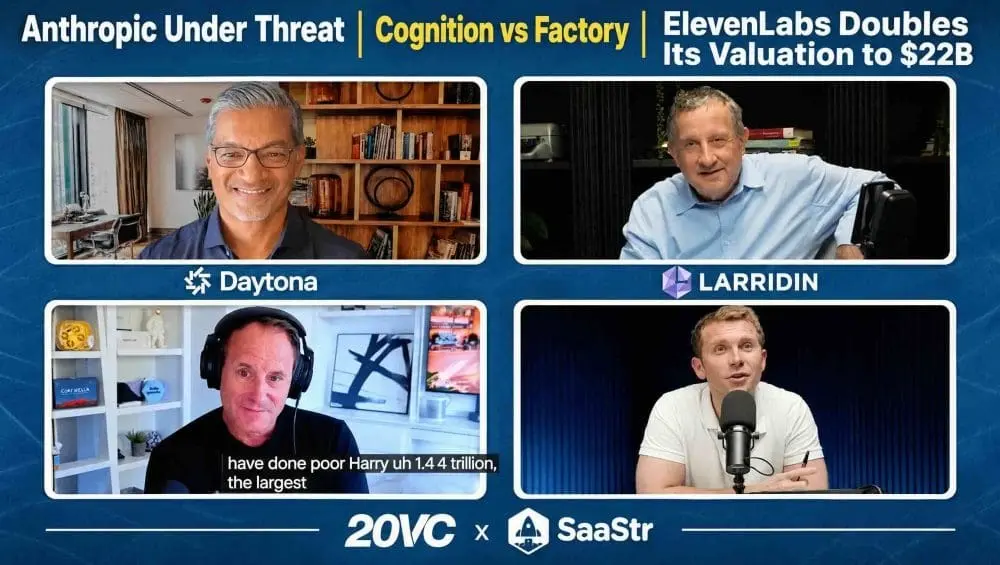
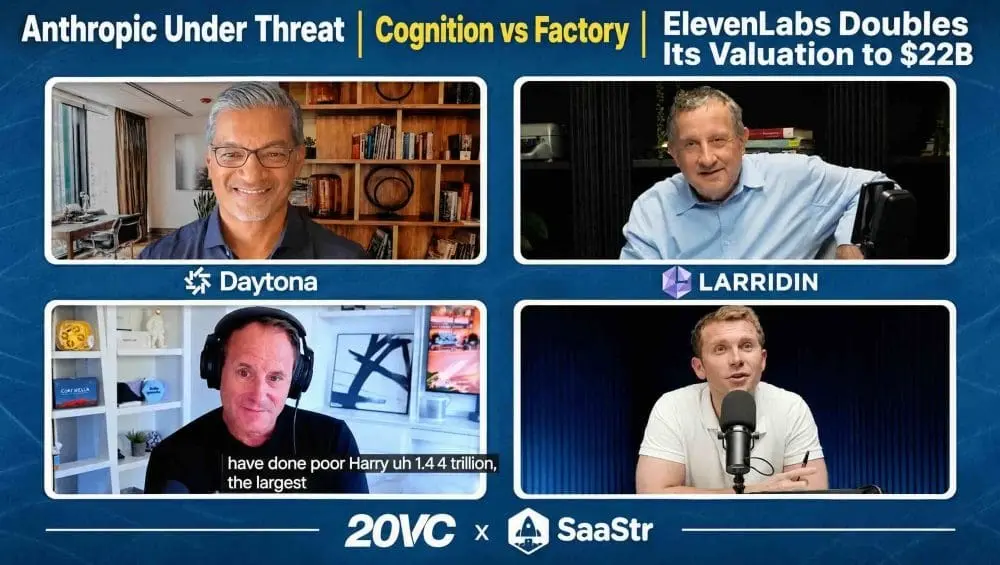
The technology sector is experiencing a period of historic velocity, defined by staggering financial milestones, ferocious talent wars, and abrupt strategic realignments. In a landmark roundtable discussion, host Harry Stebbings was joined by venture heavyweights Jason Lemkin and Rory O’Driscoll, alongside a very special guest: Dev Ittycheria, who stepped back into the CEO seat at MongoDB just one week prior.
Ittycheria’s return to MongoDB—having previously scaled the database giant from $35 million to over $2.3 billion in annual revenue between 2014 and 2025—provided a unique lens through which to analyze the week’s chaotic headlines. With CJ Desai abruptly departing MongoDB to run Meta’s new enterprise platform under Mark Zuckerberg, Ittycheria was intimately familiar with the turbulence defining the current executive landscape.
From OpenAI approaching a jaw-dropping $70 billion annualized run rate and eyeing a $1.4 trillion valuation, to Anthropic prepping a massive November IPO near the $2 trillion mark, the frontier AI race is rewriting the laws of corporate economics. Simultaneously, brutal boardroom battles—such as the public fallout between Factory, Cognition, and venture capitalist Vinod Khosla—highlight a shifting cultural paradigm where traditional notions of loyalty and discretion are being discarded. This report provides an exhaustive, authoritative breakdown of the eleven major storylines that dominated the tech ecosystem, offering deep-dive analysis into the metrics, controversies, and future trajectory of the industry.
Detailed Chronology & Narrative Breakdown
1. The Financial Ascent of OpenAI and the Shifting Enterprise Battlefield
OpenAI’s annualized revenue is hurtling toward $70 billion, marking an astonishing growth of more than 70% since the start of the third quarter alone. Enterprise sales have more than doubled over the same timeframe, signaling a massive pivot from experimental consumer usage to deeply embedded enterprise workflows.
Panelists analyzed the mechanics behind this explosive growth. Jason Lemkin emphasized that speed is the definitive narrative of the current cycle. At the beginning of the year, agentic coding tools were largely the domain of Anthropic. By mid-summer, OpenAI appeared to be trailing, but a rapid iteration cycle shifted momentum. By October, portfolio companies were aggressively swapping models, favoring solutions that offered superior performance at lower costs.
Dev Ittycheria, drawing on over a dozen years of enterprise software sales experience, noted that corporate developers exhibit virtually zero brand loyalty. Developers switch tools instantly or run multiple instances simultaneously. Consequently, the truly sticky revenue resides at the enterprise level—multi-year contracts involving thousands of employees and intricate workflow integrations. Internal dialogues with Chief Information Officers now center strictly on token costs, budgetary caps, and data governance.
Meanwhile, Rory O’Driscoll provided a nuanced financial perspective, noting that OpenAI’s quarter-over-quarter growth between Q1 and Q2 was a relatively modest 18%, while Anthropic expanded at a blistering pace. By O’Driscoll’s calculations, Q2 marked a historic milestone where Anthropic’s GAAP revenue surpassed OpenAI’s—roughly $11 billion compared to $6.8 billion. However, OpenAI’s recent 60% to 70% quarterly surge resets the competitive narrative, providing critical financial relief given the company’s massive forward commitments in compute infrastructure, data centers, and physical real estate in Virginia.
2. Trillion-Dollar Horizons: OpenAI’s Bridge Round vs. Anthropic’s Imminent IPO
The capital markets are hurtling into uncharted territory. OpenAI is currently in discussions to secure at least $30 billion in new funding at a staggering $1.4 trillion valuation (pre-money), acting as a strategic bridge to a future public offering. Concurrently, competitor Anthropic is preparing for a mid-November market debut, targeting a roadshow the week of November 9 and a public valuation hovering between $1.8 trillion and $2 trillion.
O’Driscoll highlighted the historic nature of these figures, noting that a private round above one trillion dollars represents a quantum leap of three orders of magnitude compared to the first billion-dollar private valuations of the mid-1990s. When Harry Stebbings posed a hypothetical choice to an institutional allocator—whether to purchase private OpenAI shares at $1.4 trillion or liquid Anthropic stock at $2 trillion—O’Driscoll advocated decisively for liquidity. In an environment defined by macro and technological unknowns, holding liquid public equity supersedes speculative private holds unless investors are prepared for a multi-year lockup.
3. The Factory-Cognition Executive Controversy
On September 30, Factory CEO Matan Grinberg set the tech world ablaze by publicly terminating Chris Degnan as a board adviser, leveling serious allegations that Degnan had leaked confidential strategic information to rival firm Cognition. Just two hours later, Degnan announced his appointment as Cognition’s new Chief Revenue Officer. Degnan, a former Snowflake CRO who had advised Factory for approximately a year, vehemently denied sharing proprietary details, maintaining that he had resigned. Cognition also categorically rejected Grinberg’s claims.
The roundtable fiercely debated the ethical boundaries of executive transitions. Ittycheria, an angel investor in Factory and a commercial partner to Cognition, argued that the severity of the betrayal depends entirely on the adviser’s proximity to the inner sanctum. While a peripheral adviser vetting European hires represents a low-risk relationship, an adviser privy to product roadmaps, board strategies, and financials holds a position of profound trust. For a CRO—whose job relies on selling a vision to recruits and clients—jumping immediately to a direct competitor inflicts severe reputational damage.
Jason Lemkin offered a more pragmatic industry perspective, suggesting that a vast majority of CROs view corporate mobility as a transactional game, noting that Degnan operated as an adviser and board observer rather than a full-time fiduciary. Rory O’Driscoll countered that a full-time executive possesses real-time knowledge up to their departure, framing the failure as an unspoken misalignment of expectations rather than outright malicious intent.
4. Boardroom Warfare: Vinod Khosla’s Public Denunciation
The controversy deepened when venture capitalist Vinod Khosla waded into the fray. Khosla Ventures is an investor in both Cognition and Factory, with Keith Rabois having led Factory’s $110 million Series C round in April while holding a board seat. In a stunning public escalation, Khosla sided with Degnan, accused Grinberg of dishonesty, and dismissed Factory as a "struggling second tier competitor." Rabois publicly defended Factory in response.
Ittycheria expressed utter bewilderment at Khosla’s public remarks, noting that such internal conflicts provide competing venture firms with an easy rhetorical weapon to deploy against Khosla Ventures in future competitive deals. O’Driscoll characterized the outburst as a severe tactical error, emphasizing that holding competing portfolio investments requires absolute diplomatic neutrality.
5. Reflection AI Ships "Beam": The Open-Weight Challenger
Reflection AI unveiled "Beam," its flagship open-weight model consisting of 501 billion parameters. The company claims Beam matches Z.ai’s GLM-5.2 reasoning benchmarks while consuming three to four times less inference compute. Although independent verification is pending and model weights are slated for release later in the month, the industry is already reacting.
Dev Ittycheria pointed out that a near-frontier U.S. model operating at a fraction of the cost removes primary hesitations for highly regulated industries previously wary of Chinese open-source alternatives. Jason Lemkin remained skeptical of published evaluation metrics, noting strong corporate resistance to Chinese-sourced models at industry conferences like Dreamforce. However, if Beam achieves true functional parity, U.S.-backed open-source models could command a massive share of the token economy within the year.
6. ElevenLabs Reaches $22 Billion Valuation via Employee Tender
Voice AI leader ElevenLabs completed a $300 million employee tender offer spearheaded by Wellington and T. Rowe Price, doubling its valuation to $22 billion—up from $11 billion during its $500 million Series D in February.
Jason Lemkin championed ElevenLabs as an elite investment target, arguing that voice workloads demand absolute reliability where model quality is non-interchangeable. Because mid-sized enterprises willingly pay hundreds of thousands of dollars annually for automated phone agents that execute transactions flawlessly within seconds, ElevenLabs enjoys robust, non-speculative revenue streams insulated from standard compute volatility.
7. Salesforce Acquires Listen Labs for $2 Billion
Signaling a major consolidation wave in AI applications, Salesforce entered a definitive agreement to acquire Listen Labs for approximately $2 billion. The three-year-old startup—which deploys AI agents to recruit, interview, and analyze research participants—had previously walked away from a signed $125 million Series C term sheet at a $1.5 billion valuation, boasting an annualized revenue run rate of roughly $30 million.
Harry Stebbings broke down the stellar financial returns: approximately $850 million returned to investors on just $96 million of total capital invested, yielding a staggering 25x multiple for seed and Series A backers led by Sequoia, and a swift 4x return in eight months for Series B backer Ribbit. While Rory O’Driscoll praised the acquisition as a masterclass in modernizing fragmented market research categories, Jason Lemkin questioned whether tens of millions in acquired revenue meaningfully impacts a corporate titan approaching a $50 billion top line. Dev Ittycheria noted that foundational AI applications functioning as mere features will inevitably face consolidation, making lucrative early exits a rational strategy for founders building non-generational entities.
8. Vercel and the Agentic Infrastructure Shift
Infrastructure provider Vercel revealed a massive structural shift: AI agents now trigger over 50% of its deployments, surging from less than 3% previously. With annualized recurring revenue approaching $600 million, Vercel’s trajectory highlights how autonomous software agents are actively selecting developer infrastructure vendors.
Dev Ittycheria contextualized this transformation by comparing it to the early days of search engine optimization. For decades, marketers optimized for the premier page of Google; today, brands must ensure their APIs and documentation are meticulously optimized for autonomous agents that execute vendor selection without human intervention.
9. Legal Turbulence: The Groq-Nvidia Talent Acquisition Lawsuit
Two former Groq engineers filed a high-stakes lawsuit in Delaware Chancery Court challenging a complex $20 billion transaction involving Nvidia. The deal structure comprised $17 billion for a non-exclusive technology license and $3 billion in restricted stock units (RSUs) allocated to the 150 to 200 engineers who transitioned to Nvidia.
Rory O’Driscoll highlighted the foundational principle of Delaware corporate law: all holders of the exact same security class must be treated equitably. By structuring transactions to reallocate consideration away from former shareholders, acquirers invite heavy litigation. O’Driscoll noted that Jensen Huang was reportedly briefed on the associated legal risks prior to signing and consciously accepted them to fast-track the talent acquisition.
10. Meta’s Muse Outpaces ChatGPT on the App Store
Meta’s consumer AI application, Muse, captured the top spot on Apple’s U.S. free iPhone chart within just ten days of its September 8 launch, overtaking OpenAI’s ChatGPT. In response, OpenAI unveiled "Dots," a persistent, always-on agent tied to its Codex architecture, positioned behind premium enterprise tiers. Panelists praised Meta’s execution, crediting Mark Zuckerberg and Alexandr Wang for aggressively resourcing and shipping consumer-grade AI experiences that resonate instantly with the mass market.
11. Oura Postpones Multi-Billion-Dollar IPO
In a surprising blow to public market recovery narratives, smart-ring pioneer Oura abruptly postponed its planned $2.2 billion Nasdaq IPO days before pricing. Despite books being four times oversubscribed and revenue surging 74% to $1.21 billion over the first nine months of the fiscal year, the company pulled the listing. Panelists debated whether the delay stemmed from valuation pushback or traditional investment banking miscalculation, serving as a sobering reminder that public market liquidity remains delicate for high-growth consumer hardware enterprises.
Supporting Context & Metrics
To fully appreciate the scale of transformation sweeping the technology sector, consider the following quantitative milestones discussed across the roundtable:
- OpenAI Run Rate: Approaching $70 billion annualized revenue, up over 70% since the beginning of Q3.
- Anthropic vs. OpenAI Scale: Anthropic achieved an estimated $11 billion in GAAP revenue during Q2, briefly outpacing OpenAI’s $6.8 billion before OpenAI’s subsequent surge.
- Target Valuations: OpenAI seeking a $1.4 trillion bridge valuation ahead of an upcoming IPO; Anthropic eyeing a $1.8 trillion to $2 trillion valuation for its mid-November public debut.
- ElevenLabs Valuation: Doubled to $22 billion following a $300 million employee tender offer.
- Salesforce / Listen Labs Acquisition: Valued at approximately $2 billion, translating to a 25x return for early Sequoia-led funding rounds on $96 million of invested capital.
- Vercel ARR & Agentic Traffic: Approaching $600 million in ARR, with AI agents driving over 50% of total platform deployments.
- Groq-Nvidia Transaction: A $20 billion deal structure consisting of a $17 billion non-exclusive technology license and $3 billion in Nvidia RSUs for migrating engineers.
Official Statements & Industry Perspectives
The discourse underscored a fundamental evolution in executive accountability, capital allocation, and developer psychology. Key insights from the participants encapsulate the ethos of this new era:
- On Executive Mobility & Loyalty: Jason Lemkin noted, "In the AI age, the definition of loyalty has changed. I think it’s changed permanently." Conversely, Dev Ittycheria maintained strict standards for executive conduct, stating, "I’ve never seen a CRO flip from one company to a direct competitor. The reputational damage you can do long term is going to come back and bite you."
- On Agent-Driven Commerce: Highlighting the shift in enterprise software acquisition, Lemkin observed, "When agents pick you, it’s a force of nature. My agents have opinions, and they’re really hard to argue with." Ittycheria added, "If you’re missing from an AI-generated answer, it’s like being invisible on Google."
- On Venture Capital Ethics: Addressing the public fallout between Khosla Ventures and Factory, Ittycheria remarked, "I was just totally flummoxed by that tweet. It basically handed every other firm a weapon when they’re competing on deals: is this the partner you want when things go bad?"
Future Outlook
As the fourth quarter unfolds, the technology sector stands at a monumental crossroads. The imminent public debuts of frontier labs like Anthropic will establish a definitive public valuation baseline for artificial intelligence, testing institutional appetite at unprecedented scales—approaching the $2 trillion threshold. Simultaneously, the aggressive push toward open-weight efficiencies (exemplified by Reflection AI’s Beam) and agentic infrastructure (led by Vercel and Salesforce) suggests that the locus of enterprise software value is shifting rapidly from raw frontier model dominance to integrated, cost-optimized workflow execution.
For founders, venture capitalists, and enterprise leaders alike, the rules of engagement have permanently transformed. Executive mobility will face intensified legal and reputational scrutiny, capital markets will demand absolute financial transparency despite macroeconomic volatility, and corporate survival will depend entirely on building durable data loops that appeal equally to human executives and autonomous software agents.