








Executive Overview
In an ongoing battle to capture the cultural zeitgeist of online discourse, Meta-owned text-based social network Threads has officially launched a new in-app recognition system: Gems. Designed to spotlight original posts and top-level replies that spark genuine discussion, add unique value, and drive meaningful conversations, Gems represent Meta’s latest attempt to gamify positive community participation.
Initially spotted in early development phases by independent app researchers in August, the feature has now transitioned from experimental code to a live consumer-facing rollout. Automated entirely through algorithmic selection rather than manual human curation, Gems identify stellar content in real time, tagging posts with a distinctive in-stream icon and notifying the creator of their newly minted status. Creators are given the autonomy to either showcase their achievement with a special shareable post or decline the recognition altogether.
While the feature bears a striking conceptual resemblance to other industry attempts at celebrating viral or high-impact social media content—such as X’s short-lived "Bangers" promotion—Threads’ approach relies heavily on automated detection. This distinction shifts the paradigm of algorithmic rewards from manual editorial picks to scalable, system-wide recognition. However, relying on automated detection introduces a complex web of modern content moderation challenges. Specifically, it raises critical questions about how algorithms define "meaningful conversation" in an era where outrage and controversy often masquerade as high engagement.
Currently limited to users in the United States, the rollout of Gems marks a defining moment for Threads as it carves out its distinct identity separate from its sibling platform, Instagram, and its primary rival, X (formerly Twitter). This comprehensive report examines the anatomy of Threads Gems, the mechanics behind their selection, the broader industry context, and the potential pitfalls and future outlook of automated social media rewards.
Detailed Chronology: From Experimental Code to Public Rollout
The genesis of Threads Gems traces back to the iterative, fast-paced development culture that Meta has cultivated for its microblogging platform since its explosive launch. To understand how Gems became a centerpiece of Threads’ engagement strategy, it is essential to trace the timeline of their emergence, testing, and public deployment.
August: The Alessandro Paluzzi Discovery
The first public inklings of the feature surfaced during the late summer of last year. Renowned reverse-engineer and app researcher Alessandro Paluzzi shared screenshots on social media detailing unreleased code within the Threads application package. Paluzzi’s findings revealed a notification screen and experimental UI elements indicating that Meta was actively prototyping a post-performance recognition system.
At the time, industry analysts speculated whether the feature would manifest as a tipping mechanism, a creator monetization tool, or purely a gamified badge system. The leaked user interface pointed explicitly toward the latter: a dedicated notification informing users that their content had been elevated because it had successfully driven community discourse.
Late Autumn: Refinement and Beta Testing
Following Paluzzi’s leak, Meta quietly moved the feature into closed-beta environments. During this phase, engineers fine-tuned the parameters governing what constitutes a "Gem-worthy" post. Unlike traditional algorithmic recommendation feeds—which prioritize maximizing watch time, total impressions, or ad-serving opportunities—the criteria for Gems were explicitly tied to conversational depth. Developers adjusted the underlying models to ensure that the system could differentiate between hollow engagement bait (such as generic "like for like" requests) and genuine, substantive dialogue.
Furthermore, product teams established strict operational boundaries for the feature during testing. Engineers determined that Gems would apply exclusively to public posts. For replies, eligibility was restricted strictly to direct first-tier replies to a primary post, intentionally excluding nested back-and-forth threads (replies to replies) to keep the system manageable and computationally efficient.
The Official Launch and Geographic Limitations
Threads officially pulled back the curtain on Gems, outlining the exact operational mechanics of the in-app rewards system. The company confirmed that selected posts and replies would begin receiving the Gem treatment immediately, accompanied by distinct in-stream visual indicators.
In keeping with Meta’s standard deployment strategy for major algorithmic and product changes, the company rolled out Gems as a region-locked feature. At launch, only U.S.-based users are eligible to receive and interact with Gems. This localized deployment allows Meta’s engineering teams to stress-test the algorithmic detection models at a manageable scale, monitor potential abuse vectors, and measure user sentiment before scaling the feature to international markets.
Mechanics and Architecture: How Threads Gems Work
To appreciate the significance of Gems, one must examine the technical and structural framework governing their assignment. Meta has designed a streamlined user experience masking a complex web of algorithmic decision-making.
The Automated Selection Process
Unlike legacy community awards on platforms like Reddit (where users purchase digital tokens to award others) or editorial spotlights on X, Threads Gems are selected entirely automatically. Meta is deploying a systematic detection process powered by machine learning models rather than human moderators or community voting committees.
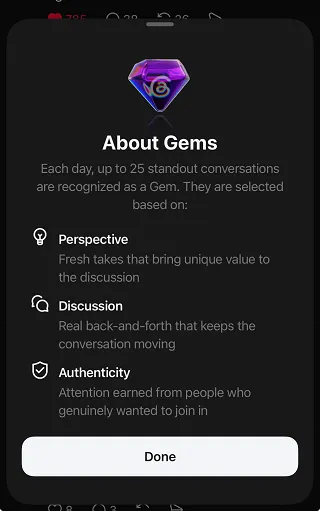
While Meta has not published the complete source code or proprietary weighting formulas for the Gem algorithm, official documentation and company statements highlight several core criteria:
- Originality: The algorithm actively scans for original thought, unique perspectives, and creative inputs rather than repetitive or plagiarized text.
- Conversational Catalyst: Posts and replies must demonstrate an ability to spark discussion. The system measures secondary engagement metrics—such as the volume, length, and depth of replies generated in response to the original post.
- Community Value: Content that contributes constructively to the platform’s discourse ecosystem is favored over noise.
The User Experience: Notifications and Control
When an algorithm flags a piece of content as a Threads Gem, the user journey unfolds through specific touchpoints designed to empower the creator:
- In-App Notification: The creator receives a dedicated notification informing them that their post or reply has been officially recognized as a "Threads Gem."
- The Share Option: Users are presented with the option to publish a special, celebratory post highlighting their achievement to their followers.
- The Right to Decline: Crucially, Threads has built an opt-out mechanism into the feature. Users can decline the recognition if they prefer not to draw unwanted attention or if they disagree with the platform’s algorithmic assessment of their content.
- In-Stream Visual Indicator: For those who accept or allow the recognition, a special icon appears alongside the post directly in the user stream. This serves as a visual badge of honor, signaling to the wider community that the content is a verified driver of high-value conversation.
Supporting Context & Metrics: The Battle for Conversational Supremacy
To understand why Meta is investing engineering resources into Threads Gems, one must analyze the broader competitive landscape of text-based social media and the macroeconomic pressures facing digital engagement platforms.
The Shift from Passive Consumption to Active Discourse
For years, social media algorithms optimized almost exclusively for reach and passive consumption. Metrics like total views, impressions, and video completion rates reigned supreme. However, this hyper-focus on scale inadvertently birthed the era of algorithmic rage-bait, clickbait, and superficial engagement loops.

Platforms like Threads, which rely heavily on text and community interaction, face a distinct existential imperative: they must foster a healthy, vibrant, and intellectually stimulating environment to retain users over the long term. If a text app devolves into endless shouting matches or empty engagement farming, users burn out and churn. By introducing Gems, Meta is attempting to pivot the incentive structure of its user base. Creators are financially and socially rewarded—not just for going viral through shock value, but for catalyzing constructive dialogue.
Parallels and Divergences: The Ghost of X’s "Bangers"
Threads Gems do not exist in a vacuum. The feature invites direct comparison to rival platform X’s short-lived and much-discussed "Bangers" promotion launched in late 2025.
During the Bangers campaign, X created a specialized corporate account to manually highlight and celebrate the most engaging posts on the platform each month. While the initiative generated brief excitement, it ultimately proved unsustainable. The manual curation process was labor-intensive, opaque, and quickly abandoned after a single month of execution, leaving users wondering about the long-term vision behind it.
Threads is attempting to solve the scalability bottleneck that doomed experiments like X’s Bangers by automating the process entirely. By leveraging machine learning models to detect high-performing conversations in real time, Meta can maintain a continuous, 24/7 recognition engine without requiring an army of human curators. However, this reliance on automation introduces its own set of high-stakes vulnerabilities.
The Automation Paradox: Challenges, Risks, and Moderation Concerns
While the promise of an automated, merit-based reward system sounds idyllic in theory, the reality of applied social media algorithms introduces significant friction. Industry experts and safety advocates have already begun highlighting the potential pitfalls of handing algorithmic keys to community recognition.
The Outrage Trap: Defining "Meaningful Conversation"
The single greatest risk facing Threads Gems lies in the inherent limitation of machine learning models when evaluating human nuance, irony, and toxicity.
An automated system tasked with finding posts that "drive meaningful conversations" or "spark discussion" will inevitably look for proxies of high engagement: heavy reply volumes, rapid comment velocity, and intense back-and-forth debates. However, on the modern internet, nothing generates rapid, high-volume replies quite like controversy, outrage, and offensive remarks.
If the algorithm mistakenly equates heated arguments, misinformation-driven debates, or outright inflammatory commentary with "valuable discussion," Threads could find itself in the awkward position of officially awarding Gems to toxic or harmful content. Imagine a scenario where a polarizing statement sparks thousands of angry replies; under a purely quantitative machine learning model, the system might misinterpret that noise as a successful community dialogue, slapping a prestigious Gem icon onto a piece of detrimental discourse.
The Need for Human Oversight
To mitigate this risk, industry analysts presume that Meta must integrate a multi-layered oversight approach. While the initial selection is automated for scalability, safety filters and secondary human vetting processes will likely be required to filter out policy-violating content before a Gem is officially cemented in the public stream.
If Meta fails to implement robust guardrails, the feature risks losing its prestige. Creators will quickly lose respect for an award system that accidentally validates bad-faith actors or trolls, rendering the coveted Gem icon a liability rather than a badge of honor.
Future Outlook: What Gems Mean for the Future of Threads
As Threads continues to scale toward its long-term vision of becoming the premier destination for public square conversations, the success or failure of features like Gems will serve as a bellwether for the platform’s maturity.
Geographic Expansion and Feature Iteration
Currently restricted to U.S. users, the future trajectory of Gems depends heavily on early performance data. If the rollout proves successful—driving measurable increases in high-quality replies without triggering widespread moderation crises—Meta is expected to accelerate international rollouts across English-speaking markets first, followed by localized language deployments globally.
Furthermore, product roadmaps suggest that Gems could eventually evolve beyond mere in-stream badges. Speculation within creator circles points toward potential integrations with monetization tiers, creator bonus pools, or algorithmic feed boosts for verified Gem recipients. If Meta ties tangible financial or reach incentives to Gems, it will fundamentally alter how creators approach writing and replying on the app.
Defining the Cultural Identity of Threads
Ultimately, Gems represent more than just a gamification gimmick; they are an ideological statement by Meta regarding what kind of platform Threads aims to be. By choosing to reward conversations over mere impressions, Meta is actively shaping the cultural norms of its user base.
Whether the algorithmic engine can successfully navigate the treacherous waters of internet discourse—distinguishing between the vibrant exchange of ideas and the toxic noise of outrage culture—remains the defining question. For now, U.S. users hold the keys to the first generation of Gems. As the algorithm begins tagging the digital landscape, the rest of the tech world will be watching closely to see whether Meta’s digital jewels truly shine, or if they simply unearth the internet’s deeper complexities.