







Executive Overview
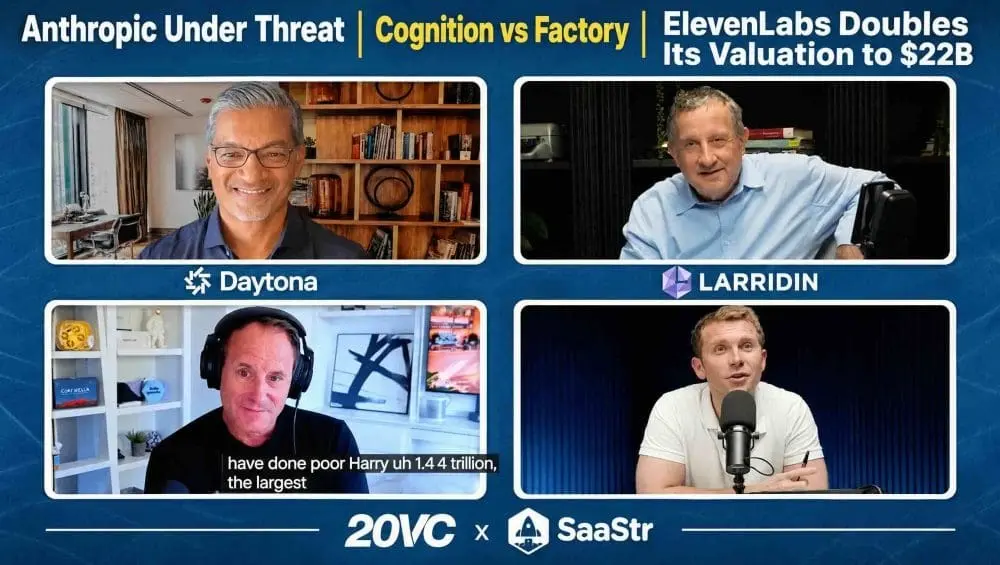
The technology sector is hurtling through an unprecedented era of hyper-acceleration, marked by staggering multi-billion-dollar valuations, fierce enterprise battles, and high-stakes corporate drama. In a recent high-profile roundtable discussion, host Harry Stebbings was joined by seasoned venture capitalists Jason Lemkin and Rory O’Driscoll, alongside special guest Dev Ittycheria—who stepped back into the CEO seat at MongoDB just one week prior.
The conversation captured a pivotal moment in the tech ecosystem. OpenAI is hurtling toward a $70 billion annualized revenue run rate, fueled by an explosive doubling of enterprise sales since July, even as competitor Anthropic preps for a monumental November IPO targeting a valuation near $2 trillion. Meanwhile, the artificial intelligence boom is fundamentally rewriting corporate loyalty, redefining product distribution through autonomous software agents, and sparking fierce public spats among legendary venture capitalists.
This deep dive unpacks the explosive developments shaking the tech landscape—from boardroom implosions and massive billion-dollar acquisitions to the rising dominance of AI agents dictating enterprise software deployment.
Detailed Chronology
The Executive Shuffle and the MongoDB Transition
The news cycle was dominated by high-profile departures and unexpected returns. Dev Ittycheria rejoined MongoDB as interim President and CEO following the immediate departure of CJ Desai on September 28. Desai left the database giant to helm Meta’s newly established enterprise platform, reporting directly to CEO Mark Zuckerberg. Ittycheria, who previously led MongoDB from 2014 to 2025 and scaled its annual revenue from $35 million to over $2.3 billion, found himself analyzing the very turbulence he had navigated firsthand just a week into his second tenure.
The Factory–Cognition Feud and Vinod Khosla’s Public Outburst
On September 30, AI startup Factory CEO Matan Grinberg publicly announced the firing of board advisor Chris Degnan, alleging that Degnan had shared confidential company information with direct competitor Cognition. Just two hours later, Degnan announced his appointment as Cognition’s new Chief Revenue Officer. Degnan—a former Snowflake CRO who had advised Factory for a year—strenuously denied sharing confidential data, a stance backed by Cognition.
The drama escalated when Khosla Ventures partner Vinod Khosla waded into the public fray, siding with Degnan, accusing Grinberg of fabrication, and disparaging Factory as a "struggling second tier competitor." The public spectacle immediately drew sharp rebukes from industry veterans, highlighting the fragile nature of dual-investor dynamics and governance ethics in competitive AI markets.
Mega-Rounds and IPO Preperations
The private and public markets are experiencing seismic tremors. OpenAI is currently in active discussions to secure at least $30 billion in new funding at a jaw-dropping $1.4 trillion valuation as a strategic bridge to a planned public offering. Hot on its heels, Anthropic is accelerating plans for a mid-November market debut, aiming for an eye-watering valuation between $1.8 trillion and $2 trillion.
Concurrently, consumer hardware standout Oura unexpectedly pump-faked its highly anticipated $2.2 billion Nasdaq IPO. Despite being four times oversubscribed, with institutional and insider orders pouring in—including plans to offload a massive 9.3% stake by Forerunner—the offering was abruptly pulled, raising fresh questions about public market appetite for consumer-facing technology hardware.
Supporting Context & Metrics
The macroeconomic and product metrics defining the current tech cycle reveal staggering shifts in capital allocation and platform utility:
- OpenAI’s Revenue Trajectory: Annualized revenue is approaching $70 billion, representing a greater than 70% increase since the beginning of Q3. Enterprise sales have more than doubled over the same timeframe.
- ElevenLabs Valuation Leap: The audio-AI pioneer closed a $300 million employee tender offer led by Wellington and T. Rowe Price, doubling its valuation to $22 billion in a matter of months.
- Salesforce’s Acquisition of Listen Labs: Salesforce finalized the acquisition of three-year-old AI agent startup Listen Labs for approximately $2 billion, cementing the tech giant’s push into automated market research.
- Vercel’s Agent-Driven Deployment: Vercel reported that autonomous software agents now trigger more than 50% of its total platform deployments—skyrocketing from under 3% and driving a significant portion of its reported $600 million annualized run rate.
- Reflection AI’s Beam Model: Reflection AI launched Beam, a 501-billion-parameter open-weight model claiming reasoning parity with leading competitors while consuming three to four times less inference compute.
Official Statements & Industry Perspectives
The roundtable panel dissected these explosive developments through distinct lenses, offering rare insights into executive behavior, capital allocation, and market dynamics.
On AI Revenue and Enterprise Loyalty
Jason Lemkin highlighted the dizzying speed of model adoption within venture-backed portfolios, noting that developers seamlessly swap underlying models based purely on cost-to-performance efficiency. Dev Ittycheria echoed this sentiment from a foundational infrastructure perspective:
"After 12-plus years selling to developers, I’ve learned there is very little loyalty. Developers switch tools fast or run several at once. The stickier revenue is in the enterprise, where you sign contracts, train thousands of employees, and build workflows."
Rory O’Driscoll pointed to the impending financial realities facing enterprise Chief Information Officers. With frontier labs capturing tens of billions in revenue, corporate finance departments are beginning to scrutinize ballooning token budgets, driving demand for cost-efficient routing models that balance frontier performance with economical execution.
On Corporate Loyalty and Boardroom Ethics
The Factory–Cognition executive defection ignited a heated debate regarding executive movement and fiduciary duty. Jason Lemkin suggested that the modern AI era has permanently altered the definition of corporate loyalty, with talent and leadership rotating fluidly across competing labs.
Dev Ittycheria strongly disagreed, drawing on his decades of executive leadership:
"I’ve never seen a CRO flip from one company to a direct competitor. The reputational damage you can do long term is going to come back and bite you."
Rory O’Driscoll criticized the lack of explicit communication during Degnan’s transition, while Harry Stebbings emphasized the unique visibility afforded to board observers compared to traditional employees. The panel universally condemned Vinod Khosla’s public outburst against his own portfolio company, noting that publicly denigrating a founder damages a venture firm’s reputation as a reliable partner in times of crisis.
On the Rise of Autonomous Software Agents
The panelists explored the profound implications of software agents taking the wheel of digital infrastructure. With agents now commanding over half of Vercel’s deployments, the traditional rules of digital marketing and software procurement are being rewritten.
"When agents pick you, it’s a force of nature," Lemkin observed. "My agents have opinions, and they’re really hard to argue with."
Ittycheria added a stark warning for enterprise software marketers:
"For 25 years every marketer optimized for page one of Google. Now agents have to find you and have current, accurate information about you. If you’re missing from an AI-generated answer, it’s like being invisible on Google."
Future Outlook
As the technology sector navigates the final stretch of the fiscal year, several defining trends will dictate the trajectory of venture capital, enterprise software, and artificial intelligence:
- The Maturation of the Open-Weight Ecosystem: With credible US-based open-weight models like Reflection’s Beam entering the market, regulated enterprises and cost-conscious CIOs will likely accelerate hybrid deployment strategies, reducing reliance on proprietary frontier APIs for routine tasks.
- The IPO Window and Valuation Realism: Anthropic’s impending November market debut will serve as a definitive litmus test for multi-trillion-dollar AI valuations. Conversely, Oura’s stalled IPO signals that public markets remain selective, demanding absolute pricing alignment even amidst stellar revenue growth.
- Agentic Infrastructure Optimization: As autonomous agents increasingly dictate software procurement, code deployment, and vendor selection, B2B companies must fundamentally redesign their APIs, documentation, and digital footprints to appeal directly to non-human purchasers.
- Governance and Fiduciary Standards: The public fallout from the Factory–Cognition dispute will likely prompt venture firms and startups to tighten advisory agreements, non-compete clauses, and governance frameworks to prevent conflicts of interest and protect sensitive intellectual property.
The tech ecosystem has officially entered a hyper-scalar phase where fortunes are minted and erased overnight. As Ittycheria aptly demonstrated by stepping back into the fray at MongoDB, adaptability, flawless execution, and an unrelenting focus on customer value remain the ultimate currencies in an industry defined by relentless disruption.