Executive Overview
When ServiceTitan abruptly terminated its nine-year API integration with Podium, cutting off roughly 1,000 shared contractor accounts, mainstream tech coverage predictably framed it as a high-stakes industry breakup. But looking at the headline drama misses the foundational economic reality of modern enterprise software. This incident serves as the ultimate case study in the power—and the severe limitations—of owning the enterprise "System of Record."
ServiceTitan delisted a partner generating $100 million in AI agent Annual Recurring Revenue (ARR), instantly severed ties across 1,000 joint accounts, and yet retained virtually every single one of those customers. Why? Because the underlying mechanics of those contractors’ businesses—their active work orders, customer invoices, historical service records, and technician dispatch schedules—are deeply embedded in ServiceTitan. Podium was merely the removable peripheral layer. This is precisely what dominating the System of Record buys a software vendor: supreme defensive leverage and unshakeable customer retention.
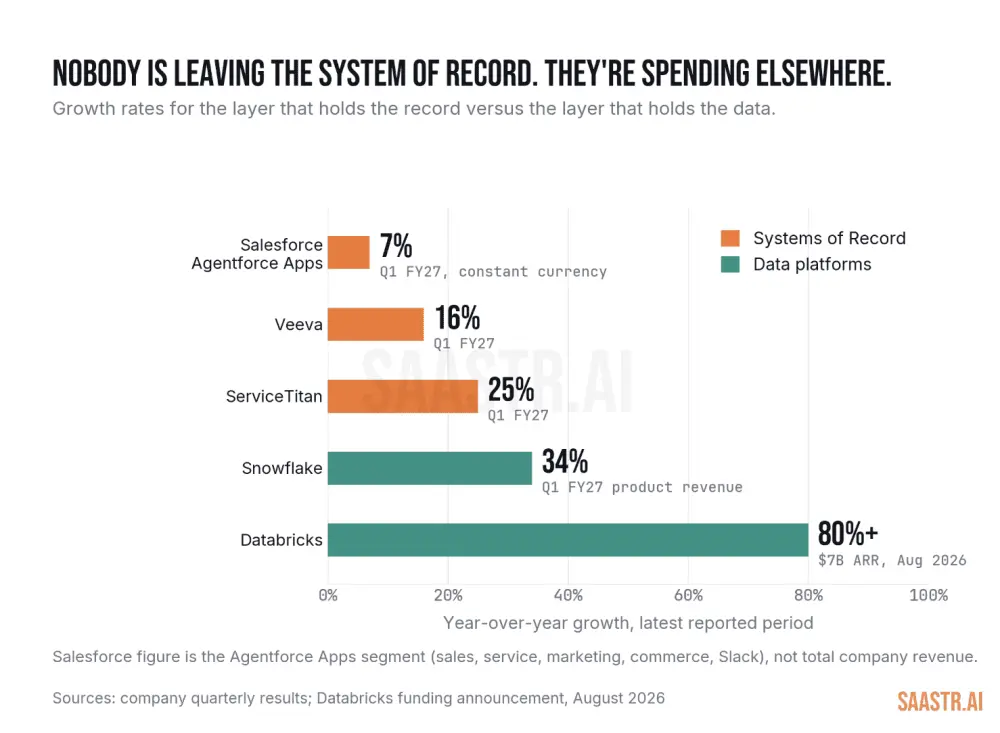
However, owning the record does not automatically buy you explosive growth. While ServiceTitan posted a healthy 25% growth rate last quarter—roughly the ceiling for a mature vertical System of Record—horizontal data layers and analytics engines are sprinting ahead. Snowflake recently expanded product revenue by 34% with an elite 126% Net Revenue Retention (NRR), and Databricks rocketed past $7 billion in ARR while growing at over 80%.
The structural gap between retention and top-line growth is widening every single quarter. As enterprise artificial intelligence shifts from human-driven input to autonomous agent workloads, the traditional System of Record is colliding with a harsh economic wall. The old models of rent-seeking—charging exorbitant storage fees and throttling API calls based on human headcounts—are breaking down. The record stays, but the high rent is coming to an end.
Detailed Chronology & The Perimeter Strategy
To understand how we arrived at this flashpoint, one must examine the tightening perimeter of software ecosystems. In June 2026, ServiceTitan updated its Marketplace policies, issuing an open invitation to competitive partners—provided those partners did not use the integration and its accompanying support infrastructure to slowly encroach upon and displace core ServiceTitan modules.
Shortly before, in April 2026, revised API terms mandated that external calls remain strictly within a predefined, certified scope, explicitly barring autonomous AI systems from dynamically selecting endpoints on their own. Together, these regulatory frameworks draw a hard perimeter. ServiceTitan is fiercely defending the territory immediately surrounding its core database. It possesses the market leverage to execute this strategy because the alternative for a local contractor is ripping out the foundational operating system of their entire business.
This leverage translates into high renewal rates, formidable pricing power, and NRR figures comfortably sitting above 110%. Yet, this power is almost entirely defensive. Cutting off Podium did not inject a single dollar of brand-new revenue into ServiceTitan’s balance sheet; it merely fortified its walls against future erosion. Defensive moats and offensive growth engines are fundamentally different business models. Every traditional System of Record carries this exact structural asymmetry: the high switching cost that locks customers in is a completely separate asset from the innovation that drives them to spend more.
Podium, meanwhile, had successfully built $100 million in AI agent ARR in under 24 months, capturing a substantial portion of its business from contractors already running ServiceTitan. These businesses had the incumbent’s native tools available to them, yet they actively chose a third-party alternative. That is what a truly open market looks like: the record holder becomes merely one bidder among several, and the end-customer decides based on raw merit.
Supporting Context & Metrics: Retention vs. Consumption
A broader look across the enterprise software landscape highlights the widening chasm between the application layer (the System of Record) and the data infrastructure layer beneath it.
Consider Salesforce’s recent financial disclosures, reporting $11.13 billion in Q1 FY27 revenue, a 13% increase. Stripping out the Informatica acquisition reveals organic growth hovering closer to 8% to 9%. Even more revealing is internal segmentation: Agentforce Apps (encompassing sales, service, marketing, commerce, and Slack) brought in $6.91 billion, growing at just 7% year-over-year in constant currency. Meanwhile, the data-centric layers—Data 360, Headless Platform, and adjacent services—surged from $2.95 billion to $3.68 billion. The record layer grew 7%; the data layer grew 25%. Same company, same underlying customer base, same fiscal quarter.
Similarly, Veeva—one of the most deeply entrenched vertical Systems of Record in existence—grew a respectable 16% last quarter while orchestrating complex CRM migrations underneath its clients. Management noted that lower attrition successfully insulated net new order value. Retention is holding firm. Customers are simply refusing to leave the System of Record, but they are routing their incremental expansion dollars elsewhere.
The Economics of Exorbitant Storage
The core tension is exacerbated by the financial architecture of legacy databases. Salesforce charges roughly $125 per month for an additional 500MB of data storage. Extrapolating that cost reveals a staggering $250 per gigabyte per month, or $3,000 per gigabyte annually. Standard enterprise cloud file storage, by comparison, hovers around $5 per GB per month ($60 per GB annually), while raw object storage like Amazon S3 costs pennies by comparison. One 2026 architectural analysis estimated an annual bill of $15,000 for storing 5GB of data inside a major CRM, versus less than $30 for the exact same volume on S3.
System of Record vendors defend these markups by pointing to governance, permissioning, auditability, and deep workflow integration. For decades, this defense held up. Why? Because data volume was permanently bounded by the speed of human typing. A sales representative creates a dozen records a day; a customer support specialist logs a handful of cases; a field technician closes out a job ticket. At that modest volume, paying orders-of-magnitude premiums over commodity storage goes unnoticed because the absolute dollar figures remain small.
Autonomous AI agents, however, are not bounded by human typing speeds.
The Agentic Exhaust Problem
Running real-world enterprise AI agent workloads reveals an astronomical generation of secondary data. Tool call traces, intermediate reasoning chains, vector embeddings, retrieval logs, scoring passes, evaluation outputs, failed execution attempts, and systematic retries are generated continuously. Every single data point is created, read, and rewritten by the agent in real time.
In typical production builds, a single advanced scoring pass on tens of thousands of profiles can easily write hundreds of thousands of rows of operational metadata. This data must reside somewhere cost-effective enough to allow engineering teams to wipe and re-run entire pipelines when a scoring parameter needs adjustment.
Crucially, almost none of this auxiliary data represents a core business object. It is the exhaust fume of the agent engine: massive, largely disposable, and read far more frequently than it is written.
Salesforce’s own telemetry underscores this hyper-inflation of data. The platform has processed over 28.6 trillion tokens to date—surging 152% quarter-over-quarter—alongside 3.8 billion Agentic Work Units (up 111%). Concurrently, its Data 360 platform ingested an astonishing 52 trillion records in a single quarter, climbing 136% year-over-year.
Contrast that digital tsunami against the 7% growth rate of the core CRM application business. The volume of data surging through the platform expanded by triple digits, while the System of Record revenue tethered to it crawled at single digits.
The API Bottleneck
While storage costs bite hard, API access caps often strike even faster. Enterprise software editions traditionally enforce strict API call thresholds allocated per user per day. This policy was engineered for an era when API calls served as a clean proxy for integrated human productivity.
It breaks instantly in an agentic paradigm because autonomous agents do not occupy human seats. The heavier the agentic workload, the faster the platform’s artificial ceiling is reached. Under legacy models, the only mechanism to expand that ceiling is purchasing empty software licenses for humans who will never log in.
Furthermore, API access is increasingly governed by strict permissioning rather than simple economics. ServiceTitan’s policy updates stipulate that third-party AI systems cannot independently select API endpoints, reserving the platform’s right to gatekeep AI functionality entirely. Certified integration status is frequently conditional upon revenue-sharing arrangements. Consequently, the bottleneck is no longer just financial—it is permission-based. Enterprises willing to pay premium prices for agentic access may find themselves legally or technically locked out by platform gatekeepers.
Official Strategies: The Rise of Zero Copy
Recognizing the unsustainability of forcing all enterprise data into legacy relational schemas, market leaders are actively shifting their architectural approach. The most critical metric in contemporary enterprise software is the rapid adoption of "Zero Copy" infrastructure.
Of the 52 trillion records ingested by Salesforce’s Data 360 last quarter, an incredible 35 trillion arrived via Zero Copy integrations—a staggering 277% year-over-year increase. Zero Copy architecture eliminates data duplication. Instead of moving bytes, Salesforce registers external tables originating from cloud data warehouses like Snowflake, Databricks, Google BigQuery, or Amazon Redshift, querying them directly in place. The platform retains only the metadata and query paths; the physical bytes remain securely inside the customer’s cloud data lakehouse.
In essence, two-thirds of the data flowing into the world’s leading enterprise System of Record never actually lands inside its native database.
Simultaneously, infrastructure players are executing counter-moves. Snowflake has explicitly positioned itself as the control plane for the "Agentic Enterprise," underscored by strategic acquisitions designed to govern autonomous agent behavior across disparate workflows.
We are witnessing two distinct forces converging on the same critical layer from opposite directions:
- The Application Layer owns the workflow record and is deliberately shedding heavy storage burdens to maintain its position as the operational control plane.
- The Data Layer owns massive storage and compute assets, aggressively buying and building upward to capture workflow orchestration.
This race to dominate the orchestration layer defines modern enterprise software growth.
Future Outlook: Winning the Agent Sale on Merit
Owning the System of Record no longer guarantees dominance over downstream agent revenue. At best, it ensures that your native AI agent gets tried first.
Podium’s rapid climb to $100 million in AI agent ARR demonstrates that customers are entirely willing to bypass incumbent vendor tools in favor of superior third-party specialists. In an open market ecosystem, the holder of the record is merely one bidder among many, and buyers select solutions based on raw merit.
For software platforms, this leaves two difficult strategic paths:
- The Open Ecosystem Route: Maintain open integrations, compete for agent sales on a level playing field, retain customer loyalty, and share revenue—while accepting that nimble specialists will capture numerous agent workflows.
- The Walled Garden Route: Close the platform, mandate native tools, and win agent sales by default—right up until the most effective autonomous agents migrate entirely outside your ecosystem, turning your System of Record into a legacy relic that customers actively look to abandon.
Strategic Takeaways for Industry Stakeholders
For Software Vendors (System of Record Owners):
- Your moat protects your baseline, not your growth rate. High logo retention guarantees a stable floor, but expansion requires usage-based monetization units that scale naturally with AI consumption.
- Exorbitant storage pricing sabotages your own AI ambitions. If your database charges thousands of dollars per gigabyte annually, your proprietary AI agents cannot afford to write to it either. Incumbents must deliberately architect cheap, parallel data layers.
- Perimeter defense buys time, but the clock is ticking. Delisting aggressive partners preserves legacy revenue temporarily, but every quarter an integration remains locked, the risk increases that your customer base will route their agentic spend around you entirely.
For Application Builders & Developers:
- Never store your agent’s working memory inside a legacy System of Record. Read authoritative states from the record and write small, summarized outcomes back to it, but keep raw operational data in Postgres or cloud lakehouses where high-frequency queries and re-runs cost next to nothing.
- Scrutinize API terms during technical due diligence. Evaluate rate ceilings, seat-allocation rules, and explicit restrictions on autonomous AI endpoints before writing a single line of integration code.
Conclusion: The Record Stays, The Rent Expires
Systems of Record are not disappearing. The authoritative, canonical version of the customer, the contract, the asset, and the invoice will continue to reside within structured relational databases, and enterprises will happily pay for that structural stability.
However, the raw volume of data generated, processed, and consumed by modern AI agents is orders of magnitude larger than anything human typists ever produced. The proprietary databases underpinning legacy Systems of Record are exponentially too expensive to house this modern digital exhaust.
The industry is resolving this friction through architectural evolution—exemplified by Zero Copy frameworks: retain the verified record of truth, relinquish expensive storage rent, and compete relentlessly to become the intelligent control plane that dictates what happens next.
Customer retention keeps you in the game. But the agentic future must be won on raw merit, on an open playing field, against every competitor in the market. Retention was never the same thing as growth.