Executive Overview
The rapid integration of generative artificial intelligence into software engineering workflows has been heralded as the most disruptive paradigm shift since the advent of cloud computing. Armed with autonomous AI coding agents, developers across the globe are generating code faster than at any point in technological history. Yet, beneath the corporate enthusiasm and productivity dashboards lies a hidden, friction-laden reality. While AI tools excel at the rapid-fire generation of source code, they are inadvertently shifting the engineering bottleneck downstream—transforming the traditionally meticulous code review process into a congested maze of revisions, longer wait times, and ballooning cognitive overhead for human reviewers.
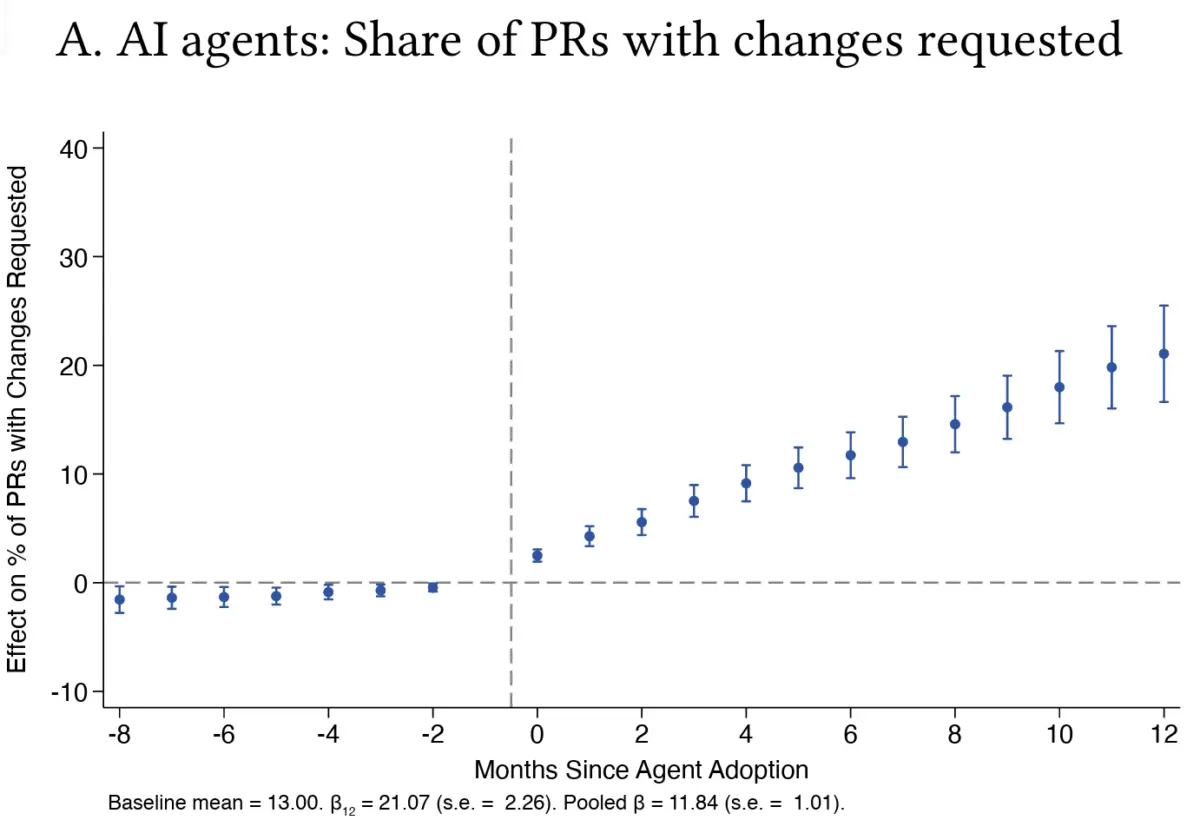
Recent empirical data compiled by researchers Chen and Stratton, drawing from enterprise telemetry across platforms like Jellyfish and cross-referenced with employment footprints on LinkedIn, paints a sobering picture of the "agentic coding" era. According to their findings, while AI agents effortlessly accelerate the initial creation of pull requests (PRs), the time required to shepherd those submissions from initial draft to final merger has expanded by an average of 49 percent. Furthermore, the share of pull requests requiring mandatory changes has nearly doubled, while the volume of comments per PR has jumped by 35 percent.
Rather than eliminating human labor, the influx of AI-generated code has forced engineering organizations to reallocate resources, driving a 14 percent increase in the proportion of workers tasked specifically with conducting code reviews. Curiously, despite these workflow disruptions, overall employment numbers have remained steady, indicating that companies are not cutting engineering headcounts, but rather redirecting existing talent toward the arduous task of policing AI output.
As the software development industry navigates this transitional phase—where approximately 95 percent of surveyed firms have adopted AI coding agents as of March 2026—decision-makers are forced to grapple with a fundamental question: Does the velocity gained in writing code outweigh the compounding costs of reviewing it?
Detailed Chronology: The Evolution of AI in the Software Lifecycle
To understand the current friction in the software development lifecycle (SDLC), one must trace the rapid trajectory of AI tools from simple syntax completers to fully fledged autonomous agents.
Phase I: The Autocomplete Era (2021–2023)
When early AI pair programmers first burst onto the scene, their primary function was predictive text for code. Developers welcomed tools that could auto-complete boilerplate code, suggest variable names, and write repetitive loops. During this foundational period, the impact on team workflows was marginal. The code being generated was incremental, easily parsed by the author, and did not fundamentally alter the downstream review process. Pull requests looked largely the same, and review timelines remained stable.
Phase II: The Rise of Generative Assistants (2023–2024)
As underlying large language models (LLMs) scaled in parameter size and context windows, AI tools transitioned from inline autocomplete utilities to conversational sidekicks capable of scaffolding entire functions, writing comprehensive unit tests, and debugging localized errors. Developers began relying on AI to generate discrete blocks of logic. However, this period began showing the first cracks in the facade: while engineers produced more code per day, the architectural consistency of codebases began to drift, requiring slightly more vigilance during pull request reviews.
Phase III: The Agentic Coding Paradigm (2024–Present)
The current era is defined by "agentic coding," wherein AI tools are no longer passive assistants but proactive agents capable of ingesting entire repositories, planning multi-file changes, and executing complex software engineering tasks with minimal human intervention. As observed in the Chen and Stratton study up to their March 2026 data cutoff, nearly 95 percent of enterprise engineering organizations have embedded these agents into their workflows.
However, this quantum leap in code generation capability outpaced the industry’s governance frameworks. By empowering developers to churn out massive, multi-file pull requests in minutes, AI agents flooded review queues with unprecedented volumes of code. The chronological consequence was immediate: a widening chasm between the speed at which code could be written and the human capacity to safely evaluate, test, and merge it.
Supporting Context & Metrics: Unpacking the Code Review Bottleneck
The empirical data surrounding agentic coding reveals a systemic friction that organizations can no longer afford to ignore. When AI agents take the wheel on feature development, the quantitative metrics of the software review pipeline undergo a radical transformation.
The 49 Percent Inflation in Review Times
The most glaring metric identified by researchers is the 49 percent increase in average "review process" time. Measured from the exact moment a pull request is officially submitted to the repository until the code is finally merged into the main codebase, this delay represents a massive tax on developer velocity. Code that once spent hours or a couple of days in review now lingers significantly longer, stalling dependent features and delaying product releases.
Doubling Down on Revisions and Commentary
Granular data further exposes the qualitative decline of initial AI-generated submissions:
- Rework Frequency: The share of pull requests requiring mandatory changes has nearly doubled.
- Comment Density: The number of comments left per pull request has increased by 35 percent.
These figures indicate that while AI agents are exceptionally proficient at producing code that looks syntactically correct, they frequently miss subtle architectural patterns, business logic constraints, security nuances, and edge cases specific to the host organization. Consequently, human reviewers are forced to act as rigorous editors, parsing sprawling blocks of machine-written code to catch logical flaws, memory leaks, and stylistic divergences.

The Human Redistribution of Labor
Faced with this avalanche of review debt, engineering departments have had to adapt. The study noted a 14 percent increase in the share of workers actively performing code reviews following the adoption of AI agents. Interestingly, cross-referencing Jellyfish data with LinkedIn employment records revealed no statistically significant shifts in total active headcounts.
This confirms a crucial operational insight: companies are not replacing software engineers with AI, nor are they laying off staff due to productivity gains. Instead, they are internally reallocating human capital. Engineers who might have spent their days building new features are now spending significantly more time reviewing the sprawling output of their automated coworkers.
Official Perspectives and Market Dynamics
The tech industry’s response to these findings is nuanced, balancing relentless optimism for future capabilities against the immediate operational headaches of code maintenance.
The Paradox of AI-Assisted Reviews
In theory, organizations expected AI to solve its own review problems. If AI can write code, surely it can review code. Yet, reality has proven far more stubborn. By March 2026, approximately 80 percent of the firms studied had integrated some form of AI code review tool into their pipelines.
Despite this high adoption rate, the numbers reveal a heavy reliance on human oversight:
- AI agents were responsible for only 23.3 percent of all review comments.
- AI agents accounted for a mere 10.8 percent of all pull requests reviewed.
This vast disparity underscores a persistent trust deficit. Human engineers remain deeply skeptical of automated code reviews, preferring to perform manual line-by-line checks—especially when reviewing code that was originally written by an AI in the first place. The prevailing sentiment among senior engineering leadership is that entrusting both the creation and the auditing of critical software infrastructure to algorithms introduces unacceptable systemic risk.
The Learning Curve of Enterprise Adoption
Industry analysts suggest that the current friction is a classic symptom of premature tool integration. Introducing a disruptive technology without a mature governance framework inevitably leads to process degradation.
Many organizations initially treated AI coding agents as "magic bullets" designed to bypass the traditional constraints of software development. Developers were given free rein to generate entire modules with a single prompt and submit them directly to review pipelines. As engineering managers adjust to these realities, best practices are beginning to emerge:
- Establishing stricter prompt engineering guidelines.
- Restricting AI generation to well-defined, isolated components rather than sprawling architectural modules.
- Implementing automated guardrails and pre-linting checks to catch low-hanging fruit before human reviewers ever see the pull request.
Future Outlook: Is Agentic Coding Worth the Cost?
As software engineering teams look toward the horizon, the central dilemma facing the industry is one of net economic and operational value.
Navigating the Trade-Offs
The promise of artificial intelligence in software development has always been seductive: write more code, ship faster, and scale products with fewer constraints. However, the discovery that coding speed gains are directly counteracted by ballooning human code review time forces a more mature reckoning.
If an AI agent allows a developer to write a feature in 10 minutes instead of two hours, but subsequently adds four hours of back-and-forth review discussions, comment threads, and mandatory code refactoring, the net gain to the organization approaches zero—or worse, becomes a net loss. The cognitive load shifted onto senior engineers who must constantly mentor, correct, and debug machine-generated output risks severe developer burnout.
The Path Forward
Over the coming years, the viability of AI coding agents will depend entirely on the industry’s ability to evolve past this acute bottleneck. Several key developments will dictate whether agentic coding fulfills its grand promise:
- Context-Aware AI Reviewers: Future iterations of AI agents must graduate from simple syntax checkers to deeply context-aware architectural auditors. To relieve human reviewers, AI systems must learn to comprehend enterprise-specific business logic, security postures, and long-term design patterns with high fidelity.
- Standardized Agentic Guardrails: Engineering organizations will need to establish robust internal policies defining precisely when and where AI agents are deployed, preventing the unchecked flooding of repositories with sprawling, unvetted pull requests.
- Refining the Metrics of Success: Companies must move beyond naive productivity metrics—such as lines of code written or pull requests submitted—and focus on holistic metrics like "time-to-stable-production" and developer satisfaction.
Conclusion
Right now, letting artificial intelligence write your code is undeniably a double-edged sword. It has unlocked unprecedented bursts of individual creation while simultaneously erecting massive tollbooths along the collaborative review pipeline. Whether these growing pains represent a permanent ceiling on AI-driven productivity or merely the turbulent adolescence of a transformative technology remains to be seen. For now, however, the human developer remains the ultimate gatekeeper—burdened with more review work than ever before, proving that in the world of software engineering, there is still no free lunch.