Executive Overview
The architecture of modern software engineering has undergone a seismic shift over the past decade. Continuous Integration and Continuous Delivery (CI/CD) pipelines have fundamentally redefined the velocity of product development. Engineering teams now merge code dozens—sometimes hundreds—of times a day; infrastructure is dynamically reprovisioned via code on every commit; and new builds can travel from a developer’s local branch to production environments in a matter of minutes.
Yet, security testing has notoriously failed to keep pace with this unprecedented cadence. Entrenched in legacy paradigms, enterprise security remains largely anchored to two diametrically opposed modes of operation: high-noise automated scanners that create endless backlogs of unverified alerts, and infrequent, manual penetration tests that offer a static, out-of-date snapshot of risk. Both methodologies fundamentally fight the velocity of the modern pipeline rather than moving harmoniously with it.
Enter the next evolution in application security: autonomous security testing. Powered by advanced reasoning agents capable of emulating human attacker methodologies, autonomous tools promise to bridge the gap between fast, noisy tooling and slow, methodical expertise. However, this transition is not without friction. The industry faces a profound dilemma: the very AI models required to power autonomous agents have historically demanded the exfiltration of sensitive internal network topologies, source code, and credentials to third-party cloud endpoints. For highly regulated industries—such as banking, healthcare, and defense—this data-sharing requirement has served as an insurmountable compliance and security wall.
To survive the enterprise gauntlet, autonomous security must pivot toward a localized model. By leveraging open-weight reasoning models and advanced boundary tokenization, organizations can finally harness the speed and accuracy of autonomous penetration testing without ever compromising their data sovereignty. This article explores the systemic failures of legacy security testing, the mechanics of true autonomous agents, the supply chain vulnerabilities they expose, and the local-first architectural shifts required to make them viable for the enterprise.
Detailed Chronology: The Evolution and Disconnect of Pipeline Security
To understand why autonomous testing is rapidly becoming a non-negotiable imperative, one must examine the historical divergence between software development velocity and security validation.
Phase 1: The Waterfall Era and Periodic Assessments
For decades, software development followed rigid, linear life cycles. Security was treated as a distinct phase occurring near the end of a project lifecycle—often referred to as "shifting left" long before it became a marketing buzzword. Penetration testing companies were hired once or twice a year to conduct black-box, grey-box, or white-box assessments. These point-in-time snapshots were sufficient because release cycles were measured in quarters or years.
Phase 2: The Rise of DevOps and the Scanner Boom
As agile methodologies and DevOps practices compressed release cycles into weeks and days, traditional pen-testing could no longer keep up. The industry responded by flooding the market with automated tooling: Static Application Security Testing (SAST), Dynamic Application Security Testing (DAST), Software Composition Analysis (SCA), and Infrastructure as Code (IaC) scanners.
While these tools integrated neatly into CI/CD pipelines, they created an unintended psychological and operational burden: alert fatigue. SAST tools began flagging abstract pattern matches, while dependency scanners highlighted known Common Vulnerabilities and Exposures (CVEs) in packages that an application might never actually invoke or execute. Security teams found themselves drowning in a sea of theoretical risk, forcing human engineers to spend hours manually triaging findings of questionable exploitability.
Phase 3: The Continuous Delivery Bottleneck
Today, organizations ship code continuously. In this hyper-accelerated environment, static scanners produce unmanageable levels of noise, while manual penetration testing results arrive months after the codebase has fundamentally transformed. The pipeline is left with fast tooling that lacks context and slow expertise that lacks timeliness.
[Legacy Security Paradigm]
Code Commit ──> Fast Scanners (High Noise / Potential Issues) ──> Human Triage Queue (Alert Fatigue)
Code Commit ──> Annual Pen Test (Trusted Proof) ───────────────> Outdated Snapshot (Structural Lag)

[The Autonomous Paradigm]
Code Commit ──> Autonomous AI Agents ───────────────────────────> Verified Exploit Paths (Immediate Fix/Accept)
This structural mismatch created a vacuum—one that is now being aggressively filled by autonomous testing agents capable of operating at the exact cadence of modern code merges.
Supporting Context & Metrics: The Anatomy of Modern Vulnerabilities
The urgency for autonomous, proof-based testing is underscored by the expanding enterprise attack surface. Modern software is no longer just the application code written by internal developers; it is an intricate web of third-party libraries, cloud configurations, CI runner privileges, and infrastructure automation scripts.
The Failure of Probabilistic Findings
According to industry studies on application security posture management (ASPM), enterprise development teams routinely ignore up to 70% of static analysis findings due to perceived false positives or lack of contextual exploitability. When a developer receives a ticket stating that a specific dependency has a critical CVE, their immediate workflow is disrupted. They must investigate whether the vulnerable function is actually reachable, whether user input flows into it, and whether compensating controls mitigate the risk.
This manual verification cycle introduces massive friction into CI/CD pipelines. Autonomous testing fundamentally alters this equation by shifting the unit of output from a probability to a proof.
Multi-Vector Attack Chains in the Supply Chain
Real-world threat actors rarely rely on a single, isolated vulnerability to compromise an enterprise. Instead, they chain multiple minor misconfigurations together—a pattern that traditional scanners are notoriously ill-equipped to detect:
- Leaked Secrets: A developer accidentally commits a service account credential into a public or internal Git history.
- Excessive Cloud Permissions: That credential, while scoped to a specific task, grants unintended wildcard read/write permissions within an AWS or Azure cloud environment.
- Metadata Exfiltration: An attacker leverages a Server-Side Request Forgery (SSRF) vulnerability to reach a local cloud metadata endpoint.
- Token Harvesting: The SSRF yields temporary security tokens, allowing lateral movement across container registries and production clusters.
While a traditional vulnerability scanner analyzes each of these components in isolation—assigning a medium severity to the leaked credential and a low severity to the SSRF—an autonomous agent simulates the adversary. It actively walks the attack chain, synthesizing disparate weaknesses into a single, cohesive demonstration of enterprise risk.
Official Statements and Industry Perspectives
Security leaders and engineering pioneers are increasingly vocal about the necessity of moving beyond legacy testing tools while acknowledging the hard boundaries imposed by enterprise compliance.
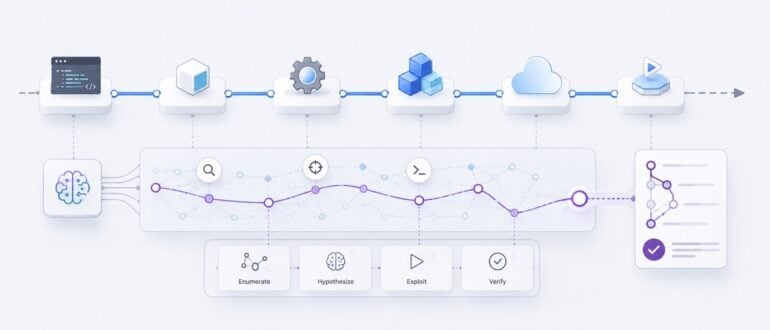
"Autonomous testing does not mean another chatbot bolted onto a legacy scanner. It means intelligent agents that reason about a target the way a human attacker does: enumerating, forming hypotheses, attempting exploitation, and reporting only what they can definitively prove."
— Industry Security Architect
This philosophy addresses the core frustration of engineering teams: trust and reproducibility. When an autonomous agent provides an exact HTTP request, the corresponding server response, and the resulting access vector, the debate ends.
However, industry experts are equally candid about the barriers to adoption. The apprehension surrounding data privacy is not paranoia; it is a regulatory requirement.
"For banks, healthcare providers, and defense contractors, shipping internal topology, IP addresses, and production credentials to a third-party AI endpoint is a non-starter. Compliance frameworks, master services agreements, and federal statutes strictly forbid it. If autonomous testing requires cloud-based proprietary models, it will remain locked out of the exact environments that need it most."
— Enterprise Compliance Officer
This tension has created a clear bifurcation in the market: tools that prioritize raw AI capability at the expense of data governance, versus emerging local-first architectures designed to satisfy the rigorous demands of enterprise security teams.
Future Outlook: The Local-First Autonomous Revolution
The future of application security within CI/CD pipelines hinges on a critical architectural realization: Autonomous is what makes testing fast enough for the pipeline; local is what makes it safe enough to allow.
1. The Maturation of Open-Weight Models
For years, advanced reasoning capabilities were exclusively locked behind proprietary, cloud-hosted Application Programming Interfaces (APIs). However, the rapid advancement of open-weight large language models (LLMs) has changed the calculus. Modern open-weight models possess sufficient reasoning, code comprehension, and logical deduction capabilities to drive autonomous penetration testing agents locally on enterprise-owned hardware. This decouples artificial intelligence from third-party data collection.
2. Boundary Tokenization and Air-Gapped Security
To make local reasoning foolproof, advanced platforms are implementing rigorous boundary tokenization techniques. Before any application data, hostnames, or internal IP addresses are processed by the reasoning engine, they are dynamically mapped to deterministic, anonymized placeholders:
- Internal IP addresses (
10.10.45.12) are tokenized into stable abstractions (TARGET_IP_A). - Hostnames and internal URIs are masked.
- Source code snippets are stripped of proprietary business logic identifiers while retaining syntactic structures necessary for vulnerability analysis.
The model reasons exclusively over these abstract structures. Once a determination or testing path is formulated, the real values are reinjected locally within a secure, isolated runner environment to execute the test, and immediately masked again on the return path. This methodology ensures full compatibility with air-gapped environments, leaving zero footprint for external data exfiltration.
Evaluating Autonomous Testing Tools
As organizations evaluate the integration of autonomous security testing into their CI/CD workflows, security architecture teams should utilize a rigorous evaluation framework based on four core criteria:
- Proof of Exploitation: Does every reported finding include a verifiable, reproducible proof-of-concept (such as an exact attack path and raw evidence), or does it merely regurgitate probabilistic severity scores and theoretical CVE warnings?
- Data Residency and Execution Boundary: Where does target data travel during reasoning and execution? Can the entire platform operate in a fully disconnected, air-gapped environment without external API calls?
- Reproducibility: Can developers easily rerun the exact attack path within their local staging environments to validate fixes immediately?
- Methodology Auditing: Is the underlying agentic framework transparent and auditable? Organizations cannot afford to rely on opaque "black box" algorithms making unsubstantiated claims about their security posture.
Conclusion
The integration of autonomous security testing into CI/CD pipelines represents an inevitable paradigm shift. Just as automated unit testing and integration testing transformed software delivery decades ago, autonomous agents will soon replace static noise and outdated annual audits with continuous, proof-based coverage.
Yet, the survival of this technology in the enterprise depends entirely on architectural restraint. By embracing local-first execution models and advanced boundary tokenization, the security industry can finally reconcile the velocity of continuous delivery with the uncompromising demands of data privacy and compliance. The future of security is autonomous, but its foundation must remain firmly under lock and key.