Executive Overview
In cloud computing, there is a fundamental disconnect between theoretical resilience and operational reality. Enterprise architecture teams routinely design sophisticated, multi-zone, geo-redundant environments equipped with automatic failovers, circuit breakers, and complex retry logic. Yet, when real-world platform disruptions hit, these mechanisms frequently fail to perform as planned.
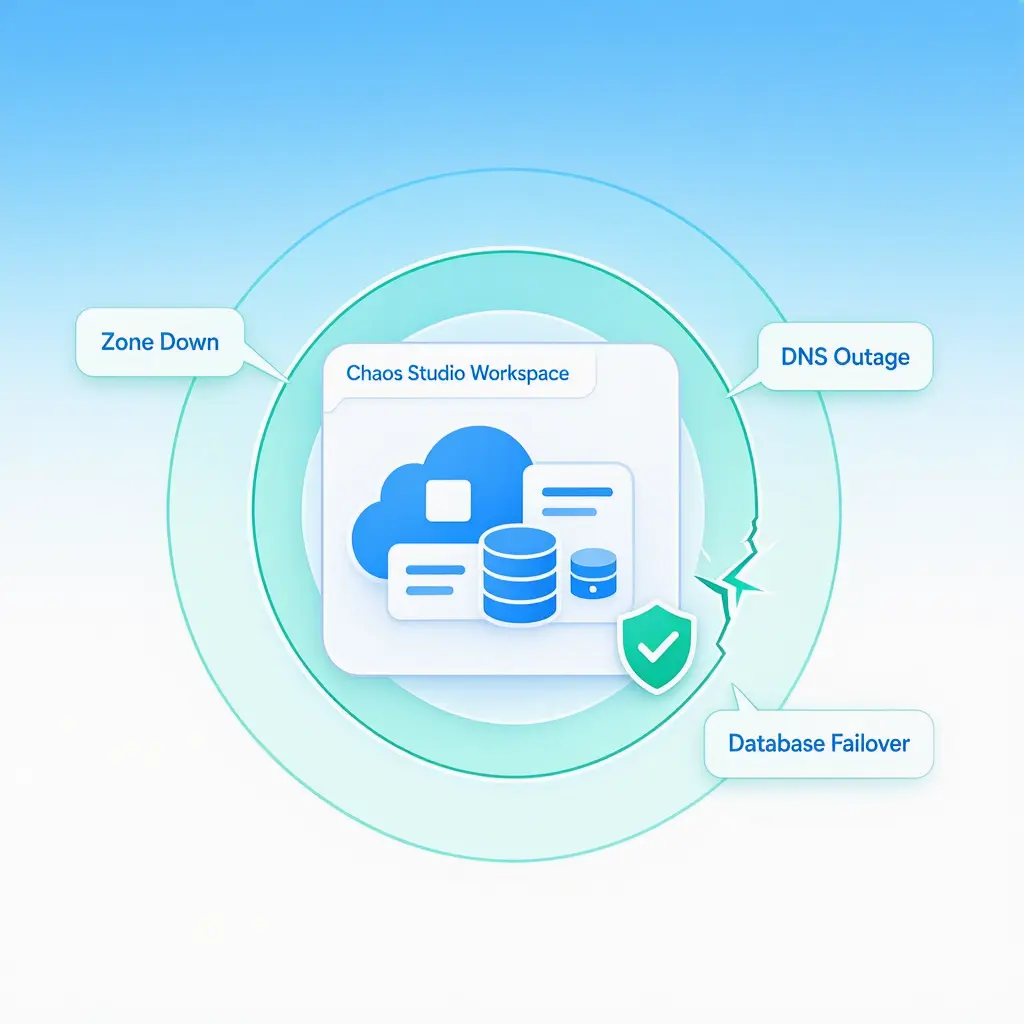
To bridge this operational gap, Microsoft has announced the public preview of Azure Chaos Studio Workspaces. This next-generation evolution of its managed chaos engineering service transitions resilience testing from atomic, isolated fault injection to real-world, scenario-driven disruption orchestration.
Designed to mirror the complex failure modes actually observed across Microsoft’s global cloud infrastructure, Azure Chaos Studio Workspaces provides engineering teams with pre-packaged outage templates, auto-discovery capabilities, visual workflow design, and automated post-drill analytical reporting.
Furthermore, Microsoft is embedding chaos engineering directly into modern, AI-assisted development workflows by launching a dedicated GitHub Copilot Skill and a native Model Context Protocol (MCP) server.
With General Availability (GA) targeted for late 2026, Azure Chaos Studio Workspaces establishes a new baseline for enterprise reliability—demanding that application resilience be validated through controlled operational stress rather than assumed through architectural diagrams.
Detailed Chronology: The Architectural Evolution of Chaos Engineering on Azure
The Shift from Atomic Faults to Orchestrate Outages
Traditional chaos engineering tools historically focused on low-level, singular disruptions—such as terminating a virtual machine (VM) instance or artificially spiking CPU utilization on a single node. While useful for verifying basic platform alerts, atomic faults rarely reflect how complex, microservice-based applications break in production.
Modern cloud outages are inherently systemic. A single regional network drop can trigger cascading connection pool exhaustion across database clusters, saturate secondary caches, and misroute global DNS traffic simultaneously.
Azure Chaos Studio Workspaces addresses this complexity by introducing pre-configured, multi-layered scenarios that test the operational durability of both the underlying platform and the application layer in tandem.
+-------------------------------------------------------------------------------+
|                        AZURE CHAOS STUDIO WORKSPACE                           |
|                                                                               |
|  [ Auto-Discovery Engine ] ---> Discovers Azure Subscriptions & Resources    |
|                                                                               |
|  [ Recommended Scenarios ] ---> Matches Topography with Curated Outage Library|
|                                                                               |
|  +-------------------------------------------------------------------------+  |
|  |                     CURATED OUTAGE SCENARIO LIBRARY                     |  |
|  |  * Zone Down         * DNS Outage        * SQL Database Failover        |  |
|  |  * Cache Stampede   * Messaging Halt    * Agent-Level Stress Tests     |  |
|  +-------------------------------------------------------------------------+  |
|                                       |                                       |
|                                       v                                       |
|  [ Visual Scenario Designer ] ---> Drag-and-Drop Sequencing, Steps & Faults   |
|                                       |                                       |
|                                       v                                       |
|  [ Execution & Telemetry ] ------> Injects Faults & Correlates Azure Monitor  |
|                                       |                                       |
|                                       v                                       |
|  [ Structured Drill Report ] ----> Recovery Timelines & Audit-Ready Insights  |
+-------------------------------------------------------------------------------+
Workspace Architecture and Automated Topography Discovery
At the center of this update is the Workspace, a top-level Azure Resource Manager (ARM) entity that serves as the central administrative hub for chaos operations. Once provisioned and pointed at a subscription or resource group, the Workspace leverages Azure Managed Identities to auto-discover ambient infrastructure resources—including compute clusters, managed databases, virtual networks, and messaging buses.
Upon scanning the environment, the platform evaluates the live topology and automatically recommends relevant failure scenarios tailored to that specific footprint. If a team deploys a zone-redundant Azure SQL Database alongside a Redis Cache cluster and an Azure Kubernetes Service (AKS) deployment, the Workspace dynamically highlights test scenarios targeting multi-zone failovers and cache invalidation.
The Curated Scenario Library and Visual Designer
The public preview launches with a library of curated scenarios directly modeled on telemetry gathered from actual Azure platform incidents. Key operational scenarios available at launch include:
- Zone Down: Simulates the complete drop of an Azure Availability Zone to verify if load balancers, container orchestrators, and storage backends handle inter-zone traffic shifting within expected Recovery Time Objectives (RTO).
- DNS Outage & Latency: Injects routing failures and elevated latency into domain resolution paths to test application resilience against endpoint unreachable errors and cascading timeout accumulation.
- SQL Database Failover: Triggers high-availability primary-to-secondary database failovers, exposing whether application connection strings correctly dynamically update or remain stubbornly pinned to dead endpoints.
- Cache Stampede & Invalidation: Flushes memory caches under synthetic traffic load to observe whether backend database instances survive sudden direct read surges without dropping connections.
- Event-Driven Messaging Disruption: Interrupts messaging queues (such as Azure Event Hubs or Service Bus) to test async retry mechanisms, message order preservation, and dead-letter queue processing.
For specialized workloads, Microsoft has introduced the Scenario Designer—a graphical, drag-and-drop canvas embedded directly within the Azure Portal. The designer allows system architects to chain API-level disruptions with in-guest VM agent actions (e.g., memory pressure, disk I/O throttling, CPU saturation), configure parallel execution branches, insert operational wait timers, and set safety abort gates without writing custom orchestration scripts.
Supporting Context & Metrics: Bridging the Shared Responsibility Gap
The Fallacy of Theoretical Design
A core driver behind the launch of Chaos Studio Workspaces is the persistent failure gap in enterprise cloud migrations. Under the cloud Shared Responsibility Model, Microsoft guarantees the availability and resilience of the core infrastructure and underlying platform services. However, customers remain responsible for configuring those resilient primitives and writing application code capable of handling transient platform states.

+-----------------------------------------------------------------------------------+
|                        SHARED RESPONSIBILITY MODEL FOR RELIABILITY                |
+-----------------------------------------------------------------------------------+
| MICROSOFT RESPONSIBILITY                      | CUSTOMER RESPONSIBILITY           |
|-----------------------------------------------+-----------------------------------|
| * Physical Infrastructure Availability        | * Correct Redundancy Configuration|
| * Hypervisor & Zone Isolation                 | * Application Retry Logic & Code  |
| * Native Service High-Availability Primitives | * End-to-End Recovery Validation  |
+-----------------------------------------------------------------------------------+
Operational data demonstrates that outages routinely stem from configuration oversights rather than platform hardware drops:
- Misconfigured Health Probes: A load balancer or traffic manager continues routing requests to an unhealthy application instance because its health check endpoint yields a static HTTP 200 OK status despite underlying backend failure.
- Hardcoded Regional Endpoints: An enterprise deploys secondary read replicas across regions, but application connection strings hardcode the primary region’s FQDN, rendering auto-failover configurations useless.
- Unchecked Retry Storms: When a database experiences transient latency, aggressive application-layer retries without exponential backoff bombard the recovering database, causing secondary self-inflicted denial-of-service outages.
Data-Driven Post-Drill Analytics: Scenario Reports
To transform chaos testing into an actionable engineering discipline, Chaos Studio Workspaces introduces Scenario Reports. Upon the conclusion of a disruption test, the platform compiles a structured post-incident review report that correlates fault injection timing with live telemetry from Azure Monitor.
Key analytical dimensions captured in the Scenario Report include:
- Disruption Telemetry Isolation: Differentiates normal baseline operational noise from anomalies explicitly caused by injected chaos faults.
- Recovery Timeline Analysis: Quantifies exact time-to-recovery metrics, comparing actual application restoration against defined Recovery Time Objectives (RTO) and Recovery Point Objectives (RPO).
- Blast Radius Metrics: Pinpoints every impacted resource, identifying downstream dependency failures that were not anticipated during the initial test design.
These reports can be natively exported and attached to corporate change management tickets, SOC 2 compliance evidence stores, and operational service health reviews, offering enterprise leaders auditable proof of application durability.
AI Workloads & Intelligent Operations: Testing the Infrastructure of Tomorrow
Stress-Testing AI Infrastructure
As enterprise adoption shifts heavily toward Generative AI, Retrieval-Augmented Generation (RAG) architectures, and autonomous AI agents, systemic platform resilience becomes critical. While AI logic introduces novel failure modes, AI applications fundamentally depend on standard distributed infrastructure—including compute clusters, high-speed vector storage, caching layers, identity services, and messaging buses.
Azure Chaos Studio Workspaces allows engineering teams to stress-test the underlying infrastructure supporting AI workloads today. By simulating storage latency, endpoint disconnects, and database failovers on vector databases or cognitive search nodes, teams can ensure AI pipelines handle underlying infrastructure drops gracefully.
Microsoft revealed that as public preview progresses toward GA, the Chaos Studio catalog will expand to address AI-specific failure modes, including:
- Token Rate-Limit Throttling: Simulating HTTP 429 rate-limit responses to validate fallback models and prompt-queuing resilience.
- Retrieval Drift & Storage Latency: Injecting delays into vector search indexing pipelines to verify how RAG orchestration frameworks behave when contextual data retrievals time out.
- Inference Endpoint Degradation: Simulating degraded GPU cluster responses to evaluate model routing logic under heavy concurrent load.
AI-Native Execution: Copilot Skill and MCP Protocol Integration
In a major shift toward AI-powered Site Reliability Engineering (SRE), Microsoft is launching two programmatic interfaces for Chaos Studio Workspaces:
+---------------------------------------------------------------------------------+
|                        AI-DRIVEN CHAOS ENGINEERING AGENTS                       |
+---------------------------------------------------------------------------------+
|                                                                                 |
|  [ Developer / SRE ] <---> [ GitHub Copilot ] ---> Chaos Studio Skill          |
|                                                          |                      |
|                                                          v                      |
|  [ Autonomous Agents ] ---> [ MCP Server ] --------> Azure Chaos Studio APIs    |
| (Cursor, Claude, Codex)                                  |                      |
|                                                          v                      |
|                                               [ Azure Infrastructure ]          |
+---------------------------------------------------------------------------------+- Chaos Studio Skill for GitHub Copilot: Developers and SREs can execute complex chaos workflows through conversational natural language. Engineers can query workspace recommendations, initiate specific failure scenarios, analyze impact timelines, and review Azure Monitor correlations directly within their IDE or GitHub workflow.
- Model Context Protocol (MCP) Server: Exposes native Chaos Studio operations as strongly typed tools readable by autonomous agent frameworks (including Claude, Cursor, Codex, and custom enterprise agents). This allows AI agents to autonomously provision workspaces, execute scheduled drills, query health metrics, and propose architectural fixes without requiring manual human intervention.
By embedding chaos operations directly into LLM agent frameworks, Microsoft ensures that conversational developer assistants rely on structured platform APIs rather than improvising commands from unstructured REST documentation.
Future Outlook & Strategic Roadmap
The introduction of Azure Chaos Studio Workspaces represents a strategic shift in enterprise cloud governance. As application topologies grow increasingly complex, static architectural reviews and theoretical disaster recovery plans are no longer sufficient to guarantee uptime.
Strategic Rollout Timeline
- Public Preview (Active): Immediate availability of Chaos Studio Workspaces across major Azure regions, featuring the curated scenario library, visual Scenario Designer, automated topography discovery, Scenario Reports, GitHub Copilot Skill, and MCP server.
- Feature Expansion (2025–2026): Progressive additions to the scenario library, introducing specialized AI infrastructure fault modes, enhanced multi-subscription targeting, and deep native integration with Microsoft Foundry operational workflows.
- Targeted General Availability (Late 2026): Full enterprise GA release, bringing complete SLA backing, expanded regional deployment, and integration into automated Azure SRE Agents.
The Imperative of Continuous Verification
Ultimately, application resilience cannot be purchased off the shelf or achieved solely through redundant hardware deployments. Resilience is an ongoing operational discipline that demands continuous, rigorous verification.
With Azure Chaos Studio Workspaces, Microsoft provides enterprise organizations with the tools required to make proactive disruption testing a standard phase of the software development lifecycle. By exposing structural weaknesses before production outages occur, Chaos Studio Workspaces helps ensure that when platform failures inevitably happen, systems recover automatically, silently, and predictably.