Executive Overview
In an era where enterprise computing spans public datacenters, remote edge nodes, multi-cloud environments, and strictly regulated sovereign enclaves, the demand for unified hybrid infrastructure has reached a critical tipping point. Validating this market evolution, Gartner, Inc. has officially named Microsoft a Leader in its 2026 Gartner® Magic Quadrant™ for Distributed Hybrid Infrastructure for the fourth consecutive year. Notably, Microsoft achieved the highest placement on the Ability to Execute axis among all evaluated technology providers.
The recognition—authored by Gartner analysts Julia Palmer, Elaine Zhang, Adrian Wong, and Daniel Bowers—comes at a pivotal moment for IT leaders. As organizations scale complex artificial intelligence workloads and navigate increasingly fragmented global compliance regulations, the traditional paradigm of choosing between centralized cloud infrastructure and isolated on-premises systems has dissolved. In its place, distributed hybrid infrastructure (DHI) has emerged as the baseline architecture for modern enterprise operations.
Central to Microsoft’s strategy is a platform designed to eliminate operational fragmentation. Through the combined capabilities of Azure Arc and Azure Local, the technology giant delivers a consistent control plane, governance framework, and developer experience across heterogeneous physical and virtual environments. By decoupling cloud operational models from specific physical locations, Microsoft offers enterprise customers the ability to deploy, manage, and scale applications—ranging from traditional line-of-business software to localized AI models—wherever operational requirements demand.
Detailed Chronology: The Architectural Evolution of Microsoft’s Hybrid Vision
Microsoft’s fourth consecutive leadership positioning in the 2026 Gartner evaluation represents the culmination of a decade-long strategic pivot toward unified, location-agnostic computing. Tracing this evolution illustrates how the enterprise infrastructure landscape matured from localized servers into a seamless cloud continuum.
+-----------------------------------------------------------------------------------+
|                         MICROSOFT HYBRID CLOUD EVOLUTION                          |
+-----------------------------------------------------------------------------------+
|                                                                                   |
|  Phase 1: Static On-Premises Extensions                                           |
|  - Azure Stack Appliance Era: Heavyweight, fixed-hardware footprints.             |
|                                                                                   |
|  Phase 2: Universal Control Plane (2019-2022)                                     |
|  - Azure Arc Launch: Extends Azure Resource Manager to third-party data centers,  |
|    multi-cloud clusters, and edge environments.                                   |
|                                                                                   |
|  Phase 3: Hyperconverged & Disaggregated Evolution (2023-2025)                     |
|  - Transition to Azure Local: Flexible hardware choices, from micro-edge nodes    |
|    to enterprise disaggregated storage & compute.                                 |
|                                                                                   |
|  Phase 4: Sovereign Control & Edge AI Realization (2026)                          |
|  - Foundry Local & Sovereign Private Cloud: Kubernetes-native local AI inference, |
|    disconnected operations, and complete digital sovereignty controls.            |
|                                                                                   |
+-----------------------------------------------------------------------------------+
Phase 1: The Early On-Premises Extensions (Pre-2019)
In the early days of enterprise cloud adoption, hybrid infrastructure was largely defined by hardware-bound appliances designed to replicate public cloud services within customer datacenters. Microsoft’s early offerings in this space established the foundational principle that cloud should be treated as an operational model rather than a static physical location. However, early market feedback indicated a need for greater hardware flexibility, lower operational complexity, and broader multi-cloud management capabilities.
Phase 2: The Universal Control Plane Paradigm (2019–2022)
Recognizing that enterprise estates were becoming inherently multi-cloud and multi-edge, Microsoft introduced Azure Arc. This marked a architectural shift. Rather than forcing workloads to migrate to standardized physical infrastructure, Azure Arc extended Azure’s native management, policy enforcement, and operational tooling—such as Azure Resource Manager (ARM)—to servers, Kubernetes clusters, and databases hosted on non-Azure hardware, competing public clouds, or remote branch offices.
Phase 3: Hardware Decoupling and the Launch of Azure Local (2023–2025)
As operational demands at the edge grew—spanning retail outlets, manufacturing floors, and maritime vessels—Microsoft modernized its hyperconverged infrastructure portfolio. By transitioning from rigid hardware requirements to a flexible system now recognized as Azure Local, Microsoft enabled organizations to run cloud services natively on customer-selected infrastructure. During this period, support expanded beyond standard hyperconverged architectures to include options for disaggregated compute and external storage, catering to high-performance enterprise workloads.
Phase 4: The Era of Digital Sovereignty and Edge AI (2026)
By 2026, two massive macroeconomic forces shifted distributed infrastructure requirements: stringent international data sovereignty mandates and the explosive deployment of edge AI. Microsoft responded by fully integrating Microsoft Sovereign Private Cloud—including completely disconnected, air-gapped operational modes—and launching Foundry Local, bringing Kubernetes-native generative AI inference directly into local customer environments. This comprehensive strategy cemented Microsoft’s top positioning in Gartner’s 2026 evaluation.
Supporting Context & Metrics: Architectural Underpinnings and Market Realities
To understand why Microsoft achieved top placement for "Ability to Execute" in Gartner’s evaluation, it is necessary to examine the core technological components underpinning its distributed infrastructure platform.
               +---------------------------------------------------+
               |             Azure Arc Control Plane               |
               | (Governance, Security, Identity, Policy, Telemetry)|
               +-------------------------+-------------------------+
                                         |
         +-------------------------------+-------------------------------+
         |                               |                               |
         v                               v                               v
+-----------------+             +-----------------+             +-----------------+
| Public Cloud    |             | Azure Local     |             | Sovereign Enclave|
| Datacenters     |             | (Edge & Datacenter)|          | (Disconnected)  |
| - Scale & AI    |             | - Hyperconverged|             | - Local Control |
|   Training      |             | - Disaggregated |             |   Plane         |
|                 |             | - Foundry Local |             | - Air-Gapped    |
+-----------------+             +-----------------+             +-----------------+
1. The Dual Engine: Azure Arc and Azure Local
Microsoft’s distributed hybrid framework operates through a synergistic relationship between software governance and local hardware runtime environments:
- Azure Arc (Management & Governance Layer): Functions as the centralized administrative engine. It project resources running outside Azure—whether physical servers, virtual machines, or Kubernetes distributions—into a single operational dashboard. It allows IT teams to enforce consistent role-based access control (RBAC), security baselines, and patch management across fragmented environments.
- Azure Local (Runtime Layer): Serves as the modern infrastructure foundation bringing cloud services directly onto customer-controlled hardware. Designed to scale from low-footprint, small-form-factor devices at the remote edge up to high-capacity datacenter environments, Azure Local hosts hybrid virtual machines, containerized workloads, and cloud-native services locally.
2. Physical Flexibility: Hyperconverged vs. Disaggregated Systems
Enterprise infrastructure teams frequently struggle with rigid hardware deployment constraints. To solve this, Azure Local accommodates diverse physical topologies:
- Hyperconverged Infrastructure (HCI): Blends compute, storage, and networking into unified nodes—ideal for branch offices, retail hubs, and resource-constrained edge deployments.
- Disaggregated Architectures: Separates compute capacity from external enterprise storage arrays. This allows organizations with massive existing storage investments or compute-heavy analytical requirements to scale hardware tiers independently, maximizing capital efficiency without sacrificing cloud-managed operational features.
3. The Digital Sovereignty Continuum
Compliance requirements increasingly mandate localized control over sensitive data, telemetry, and operations. Rather than enforcing a rigid, one-size-fits-all model, Microsoft’s approach through the Microsoft Sovereign Cloud program provides a progressive continuum of operational isolation:
| Deployment Model | Network Connectivity | Operational Control | Primary Enterprise Use Case |
|---|---|---|---|
| Public Cloud (Sovereign Controls) | Continuous Cloud Connection | Managed by Microsoft with customer policy controls | Low-latency public cloud workloads requiring encryption and residency. |
| Microsoft Sovereign Private Cloud | Restricted / Governed Connection | Shared/Customer-managed operations on Azure Local | Highly regulated industries (finance, healthcare, public sector) needing local data hosting. |
| Disconnected Azure Local | Zero Cloud Connection (Air-Gapped) | 100% Local Customer Control Plane | Defense, critical infrastructure, offshore maritime, and remote industrial environments. |
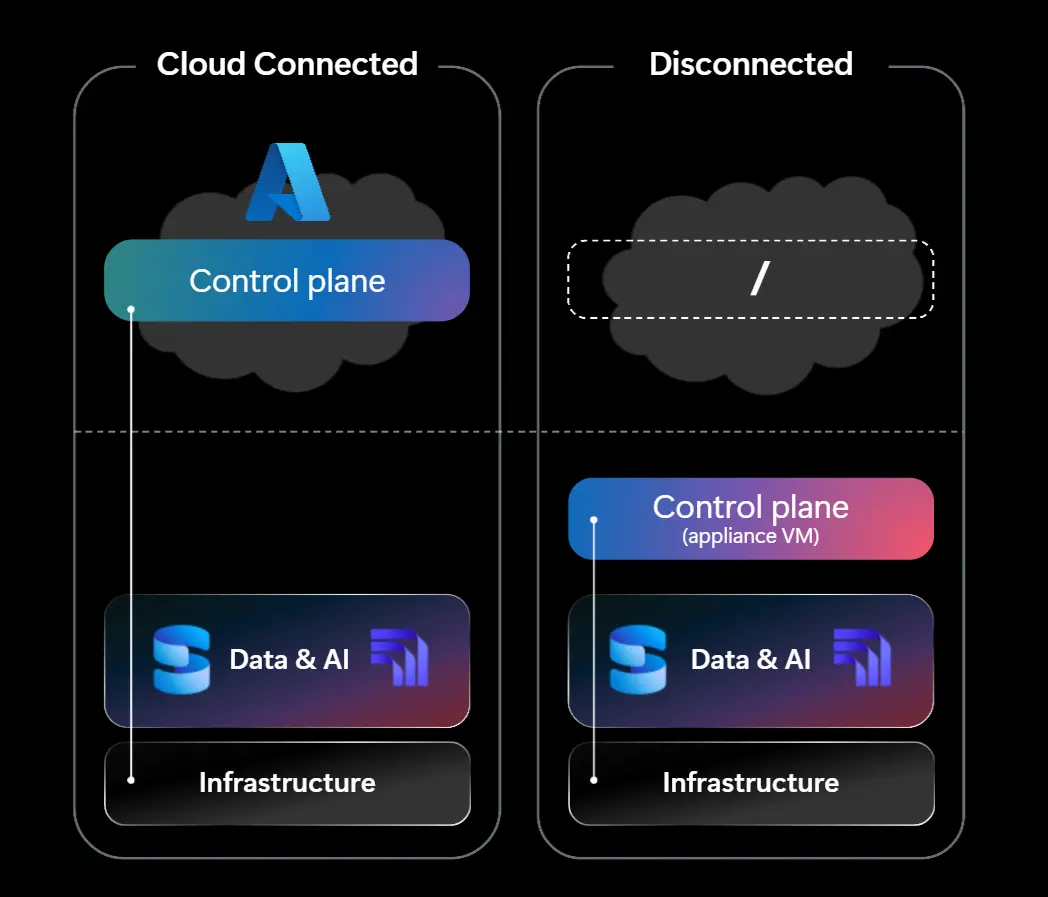
For fully disconnected environments, Azure Local introduces a native local control plane. This enables administrators to deploy, configure, and maintain containerized workloads, virtual machines, and management policies completely offline, ensuring business continuity even when connectivity to cloud datacenters is severed or prohibited.
4. Edge AI Realization via Foundry Local
Centralized cloud datacenters remain the primary venue for training large language models (LLMs). However, executing inference—running AI queries against operational data—often faces severe real-world constraints: bandwidth costs, network latency, data residency laws, and intermittent connectivity.
To address these hurdles, Foundry Local on Azure Local extends AI inferencing capabilities directly into local infrastructure. Operating through Kubernetes-native management patterns, Foundry Local allows enterprises to run optimized AI models directly adjacent to where data is harvested—such as factory floors, medical imaging suites, or logistics warehouses—enabling sub-millisecond decision-making without exposing sensitive raw data to the public internet.
Official Statements and Industry Insights
The industry response to Gartner’s 2026 report emphasizes a broader strategic transition occurring across enterprise IT organizations.
Reflecting on the Gartner recognition, Microsoft’s cloud infrastructure leadership highlighted the imperative for operational consistency in an increasingly complex IT landscape:
"We believe this recognition reflects the strength of Microsoft’s unified approach to distributed infrastructure. Customers want the flexibility to run workloads where it makes the most sense for their business without taking on additional operational complexity. As infrastructure extends across datacenters, edge locations, and the cloud, Microsoft helps customers maintain consistency through common tools, processes, and management experiences, reducing fragmentation and allowing teams to focus on delivering business value."
Company executives emphasized that securing the highest position for Ability to Execute directly correlates with real-world enterprise outcomes:
"Whether an application belongs in the public cloud, an enterprise data center, a remote retail location, or an air-gapped sovereign facility, management and governance must remain unified. We see the 2026 Gartner recognition as validation of a clear direction: distributed infrastructure should provide customers with choice over where workloads run without requiring fragmented operational models."
Industry analysts point out that Gartner’s rigorous evaluation framework assesses vendor performance across crucial parameters including product maturity, market responsiveness, customer experience, and operational vitality. Securing the leader position for four consecutive years indicates that Microsoft’s hybrid cloud roadmap has continuously aligned with real-world enterprise procurement and operational demands.
Future Outlook: The Next Horizon for Distributed Infrastructure
As enterprise technology enters the latter half of the decade, the distributed hybrid infrastructure market is poised for accelerated transformation driven by three core industry trends.
+-----------------------------------------------------------------------------------+
|                            FUTURE INFRASTRUCTURE TRENDS                           |
+-----------------------------------------------------------------------------------+
|                                                                                   |
|  [1] Autonomous Edge Operations                                                   |
|      Self-healing nodes and localized AI management driving zero-touch edge sites. |
|                                                                                   |
|  [2] Pervasive Local Inferencing                                                  |
|      AI models embedded across millions of physical nodes, operating dynamically. |
|                                                                                   |
|  [3] Stringent Global Sovereignty Mandates                                        |
|      Air-gapped and localized control planes becoming mandatory enterprise standard.|
|                                                                                   |
+-----------------------------------------------------------------------------------+
1. Autonomous Edge and Zero-Touch Operations
As the sheer volume of distributed edge sites expands from dozens to tens of thousands per enterprise, manual administration becomes mathematically impossible. Future investments in platforms like Azure Local will center heavily on zero-touch provisioning, automated telemetry-driven repair, and AI-assisted infrastructure management. Local nodes will increasingly self-diagnose, apply security patches, and reconfigure compute capacity autonomously without interrupting local business operations.
2. Ubiquitous Local Inferencing at Scale
The proliferation of specialized, smaller footprint foundational models will shift AI workload dynamics. While heavy model training will remain concentrated in massive hyperscale datacenters, standard enterprise software will rely heavily on localized inferencing. Through platforms like Foundry Local, edge devices will continuously run localized models capable of analyzing video streams, processing localized telemetry, and executing real-time financial transactions, uploading only summarized insights back to the central cloud.
3. Deepening Regulatory Fragmentation and Sovereign Enclaves
Geopolitical shifts and regulatory frameworks worldwide are continuously raising the bar for data jurisdiction, operational access, and cybersecurity resilience. Distributed hybrid infrastructure will remain the primary strategy for global organizations striving to maintain a unified technology stack while complying with localized regulations. Systems offering truly disconnected operational capabilities—where data and control planes remain strictly within defined borders—will transition from niche requirements to standard enterprise prerequisites.
Microsoft’s Continued Commitment
In response to these market shifts, Microsoft has confirmed ongoing investments across both connected and disconnected operational models, scalable hardware abstractions, edge AI frameworks, and unified governance tools. As enterprise IT continues to transcend physical boundaries, the platform’s focus remains clear: enabling organizations to run any workload, anywhere, without operational compromise.
Gartner Reference Details: Gartner, Magic Quadrant for Distributed Hybrid Infrastructure, Julia Palmer, Elaine Zhang, Adrian Wong, Daniel Bowers, 7 September 2026.
Disclaimer: Gartner does not endorse any vendor, product or service depicted in its research publications, and does not advise technology users to select only those vendors with the highest ratings or other designation. Gartner publications consist of the opinions of Gartner’s research organization and should not be construed as statements of fact. Gartner disclaims all warranties, expressed or implied, with respect to this research, including any warranties of merchantability or fitness for a particular purpose.