Executive Overview
In a milestone move for hybrid cloud architecture and data sovereignty, Microsoft has announced the General Availability (GA) of SQL Server on Azure Local, delivering a unified, enterprise-grade data platform engineered to run seamlessly across both connected and fully air-gapped environments. The release addresses a persistent architectural challenge faced by global enterprises: how to modernize critical database infrastructure without sacrificing strict control over data placement, regulatory compliance, and localized operational uptime.
As public cloud adoption reaches maturity, a significant subset of enterprise workloads remains tethered to local physical infrastructure. Industrial manufacturing execution systems (MES), defense command centers, financial settlement networks, and offshore energy extraction sites operate under physical or regulatory constraints where continuous public cloud connectivity cannot be guaranteed—or is explicitly forbidden.
+-----------------------------------------------------------------------+
|                       AZURE LOCAL INFRASTRUCTURE                      |
|                                                                       |
|  +---------------------------------+   +---------------------------+  |
|  |           SQL SERVER            |   |       FOUNDRY LOCAL       |  |
|  |   (Windows / Linux Guest VMs)   |   |   (Preview - Local AI)    |  |
|  +---------------------------------+   +---------------------------+  |
|                  |                                   |                |
|                  +-----------------+-----------------+                |
|                                    |                                  |
|            Local Data & Execution (Air-Gapped/Sovereign)              |
+-----------------------------------------------------------------------+
                                     |
               +---------------------+---------------------+
               |                                           |
               v                                           v
    [ CONNECTED MODE ]                           [ DISCONNECTED MODE ]
    • Azure Arc Integration                      • Local Autonomy
    • Pay-As-You-Go / Software Assurance          • Azure Hybrid Benefit
    • Cloud Management & Telemetry               • Fully Air-Gapped Execution
By bringing SQL Server natively to Azure Local—Microsoft’s hyperconverged infrastructure (HCI) solution designed for modern hybrid deployments—organizations gain the ability to deploy mission-critical databases closer to where operational data is generated. Crucially, the announcement is paired with the public preview of Foundry Local on Azure Local, an initiative designed to execute generative AI inferencing locally alongside SQL Server workloads, eliminating the need to export sensitive corporate data to external cloud APIs for processing.
Detailed Chronology: The Evolution of Microsoft’s Hybrid Strategy
The path to fully disconnected, AI-capable enterprise database infrastructure reflects a decade-long shift in how hyperscalers approach the on-premises datacenter.
┌─────────────────────────────────────────────────────────────────┐
│                      HYBRID CLOUD EVOLUTION                     │
└─────────────────────────────────────────────────────────────────┘
                                  │
  Phase 1: Isolated Datacenters   ▼  (SQL Server 2008–2019)
  Monolithic on-prem deployments with zero native cloud hooks.
                                  │
  Phase 2: Cloud-First Expansion  ▼  (Public Azure Migration Push)
  Hyperscaler pressure to migrate all relational workloads to SaaS/PaaS.
                                  │
  Phase 3: Hybrid & Multi-Cloud   ▼  (Azure Arc & Azure Stack HCI)
  Bridge management across fragmented cloud and physical environments.
                                  │
  Phase 4: Sovereign Edge & AI    ▼  (GA: SQL Server on Azure Local)
  Fully air-gapped execution paired with local AI inferencing capabilities.
Phase 1: Isolated Datacenters (SQL Server 2008–2019)
For over two decades, SQL Server established itself as a foundational enterprise database engines. However, deployments remained strictly partitioned between traditional on-premises virtualization platforms and physical bare-metal hardware. Operations relied on local system administrators, localized backup targets, and independent patch management cycles.
Phase 2: The Cloud-First Migration Push
With the rise of Microsoft Azure, enterprise IT strategies prioritized public cloud migration. Services like Azure SQL Managed Instance offered automated patching, dynamic scaling, and cloud-native resilience. Yet, global enterprises quickly encountered structural bottlenecks: regulatory mandates preventing cross-border data transfers, physics-based latency constraints in industrial operations, and internet instability in edge environments.
Phase 3: The Hybrid Bridge via Azure Arc and Azure Stack HCI
Recognizing that enterprise infrastructure would remain hybrid indefinitely, Microsoft introduced Azure Arc and Azure Stack HCI. This enabled cloud-consistent control planes to extend into physical environments, allowing administrators to manage on-premises resources via the Azure portal. However, many of these hybrid management frameworks still required persistent cloud connectivity for heartbeat telemetry, licensing verification, and operational control.
Phase 4: Unified Sovereignty and Disconnected Autonomy
The GA of SQL Server on Azure Local represents the culmination of this evolution. By decoupling core operational capabilities and licensing validation from mandatory, continuous cloud endpoints, Microsoft has established a deployment model capable of sustained, independent execution—while offering a path to cloud management via Azure Arc when connectivity is available.
Supporting Context & Industry Metrics
The shift toward localized, highly control-oriented compute platforms is accelerated by regulatory, structural, and technological trends. Enterprise data estates are becoming increasingly decentralized, forcing architectural changes across multiple sectors.
+---------------------------------------------------------------------+
|                     KEY MARKET DRIVERS & CONSTRAINTS                 |
+---------------------------------------------------------------------+
|  Data Sovereignty   |  NIS2, DORA, GDPR, ITAR, and regional compliance |
|                     |  mandates prohibiting cross-border telemetry. |
+---------------------+-----------------------------------------------+
|  Edge Generation    |  Gartner projects >75% of enterprise data     |
|                     |  will be created at the edge by 2026.         |
+---------------------+-----------------------------------------------+
|  Operational Risk   |  Unplanned WAN outages halting real-time      |
|                     |  industrial assembly lines or remote plants.  |
+---------------------+-----------------------------------------------+
|  AI Data Gravity    |  Exorbitant bandwidth costs and risks associated|
|                     |  with streaming petabytes to public cloud LLMs.|
+---------------------------------------------------------------------+
1. The Global Sovereign Data Mandate
Strict compliance frameworks—such as the European Union’s NIS2 Directive and Digital Operational Resilience Act (DORA), alongside US ITAR rules—have imposed strict penalties for unauthorized data exposure. Organizations handling critical infrastructure, defense logistics, healthcare records, and sovereign citizen data are required to maintain strict boundaries around data processing.
2. Edge Data Growth
Market intelligence firm Gartner estimates that by 2026, more than 75% of enterprise-generated data will be created and processed outside traditional centralized datacenters or public cloud regions, up from less than 20% in 2019. Industrial IoT sensors, automated manufacturing lines, remote medical devices, and smart grids generate massive telemetry volumes that require real-time local processing.
    ENTERPRISE DATA CREATION LOCATION (HISTORICAL VS. PROJECTED)

    2019  [██████ 20%]  ───────────────────────────── (Edge Data)

    2026  [█████████████████████████████████████ 75%] (Edge Data)
3. The Physical Limits of Connectivity
In industries such as maritime shipping, underground mining, defense deployments, and remote energy facilities, wide-area network (WAN) connectivity is frequently intermittent or unavailable. A database architecture that relies on cloud connectivity for execution runs the risk of operational disruptions during network drops.
4. "Data Gravity" in the Era of Enterprise AI
As organizations train and query generative AI models using enterprise data, the concept of "data gravity" becomes an operational challenge. Transferring multi-terabyte SQL databases to public cloud endpoints to run AI inferencing incurs significant egress charges, latency overhead, and security exposure. Modern architectures favor moving the AI processing engine to the data, rather than streaming data to the cloud.
Technical Architecture & Operational Deep-Dive
SQL Server on Azure Local is engineered to deliver enterprise database performance within customer-managed physical environments, supported by underlying hyperconverged infrastructure.
+-------------------------------------------------------------------------------+
|                      AZURE LOCAL ARCHITECTURAL STACK                          |
+-------------------------------------------------------------------------------+
|  AI LAYER           |  Foundry Local (SLMs, Local Vector Inference, RAG)     |
+---------------------+---------------------------------------------------------+
|  DATABASE LAYER     |  SQL Server (Windows Server / Linux Guest VMs)          |
+---------------------+---------------------------------------------------------+
|  HYPERVISOR LAYER   |  Azure Local Hyperconverged Infrastructure (HCI Engine) |
+---------------------+---------------------------------------------------------+
|  HARDWARE LAYER     |  Validated Customer / OEM Hardware (Dell, HPE, Lenovo)  |
+-------------------------------------------------------------------------------+
Dual Operational Modes: Connected vs. Disconnected
The framework is built around operational flexibility, allowing organizations to run SQL Server across distinct connectivity profiles without altering the underlying database code or application layer.
| Feature / Dimension | Connected Deployment Mode | Disconnected Deployment Mode |
|---|---|---|
| Primary Use Case | Hybrid enterprise datacenters with reliable WAN connectivity | Sovereign clouds, air-gapped defense facilities, remote sites |
| Control Plane | Azure Arc via Azure Portal | Local management toolsets & local cluster APIs |
| Licensing Options | Software Assurance, Pay-As-You-Go (Azure Arc), Subscriptions | Azure Hybrid Benefit with eligible perpetual licenses |
| Telemetry & Patching | Automated via Azure update management workflows | Local manual patch staging or localized orchestration |
| AI Processing | Azure AI Studio, Azure OpenAI, or Foundry Local | Localized Foundry Local engine execution |
Connected Deployments
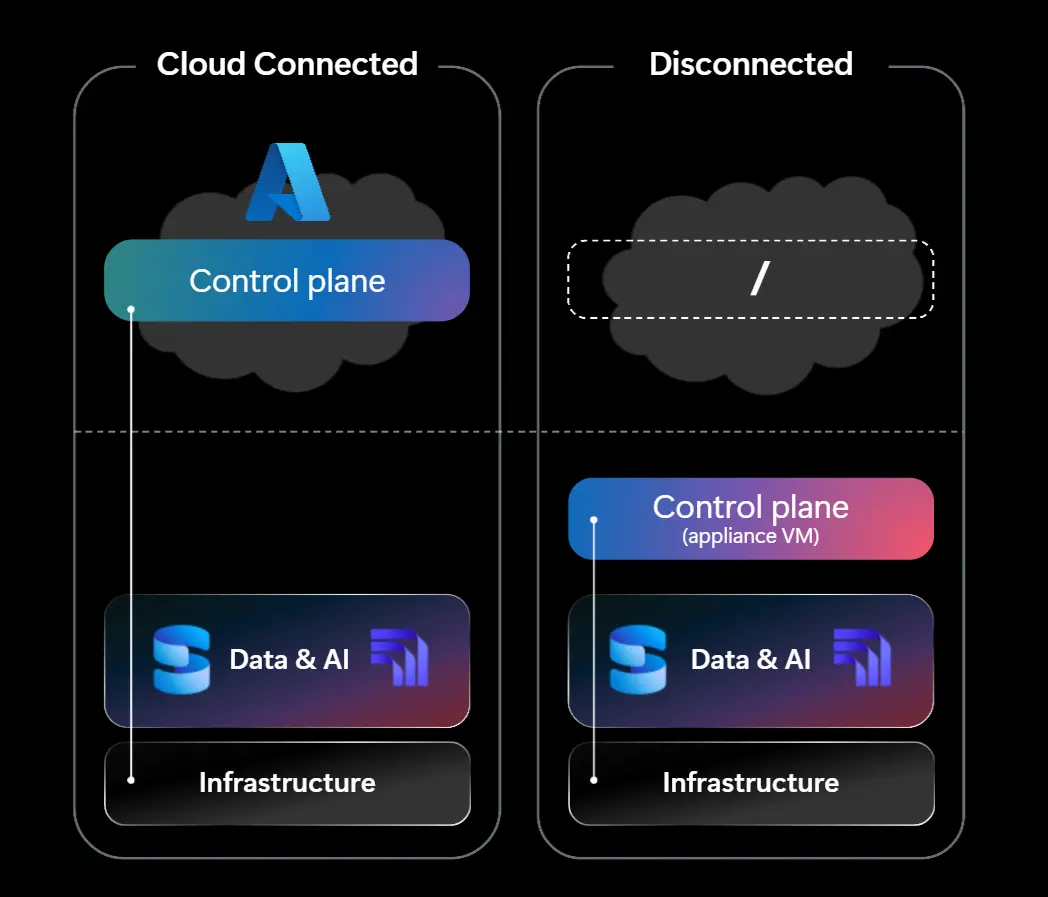
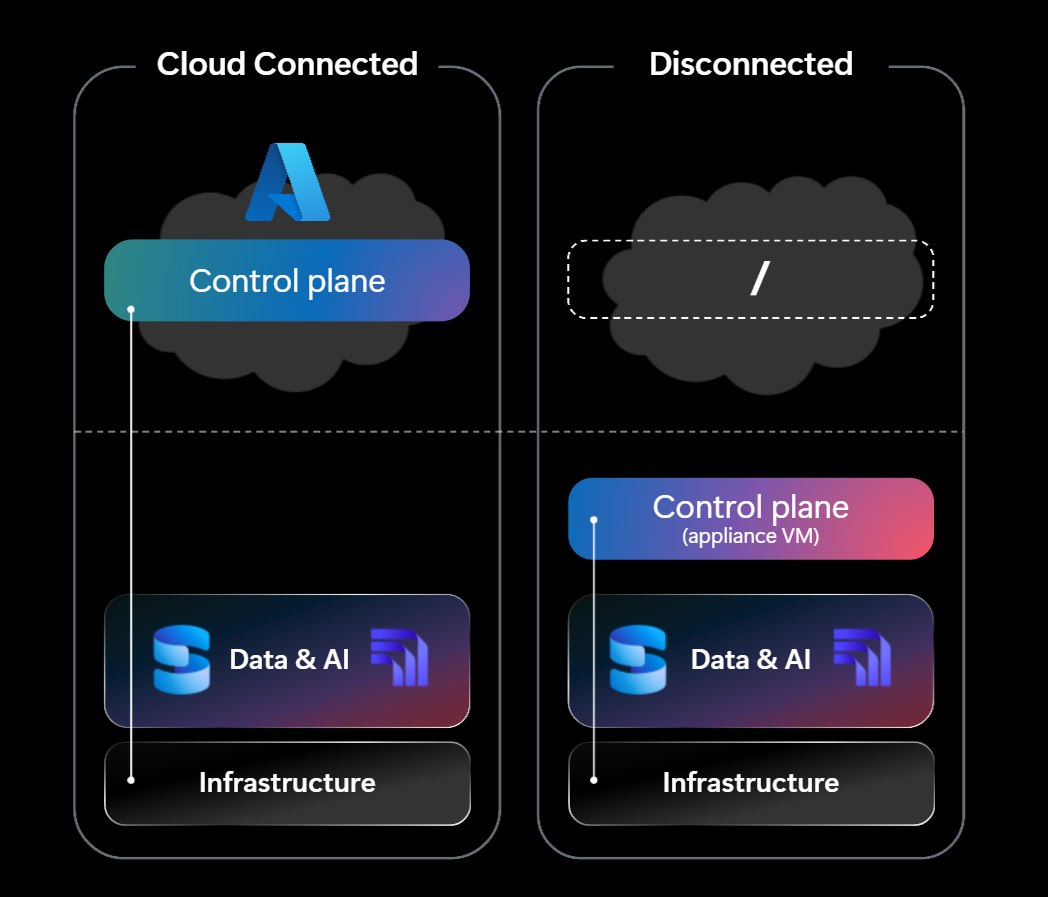
In connected mode, Azure Arc serves as the central control plane. Infrastructure and database administrators can monitor health, enforce policy configurations, automate backups, and stream security telemetry back to Azure Sentinel. Organizations can adopt dynamic, pay-as-you-go billing, scaling database spend based on actual consumption without upfront software commitments.
Disconnected Operations
In fully air-gapped scenarios, the database engine runs entirely self-contained on local physical nodes. The control plane remains contained within the localized infrastructure boundary, guaranteeing that high-availability failovers, transaction logging, indexing, and storage operations function without external dependency. Licensing is maintained through the Azure Hybrid Benefit, allowing organizations to apply existing SQL Server licensing investments directly to disconnected physical hardware.
Bringing Generative AI to the Perimeter: Foundry Local
A key aspect of this release is the public preview of Foundry Local on Azure Local. Designed to address the security risks associated with public cloud AI services, Foundry Local enables local inference pipelines alongside SQL Server databases.
+-----------------------------------------------------------------------+
|                    LOCAL AI INFERENCING ARCHITECTURE                  |
+-----------------------------------------------------------------------+
|                                                                       |
|   +-----------------------+              +------------------------+   |
|   |   SQL Server Engine   |              |     Foundry Local      |   |
|   |   (Enterprise Data)   |              |  (Local SLM / LLM Model) |   |
|   +-----------+-----------+              +-----------+------------+   |
|               |                                      |                |
|               |  1. Local Read (Zero Egress)         |                |
|               +──────────────────────────────────────>                |
|                                                      |                |
|               |  2. Local Vector Generation & RAG    |                |
|               <──────────────────────────────────────+                |
|                                                                       |
|   =================================================================   |
|          RESULT: Zero Data Exposure Outside Customer Perimeter        |
+-----------------------------------------------------------------------+- In-Perimeter Inference Engine: Small Language Models (SLMs) and targeted Large Language Models (LLMs) execute directly on the local Azure Local physical nodes.
- Retrieval-Augmented Generation (RAG) Support: SQL Server tables—containing sensitive unstructured or structured text, financial records, or operational logs—can be vectorized and queried locally.
- Zero-Egress Security Model: Data never leaves the enterprise boundary. Inference requests, model embeddings, and final analytical outputs remain within the local physical hardware frame.
Target Industry Use Cases
+-----------------------------------------------------------------------+
|                      TARGET INDUSTRY USE CASES                        |
+-----------------------------------------------------------------------+
|  DEFENSE & PUBLIC SECTOR   | Tactical edge units, command systems,     |
|                            | air-gapped government data centers.       |
+----------------------------+------------------------------------------+
|  MANUFACTURING & ENERGY    | SCADA systems, refinery sensors,         |
|                            | localized plant management (MES).        |
+----------------------------+------------------------------------------+
|  FINANCIAL SERVICES        | High-frequency trading, local regulatory |
|                            | vaults, cross-border privacy zones.      |
+----------------------------+------------------------------------------+
|  HEALTHCARE PROVIDERS      | On-premise Electronic Health Records     |
|                            | (EHR), medical imaging, HIPAA compliance. |
+-----------------------------------------------------------------------+- Defense and Public Sector: Deploying classified data stores at the tactical edge or in sovereign, air-gapped government facilities without external dependencies.
- Manufacturing and Energy: Operating continuous industrial plant software (MES/SCADA), maintaining sub-millisecond control loops on production lines, and surviving extended network cutoffs without downtime.
- Financial Services: Maintaining local transaction vaults that enforce regional data-sovereignty mandates, while using Foundry Local to run compliance auditing scripts locally.
- Healthcare Systems: Processing patient records and running diagnostics via local AI inferencing, ensuring sensitive medical data remains within hospital facilities.
Strategic Implications & Future Outlook
The release of SQL Server on Azure Local signals a strategic pivot in how hyperscale cloud providers address physical infrastructure. Rather than viewing on-premises datacenters merely as legacy environments awaiting public cloud migration, the operational paradigm now treats the physical edge as a permanent tier of enterprise computing.
┌─────────────────────────────────────────────────────────────────┐
│                     HYPERSCALE COMPETITIVE MAP                  │
└─────────────────────────────────────────────────────────────────┘

  Microsoft      ► SQL Server on Azure Local + Foundry Local
                   (Full Air-Gap Autonomy + On-Prem AI Execution)

  AWS            ► AWS Outposts
                   (Requires persistent connection for control plane)

  Google Cloud   ► Google Distributed Cloud (GDC)
                   (Targeted sovereign/air-gapped deployments)
Competitive Dynamics in the Hybrid Era
This architecture sets a high standard for hyperscale hardware and database offerings:
- AWS Outposts has historically depended on a constant connection back to parent AWS regions, making true, long-term air-gapped deployments challenging for disconnected operational sites.
- Google Distributed Cloud (GDC) has made strides in air-gapped sovereign environments, but lacks the deep, enterprise database footprints that SQL Server commands across legacy on-premises applications.
Microsoft’s ability to combine a ubiquitous relational database engine (SQL Server) with hyperconverged virtualized infrastructure (Azure Local) and edge AI capabilities (Foundry Local) provides a compelling path forward for enterprises navigating complex sovereignty mandates.
Preserving Capital Investments via Hybrid Licensing
By decoupling software innovation from cloud-only lock-in, Microsoft is offering enterprise buyers a clear economic model:
+-----------------------------------------------------------------------+
|                      LICENSING FLEXIBILITY MATRIX                     |
+-----------------------------------------------------------------------+
|  DEPLOYMENT MODE  | LICENSING MECHANISM                               |
+-------------------+---------------------------------------------------+
|  Connected        | • Pay-As-You-Go via Azure Arc                     |
|                   | • Software Assurance (SA)                         |
|                   | • Standard Subscription Licensing                 |
+-------------------+---------------------------------------------------+
|  Disconnected     | • Azure Hybrid Benefit (AHB)                      |
|                   | • Existing Perpetual SQL Server Core Licenses     |
+-----------------------------------------------------------------------+
This dual-licensing methodology helps protect existing capital expenditure investments in perpetual licenses while providing a clear transition path to operational expense models through Azure Arc when business requirements shift.
The Trajectory of Distributed Sovereign Cloud
Looking ahead, the enterprise stack will increasingly rely on distributed execution models. Cloud management platforms will coordinate workloads, but actual data storage, transaction processing, and AI inference will run close to physical operations.
By combining SQL Server on Azure Local with on-premise AI capabilities, Microsoft has set a clear path for enterprise infrastructure—enabling high performance, air-gapped operational resilience, and strict data sovereignty across modern data estates.