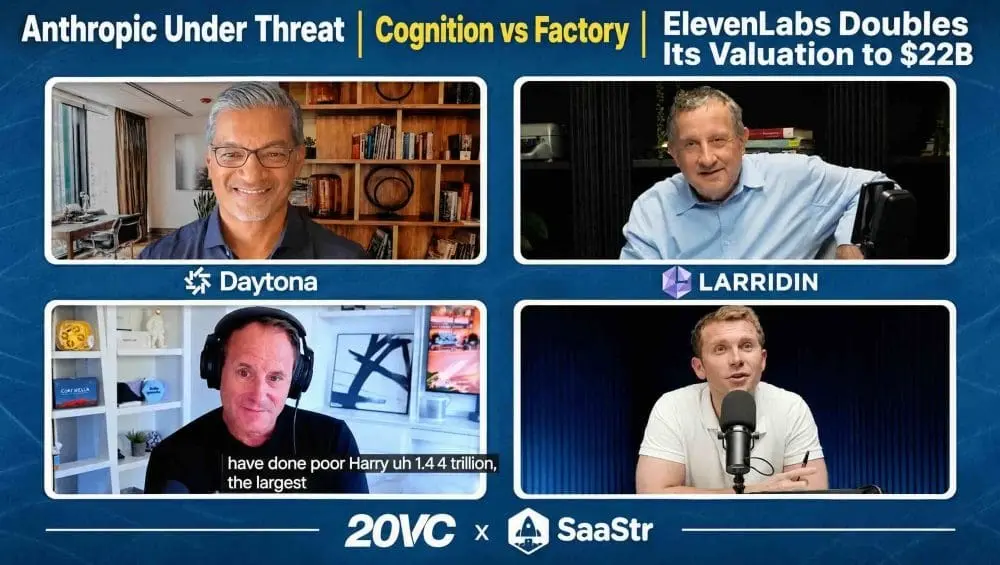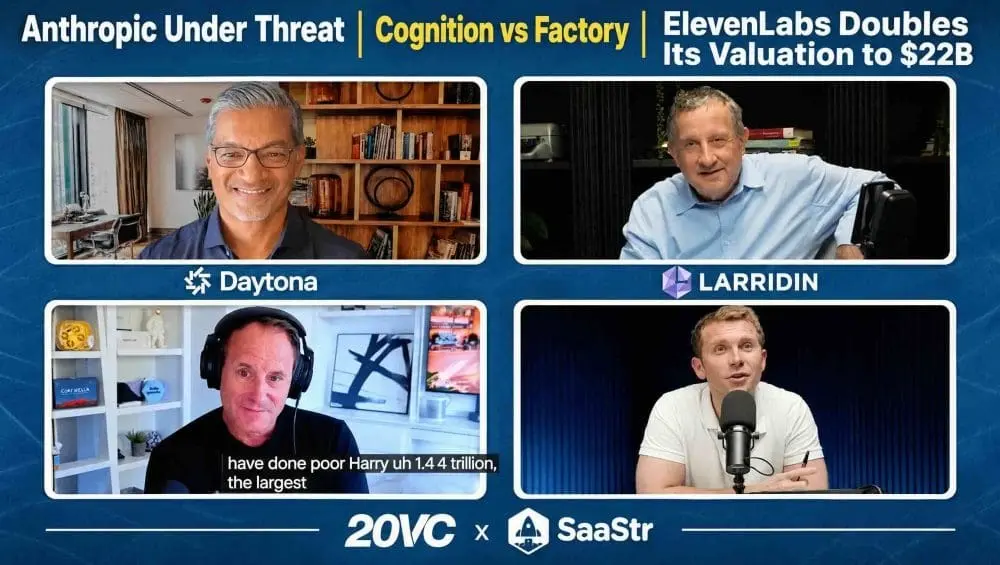
Featuring: Harry Stebbings, Rory O’Driscoll, and Jason Lemkin
Date: October 2026
Executive Overview
The artificial intelligence boom has reached a fever pitch, forcing venture capitalists, institutional limited partners (LPs), and tech founders to grapple with an overarching, uneasy question: What do you do differently when everyone in the room agrees we are standing near the absolute peak of the cycle?
This week’s joint 20VC x SaaStr briefing tackled this exact dilemma, dissecting a whirlwind period in tech and finance. From Anthropic postponing its anticipated $2 trillion IPO to November to ensure a pristine Q3 reporting window, to OpenAI’s jaw-dropping internal forecasts projecting a $278 billion cash burn through 2030, the stakes have never been higher. Meanwhile, Meta shocked the consumer market by rocketing to the #1 spot on the App Store with Muse—a new AI agent that added roughly $100 billion to the tech giant’s market cap in a single week—triggering a defensive scramble from legacy web giants like Amazon.
Amidst these macro tremors, the investment landscape is undergoing radical structural changes. Seed rounds are inflating past the $20 million mark, early-stage funds are moving deeper into "pre-inception" dealmaking, and venture investment committees are fiercely debating multi-billion-dollar valuations for enterprise coding and data infrastructure players like Factory, Legora, and Crusoe.
This comprehensive report breaks down the top ten learnings from the session, exploring how top-tier investors are navigating the apex of the AI revolution, adjusting their risk parameters, and separating sustainable technological shifts from speculative market froth.
Detailed Chronology & Key Developments
1. Anthropic’s $2 Trillion IPO Delay: Market Crack or Strategic Polish?
The rumor mill went into overdrive when Anthropic pushed its blockbuster IPO—projected at a staggering $2 trillion valuation—from October to November. While skeptics immediately pointed to the move as a sign of institutional hesitation or a weakening market, insiders offer a starkly different interpretation.
According to Rory O’Driscoll, the delay is purely operational and strategic, centering on quarterly timing rather than systemic market weakness. Anthropic posted an explosive Q2, reportedly outpacing OpenAI in revenue. In retaliation, OpenAI aggressively marketed its own Q3 performance metrics throughout July. Listing in October would have forced Anthropic to go public immediately after Q3 closed without fully audited figures ready for the prospectus—a dangerous gamble for a high-stakes market debut.
However, Harry Stebbings pushed back, arguing that a company expecting to be 20x or 30x oversubscribed shouldn’t need to stall. If pre-marketing conversations were entirely smooth, timing would matter less.
The Liability Question: The conversation also turned to the existential hurdle of product liability insurance for autonomous AI agent swarms. With no traditional insurer willing to underwrite autonomous risk—and venture leaders publicly comparing frontier labs to atomic developments—how does a company go public? Panelists noted that a multi-trillion-dollar enterprise can readily self-insure, utilizing robust internal legal teams akin to Big Tech’s historic defenses against intellectual property trolls. Securities law does not demand zero risk; it demands full disclosure, which Anthropic has provided in spades.
2. OpenAI’s $278B Burn Through 2030: The High Cost of Intelligence
Leaked internal forecasts reveal that OpenAI’s total cash burn through 2030 is projected to hit $278 billion, driven by massive capital expenditures nearing $700 billion.
Jason Lemkin offered a blunt assessment of these figures: "I bet it’s more." Historical data shows that high-growth tech rocket ships routinely outpace their projected burn by 30% to 50%, regardless of CFO oversight. Consequently, OpenAI’s true capital requirement by the end of the decade could easily crest toward $400 billion. Unlike traditional B2B software, which scales efficiently on minimal infrastructure, frontier AI model training and inference represent one of the most capital-intensive business models in human history. As O’Driscoll succinctly summarized: "Intelligence is not cheap."
3. Meta’s Muse Captures the App Store and Adds $100 Billion in Value
In one of the most disruptive product launches of the year, Meta Superintelligence Labs—led by Alexandr Wang’s team—released Muse, an advanced consumer AI agent that claimed the #1 spot on the US App Store within a week, briefly dethroning ChatGPT. The market reaction was swift, with Meta’s stock climbing 7% to 8% (adding approximately $100 billion in market cap) and extending a 34% monthly rally.
Lemkin praised Muse as one of the best software applications he has ever used, highlighting its free model, generous token limits, and truly autonomous agent capabilities. Behind its friendly consumer interface lies a "Trojan horse": users query Muse for everyday tasks, effortlessly pulling them into Meta’s ecosystem while routing complex workflows directly through Meta’s underlying LLMs. Crucially, Lemkin noted that Muse allowed him to build a fully functional, real-time CRM tracking 150 SaaStr sponsors in just two weeks at zero cost.
Supporting Context & Metrics: The B2B Infrastructure Battle
The emergence of autonomous agents is forcing legacy platforms to rapidly adapt or face disintermediation, creating a ripple effect across e-commerce, cloud computing, and developer tooling.
4. Amazon Blocks Muse, Shopify Partners: The War Over Agentic Commerce
As consumers increasingly deploy AI agents to handle shopping and purchasing decisions, major retail gatekeepers are drawing battle lines.
- Amazon’s Block: Amazon blocked Muse from executing purchases on its platform. Analysts note that agentic checkout threatens Amazon’s lucrative advertising engine—which now generates more profit than its core e-commerce operations—by bypassing traditional search pages, sponsored product ads, and cross-selling recommendations.
- Shopify’s Partnership: Conversely, Shopify enthusiastically integrated with Muse, recognizing an opportunity to funnel incremental demand from independent merchants through Shop Pay.
Panelists agreed that systemic attempts by legacy platforms to block AI agents represent "the last stand of the unnecessary system of record." Agents inherently route around friction, utilizing unofficial APIs, direct vendor communications, or secondary access points to complete tasks. While tech giants like Amazon will not vanish, they face severe margin compression and the prospect of being strategically "maimed" by agent-driven commerce.
5. TypeSafe’s Jev and the Rise of "System One" Decision Models
TypeSafe AI disrupted the developer ecosystem with the launch of Jev, a "System One" model designed strictly to return rapid binary decisions, classifications, and rankings rather than conversational text. Secured by a $40M seed round, Jev operates at a fraction of the cost—roughly 1/100th the price of Anthropic’s frontier models—and has become one of Vercel’s fastest-ever adopted tools.
While not a replacement for general-purpose LLMs like ChatGPT, Jev highlights a growing architectural split: developers do not always want conversational filler; they often simply need high-speed, cost-effective programmatic logic ("Is this A or B?").
Official Statements & Investment Committee Debates
6. The New Venture Economics: $20M Seeds and "Pre-Inception" Plays
Venture capital entry points have inflated dramatically. Standard seed rounds routinely cross the $20M threshold, while spinouts from tier-one labs command $8M to $10M just to get off the ground. In response, elite firms like Andreessen Horowitz (a16z) have launched specialized $40M pre-inception funding programs—essentially scaling up the fellowship model to catch founders before companies are even officially formed.
Lemkin noted that traditional seed checks offering low ownership percentages no longer make mathematical sense unless investors secure massive outcomes exceeding $25 billion upon exit. Rory O’Driscoll added a macro perspective: nominal GDP growth has expanded roughly 2.5x since 2010. Consequently, writing a $10M check today requires the exact same foundational logic as writing a $4M check fifteen years ago.
7. Evaluating the IC Pipeline: Factory, Legora, and Crusoe
To capture how top investors evaluate late-stage tech bets at cycle peaks, the panel simulated an active Investment Committee (IC) review for three high-profile companies:
- Factory (Approved): Seeking $200M at a $5B valuation, Factory provides enterprise coding agents (Droid). Both Lemkin and O’Driscoll approved the round. With C-suite executives increasingly wary of sending proprietary source code to centralized frontier labs like OpenAI and Anthropic due to data privacy concerns, independent enterprise coding solutions represent a massive, compounding market opportunity.
- Legora (Divided/Mixed): Boasting $200M in ARR with a reported upcoming valuation of $11B, legal AI player Legora faced scrutiny regarding unit economics. While high-growth metrics are undeniable, panelists questioned whether the total addressable legal headcount can sustainably support an $11-decacorn valuation, noting that legal AI monetization scales differently than core software engineering infrastructure.
- Crusoe (Passed): Raising a $3.9B Series F at a $30.9B valuation backed by extensive infrastructure contracts, Crusoe sits at the top tier of data center and power providers. Despite its impressive scale, Lemkin passed due to strict return thresholds at that entry price. O’Driscoll concurred, noting that data center investments carry 4x to 5x financial leverage tied directly to macro AI adoption rates. While excellent during a secular surge, capital-intensive infrastructure plays introduce severe downside vulnerability if market momentum stumbles.
Future Outlook & Strategic Takeaways
As the AI supercycle matures, the road ahead demands unprecedented discipline from founders, venture capitalists, and institutional limited partners.
- For Founders: The era of relying solely on general-purpose consumer hype is drawing to a close. Decacorn leadership now requires proactive advocacy networks to counter public controversies, rigorous data governance, and deep integration into agentic workflows.
- For Venture Capitalists: The margin of safety has narrowed significantly. Writing checks at peak valuations requires absolute conviction in top-quartile technical execution or early positioning at the pre-seed and pre-inception stages. Managers must balance high-stakes AI infrastructure bets with resilient, compounding software plays.
- For Limited Partners: Allocating capital has never been more complex. LPs must differentiate between enduring momentum in foundational developer ecosystems and speculative froth in capital-intensive hardware layers, carefully backing managers who possess authentic edge in rapidly evolving tech domains.
Ultimately, as O’Driscoll reminded the audience by quoting Bernard Baruch: “If you look in the mirror every day and say two and two makes four, you’ll avoid most mistakes.” In a market driven by unprecedented technological transformation, maintaining analytical rigor remains the ultimate competitive advantage.