Executive Overview
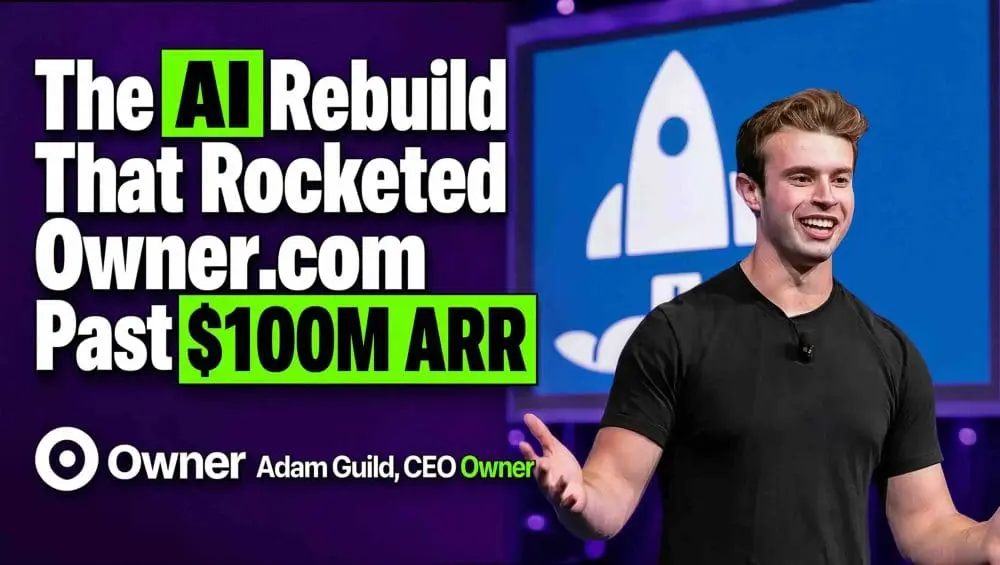
In the rapidly evolving landscape of vertical B2B software, few transformations have been as swift, absolute, or illuminating as that of Owner.com. Over a grueling yet triumphant three-year period, the independent restaurant platform systematically dismantled and rebuilt its entire infrastructure around artificial intelligence. The result? A rocket-ship trajectory vaulting the company past $100 million in Annual Recurring Revenue (ARR), growing at triple-digit year-over-year rates, and accelerating faster than it did prior to its seed round.
Today, more than 83% of new customers begin their journey with Owner.com inside a generative AI product rather than a legacy marketing funnel. Yet, this meteoric rise was far from a foregone conclusion. Just three months before their breakthrough, Owner’s internal customer research painted a bleak picture: restaurant owners were allegedly terrified of AI, legacy industry experts warned that pivoting would alienate their core demographic, and traditional product managers pushed back against what they perceived as a reckless distraction.
As detailed by CEO Adam Guild at SaaStr AI 2026, those insights were not just outdated—they were entirely wrong. By ignoring stale market research, eliminating customer friction through outcome-driven architecture, and deploying autonomous agents to handle internal coordination, Owner.com charted a new course for vertical software leaders. This article investigates the anatomy of Owner’s AI transformation, breaking down the seven pivotal strategies that drove their hyper-growth, the metrics that validate their success, and the critical lessons for founders navigating the post-ChatGPT economy.
Detailed Chronology: The Pivot That Almost Didn’t Happen
The Pre-Pivot Reality and the Danger of Stale Research
Before the pivot, Owner.com operated as a traditional, albeit successful, website builder and online ordering system for independent restaurants. Growth was strong, efficiency was high, and the company was comfortably exceeding the coveted "triple-triple-double-double" SaaS trajectory. The decision to rebuild wasn’t born out of desperation; it was an elective, aggressive strike by leadership to capture a paradigm shift before it captured them.
However, moving upstream into AI wasn’t welcomed by everyone in the room. Discovery interviews conducted merely a quarter prior indicated that independent restaurant operators viewed artificial intelligence with deep suspicion and fear. Industry veterans cautioned that introducing complex algorithms to mom-and-pop restaurateurs would alienate a demographic known for its aversion to steep tech learning curves.
The "Pizza Expo" Epiphany
The inflection point occurred at the National Pizza Expo. Adam Guild was stationed at a booth demonstrating their standard website and ordering products when a product manager casually introduced a rough, last-minute MVP: a poster with a QR code allowing operators to scan their struggling online presence and instantly receive an AI-generated audit and fix.
The response shattered months of conventional user research. A 55-year-old pizzeria owner from Pennsylvania named Joe scanned the code and became instantly captivated. By midday, despite the booth collateral barely mentioning AI, it was the only thing operators wanted to talk about. They weren’t afraid of the technology; they were desperate for solutions to drive customer discovery and slash labor costs.
Owner’s leadership realized a fundamental truth of the current technological epoch: in a market accelerated by generative AI, customer research goes stale in 90 days or less. Stated preferences (what customers say they want in an interview) diverged wildly from revealed behavior (what they gravitated toward when presented with a live, functional tool). Armed with this insight, Owner committed fully to a ground-up reconstruction of their platform.
Core Pillars: The Seven Strategies That Moved the Needle
1. Eliminating the Login: Outcome Instrumentation Over Engagement Metrics
In traditional Software-as-a-Service (SaaS), Daily Active Users (DAU) and Monthly Active Users (MAU) serve as the holy grail of product health. Guild argues that for modern AI-driven platforms, this metric is inverted. If a restaurant owner has to log into a website builder to manually fix what the software configured incorrectly, the software has failed.
Owner replaced human engagement tracking with outcome instrumentation. Their lead qualification agent can estimate the Gross Payments Volume (GPV) of a restaurant it has never previously worked with to within a remarkable $250 margin—all before a human sales rep ever speaks to the prospect. By building a system capable of accurately predicting financial outcomes upfront, Owner can automatically verify, without manual prompting, whether an existing customer’s sales have surged post-activation.
2. Proprietary Data vs. Public Corpora
With foundational models capable of spinning up impressive web designs in seconds, software companies often lean on the crutch of "proprietary data" as a moat. Owner’s approach exposes the flaw in this logic.
While an off-the-shelf LLM can build a decent restaurant website, it lacks what Owner captures through its Grader tool. Grader audits roughly 90 SEO and Conversion Rate Optimization (CRO) factors, cross-referencing local competitors, Google Business Profiles, and customer reviews from Reddit, Instagram, and Facebook.
Owner’s moat is not its corpus of public data—which the foundational models have already ingested—but its outcome data. By enforcing a unified, opinionated system across thousands of live restaurant deployments, Owner correlates specific design and SEO adjustments directly with fluctuations in food order volumes. Every new customer compounds this proprietary feedback loop, creating a compounding advantage that generic AI coders cannot replicate.
3. Deploying Internal Agents for Coordination Overhead
While most engineering teams utilize AI for writing code (via tools like Claude Code or Cursor), Owner recognized that technical debt is often secondary to coordination debt.
To combat this, they built Owen, an autonomous internal agent that monitors GitHub, Slack, Notion, Linear, and Google Meet transcripts. Owen handles approximately 90% of builder coordination work. Star engineers no longer spend hours in standups or updating ticket statuses; Owen keeps teams aligned automatically. Furthermore, when minor front-end issues are flagged in Slack, Owen directly invokes Claude Code to generate a first-draft Pull Request, completely bypassing the traditional ticketing lifecycle.
Similarly, CTO Dean built a Product Insight Command Center that aggregates customer support tickets, sales calls, and CRM data to auto-assemble product roadmaps, eliminating the manual friction of cross-departmental interviews.
4. Re-evaluating Headcount: Hiring More Builders Amid High Demand
While many tech companies utilized the dawn of AI to downsize and run leaner, Owner took the opposite path. Because they operate in a massive, underpenetrated market of hundreds of thousands of independent restaurants—and face more inbound demand than their product can satisfy—they accelerated hiring.
The philosophy is simple: if your market ceiling is wide open and you have an insatiable demand for features, use AI leverage not to cut headcount, but to compress a ten-year product roadmap into one or two years by empowering high-agency builders.
5. Revenue Metrics Over Activity Metrics
Many organizations celebrate AI implementation by measuring internal efficiency metrics, such as hours saved or call volume increased. CRO Kyle Norton dismisses these as mere input metrics.
The true test of Go-To-Market (GTM) AI is top-line impact. By deploying pre-call research agents that automate the 20 to 30 minutes reps previously spent manually auditing restaurants, Owner’s sales reps increased their customer-facing time exponentially. The resulting output metrics tell the real story: over $2 million in ARR per rep on a $150K OTE—roughly four times the efficiency of direct SMB competitors—and over $100K in closed-won ARR per outbound BDR per month.
6. Relentless Customer-to-Feature Latency
Traditional B2B software measures release cycles in quarters. Owner measures its responsiveness in hours.
Highlighting a real-world example, CEO Adam Guild recounted how a restaurant owner, Juliana Vasquez, lamented on a Friday that she couldn’t afford a professional photo shoot for her new spring menu items, leaving her smartphone photos looking subpar. By Saturday afternoon, Guild had utilized AI pipelines to ship Owner Photographer—a feature that automatically enhances and styles amateur food photos to match professional standards.
By shrinking "customer-to-feature latency" from months to a single day, Owner bridged the gap between frontline customer pain and technical execution, proving that leadership can actively ship production-grade software in the era of AI-native development.
Supporting Context & Metrics
To contextualize Owner.com’s extraordinary ascent, consider the quantitative pillars underpinning their SaaStr AI 2026 presentation:
- Financial Milestone: Surpassed $100 million ARR, maintaining triple-digit year-over-year growth.
- Customer Journey: More than 83% of new customers begin their onboarding flow inside an AI-native product interface.
- Sales Efficiency: Generating >$2M ARR per sales representative, dwarfing traditional SMB SaaS benchmarks.
- Agentic Efficiency: Internal agent "Owen" successfully absorbs 90% of builder coordination overhead, freeing elite engineering talent to focus purely on shipping code.
- Speed to Market: Demonstrated capability to ingest a customer complaint on Friday and deploy a fully functional production feature by Saturday afternoon.
Future Outlook: The Imperative for Vertical SaaS
The transformation of Owner.com serves as both a masterclass and a warning for the broader software industry. As foundational AI models continue to commoditize basic code generation and user interface creation, horizontal and vertical SaaS companies resting on static data repositories or sluggish release cycles face imminent obsolescence.
The future belongs to companies that can successfully bridge the gap between autonomous execution and proprietary outcome data. By ruthlessly discarding stale customer assumptions, automating internal organizational drag, and measuring success through closed-loop financial results rather than vanity activity metrics, Owner.com has established the definitive blueprint for modern software dominance. For founders and executives looking ahead, the mandate is clear: adapt your infrastructure to the AI-native reality, or watch your market share dissolve into the models.