






Executive Overview
For enterprise technology executives and principal architects, selecting the optimal operating model for production database workloads represents one of the most consequential decisions in modern platform engineering. As organizations increasingly standardize on PostgreSQL—the open-source relational database renowned for its compliance, extensibility, and rich ecosystem—the primary strategic dilemma shifts from which engine to adopt to how and where that engine should be operated.
Technical leadership faces a structural trade-off between absolute infrastructure control and engineering productivity. Running self-managed PostgreSQL on bare metal or virtual machines (VMs) grants unrestricted access to the underlying operating system, kernel configurations, and custom extensions. However, this flexibility imposes an ongoing, compounding "operational tax." Engineering teams must divert valuable capacity toward low-level plumbing: operating system patching, high-availability orchestration, backup validation, and manual disaster recovery drills.
Conversely, managed cloud services—such as Azure Database for PostgreSQL and cloud-native solutions like Azure HorizonDB—reframe the operational baseline. By transferring infrastructure, OS maintenance, and routine platform orchestration to a cloud provider under a PaaS (Platform-as-a-Service) model, organizations can reallocate engineering capacity toward data modeling, query optimization, and feature delivery.
Evaluating these deployment paradigms requires a rigorous analysis across multi-dimensional criteria: engineering capacity allocation, security posture, risk tolerance, high-availability targets, and long-term cost predictability. This document provides technical decision-makers with a comparative framework to align their PostgreSQL deployment model with broader business and operational goals.
Detailed Chronology: The Evolution of Enterprise PostgreSQL Deployment
Understanding the current database landscape requires examining how database management paradigms have evolved alongside cloud architecture over the past two decades.
+-----------------------------------------------------------------------------------+
| ERA 1: On-Premises & Bare-Metal (1990s–Late 2000s)                               |
| • Direct hardware access, custom SAN/NAS, manual kernel tuning.                   |
| • Operational Burden: Heavy (Physical provisioning, OS patching, manual failover).|
+-----------------------------------------------------------------------------------+
                                         │
                                         ▼
+-----------------------------------------------------------------------------------+
| ERA 2: Virtualization & Early Cloud IaaS (2010s)                                 |
| • PostgreSQL deployed on Cloud VMs (e.g., Azure VMs, AWS EC2).                    |
| • Operational Burden: Moderate-High (Automated hardware, but manual Patroni,      |
|   OS updates, and WAL archiving pipelines).                                       |
+-----------------------------------------------------------------------------------+
                                         │
                                         ▼
+-----------------------------------------------------------------------------------+
| ERA 3: First-Generation Managed PaaS (Mid-2010s–2020)                             |
| • Fully managed instances (e.g., Azure Database for PostgreSQL - Flexible Server) |
| • Operational Burden: Low (Automated OS/minor version patching, built-in HA,      |
|   point-in-time recovery, managed storage growth).                                |
+-----------------------------------------------------------------------------------+
                                         │
                                         ▼
+-----------------------------------------------------------------------------------+
| ERA 4: Distributed & Cloud-Native PostgreSQL (Present)                            |
| • Architectures with decoupled compute and storage (e.g., Azure HorizonDB).       |
| • Operational Burden: Minimal (Instant read scale-out, zero-downtime maintenance, |
|   built-in zone resilience, zero-trust Entra ID integration).                      |
+-----------------------------------------------------------------------------------+
Era 1: On-Premises & Bare-Metal Deployments (1990s–Late 2000s)
Historically, enterprise PostgreSQL was deployed directly on physical servers or SAN/NAS infrastructure. Data Architecture teams controlled every layer of the stack, from host bus adapters (HBAs) and RAID controllers to Linux kernel flags (sysctl parameters) and local compile-time PostgreSQL flags. While this provided maximum execution performance and hardware customization, it demanded specialized database administrators (DBAs) and system engineers to manage hardware failures, disk replacement, physical site redundancy, and complex tape/network backup rotations.
Era 2: Virtualization and Cloud Infrastructure-as-a-Service (2010s)
The rise of public cloud Infrastructure-as-a-Service (IaaS) allowed teams to lift and shift PostgreSQL workloads onto virtual machines. This eliminated physical hardware procurement cycles, but the fundamental operational overhead persisted. Engineers remained responsible for provisioning secondary VMs, configuring state-machine cluster tools (such as Patroni, repmgr, or Corosync/Pacemaker) for failover, managing WAL (Write-Ahead Logging) archive storage, and scheduling host operating system patches without causing service disruption.
Era 3: Modern Platform-as-a-Service Solutions (Mid-2010s–Present)
To eliminate undifferentiated platform management, cloud providers introduced managed PostgreSQL services. Offerings like Azure Database for PostgreSQL – Flexible Server abstracted the underlying virtualized hardware and operating system. Routine tasks—such as point-in-time recovery, minor-version engine upgrades, OS vulnerability remediation, and multi-zone high-availability failover—became configurable platform features rather than custom-built engineering projects.
Era 4: Cloud-Native Engine Innovations (Present)
The current paradigm introduces cloud-native, decoupled architectures designed for modern enterprise requirements. Services like Azure HorizonDB decouple compute processing from persistent storage, enabling rapid scaling, independent resource allocation, instant read scale-out, and built-in cross-zone resilience. This architecture minimizes maintenance windows, accelerates failover recovery, and seamlessly scales storage without needing manual disk volume resizing or storage migration routines.
Supporting Context & Metrics: Operational Analysis & Comparative Matrix
Evaluating operating models requires assessing where responsibility sits across the stack. The cloud Shared Responsibility Model defines how risk, operational overhead, and control are partitioned between an enterprise and its cloud provider.
  Self-Hosted / On-Prem          Cloud IaaS (VMs)             Cloud PaaS (Managed)
+-----------------------+     +-----------------------+     +-----------------------+
| Application & Data    |     | Application & Data    |     | Application & Data    |
+-----------------------+     +-----------------------+     +-----------------------+
| Database Schema & Auth|     | Database Schema & Auth|     | Database Schema & Auth|
+-----------------------+     +-----------------------+     +-----------------------+
| PostgreSQL Engine     |     | PostgreSQL Engine     |     | Managed Service Layer |
+-----------------------+     +-----------------------+     | (Cloud Provider)      |
| OS & Kernel Tuning    |     | OS & Kernel Tuning    |     |                       |
+-----------------------+     +-----------------------+     |                       |
| Virtualization/HV     |     | Virtualization/HV     |     |                       |
+-----------------------+     | (Cloud Provider)      |     |                       |
| Hardware & Datacenter |     |                       |     |                       |
+-----------------------+     +-----------------------+     +-----------------------+
  (Customer Manages All)       (Shared Responsibility)       (Provider Manages Infrastructure)
In an IaaS deployment, the customer remains responsible for OS security patching, database binary updates, disaster recovery orchestration, storage growth monitoring, and backup integrity verification.
In a PaaS deployment, the provider absorbs the infrastructure layer, host operating system, and database platform engine administration. The customer retains control over schema design, indexing strategies, user permissions, connection pooling configuration, query tuning, and application logic.
Deep-Dive Feature & Operational Comparison Matrix
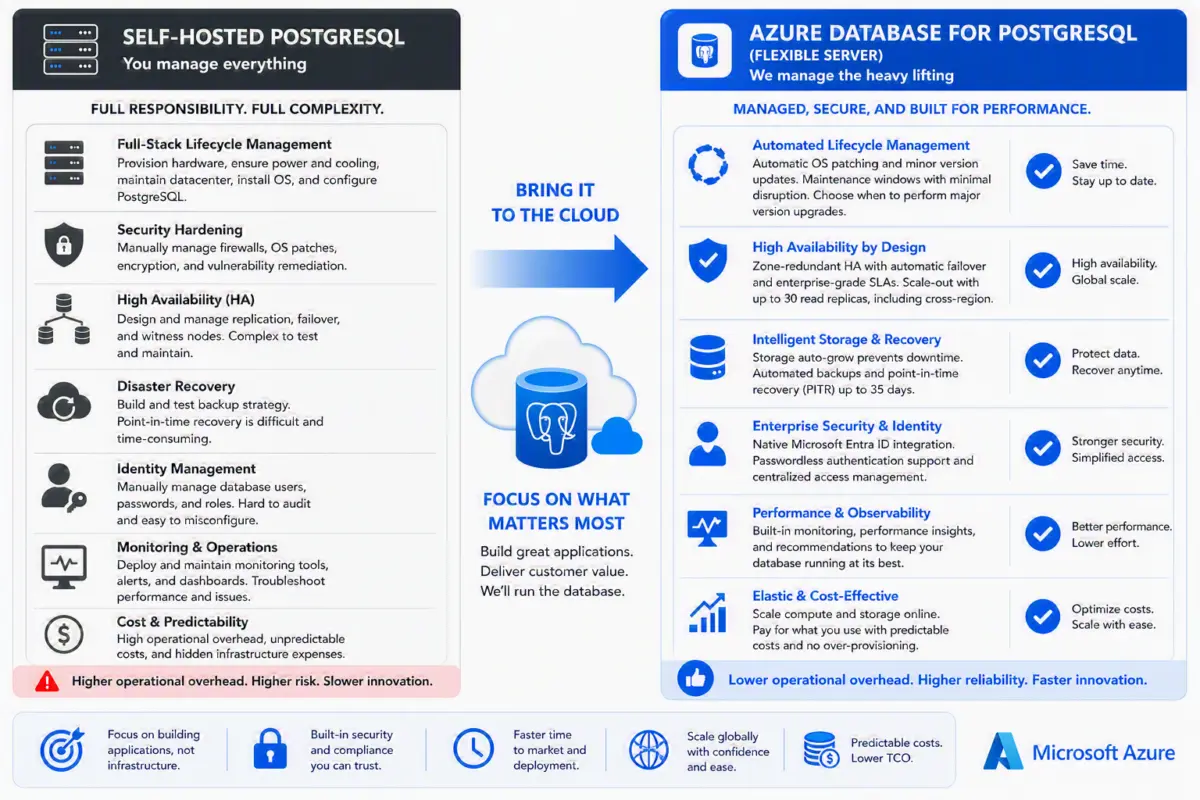
| Operational Vector | Self-Managed PostgreSQL (IaaS / VM) | Managed PostgreSQL Service (PaaS / Azure) |
|---|---|---|
| Authentication & Identity | Manual user creation; custom script rotation; static passwords; isolated local credential files. | Native Microsoft Entra ID (formerly Azure AD) integration; passwordless authentication; centralized identity lifecycle management. |
| Patching & Maintenance | Requires manual scheduling, testing, and downtime execution for host OS vulnerabilities and Postgres minor versions. | Automated OS updates and minor version upgrades scheduled within custom maintenance windows; zero-downtime options on cloud-native engines. |
| High Availability (HA) | Requires building and maintaining cluster solutions (e.g., Patroni, etcd, Consul, pg_auto_failover). Complex witness node logic. |
Configurable warm/hot standby across Availability Zones with automated health probes and automatic, managed failover SLAs. |
| Storage & Backup Recovery | Manual WAL archiving scripts, storage volume sizing, cron-based pg_dump or pg_backrest validation; manual point-in-time restore testing. |
Automated point-in-time restore (PITR) with continuous log backup; automated storage auto-grow; configurable geo-redundant backup storage. |
| Scaling Dynamics | Manual provisioning of larger compute VMs; storage volume expansion requiring filesystem resizing; risk of disk exhaustion outages. | Online compute scaling (vCores/RAM); auto-scaling storage; decoupled, cloud-native storage tiers (e.g., Azure HorizonDB) supporting rapid read-replica expansion. |
| Compliance & Monitoring | Requires building custom log shippers, alerting pipelines (Prometheus/Grafana), SIEM connectors, and CIS baseline hardening. | Out-of-the-box telemetry export to Azure Monitor / Log Analytics; built-in security alerts; pre-aligned compliance certifications (SOC, ISO, HIPAA, PCI-DSS). |
Quantifying the "Operational Tax"
When operating self-managed PostgreSQL environments, technical teams frequently undercount the hours required to maintain system stability and compliance. Key operational burdens include:

- Vacuum & Bloat Management: Managing
pg_autovacuumparameters under heavy write workloads to prevent transaction ID wraparound (wraparound freeze) and table/index bloat. - Failover Validation: Frequently testing consensus mechanisms (e.g.,
etcdorConsulclusters driving Patroni) to ensure split-brain conditions do not occur during network partitions. - Backup Integrity Verification: Regularly pulling backup archives (via
pgBackRestorWAL-G) to an isolated sandbox to perform full restoration tests, verifying point-in-time recovery targets (RTO/RPO). - Security Hardening: Keeping local Linux distributions updated with kernel security patches, monitoring CVE database registries, and managing rotating SSL/TLS certificates across database instances.
Managed services automate these low-level infrastructure tasks, allowing engineers to focus on application-level database optimizations.
Official Statements & Architectural Perspectives
Industry experts and enterprise cloud architects highlight that selecting a deployment model is driven primarily by an organization’s core focus and architectural needs.
"The decision to choose between self-managed and managed PostgreSQL rarely comes down to engine capability—it comes down to enterprise resource allocation," explains Dr. Aris Thorne, Lead Cloud Infrastructure Architect at Global Systems Strategy. "Every engineering hour spent monitoring disk bloat, orchestrating failovers, or validating OS kernel patches is an hour not spent optimizing domain data models or improving application throughput. Managed services like Azure Database for PostgreSQL allow organizations to convert fixed operational labor into agile application delivery."
Security and regulatory experts emphasize the zero-trust advantages inherent in modern PaaS offerings:
"In enterprise environments, credential leakage remains a primary attack vector," notes Elena Rostova, Principal Cybersecurity Analyst at SecureData Enterprise. "Operating PostgreSQL on infrastructure where DBAs manage static passwords or local config files introduces continuous risk. Managed platform integration with enterprise identity providers—such as Microsoft Entra ID—enables true passwordless authentication and centralized, RBAC-driven access control. This significantly shrinks the attack surface while simplifying compliance auditing."
Addressing edge cases where self-management remains necessary, technical specialists point out specific system requirements:
"Self-management remains a valid, strategic choice when an application depends on deep kernel-level customizations, non-standard C-language third-party extensions, or ultra-customized physical deployments," states Marcus Vance, Senior Principal Database Engineer. "If your workload demands custom operating system tweaks or specialized extensions not yet approved in managed cloud environments, the operational tax of self-hosting becomes a deliberate, necessary trade-off for absolute platform control."
Future Outlook & Strategic Decision Framework
As enterprise architecture evolves, database management is shifting away from low-level server administration toward automated, cloud-native data platforms. The emergence of AI-driven workloads and large language models (LLMs) requires databases that integrate seamlessly with vector search extensions (such as pgvector), scale storage and compute independently, and support sub-second query latency without operational overhead.
Strategic Allocation of Engineering Capacity
Organizations must evaluate their engineering team’s primary role:
Self-Managed Model (IaaS / On-Prem)          Managed Services Model (PaaS)
+------------------------------------+       +------------------------------------+
| 60% Infrastructure & Maintenance   |       | 15% Governance & Access Policies   |
| (OS, Patroni, WAL, Upgrades, HA)   |       +------------------------------------+
+------------------------------------+       | 85% Value-Add Engineering          |
| 40% Value-Add Engineering          |       | (Data Modeling, Query Performance, |
| (Schema, Queries, App Features)    |       |  pgvector, App Delivery)           |
+------------------------------------+       +------------------------------------+
Transitioning to a managed model shifts team capacity away from infrastructure maintenance and toward high-value activities, such as query performance tuning, index optimization, schema design, and domain modeling.
Decision-Maker Evaluation Framework
Technical leaders should evaluate the following questions before selecting their PostgreSQL operating model:
                           [Evaluate Workload Requirements]
                                          │
                                          ▼
                   /----------------------------------------------
                  / Does the workload require custom C-extensions,
                 <  unsupported OS access, or hyper-specific kernel >
                                parameter flags?                  /
                   ----------------------------------------------/
                                 │                  │
                        YES      │                  │      NO
                                 ▼                  ▼
                    [Choose Self-Managed]   /-------------------------
                    • Full OS Control      / Does your team have dedicated
                    • Custom Extensions   <  24/7 DBA capacity for HA,  >
                    • Absolute Isolation    patching, & recovery?     /
                                            -------------------------/
                                                  │             │
                                         YES      │             │      NO
                                                  ▼             ▼
                                        [Evaluate TCO vs. Ops]  [Choose Managed PaaS]
                                        • Calculate Total     • Azure DB for Postgres
                                          Cost of Ownership   • Azure HorizonDB
                                                              • Focus on App Delivery
1. Technical & Architectural Dependencies
- Do your applications require custom OS-level access, unapproved third-party C-language extensions, or specialized Linux kernel modifications?
- If Yes: Self-managed PostgreSQL provides the necessary low-level access.
- If No: Managed services offer a broader feature set with less operational overhead.
2. Operational Capacity & Specialist Availability
- Does your organization maintain a 24/7 Site Reliability Engineering (SRE) or Database Administration team capable of handling low-level database incidents, WAL corruption, and cross-zone failovers?
- If No: A managed service provides built-in SLAs, automated failover, and managed disaster recovery capabilities.
3. Security, Governance, and Identity
- Is your organization adopting Zero Trust security principles requiring central identity management, single sign-on (SSO), and passwordless database authentication?
- If Yes: PaaS options like Azure Database for PostgreSQL provide native integration with Microsoft Entra ID out of the box.
4. Performance & Scale Requirements
- Does your workload require independent, instant scaling of compute and storage, rapid read-replica expansion, or continuous multi-zone resilience?
- If Yes: Next-generation options like Azure HorizonDB provide a cloud-native architecture optimized for scale-demanding, mission-critical workloads.
Conclusion
The choice between self-managed and managed PostgreSQL is fundamentally an allocation of engineering resources, risk, and control. While self-management provides fine-grained platform control, it requires significant ongoing investment in infrastructure engineering.
For most enterprise workloads, managed cloud services—such as Azure Database for PostgreSQL and Azure HorizonDB—offer a more efficient path forward. By shifting platform management, security baselines, and high-availability orchestration to managed cloud infrastructure, organizations can direct their engineering talent toward building resilient, high-performing applications that drive core business value.