





Executive Overview
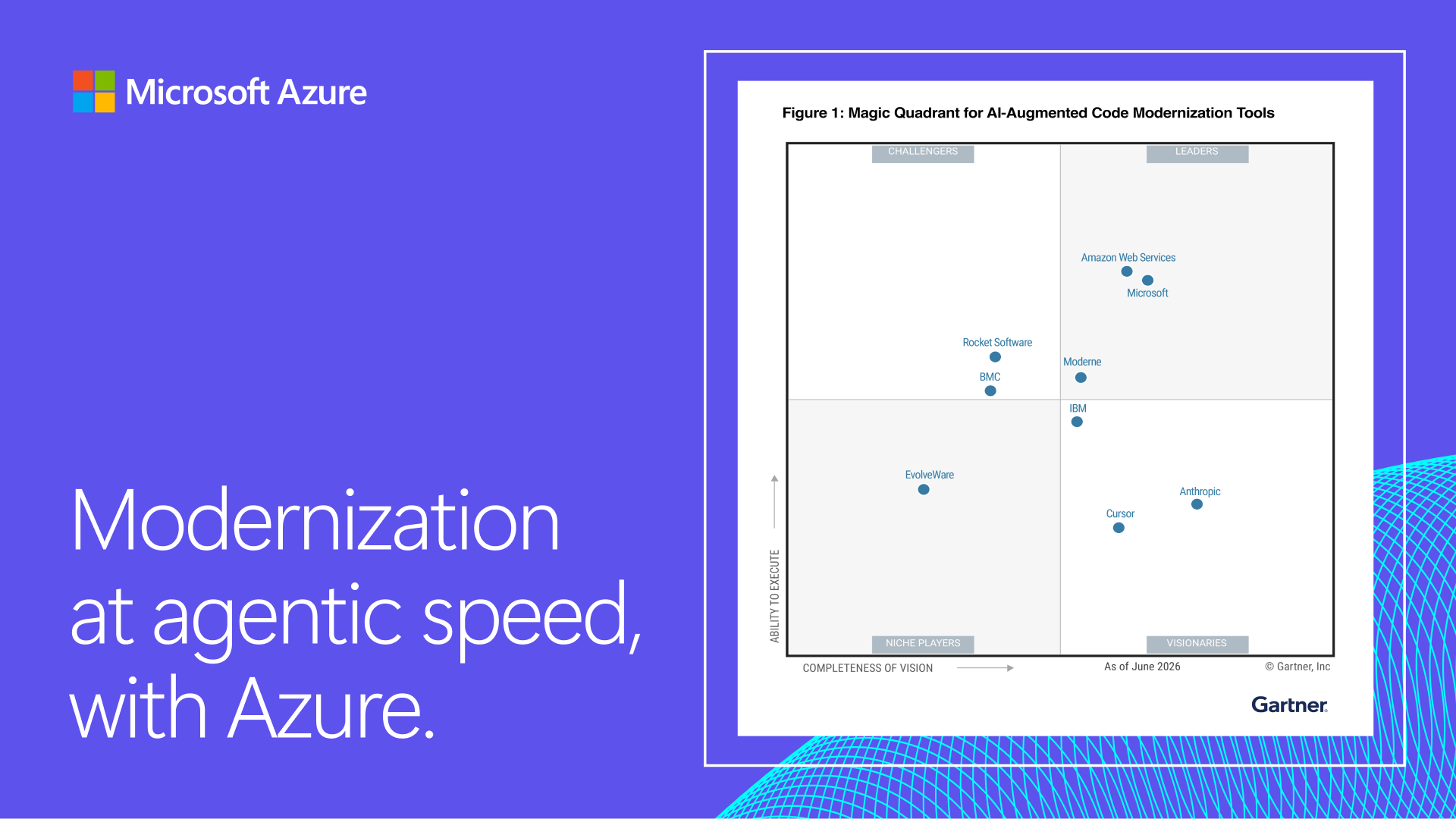
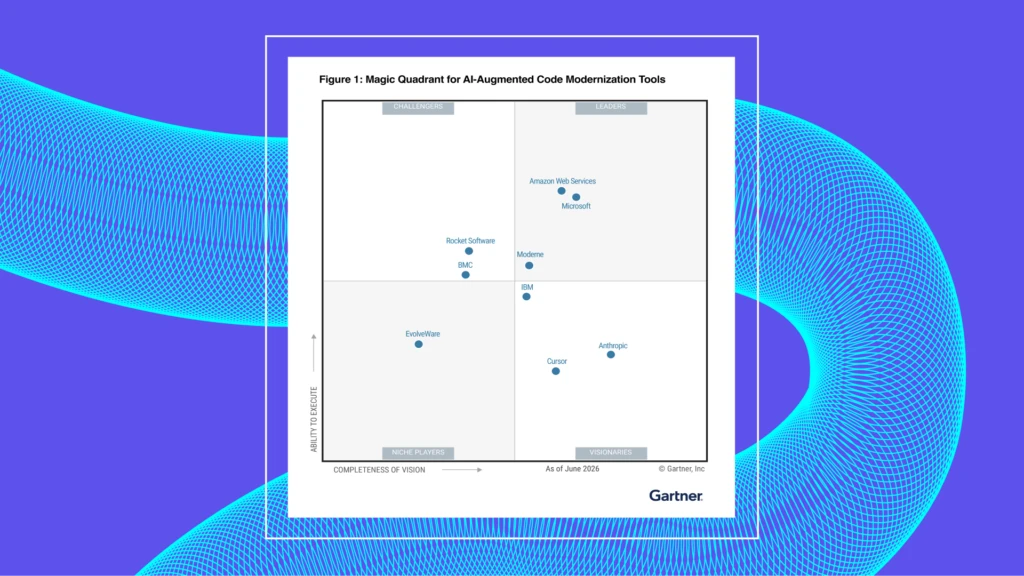
In a milestone report evaluating the evolving landscape of enterprise software engineering, Gartner, Inc. has named Microsoft a Leader in its inaugural 2026 Gartner® Magic Quadrant™ for AI-Augmented Code Modernization Tools. Published on August 3, 2026, by analysts Prasanna Lakshmi Narasimha, Erin Khoo, Deacon D.K. Wan, and Wei Jin, the report marks a formal recognition of a critical industry transition: the integration of specialized AI agents, generative AI, and deterministic code analysis to solve the decades-old problem of legacy technical debt.
For decades, enterprise modernization was regarded as an unavoidable financial tax—a slow, high-risk operational necessity that drained engineering resources away from value-generating innovation. The emergence of agentic AI has inverted this economic equation. Rather than serving as a prerequisite cost before innovation can begin, modernizing legacy infrastructure has become the fastest pipeline for enterprise AI adoption.
By leveraging an end-to-end agentic ecosystem built around GitHub Copilot, the Modernize Command Line Interface (CLI), and Azure Copilot, Microsoft has repositioned code refactoring from a multi-year consulting engagement into an automated, developer-governed workflow capable of executing in days or weeks. This strategic repositioning reflects a fundamental market shift: every enterprise modernization decision is now inherently an AI readiness decision.
Detailed Chronology & Strategic Context
The Legacy Dilemma: Decades of Accumulated Technical Debt
Enterprise IT departments have long operated under a persistent constraint: the presence of core legacy systems that power essential operations but are too fragile or complex to rewrite manually. Applications constructed on aging frameworks—such as early .NET Framework iterations, obsolete Java runtimes, and monolithic architectures—accumulate substantial security vulnerabilities, operational inefficiencies, and compliance overhead over time.
+-----------------------------------------------------------------------+
|                    TRADITIONAL MODERNIZATION TAX                      |
|  Legacy Systems --> Compounding Debt --> High Cost / High Risk       |
|  (Monolithic Code)    (Unpatched Bugs)   (Multi-Year Consulting)      |
+-----------------------------------------------------------------------+
                                   │
                                   ▼
+-----------------------------------------------------------------------+
|                    AGENTIC AI PARADIGM SHIFT                          |
|  Legacy Code --> Modernize CLI & Agents --> Cloud-Native AI Platform  |
|  (Deterministic)   (GitHub Copilot IDE)     (Azure-Ready Infrastructure)|
+-----------------------------------------------------------------------+
Historically, software engineering leaders faced a zero-sum trade-off:
- Allocate capital toward continuous innovation, leaving underlying architecture to age and decay.
- Commit massive engineering hours to manual refactoring, freezing feature development for quarters or years.
Because manual code migration carried severe risks of breaking functional dependencies, modernization proposals were routinely deferred. As a result, technical debt compounded, widening the gap between legacy on-premises workloads and cloud-native environments optimized for machine learning and real-time analytics.
The Technological Turning Point: From Generative Text to Agentic Orchestration
The catalyst for Gartner’s creation of this new Magic Quadrant category is the transition from raw generative AI code completion to agentic workflows. Early iterations of Large Language Models (LLMs) excelled at generating isolated code snippets but struggled with repository-wide context, dependency graph resolution, and deterministic execution.
The current architecture addresses these limitations by pairing generative AI with deterministic code analysis engine capabilities. Instead of relying solely on probabilistic language predictions, modern systems utilize specialized AI agents that scan entire codebases, model abstract syntax trees (ASTs), construct dependency maps, and execute targeted transformations under human supervision.
This advancement allowed Microsoft to construct an end-to-end framework capable of evaluating macro-architectural requirements across hundreds of application repositories simultaneously while preserving developer control at the line-of-code level.
Deconstructing the Engine: How Agentic Code Modernization Works
Microsoft’s framework operates through a two-tiered architectural strategy designed to bridge macro-level enterprise planning with micro-level code execution inside the integrated development environment (IDE).
 ┌──────────────────────────────────────────────────────────────────┐
 │                    1. MACRO ORCHESTRATION                        │
 │   Architects / Leads ──► Modernize CLI / Modernization Agent     │
 │                          • Multi-repo codebase assessment        │
 │                          • Dependency & runtime mapping          │
 │                          • Automated upgrade plan generation     │
 └─────────────────────────────────┬────────────────────────────────┘
                                   │
                                   ▼
 ┌──────────────────────────────────────────────────────────────────┐
 │                     2. MICRO EXECUTION                           │
 │   Developers ─────────► GitHub Copilot in the IDE                │
 │                          • Automated runtime refactoring         │
 │                          • Dependency migration to Azure         │
 │                          • Infrastructure-as-Code generation     │
 └─────────────────────────────────┬────────────────────────────────┘
                                   │
                                   ▼
 ┌──────────────────────────────────────────────────────────────────┐
 │               3. VALIDATION & DEPLOYMENT                         │
 │   CI/CD Pipelines ────► Deterministic Analysis & Testing          │
 │                          • Human-in-the-loop review              │
 │                          • Automated testing validation          │
 │                          • Direct Azure Deployment               │
 └──────────────────────────────────────────────────────────────────┘
1. Macro Orchestration via the Modernize CLI
At the architectural level, application owners and systems architects utilize the Modernization Agent accessible through the Modernize CLI. This component executes system-wide scans across extensive software portfolios to:
- Evaluate existing codebases for runtime vulnerabilities, deprecated dependencies, and architectural bottlenecks.
- Automatically construct dependency graphs mapping how components interact.
- Generate structured, application-specific migration blueprints tailored to target cloud environments.
2. Micro Execution via GitHub Copilot
Once the macro-plan is generated, it flows directly into the developer’s workspace. Working within the IDE, developers utilize GitHub Copilot to implement the transformation plan step-by-step:
- Runtime & Framework Upgrades: Automated refactoring of legacy calls (e.g., migrating legacy .NET Framework applications to modern, cross-platform .NET, or updating legacy Java EE setups to modern Spring Boot frameworks).
- Cloud Service Binding: Converting local file systems, database connectors, and state management mechanisms into cloud-native equivalents (such as Azure SQL, Azure App Service, or Blob Storage).
- Infrastructure-as-Code (IaC) Generation: Automatically writing Terraform or Bicep scripts to provision required cloud infrastructure alongside code changes.
3. Deterministic Analysis and Human-in-the-Loop Safeguards
A core design requirement of this architecture is the deliberate retention of human oversight. Probabilistic AI models are constrained by deterministic analysis engines:
- Every automated code transformation must pass strict static analysis checks before pull request generation.
- Structural changes are validated against existing unit, integration, and performance test suites within the customer’s CI/CD pipelines.
- Developers retain total visibility, with full authority to accept, modify, or reject agent-generated recommendations.
Supporting Context & Metrics
Quantifiable Performance Metrics
Data collected from enterprise deployments highlights a step-function improvement in modernization velocity, shifting timelines from quarters down to weeks or days.
| Performance Dimension | Historical Baseline (Manual) | Agentic AI Benchmark | Impact Metrics |
|---|---|---|---|
| Migration Timeframe | Months to Years | Days to Weeks | Up to 70% reduction in total project duration |
| Developer Labor Effort | High manual refactoring | Agent-guided execution | 50% decrease in total engineering effort |
| Code Refactoring Scale | Incremental / Limited | Large-scale automation | 500,000+ lines of code transformed in weeks |
| Developer Adoption | N/A | Rapid extension uptake | >1.4 million developer installations for Java/Azure tooling |
These operational statistics demonstrate that agentic AI fundamentally alters the unit economics of enterprise code transformation.
Economic ROI: Unlocking the AI Gateway
The primary driver for legacy code transformation is no longer merely cost avoidance—it is the imperative to achieve AI readiness. Legacy monolithic architectures present severe barriers to modern AI integrations:
- Data Isolation: Legacy code bases frequently encapsulate operational data in proprietary formats, blocking modern Retrieval-Augmented Generation (RAG) pipelines.
- Scalability Bottlenecks: Monolithic infrastructure cannot dynamically scale computing resources to handle bursty AI workloads.
- Security & Compliance Risks: Unsupported frameworks introduce security liabilities that violate modern zero-trust enterprise architecture requirements.
By automating the removal of technical debt, organizations clear the path toward embedding real-time AI capabilities, intelligent agents, and advanced analytics directly into core enterprise applications.
Official Statements & Case Studies
Enterprise Case Study: SAP Labs China
The real-world impact of agentic code modernization is demonstrated by major enterprise deployments. SAP Labs China, a division managing mission-critical enterprise enterprise software components, integrated Microsoft’s GitHub Copilot modernization agent into its core Java refactoring pipeline.
Evaluating the transition, Dr. Richard Cai, Managing Director at SAP Labs China, stated:
"GitHub Copilot’s modernization agent significantly saved time on our Java modernization effort from days down to mere hours at SAP Labs. It runs seamlessly at scale, significantly reducing manual complications for our developers. The modernization agent is now an essential pillar of our modernization effort."
This shift—reducing developer labor from multi-day manual refactoring cycles to automated execution completed in hours—underscores the utility of agentic automation across large-scale software portfolios.
Governance, Compliance, and Ecosystem Integration
To maintain enterprise-grade trust, Microsoft has anchored its agentic modernization stack within the broader governance framework of Microsoft Azure. This structural pairing ensures that code transformation activities automatically align with enterprise regulatory demands:
- Data Privacy Assurances: Customer code repos used during modernization sessions are protected under strict enterprise privacy guarantees and are not used to train public foundational models.
- Integrated Risk Reduction: By combining vulnerability remediation directly into the refactoring workflow, systems lower operational, data, and security exposure simultaneously.
Future Outlook: The Next Horizon in AI-Driven Development
Strategic Trajectory and Expansion
The recognition of Microsoft as a Leader in the 2026 Gartner Magic Quadrant for AI-Augmented Code Modernization Tools marks an initial milestone in a broader evolution of the software development lifecycle (SDLC). The roadmap for agentic code transformation focuses on several core vectors:
- Expanded Framework and Language Portfolios: Expanding deep agentic refactoring capabilities across older enterprise languages, including legacy COBOL systems, older C++ dialects, and custom internal frameworks.
- Autonomous End-to-End Migration Pipelines: Transitioning from developer-initiated agent workflows toward fully automated, background CI/CD modernization agents capable of recommending and drafting framework upgrades continuously as new security dependencies emerge.
- Deeper Azure Copilot Integration: Tightly integrating application refactoring engines with live cloud runtime telemetry, allowing AI agents to dynamically refactor code based on real-world performance, memory consumption, and network latency metrics observed in production.
Long-Term Industry Implications
As software engineering leaders adapt to this new paradigm, the gap between organizations actively addressing technical debt and those relying on legacy maintenance models is expected to widen rapidly.
Organizations embracing agentic modernization gain a structural velocity advantage: they can continuously align their software architecture with modern cloud and AI capabilities without interrupting ongoing business operations. Conversely, organizations stuck in manual refactoring models risk devoting an increasing portion of their engineering budgets strictly to maintaining aging infrastructure.
In this context, agentic code modernization has evolved beyond a pure engineering utility. It has established itself as an essential strategic discipline for enterprises seeking to maintain competitive agility in an AI-driven economy.
Disclaimers & Citation Context
- Gartner ® Magic Quadrant™ for AI-Augmented Code Modernization Tools, Prasanna Lakshmi Narasimha, Erin Khoo, Deacon D.K Wan, Wei Jin, 3 August 2026.
- Gartner does not endorse any vendor, product or service depicted in its research publications, and does not advise technology users to select only those vendors with the highest ratings or other designation. Gartner research publications consist of the opinions of Gartner’s research organization and should not be construed as statements of fact. Gartner disclaims all warranties, expressed or implied, with respect to this research, including any warranties of merchantability or fitness for a particular purpose.
- Gartner and Magic Quadrant are registered trademarks and service marks of Gartner, Inc. and/or its affiliates in the U.S. and internationally and are used herein with permission. All rights reserved.