








Executive Overview
The landscape of professional and semi-professional videography has undergone a quiet revolution over the past decade. Where high-quality audio acquisition once demanded bulky shotgun microphones, dedicated boom operators, and complex multi-channel field recorders, modern content creators and independent journalists now rely on ultra-compact, wireless clip-on systems. This technological shift has democratized broadcasting, allowing solo operators to capture broadcast-grade dialogue in challenging environments.
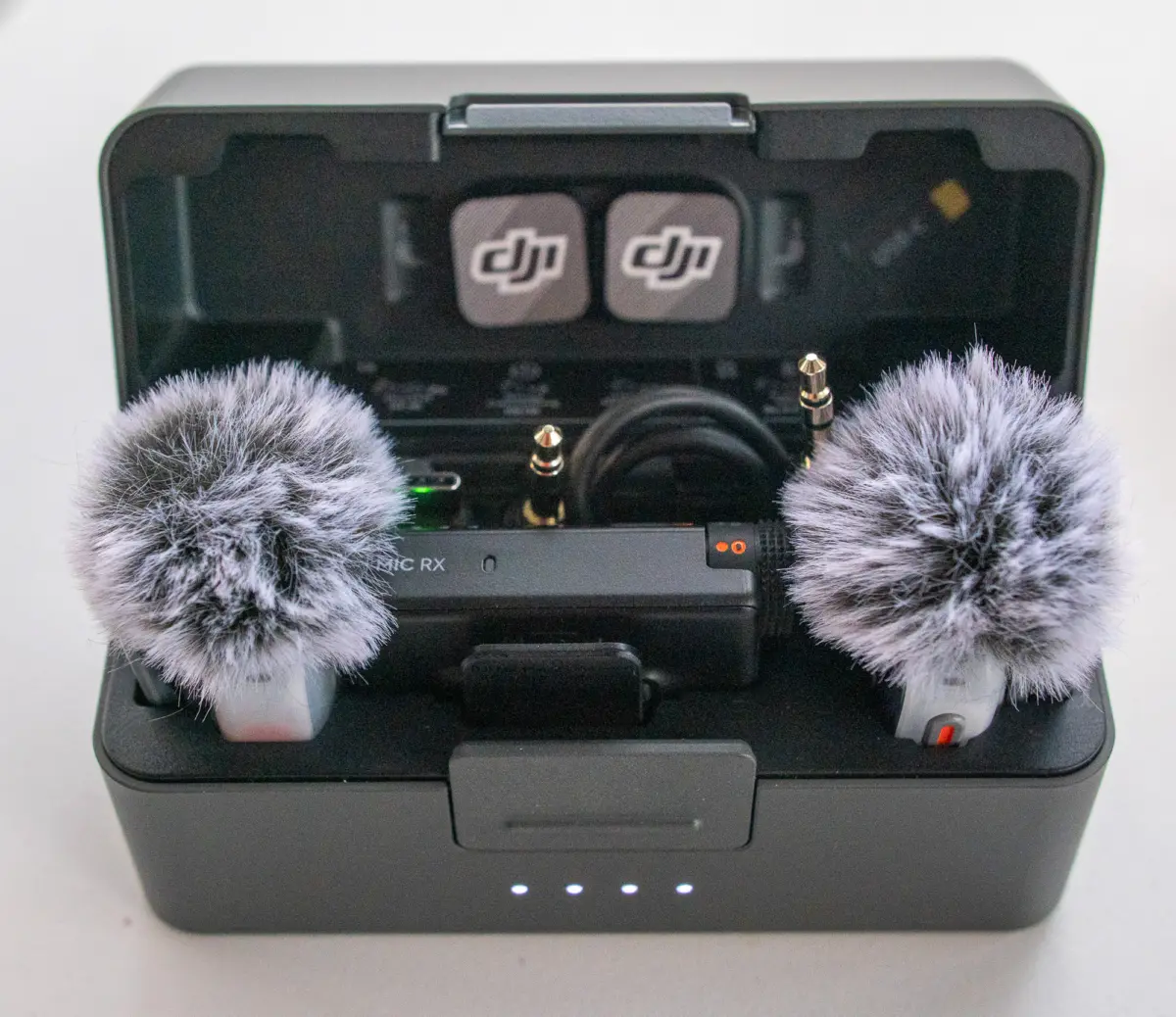
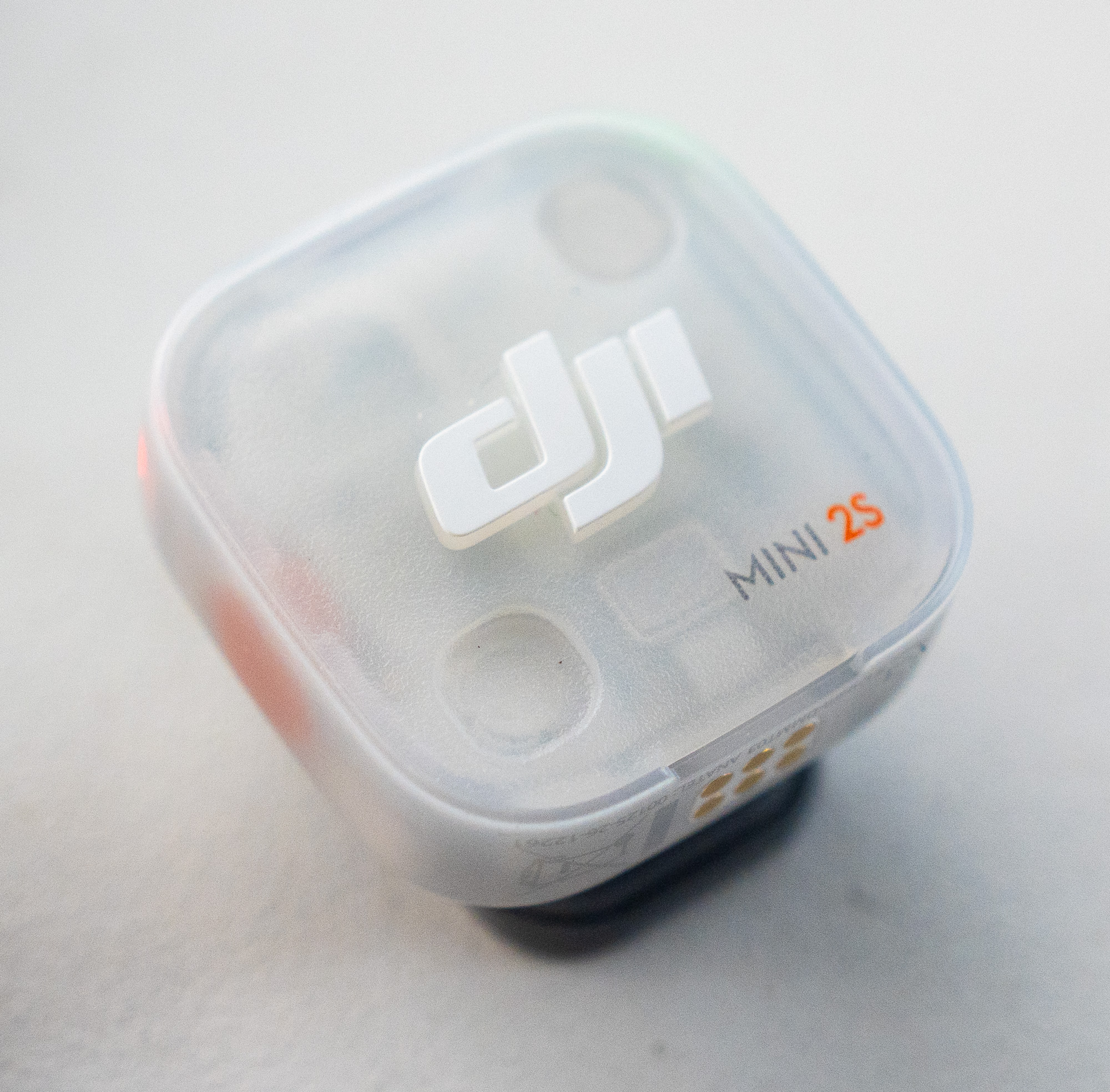
At the vanguard of this transition is DJI. Known globally for its dominance in aerial imaging and stabilization platforms, the company has aggressively expanded its footprint in the wireless audio market. The release of the DJI Mic Mini 2S represents a critical convergence point in this product category. Weighing a mere 12 grams, the Mic Mini 2S attempts to solve the historic trade-off between physical footprint and professional-grade internal architecture.
By integrating 32-bit float onboard recording, 14.5GB of internal storage, and support for up to four simultaneous transmitters, the Mic Mini 2S directly challenges larger, heavier industry standards. However, this miniaturization comes with engineering compromises, including the omission of auxiliary inputs for external lavalier microphones and the removal of dedicated receiver screens. This analysis investigates the technical capabilities, competitive positioning, and broader market implications of DJI’s latest audio offering.
Detailed Chronology: The Evolution of DJI’s Wireless Audio Ecosystem
To understand the positioning of the Mic Mini 2S, it is essential to trace the rapid, iterative development of DJI’s wireless microphone portfolio. Within a span of a few product generations, DJI has fragmented its lineup to target distinct user demographics, ranging from casual mobile vloggers to high-end documentary filmmakers.
[2022] DJI Mic (Original)
  └─ First-generation dual-transmitter system (30g transmitters, 24-bit audio, 8GB storage)
       │
       ▼
[2023] DJI Mic 2
  └─ Premium upgrade (28g, 32-bit float recording, 8GB storage, transparent aesthetic)
       │
       ├─► [Late 2023] DJI Mic Mini (First Gen)
       │     └─ Ultra-lightweight (10g, 24-bit audio, no internal storage, magnetic mount)
       │
       ▼
[2024] DJI Mic 3
  └─ Multi-person flagship (16g, 32-bit float, 32GB storage, 4-transmitter support, Timecode)
       │
       ▼
[Late 2024] DJI Mic Mini 2S
  └─ Hybrid ultra-compact (12g, 32-bit float, 14.5GB storage, 4-transmitter support, no Timecode)
Phase 1: The Original DJI Mic (2022)
DJI entered the wireless audio market with the original DJI Mic, a direct competitor to the Røde Wireless GO series. It featured a dual-transmitter-to-one-receiver configuration, housed in a convenient charging case. The 30-gram transmitters recorded 24-bit audio and featured 8GB of non-expandable internal storage, acting as a crucial safety net against wireless signal dropouts.
Phase 2: Professionalization and Miniaturization (2023–2024)
With the launch of the DJI Mic 2, the brand introduced 32-bit float internal recording, a larger touchscreen receiver, and improved analog preamps. Recognizing that a subset of creators demanded a virtually invisible microphone, DJI branched its development into the "Mini" series. The first-generation DJI Mic Mini stripped away internal storage and 32-bit float processing to achieve a 10-gram footprint, relying entirely on real-time wireless transmission to a receiver or smartphone.
Phase 3: The Multi-Transmitter and High-Capacity Era (2024)
As production demands evolved toward multi-subject interviews and panel discussions, DJI launched the Mic 3. This system introduced support for up to four transmitters connected to a single receiver, backed by 32GB of internal storage per transmitter and SMPTE timecode support.
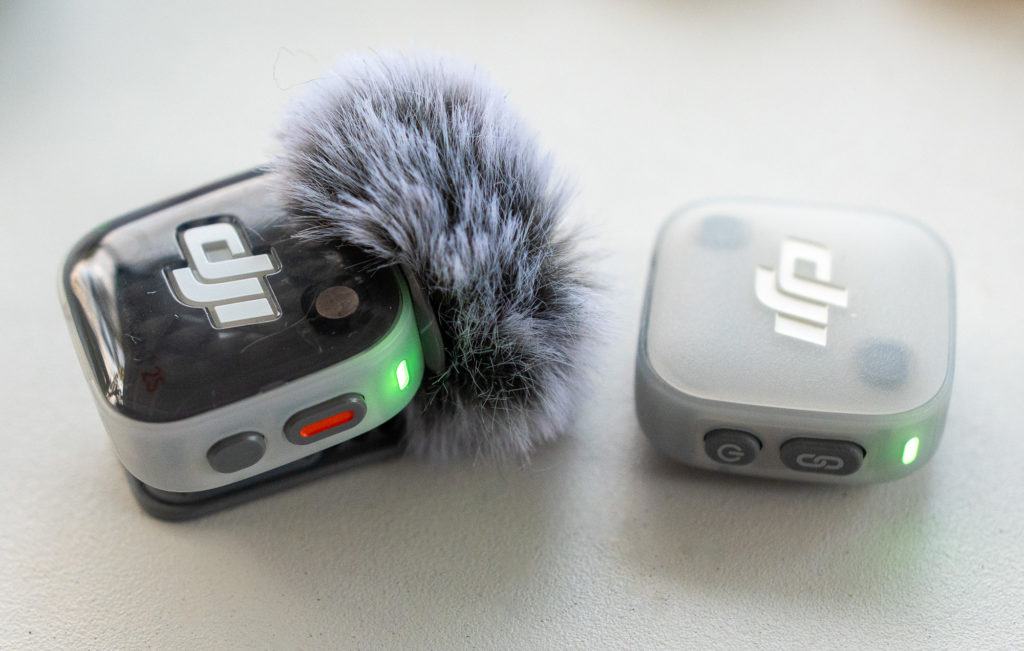
The DJI Mic Mini 2S is the latest evolutionary step, acting as a hybrid. It successfully shoehorns the premium internal recording capabilities of the Mic 3 (32-bit float, multi-transmitter sync) into the ultra-lightweight, square form factor of the Mic Mini series.
Supporting Context & Metrics
Comparative Hardware Analysis
To evaluate how the Mic Mini 2S fits into the current marketplace, it must be measured against its predecessors and stablemates. The table below outlines the core technical specifications across DJI’s wireless audio portfolio:
| Model | Physical Form Factor | Transmitter Weight | Mounting Mechanism | Maximum Audio Resolution | Supported Transmitters | Internal Storage Capacity | Physical Ports (On Transmitter) |
|---|---|---|---|---|---|---|---|
| DJI Mic | Rectangular | 30g | Integrated Clip | 24-bit | 2 | 8 GB | 3.5mm Minijack + USB-C |
| DJI Mic Mini | Square | 10g | Magnetic / Clip | 24-bit | 2 | None | None |
| DJI Mic 2 | Rectangular | 28g | Integrated Clip | 32-bit Float | 2 | 8 GB | 3.5mm Minijack + USB-C |
| DJI Mic Mini 2 | Square | 11g | Magnetic / Clip | 24-bit | 2 | None | None |
| DJI Mic 3 | Square | 16g (inc. magnet) | Magnetic | 32-bit Float | 4 | 32 GB | None |
| DJI Mic Mini 2S | Square | 12g | Magnetic | 32-bit Float | 4 | 14.5 GB | None |
Kit Configurations: Mobile vs. Camera Systems
DJI distributes the Mic Mini 2S in two primary configurations, each engineered for distinct production environments:
- The Mobile Kit: Designed for smartphone-centric workflows, this kit includes a compact receiver that interfaces directly via USB-C or Lightning. While highly portable, this receiver lacks physical analog outputs and is optimized for rapid-turnaround social media production.
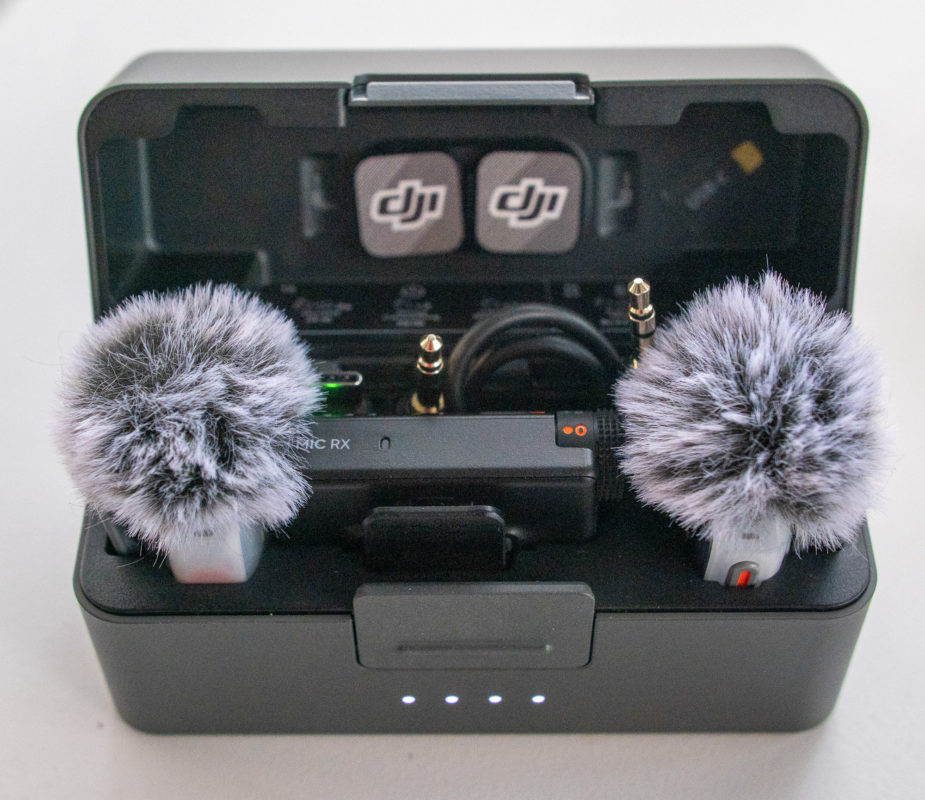
- The Camera Kit: Engineered for traditional mirrorless and cinema camera systems. The receiver in this kit features a 3.5mm TRS analog output for direct-to-camera recording. Crucially, the Camera Kit’s charging case is physically deeper, allowing operators to store the transmitters with their wind muffs (deadcats) attached—a minor but significant workflow improvement for field production.
Technical Deep Dive: Audio Processing & Wireless Performance
The Power of 32-Bit Float Recording
The defining technical advancement of the Mic Mini 2S over previous compact iterations is its 32-bit float onboard recording.
Unlike traditional 24-bit fixed-point audio, which has a maximum dynamic range of 144 dB, 32-bit float audio offers an astronomical dynamic range of approximately 1,528 dB. In practical terms, this means the analog-to-digital converters (ADCs) inside the Mic Mini 2S cannot be overloaded by sudden acoustic transients.
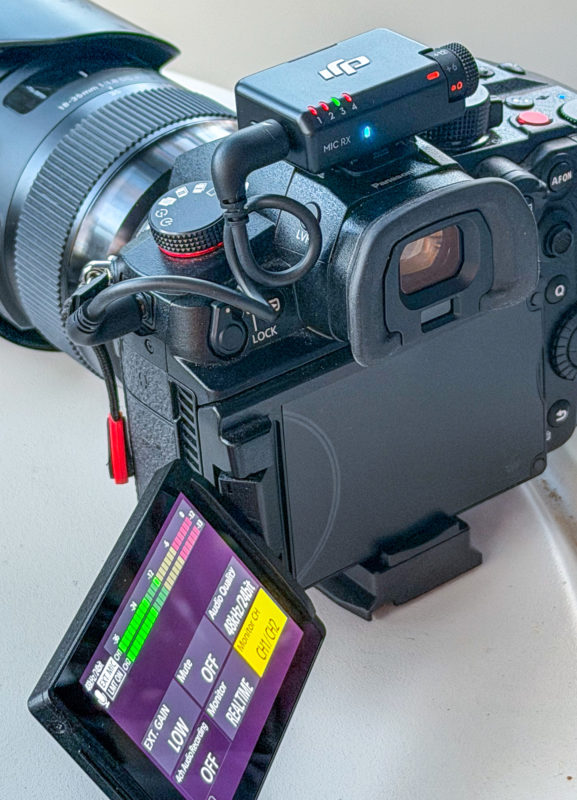
If a subject transitions from a whisper to a scream, a traditional 24-bit system will clip at the analog or digital stage, resulting in irreversible distortion. With 32-bit float, even if the real-time transmission to the camera clips, the backup file recorded onto the transmitter’s 14.5GB internal storage retains the entire waveform. During post-production, an editor can simply lower the gain of the clipped section to restore clean, undistorted audio.
Traditional 24-Bit Fixed Recording:
[Whisper: OK] ───► [Normal Speech: OK] ───► [Loud Scream: DIGITAL CLIPPING / DISTORTION]

32-Bit Float Recording (Mic Mini 2S):
[Whisper: OK] ───► [Normal Speech: OK] ───► [Loud Scream: Signal Exceeds 0dB] ───► [Post-Production: Gain Reduced, Audio Fully Recovered]
Transmission Range and Frequency Management
The Mic Mini 2S employs DJI’s proprietary wireless transmission technology, operating on the crowded 2.4GHz ISM band. To mitigate interference in RF-dense urban environments, the system utilizes adaptive frequency hopping.
The transmission metrics vary significantly based on the chosen receiver and connection protocol:
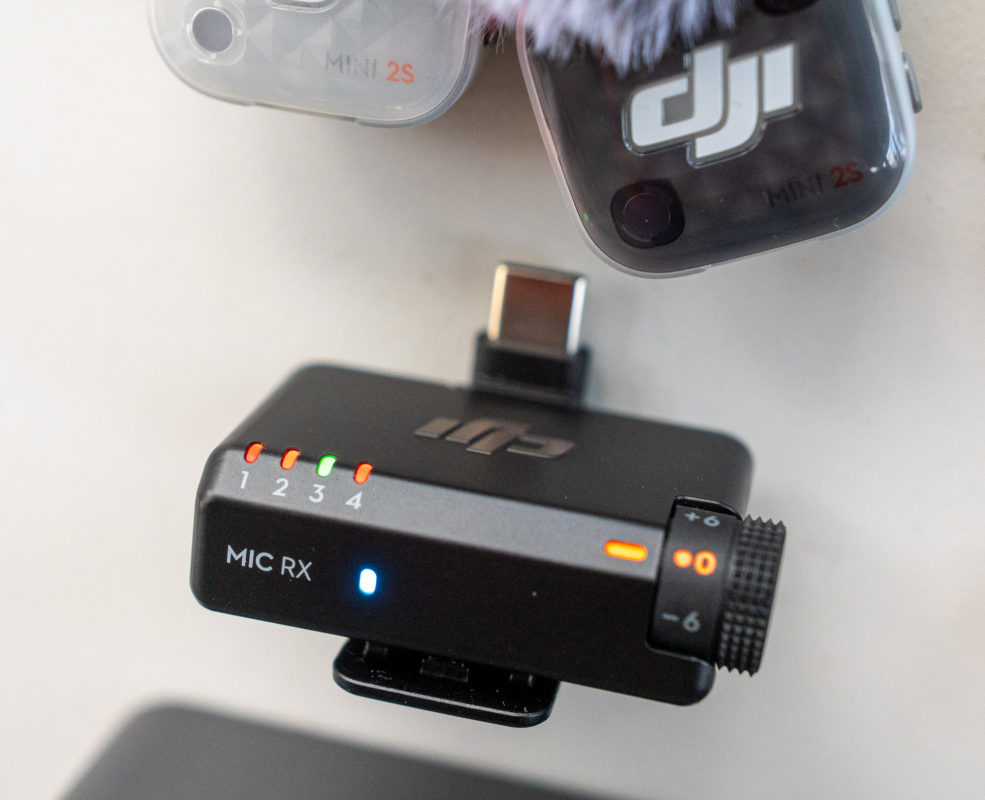
- Camera Receiver (Camera Kit): Achieves a maximum line-of-sight transmission range of up to 400 meters under optimal conditions.
- Mobile Receiver (Mobile Kit) – Green LED Mode: Optimizes compatibility for all DJI mini transmitters, delivering a 300-meter range.
- Mobile Receiver (Mobile Kit) – Blue LED Mode: Activates backward compatibility with the larger Mic 2 and Mic 3 transmitters, though this dual-protocol operation reduces the maximum range to 200 meters.
Onboard Storage and High-Speed Data Retrieval
With 14.5GB of non-volatile NAND flash memory, each Mic Mini 2S transmitter can record up to 22 hours of continuous 32-bit float audio, or 28 hours of 24-bit audio.
To streamline the offloading process, DJI has upgraded the internal controller. When the transmitters are docked in the charging case and connected to a computer via USB-C, data transfer speeds reach up to 34 MB/s. This is approximately twice the transfer speed of the flagship DJI Mic 3, drastically reducing ingest times during media management phases.
Data Offload Transfer Speeds (MB/s):
┌──────────────────────────────────────┐
│ DJI Mic 3: ~17 MB/s                  │
├──────────────────────────────────────┴───────────────────────────┐
│ DJI Mic Mini 2S: ~34 MB/s (2x Faster)                            │
└──────────────────────────────────────────────────────────────────┘
User Experience & Acoustic Evaluation
Ergonomics and Mounting Practicalities
The physical design of the Mic Mini 2S is optimized for concealment and low-profile mounting. At 12 grams, the transmitter does not pull or sag lightweight clothing fabrics—a common issue with heavier 30-gram transmitters. The inclusion of high-strength magnetic backplates allows the microphone to be placed anywhere on a subject’s wardrobe, rather than being restricted to lapels or button lines.
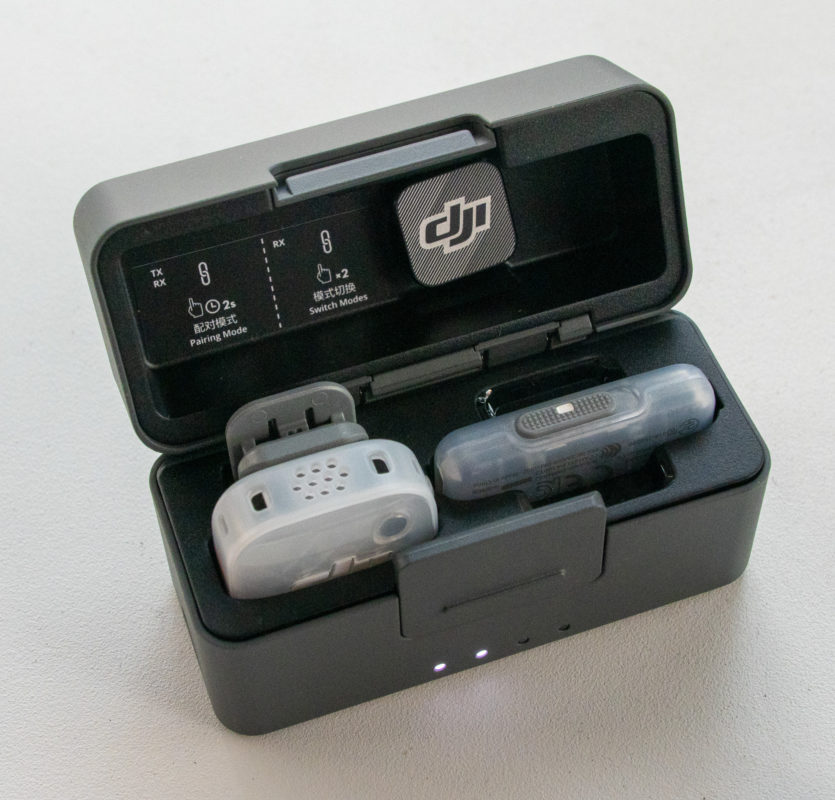
However, the lack of a 3.5mm auxiliary input on the transmitter is a notable omission. Users cannot plug in a traditional wired lavalier microphone. The Mic Mini 2S must act as the acoustic pick-up point itself. While its omnidirectional condenser capsule performs admirably, the physical unit remains visible unless hidden beneath clothing, which introduces acoustic muffling and friction noise.
Acoustic Character: DJI Mic Mini 2S vs. Røde Wireless Pro
Acoustic evaluations reveal a highly competitive, if slightly tailored, sound signature. When compared directly to the Røde Wireless Pro—widely considered a benchmark for professional compact wireless audio—the DJI Mic Mini 2S delivers clean, intelligible dialogue with a slight presence boost in the upper-midrange (around 3kHz to 5kHz). This tuning enhances speech clarity, making it highly suitable for quick-turnaround web content.
By contrast, the Røde Wireless Pro exhibits a flatter frequency response with a richer, more extended low-end response. For narrative filmmaking or high-fidelity vocal tracking, the Røde system provides a more natural foundation. However, for standard interview applications, the differences are negligible after basic equalization.
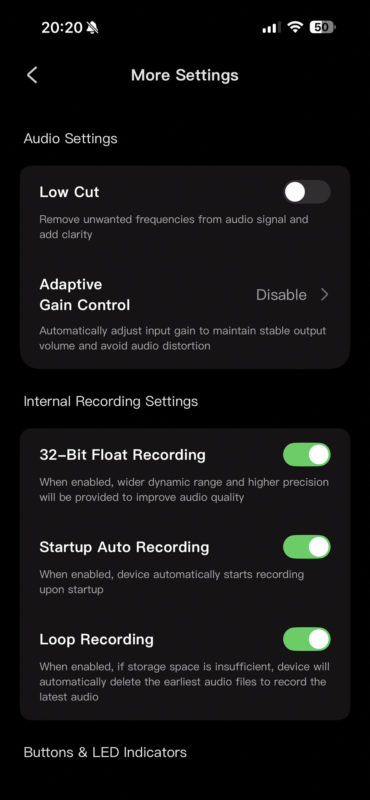
Onboard DSP: Hardware Noise Reduction
For fast-turnaround workflows where audio is edited on mobile devices without extensive post-processing, the Mic Mini 2S offers built-in, real-time noise reduction. Controlled via a physical toggle on the mobile receiver or via the DJI Fly app, the DSP offers two modes:
- Low Noise Reduction: Mild attenuation of low-frequency rumble (e.g., HVAC systems, distant traffic) while maintaining vocal timbre.
- High Noise Reduction: Aggressive gating and spectral subtraction. While highly effective at silencing loud environmental noise, it introduces audible digital artifacts, making vocals sound slightly processed and compressed.
Market Positioning & Future Outlook
The Regulatory Landscape and Geopolitical Hurdles
Despite its technical achievements, the commercial success of the DJI Mic Mini 2S faces significant non-technical headwinds. DJI continues to navigate a highly volatile regulatory environment in the United States.
Due to ongoing national security concerns and legislative efforts targeting Chinese technology firms, new DJI products face import and distribution restrictions in the US market. Consequently, at the time of writing, the Mic Mini 2S is primarily targeted at European, Asian, and Latin American markets. This regulatory vacuum in the US leaves a massive opening for competitors like Røde, Hollyland, and Saramonic to capture the North American market share.
European Market Pricing (Tax-Exclusive Estimates)
In regions where the Mic Mini 2S is commercially available, DJI has positioned it aggressively to undercut established professional systems:
- DJI Mic Mini 2S Camera Kit (Dual Transmitter + Receiver + Case): ~€239 – €259 (Tax-exclusive)
- DJI Mic Mini 2S Mobile Kit (Dual Transmitter + Mobile Receiver + Case): ~€179 – €199 (Tax-exclusive)
- Single Transmitter (Standalone): ~€89 (Tax-exclusive)
Conclusion
The DJI Mic Mini 2S represents a impressive engineering achievement. By cramming 32-bit float internal recording, high-speed data transfer, and multi-transmitter capabilities into a 12-gram chassis, DJI has redefined what creators can expect from an ultra-portable microphone.
While the lack of an external lavalier input and timecode support prevents it from completely replacing high-end wireless systems on traditional film sets, its physical convenience, reliability, and sheer ease of use make it an invaluable tool for modern digital journalism, corporate videography, and independent content creation. If DJI can successfully navigate its current geopolitical challenges, the Mic Mini 2S is poised to set a new benchmark for the global compact audio market.