







Executive Overview
In the hyper-accelerated ecosystem of modern B2B software, artificial intelligence agents, and infrastructure APIs, customer acquisition has become heavily automated. Companies deploy sophisticated marketing automation suites, multi-touch outbound sequences, intent data triggers, and behavior-driven drip campaigns designed to convert signups into paying customers at scale. Yet, beneath the polished veneer of modern growth-hacking infrastructure, a fundamental disconnect has emerged between software vendors and the actual developers and product leaders evaluating their tools.
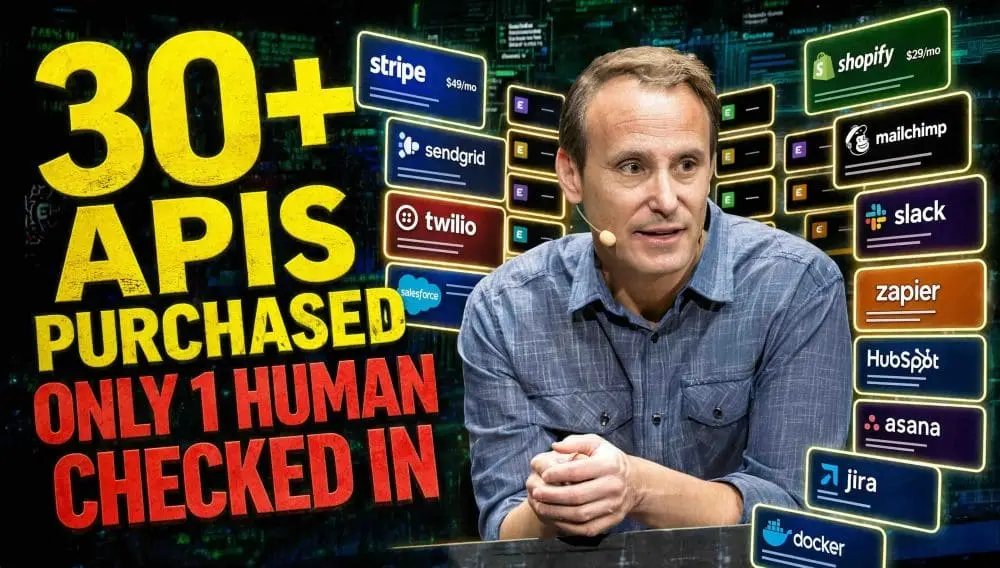
A recent, telling case study from SaaStr—which currently runs over 21 AI agents in production and is building SaaStr AI Connect atop them—lays bare this systemic failure. Over the course of a single year, SaaStr’s leadership signed up for more than 30 distinct API providers spanning search, data enrichment, structured data parsing, email infrastructure, model inference, and cloud storage.
Out of those 30+ enterprise-grade and developer-focused companies, exactly one checked in to see if the product was working for its intended use case.
The remaining vendors relied on automated marketing sequences, aggressive upselling triggers based on credit card billing thresholds, or—most commonly—total silence. In stark contrast, a single four-sentence email from a product manager at Exa, offering $50 in API credits for candid feedback, successfully unlocked a comprehensive, 400-word production specification, detailed technical benchmarks, throughput constraints, and a design-partner relationship.
This investigation explores the anatomy of that interaction, dissects why traditional software-as-a-service (SaaS) onboarding playbooks are failing technical buyers, and outlines how product-led growth (PLG) teams can overhaul their engagement strategies to capture invaluable user insights before competitors even notice a new account has gone live.
Detailed Chronology: The Anatomy of a Missed Market Opportunity
To understand the magnitude of the engagement gap in modern B2B tech, one must examine the workflow of a high-velocity technical buyer. Organizations building complex AI workflows cannot rely on theoretical assessments; they must test infrastructure under real production loads.
Over the past year, SaaStr’s engineering and product teams evaluated more than 30 API platforms to support their growing stable of AI agents. These evaluations were not casual inquiries. They involved actual API key generation, sandbox testing, data ingestion, and initial batch processing.
The Great Silence
Despite the financial stakes and the clear signals of active developer testing, the response from the vendor community was overwhelmingly muted.
- Automated Sequences: The vast majority of vendors initiated standard onboarding drips—Day 0, Day 1, Day 3, and Day 7 emails—that deployed identical content regardless of whether the user had deployed code to production or abandoned the platform four minutes after signing up.
- The Upsell Trap: The sole near-miss came from a data-enrichment provider, Coresignal. Days after an account tier upgrade, a sales representative reached out. While the rep was articulate and well-prepared, the outreach was fundamentally transactional. Triggered by a billing update rather than a usage milestone, the conversation centered entirely on an upsell. It asked nothing about developer friction, latency, or architectural fit, yielding zero actionable product intelligence.
- Total Attrition: Aside from Coresignal’s billing-triggered sales touch, the remaining vendors offered absolute silence. No humans reached out. No diagnostic questions were asked. No feedback loops were initiated.
The Turning Point: The Exa Engagement
Amidst this vacuum of engagement, Exa—an AI-focused search infrastructure provider—executed a radically different playbook. Four days after SaaStr’s product team executed its first real batch of API calls, an email arrived from Alina, a member of Exa’s product team.
The message was disarmingly concise:
“Hi Jason, I’m on the product team here at Exa. I noticed you signed up and tested Exa. If you have a one-liner on how we did (or what could have been done better), that would be greatly appreciated (& I’m happy to drop $50 of credits in your account). Thanks a mil, Alina”
The psychological impact of this outreach was immediate. Within 33 minutes, the SaaStr product team responded not with a casual sentence, but with a rigorous, 400-word product specification. It detailed production feedback, benchmark numbers, specific feature requests, and strict throughput and pricing constraints.
In under three hours, Alina replied with two precise endpoint configurations and an honest, transparent acknowledgment of features the platform did not yet support. This single exchange outpaced the customer success and onboarding motions of the other 30 companies combined.
Supporting Context & Metrics: Five Pillars of Modern Developer Engagement
The success of Exa’s outreach was not an accident of timing; it was the result of a deliberate design philosophy that dismantles conventional SaaS engagement rules. Five core elements explain why this approach succeeded where traditional enterprise playbooks failed.
1. The Power of the Micro-Ask
Traditional sales and customer success teams often demand heavy commitments: "Do you have 30 minutes for a quick introductory call?"
For a busy developer or product leader shipping code in production, a calendar negotiation is an immediate friction point. It requires allocating scarce time to a vendor whose value has not yet been proven.
By contrast, asking for a "one-liner" lowers the barrier to entry to a 15-second commitment. It can be answered from a mobile phone between meetings or while waiting in line for coffee. Paradoxically, this microscopic ask is precisely what unlocked a comprehensive, macro-response. Engineers are far more willing to drop a detailed technical spec when approached with low-pressure humility than when cornered into a rigid calendar slot.
2. Human Agency Over Scaled Automation
Every modern B2B vendor possesses the tooling to generate hyper-personalized outreach at infinite scale. AI-driven email generators can pull public data, reference recent funding rounds, and simulate bespoke interest.
Because automated outreach has become ubiquitous, its signal value has plummeted. Conversely, the value of authentic human attention from someone with direct roadmap influence has skyrocketed. When an email originates from a named human on the product team—rather than "The Product Team," a no-reply@ alias, or an SDR running a rigid seven-touch sales sequence—it signals that the feedback will actually be heard and acted upon.
3. Usage-Based Triggers vs. Calendar-Based Drips
Most SaaS onboarding drips operate on a calendar clock: Day 0, Day 1, Day 3. They fire uniformly, ignoring user behavior. An engineer who has pushed code to production receives the exact same generic "5 Ways to Get Started" guide as a casual browser who abandoned the platform minutes after signup.
Exa’s outreach was triggered by a behavioral milestone: the execution of a real batch of API calls ("I noticed you signed up and tested Exa"). This timing hit the narrow window where developer feedback holds maximum value. The data was fresh, opinions were fully formed, and architectural decisions had not yet been permanently locked in. A week later, developers either build around a tool or route around its limitations, rendering their retrospective feedback obsolete.
4. Native, Low-Friction Incentives
Traditional user research often relies on cumbersome incentives: 45-minute interviews under Non-Disclosure Agreements (NDAs) compensated by delayed, friction-heavy rewards like $100 Amazon gift cards or corporate raffle entries.
Exa bypassed administrative overhead by depositing $50 of credits directly into the user’s account. For an API provider, the marginal cost of software credits approaches zero, allowing this tactic to scale without triggering budget disputes. More importantly, paying a developer in API credits incentivizes further interaction with the core product. It rewards the user with the exact utility they are evaluating, aligning the vendor’s commercial goals with the developer’s technical workflow.
5. Technical Competence and Radical Transparency
In standard enterprise workflows, customer feedback dies a quiet death. A user submits detailed architectural critiques only to receive a boilerplate response: "Thanks so much for sharing this, I’ve passed it along to our product team!" This frictionless dismissal trains users never to bother providing feedback again.
Exa’s follow-up broke this cycle. The response came from a practitioner who understood the technical stack cold, offering specific endpoint configurations within three hours. Crucially, it included an honest admission of architectural limitations—explicitly stating what the current platform did not support. In developer relations, a clear "no" backed by technical comprehension builds infinitely more trust than an enthusiastic "maybe" from an uninformed account executive.
Official Industry Analysis & Implications
The implications of this case study extend far beyond individual developer relations strategies. They point to a structural fracturing of the traditional B2B go-to-market (GTM) engine.
For the past decade, enterprise software growth has been dominated by a tripartite organizational structure:
- Growth Teams: Responsible for activation, typically monitoring dashboard metrics rather than engaging in qualitative dialogue.
- Product Teams: Responsible for roadmap execution, usually operating behind scheduled interview cycles that lag months behind real market conditions.
- Customer Success & Sales Teams: Responsible for expansion and retention, typically initiating engagement post-contract—long after the customer’s technical architecture has been frozen.
When these three functions operate in silos on separate timelines, companies miss the critical window of initial adoption. Exa’s model collapses these three roles into a single, highly efficient motion executed by a single product manager equipped with a modest credit budget and a genuine curiosity.
Industry analysts note that as AI lowers the barrier to software creation and API proliferation accelerates, developer attention has become the ultimate scarce resource. Vendors that treat the first week of an account lifecycle as an automated marketing funnel will continue to experience high churn and low retention. Conversely, those that treat early usage as the beginning of an active dialogue will secure disproportionate market share.
Future Outlook: The Next Evolution of Product-Led Growth
As the B2B landscape matures through 2026 and beyond, the playbook highlighted by this interaction is expected to redefine product-led growth across the tech sector.
1. The Death of Rigid Sequencing
The era of rigid, time-based email sequences is coming to a close. Forward-thinking infrastructure and SaaS companies are shifting toward event-driven, human-in-the-loop engagement models. When an API call threshold is met or a specific feature is utilized for the first time, automated systems will no longer dispatch marketing collateral; instead, they will alert relevant product managers or engineering leads to initiate a high-touch, low-friction conversation.
2. Democratizing Product Research
Traditional user research panels are expensive, slow, and often yield skewed data because participants know they are being observed. In contrast, embedding product managers directly into the live usage stream—engaging users at the exact moment of initial friction—turns every active user base into an organic design partner community.
3. Compounding Network Effects
The ultimate lesson of the SaaStr-Exa interaction lies in its compounding returns. A single, well-timed email cost a vendor $50 in credits and a few minutes of a product manager’s time. In return, it secured an exhaustive product specification, real-time benchmark data, architectural validation, and an unprompted, high-profile case study published to thousands of influential B2B software buyers.
As B2B buyers grow increasingly numb to automated outreach, the companies that win will not be those with the largest marketing budgets or the most sophisticated outbound sequences. They will be the ones willing to ask a simple, honest question at the exact moment it matters most—proving that in an age of infinite artificial intelligence, authentic human attention remains the most powerful growth engine in software.