Executive Overview
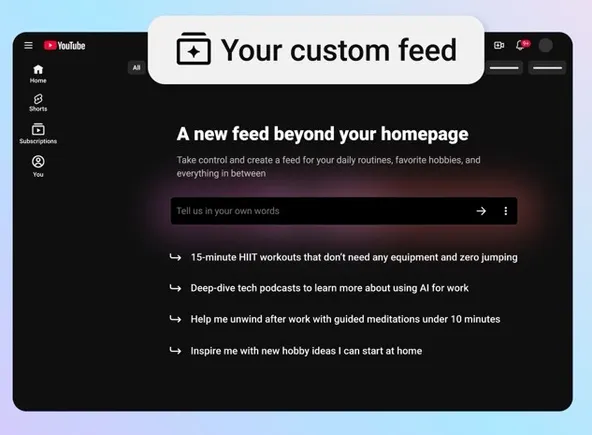
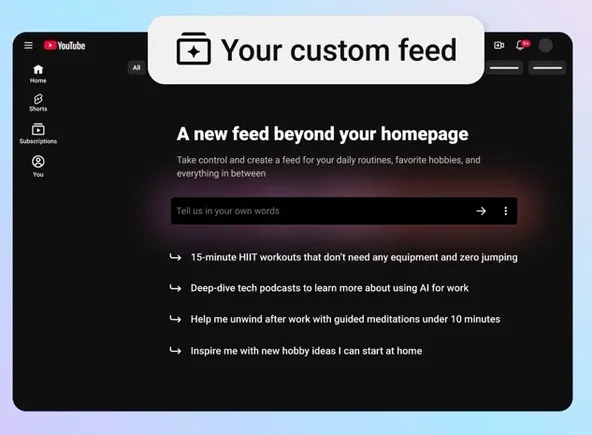
In a significant strategic shift within the social media landscape, YouTube has announced a major expansion of its custom feeds feature. This innovative update empowers users with direct, conversational input to shape their content consumption experience. Rather than relying solely on the platform’s traditional, opaque recommendation engines, users can now generate up to eight personalized, AI-driven video feeds by simply entering text prompts. These bespoke streams can then be pinned directly to the mobile and desktop Home display, completely replacing the legacy topic chips that have long dictated how viewers navigate niche interests on the app.
This move represents a fascinating philosophical divergence from contemporary tech industry norms. For over a decade, social media giants have championed automated, purely algorithmic matching systems designed to maximize dwell time and engagement, often at the expense of user control. YouTube’s latest experiment blends explicit user-driven prompts with implicit behavioral signals, signaling a hybrid approach to platform curation. By allowing viewers to actively define their interests through conversational AI—and edit those parameters on the fly—YouTube is betting that transparent, user-guided discovery will yield a more satisfying and enduring viewer experience. Currently rolling out to signed-in users in the United States across Android, iOS, and desktop platforms, this feature marks the dawn of a more interactive, customizable era in digital video consumption.
Detailed Chronology of the Feature’s Development
To fully appreciate the scope of YouTube’s new custom feeds initiative, it is essential to trace its evolution from a theoretical concept to a sweeping interface overhaul. The journey underscores YouTube’s methodical approach to integrating generative AI and conversational tools into its core user experience.
Phase 1: The Initial Concept and Late-2023 Testing
The groundwork for this feature was laid as YouTube began exploring ways to help users navigate its staggering library of billions of videos without getting trapped in repetitive algorithmic loops. In November, YouTube initiated the first formal public test of its custom feed control options. During this initial rollout, a select group of users was given the ability to input basic text prompts into the app. These prompts acted as hyper-specific filters, instructing the recommendation engine to pull content that aligned with micro-interests that standard algorithmic suggestions often missed or misunderstood.
Phase 2: Expanding the Scope in Mid-2024
Building upon early positive feedback and internal testing metrics, YouTube significantly scaled up the experiment in May. The platform expanded the conversational custom feed generation capabilities to a much broader audience. During this phase, engineers refined the natural language processing (NLP) backend to better interpret nuanced prompts. Users no longer had to rely on rigid keywords; instead, they could describe complex thematic preferences—such as "long-form historical documentaries mixed with architectural restoration tutorials"—allowing the AI to construct a cohesive, multi-faceted content stream tailored precisely to that exact mood or learning objective.
Phase 3: The Current Expansion and Interface Overhaul
Today’s announcement marks the culmination of these iterative tests, introducing structural UI changes that permanently alter the YouTube Home page. Under the newly expanded system, users can seamlessly switch between multiple active feeds displayed prominently along the top of their Home screen. The platform now supports up to eight simultaneous custom feeds per user. To keep the database lean and relevant, inactive prompts automatically expire after a few weeks of disuse. Furthermore, YouTube has introduced a real-time editing feature: viewers can modify their original prompts via a convenient text box situated at the top of each custom feed, instantly recalibrating the underlying recommendation parameters without having to delete and recreate the stream from scratch. Most notably, YouTube confirmed that these custom feeds are officially replacing the standard topic chips on the mobile app, signaling that this is not merely an optional add-on, but a foundational reimagining of app navigation.
Supporting Context & Metrics: The Paradigm Shift in Content Discovery
The decision by YouTube to pivot toward user-directed feeds stands in stark contrast to broader industry trends. For years, data scientists and product managers across Silicon Valley have treated pure algorithmic curation as the holy grail of digital engagement.
The Rise and Reach of Algorithmic Matching
Historically, social media algorithms have been fine-tuned to extract maximum attention. By analyzing watch history, click-through rates, watch time, and micro-interactions, platforms like TikTok, Instagram, and YouTube built sophisticated predictive models. These systems excel at serving content users didn’t know they wanted, driving massive engagement gains across the board. However, this heavy reliance on automated matching has not come without costs. Critics and researchers have increasingly pointed out that opaque algorithms can foster filter bubbles, drive ideological division, and induce user fatigue through relentless streams of sensationalized or repetitive content.
Combining Explicit and Implicit Signals
Recognizing the limitations of purely automated curation, YouTube’s latest experiment represents a calculated middle ground. By combining explicit signals (the direct text prompts provided by the user via conversational AI) with implicit signals (historical viewing habits, likes, and skips), YouTube aims to build a smarter, more cooperative recommendation ecosystem.
- Explicit Signals: Give the user ultimate agency. If someone wants to spend an evening learning about astrophysics and nothing else, they can explicitly command the platform to construct a temporary feed dedicated to that topic.
- Implicit Signals: Ensure that within that explicit category, the highest-quality, most engaging videos bubble to the top based on historical platform data.
This hybrid model acknowledges that while AI is exceptionally powerful at processing data, human intent remains the ultimate north star for meaningful digital experiences.
Official Statements and Industry Implications
While YouTube’s official rollout details have been communicated through creator support threads and platform updates, the strategic philosophy behind the move speaks volumes about where the video giant sees the future of digital media heading.
Industry analysts have noted that YouTube’s integration of conversational prompts mirrors the broader societal embrace of generative AI tools like ChatGPT and Claude. Consumers are increasingly accustomed to interacting with software through natural language rather than rigid menu hierarchies. By bringing this conversational paradigm into content discovery, YouTube is modernizing its interface to match contemporary expectations.

Moreover, replacing legacy topic chips with user-generated custom feeds demonstrates a bold confidence in user autonomy. For years, topic chips—such as "Gaming," "Music," or "Podcasts"—served as blunt instruments for filtering content. They were universal, static, and dictated entirely by the platform’s categorization taxonomy. Custom feeds, by contrast, are infinitely granular and entirely personal.
From an ecosystem perspective, this shift could profoundly impact content creators, particularly those producing specialized or niche educational and entertainment content. As users curate hyper-specific feeds based on conversational prompts, creators who master the art of deeply targeted, searchable content may find themselves benefiting from higher-intent audiences who actively sought out their specific sub-genre, rather than stumbling upon it via a generic algorithmic roll of the dice.
Future Outlook: What This Means for Viewers and Creators
As the updated custom feeds experiment continues to roll out to signed-in viewers on mobile (Android and iOS) and desktop across the United States, industry watchers are eager to see how user habits evolve.
For Viewers: Tailored Digital Spaces
The ability to maintain up to eight active, easily editable custom feeds transforms YouTube from a passive broadcasting feed into an active, modular library. Imagine a user maintaining distinct feeds for "Marathon Training," "Gourmet Cooking Techniques," "Indie Game Development," and "Relaxing Ambient Music"—all accessible with a single tap at the top of the Home page, completely free from the clutter of unrelated algorithmic recommendations. As these prompts are refined over time through the simple text-box editing feature, the user experience becomes hyper-personalized in a way that feels organic and intentional rather than manipulative.
For Creators: A New SEO and Metadata Frontier
For creators and digital marketers, the rise of conversational custom feeds underscores the growing importance of clear, descriptive metadata and deep subject-matter authority. When users begin prompting AI to build feeds around ultra-specific niches—such as "mid-century modern interior design on a budget"—the recommendation system will rely heavily on precise video titles, descriptions, and transcripts to match the right content to the right prompt. Creators who lean into authentic, deeply informative content tailored to specific viewer intents will likely thrive in this new environment.
The Road Ahead
YouTube’s willingness to experiment with moving away from purely algorithmic feeds marks a watershed moment for digital media design. If this U.S. rollout proves successful and eventually sees a global release, it could prompt other major social and video platforms to reevaluate their reliance on black-box recommendation engines. By returning a degree of editorial control directly to the hands of the audience, YouTube is charting a pioneering course for the future of interactive entertainment—one where artificial intelligence serves to empower human curiosity rather than dictate it.