





Executive Overview
In the rapidly evolving landscape of digital discovery, traditional search engine optimization (SEO) is no longer the sole battleground for brand visibility. As artificial intelligence chatbots and conversational search interfaces increasingly replace traditional browser queries, digital marketers face a paradigm shift. A comprehensive new study from SE Ranking reveals a critical lifeline for modern brands: maintaining an active, robust presence on social media platforms is no longer just about community engagement—it is a core driver of visibility in AI-generated search results.
Analyzing 100,000 keywords across a diverse spectrum of brand niches, SE Ranking’s research sheds light on how major AI models—including Google’s AI Overviews, Google AI Mode, and OpenAI’s ChatGPT—source their information. The findings are striking. Social media links are routinely cited within AI-generated answers, appearing in over two-thirds of Google AI Overviews and holding significant weight across branded and non-branded queries alike.
However, the data also uncovers a complex, fragmented ecosystem. Unlike legacy SEO, which has long been dominated by Google’s monolithic algorithms, optimizing for AI discovery requires a nuanced, platform-specific strategy. From YouTube’s heavy integration into Google’s ecosystem to Reddit’s volatile relationship with ChatGPT, brands can no longer rely on a one-size-fits-all approach. As consumer behavior shifts from keyword clicking to conversational AI queries, understanding how artificial intelligence ingests and surfaces social media content has become an existential imperative for digital marketers, brand strategists, and enterprise executives alike.
Detailed Chronology: The Evolution of AI Search and Social Citations
To fully grasp the current reliance of AI chatbots on social media, it is necessary to examine how conversational search has evolved from experimental text-generators into primary web gateways.
The Shift from Links to Answers
For decades, the digital marketing playbook was straightforward: target high-volume keywords, optimize meta-tags, build backlinks, and secure a spot on the coveted first page of Google search results. Users would then manually sift through blue links to find their answers.
The introduction of Generative AI completely disrupted this journey. When companies like OpenAI launched ChatGPT and Google rolled out generative search experiences (such as AI Overviews and AI Mode), the user experience shifted from discovery to synthesis. Instead of presenting a list of websites, AI tools synthesize information and provide a direct answer, accompanied by inline citations and reference links.
The Rise of Social Integration in AI Overviews
As AI models began crawling the live web to support their generative outputs, researchers quickly noticed an unexpected trend: user-generated content (UGC) and social media platforms were heavily over-indexed in chatbot responses. Platforms characterized by real-time discussions, authentic reviews, and peer-to-peer recommendations became primary training and retrieval grounds for Large Language Models (LLMs).
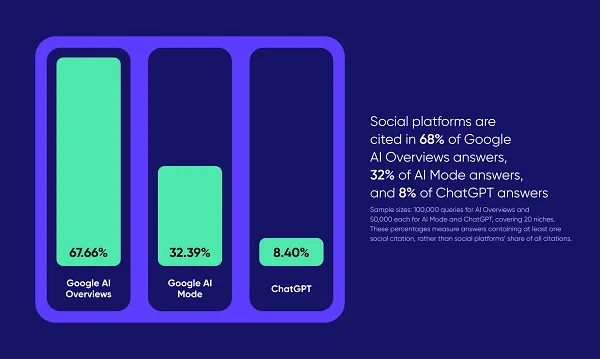
SE Ranking’s recent investigation marks a milestone in quantifying this phenomenon. By analyzing 100,000 keywords spanning multiple industries, the study tracked the exact frequency with which social platforms appeared in AI-generated answers. The resulting data proved that AI models rely on social platforms to validate product claims, aggregate consumer sentiment, and provide up-to-date, real-world context that traditional corporate websites often lack.
The Great Volatility: Platform Fractures
Yet, this integration has not been without friction. The chronology of AI search took a dramatic turn in mid-2024 when platform-level partnerships and sudden algorithm adjustments began altering citation behaviors in real-time.
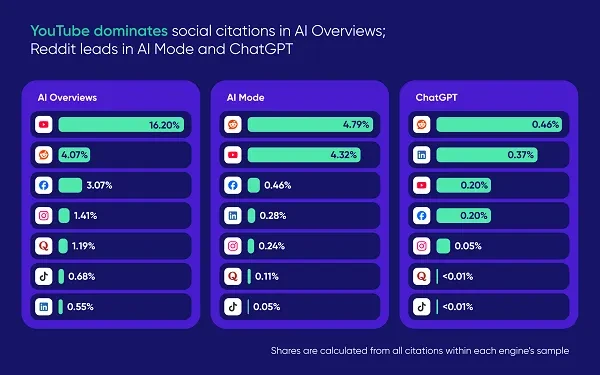
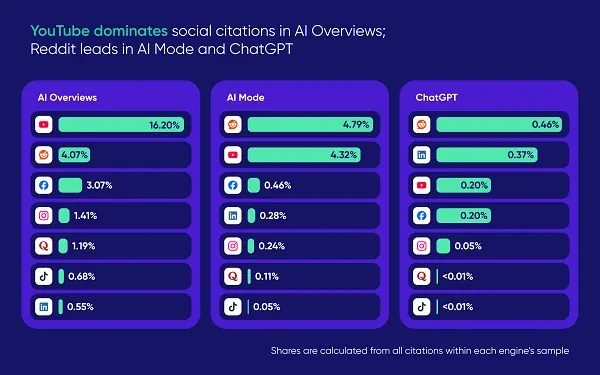
Most notably, in August, industry reports highlighted a sudden and drastic collapse in Reddit’s visibility within ChatGPT search citations—dropping by over 86% in a matter of just four days. While OpenAI and Reddit remained tight-lipped regarding the exact catalysts behind this abrupt decoupling, it underscored a terrifying reality for marketers: relying on a single AI platform for visibility is inherently risky.
Conversely, Reddit’s deep-rooted commercial data-sharing partnership with Google has ensured that its citations remain resilient and steady within Google’s AI Overviews. This stark divergence illustrates that the pipeline between social platforms and AI search is governed not only by algorithmic relevance, but also by high-stakes corporate partnerships, licensing agreements, and underlying data contracts.
Supporting Context & Metrics: Unpacking the SE Ranking Data
To understand the mechanics of AI visibility, one must dive deep into the empirical metrics unearthed by SE Ranking’s exhaustive analysis of 100,000 keywords. The data provides a clear hierarchy of how different AI systems utilize social media platforms.
Cross-Platform Citation Breakdown
The study evaluated three distinct AI search environments, revealing stark differences in how social media links are deployed:
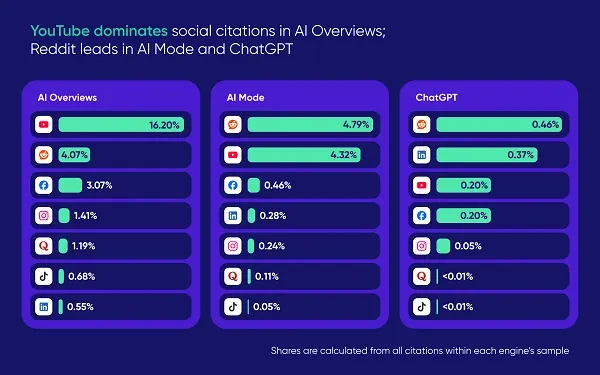
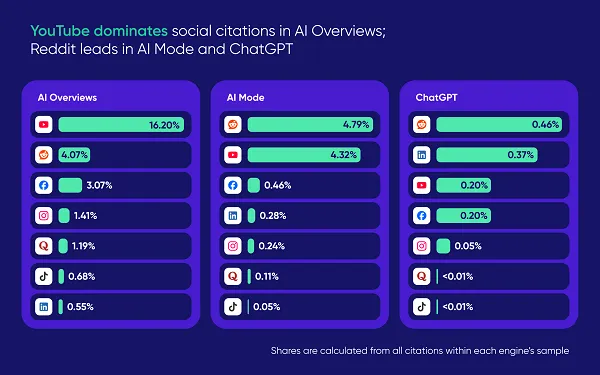
- Google AI Overviews: Social platform links appeared in an overwhelming 67.66% of responses. This massive saturation indicates that Google’s generative search heavily favors peer-reviewed discussions, video tutorials, and forum threads to supplement its summaries.
- Google AI Mode: Social platform links were present in 32.39% of replies, showcasing a balanced approach to integrating conversational intent with social validation.
- ChatGPT: Social platform links surfaced in 8.4% of answers. While significantly lower than Google’s ecosystem, an 8.4% appearance rate across a massive volume of queries still represents millions of potential referral touchpoints globally.
Platform-Specific Preferences
Not all social media platforms are created equal in the eyes of an LLM. The research highlights distinct channel preferences depending on the search engine or chatbot being utilized:
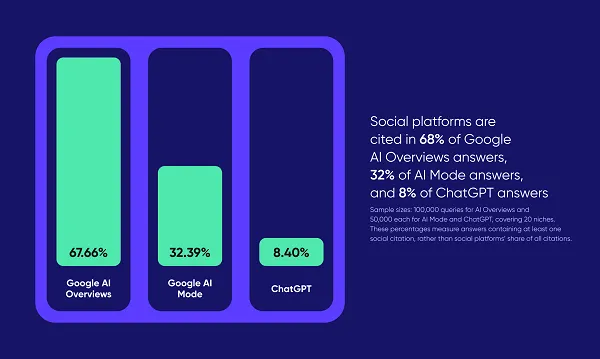
- Google and YouTube: Google-owned YouTube reigns supreme as the most commonly cited source in Google’s AI Overviews. Because video content is richly transcribed, tagged, and indexed within Google’s ecosystem, AI models naturally pull YouTube tutorials, reviews, and unboxing videos to answer user queries visually and textually.
- ChatGPT’s Preferred Networks: When ChatGPT chooses to cite social platforms, its primary destinations are Reddit and LinkedIn. Professional queries frequently trigger LinkedIn pulse articles and company updates, while consumer queries pull heavily from Reddit threads discussing product quality, troubleshooting, and personal recommendations.
Branded vs. Non-Branded Query Dynamics
SE Ranking’s deep dive into Google’s AI Mode further categorized queries into two distinct buckets: branded searches (containing specific company or product names) and non-branded searches (general category or intent-based searches).
The breakdown yielded fascinating insights:
- Branded Queries: Social media sources were referenced in 39.34% of responses. When users search explicitly for a brand, AI engines pull social proof—such as Facebook reviews, Reddit customer complaints, or YouTube brand mentions—to construct a comprehensive brand profile.
- Non-Branded Queries: Social media sources jumped to 48.58% of responses for general searches. This indicates that when users look for recommendations within an entire industry (e.g., "best project management software for remote teams"), AI models rely on social conversations and community forums to determine which brands are actively discussed and praised by real users.
Official Industry Perspectives and Implications
The seismic shift toward AI-driven search has forced digital marketing agencies, brand architects, and SEO professionals to radically rethink their strategies. Industry experts argue that the traditional boundaries separating social media marketing from search engine optimization have officially dissolved.
The Demise of Siloed Marketing
For over a decade, organizations operated with strict silos: the SEO team focused on keyword rankings and technical site architecture, while the social media team focused on community building, influencer partnerships, and brand awareness.
SE Ranking’s findings demonstrate that these departments must now operate in tandem. A strong social media presence is no longer just a top-of-funnel branding exercise; it is an active technical asset that feeds directly into an enterprise’s AI search visibility. When an AI chatbot evaluates a brand, it does not just read the company’s official landing page—it crawls public sentiment, customer complaints on Reddit, video breakdowns on YouTube, and professional discourse on LinkedIn.
The Variability Challenge
Unlike traditional SEO, which offered a predictable rulebook centered primarily on Google’s ranking algorithms, the AI search ecosystem is wildly fragmented. Industry leaders emphasize that marketers must build diversified optimization frameworks.
"You cannot optimize for AI the way you used to optimize for a static search engine," notes digital strategy analyst Marcus Vance. "Google’s AI Overviews, Microsoft Copilot, ChatGPT, and Perplexity all ingest data differently, weigh social signals through unique proprietary filters, and maintain different data licensing partnerships. Brand survival in the age of conversational search requires an omnipresent, highly active social footprint across multiple networks."
Future Outlook: Navigating the Landscape of Conversational Discovery
As artificial intelligence continues to mature, the intersection of social media and search optimization will only deepen. Several key trends are expected to shape the future of brand visibility in the coming years:
1. The Weaponization of Community Sentiment
As AI chatbots increasingly prioritize authentic human conversations over polished corporate copy, brand reputation management will become inextricably linked to AI search optimization. Negative sentiment, unresolved customer service issues, and unaddressed product flaws aired publicly on Reddit, TikTok, or X (formerly Twitter) will be ingested and synthesized by AI models, directly influencing how a brand is portrayed to prospective buyers. Consequently, active social listening and rapid community intervention will serve as vital defensive measures for brand health.
2. The Evolution of Data Licensing and Paywalls
The sudden fluctuation of Reddit citations within ChatGPT highlights an unstable underlying infrastructure. As publishers, social networks, and AI developers negotiate multi-million-dollar data-sharing agreements, the availability of free social data for LLM training will likely shrink. Platforms may increasingly gatekeeper their content behind paid API access. This could create a bifurcated digital economy where only brands and platforms with formal data partnerships maintain guaranteed AI visibility, while smaller players must rely on organic, highly viral social engagement to break through the algorithmic noise.
3. Redefining Success Metrics for Digital Marketers
As click-through rates from traditional search engine results pages (SERPs) decline in favor of zero-click AI summaries, marketing executives must develop new key performance indicators (KPIs). Tracking "Share of AI Voice"—how frequently a brand is mentioned and cited within chatbot-generated answers across major platforms—will likely become the gold standard of digital marketing efficacy.
Conclusion
SE Ranking’s study serves as a definitive wake-up call for the corporate world. The era of passive social media management is over. By recognizing that social channels act as the primary foundational pillars for AI-generated search results, forward-thinking brands can bridge the gap between community engagement and technical visibility. In the age of conversational AI, your social media presence isn’t just speaking to your customers anymore—it is speaking directly to the algorithms shaping the future of global commerce.