The Anatomy of Abandoned Carts: Why Traditional Recovery Playbooks Are Failing and How AI Is Reshaping Conversion

After three decades of e-commerce evolution, the digital shopping cart remains the most critical battleground for retail profitability. Despite decades of user-experience refinements, lightning-fast checkout integrations, and advanced targeting, shopping cart abandonment persists as an intractable industry headache. According to benchmark data from the Baymard Institute, roughly 70% of all e-commerce shopping carts are abandoned…

Read Full News

The Evolution of System Visibility: Why Modern Infrastructure Demands Observability Beyond Traditional Monitoring

Executive Overview For decades, the standard operating procedure for software engineering teams relied on a reactive monitoring paradigm. Dashboards filled with glowing green gauges and ominous red flashes dictated the health of an enterprise application. If CPU utilization spiked, memory leaked, or error rates crept past a predefined threshold, an automated alert would fire, dragging…

Read Full News

Securing the AI Software Supply Chain: Why Trusted Open-Source Catalogs Are Replacing the Traditional Scanner

Executive Overview The paradigm of open-source software security is undergoing a structural collapse. For well over a decade, security operations teams, platform engineers, and developers have relied on a reactive, after-the-fact methodology: pulling a package from a public repository, running a static or dynamic vulnerability scanner, cross-referencing the results against Common Vulnerabilities and Exposures (CVE)…

Read Full News

YouTube’s AI-Powered Revolution: Empowering Users with Custom Feeds and Moving Beyond Traditional Algorithms

Executive Overview In a significant strategic shift within the social media landscape, YouTube has announced a major expansion of its custom feeds feature. This innovative update empowers users with direct, conversational input to shape their content consumption experience. Rather than relying solely on the platform’s traditional, opaque recommendation engines, users can now generate up to…

Read Full News

Enterprise Java Meets the Intelligence Era: How Jakarta EE is Bridging Traditional Architecture and Generative AI

Executive Overview The paradigm of software engineering is undergoing its most profound transformation since the advent of cloud computing. Artificial intelligence—catalyzed by the rapid evolution of Large Language Models (LLMs), deep learning heuristics, and autonomous multi-agent systems—is completely redefining both how software is built and what applications are capable of achieving. For the vast global…

Read Full News

Beyond the Green Dashboard: Why Traditional SRE Fails AI and How to Build a Production-Grade Evaluation System

Executive Overview For the past fifteen years, Site Reliability Engineering (SRE) teams have relied on a dependable, time-tested playbook. Systems were deterministic. Given the same input, software produced the exact same output. Latency spikes, error rates, CPU throttles, and HTTP 5xx responses were all faithfully registered on dashboards rendered in reassuring shades of green. Today,…

Read Full News

The Silent Churn: Why AI Agents Are Breaking Traditional B2B Customer Success

EXECUTIVE SUMMARY For enterprise software companies, the traditional definition of account health is built on a comforting premise: happy customers are vocal, unhappy customers file support tickets, and quiet customers are thriving. But in the era of artificial intelligence, this foundational tenet of SaaS business models is rapidly disintegrating. A stark wake-up call arrived recently…

Read Full News

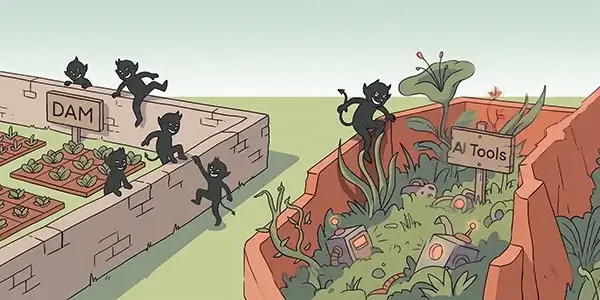
Rethinking the Digital Supply Chain: Why the Traditional DAM Manager Role is Broken and Needs to Be Split

Executive Overview The modern enterprise digital asset management (DAM) ecosystem has reached a critical inflection point. For decades, organizations have relied on a singular, monolithic role—the DAM Manager—to oversee the entire lifecycle of digital media, from its initial ingestion into the repository to its final distribution across global marketing channels. However, a provocative and widely…

Read Full News

Rethinking the Digital Supply Chain: Why the Traditional DAM Manager Role is Broken—and How to Fix It

Executive Overview In the modern enterprise, the Digital Asset Management (DAM) ecosystem has evolved from a simple repository for marketing images into a mission-critical nerve center. Brands manage millions of dollars in rich media, video assets, synthetic media, and localized campaigns. Yet, despite this massive increase in complexity, volume, and regulatory scrutiny, organizations stubbornly cling…

Read Full News