Executive Overview
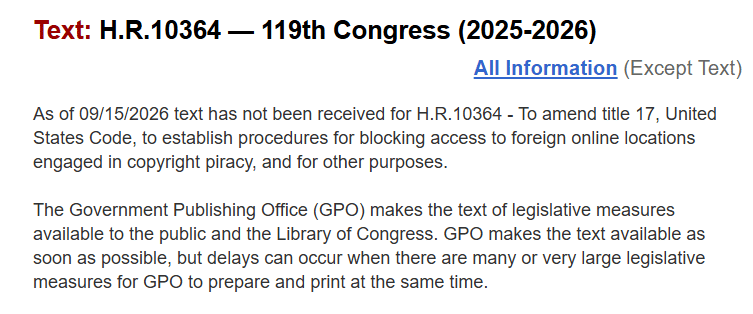
The landscape of American copyright enforcement and internet governance is facing a potential watershed moment. U.S. Representative Darrell Issa, serving as the chair of the House Intellectual Property subcommittee, has officially introduced a new piece of legislation—designated as H.R. 10364—designed to establish explicit administrative and judicial procedures for blocking access within the United States to foreign online locations engaged in rampant copyright piracy.
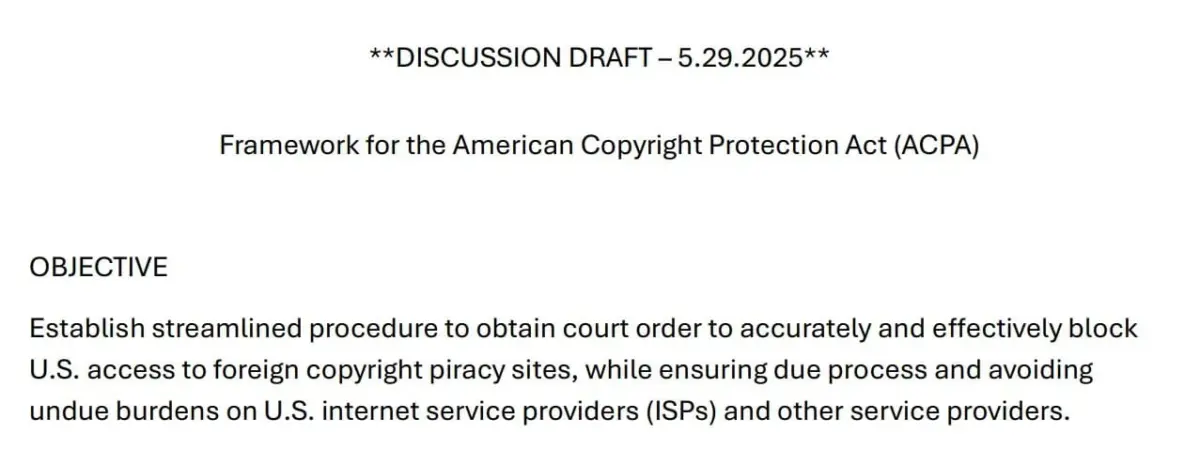
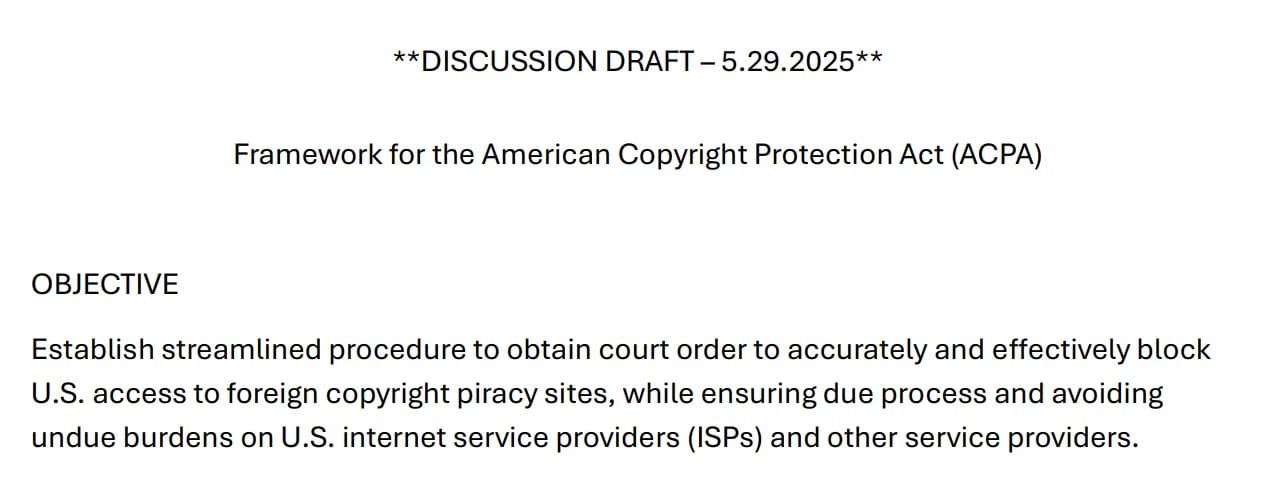
While the official text of the legislative bill has not yet been processed and published by the Government Publishing Office (GPO), early drafts and background details from previous iterations—widely referred to as the American Copyright Protection Act (ACPA)—point toward a comprehensive, aggressive legal framework. If passed, the framework would compel both Internet Service Providers (ISPs) and Domain Name System (DNS) resolvers to implement technical blocks against designated foreign-hosted pirate domains.
This introduction breaks a long-standing legislative stalemate that has persisted in the United States since the catastrophic collapse of the Stop Online Piracy Act (SOPA) and the PROTECT IP Act (PIPA) in 2012. For over a decade, ISP-level site blocking was considered politically toxic, a "third rail" of digital policy due to widespread fears over collateral damage to internet freedom, technical overreach, and speech suppression.
However, shifting geopolitical realities, the globalization of digital distribution, and sustained pressure from Hollywood and major rightsholder coalitions have breathed new life into site-blocking initiatives. Rep. Issa’s bill arrives during a highly contentious period on Capitol Hill. It operates alongside competing, parallel efforts from both the House and Senate, all vying to shape the definitive American copyright enforcement mechanism of the decade.
At the same time, the bill has immediately reignited fierce opposition from digital rights groups, civil liberties organizations, and public interest advocates. Critics argue that even preliminary drafts of the legislation threaten to destabilize open internet infrastructure, create severe hazards of overblocking for innocent third parties, and turn commercial broadband providers into private copyright police.
Detailed Chronology: The Revival of American Site-Blocking
To understand the weight of H.R. 10364, it is vital to trace the tortuous legislative journey that brought site-blocking back to the forefront of American politics after a twelve-year hiatus.

The Post-SOPA Wasteland (2012–2024)
Following the historic public and tech-industry backlash that sank SOPA and PIPA in early 2012, mainstream U.S. lawmakers largely abandoned the concept of mandatory ISP-level DNS and IP blocking. While countries across Europe, Asia, and Latin America rapidly adopted dynamic site-blocking injunctions—empowering rightsholders to secure court orders forcing local telecom monopolies to restrict access to pirate streaming hubs and torrent indexes—the United States relied almost exclusively on Digital Millennium Copyright Act (DMCA) takedown notices, payment processor blockades, and targeted domain seizures orchestrated by federal law enforcement agencies like Homeland Security Investigations (HSI).
Although these tools proved effective against domestic targets or registries under U.S. jurisdiction, they often bounced off resilient foreign-based pirate operations hosted in jurisdictions with lax enforcement laws or corrupted legal systems. For years, American rightsholders watched enviously as European counterparts dismantled sprawling piracy networks with a single court order, fueling a persistent campaign in Washington to bring the U.S. framework into alignment with international standards.
The Legislative Tipping Point (2025–Present)
The dam finally broke in January 2025, when Representative Zoe Lofgren introduced the Foreign Anti-Digital Piracy Act (FADPA). FADPA cracked open the door to foreign site-blocking, signaling to the tech and entertainment industries that bipartisan appetite for structural internet filtering was returning.
Sensing momentum, a coalition of Senators launched the Block BEARD site-blocking draft in the summer of 2025. Concurrently, Rep. Darrell Issa—leveraging his influential position leading the House IP subcommittee—accelerated work on his own bespoke legislative vehicle: the American Copyright Protection Act (ACPA). While ACPA was actively debated among closed-door stakeholder groups throughout late 2025 and early 2026, it remained an unnumbered discussion draft until Issa officially filed it as H.R. 10364 in the House of Representatives.
Crucially, Issa’s introduction of H.R. 10364 occurs under immense time constraints. The veteran lawmaker is retiring at the end of his current congressional term, leaving a narrow, high-stakes window of just a few months to shepherd the measure through the committee process, secure floor votes, and negotiate a unified package with the Senate before the legislative clock runs out.
Supporting Context & Framework Mechanics
Because the official statutory text of H.R. 10364 has not yet been posted to Congress.gov—and Rep. Issa’s office has not yet released an accompanying press release or text excerpt—observers must rely on the comprehensive 2025 discussion draft of the ACPA to understand the bill’s mechanics.
The Core Mandate: ISPs and DNS Resolvers
According to the previous draft framework, the ACPA is designed to empower copyright holders to seek federal court orders compelling two distinct layers of the internet’s routing infrastructure to block access to foreign pirate sites:
- Internet Service Providers (ISPs): Traditional broadband providers (cable, fiber, and mobile network operators) would be required to block web traffic destined for adjudicated pirate IP addresses or domains.
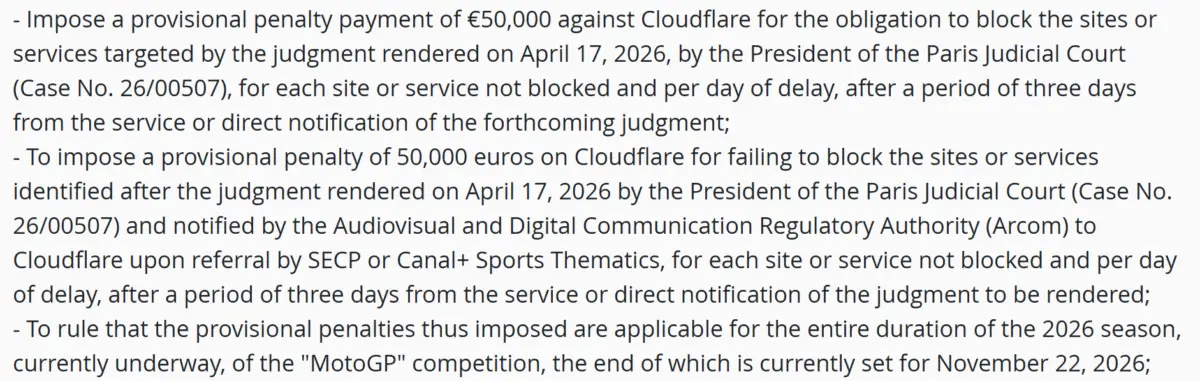
- Domain Name System (DNS) Resolvers: Public and recursive DNS providers (such as Google Public DNS, Cloudflare, or Quad9) would be forced to drop or redirect resolution requests for targeted foreign domains, effectively scrubbing them from the lookup directories used by everyday web browsers.
Procedural Safeguards and Unique Provisions
Unlike other site-blocking models that have drawn intense scrutiny, Issa’s previous draft incorporated distinct procedural elements designed to streamline litigation while purportedly protecting against abuse:
- Specialized Judicial Roster: Rather than allowing copyright cases to scatter across random federal district courts with varying levels of technical familiarity, the proposal stipulated that the Judicial Conference of the United States would maintain a specialized roster of designated judges specifically assigned to hear and adjudicate all foreign site-blocking injunction requests.
- Centralized Registry: The U.S. Copyright Office would be tasked with publishing and maintaining a transparent, publicly accessible master list of all active site-blocking orders.
- The Overblocking Penalty Fund: In a unique nod to critics of collateral damage, the early ACPA draft included a notable financial penalty provision. If a rightsholder’s overzealous or erroneous filing resulted in the wrongful blocking of an innocent third-party website, the affected business or individual could sue for statutory damages of up to $250,000 in compensation. Whether this specific safeguard survived the transition into the final legislative text of H.R. 10364 remains a critical question for legal analysts.
Multiple Tracks and Hill Competition
H.R. 10364 is not operating in a vacuum. Capitol Hill is currently witnessing a three-way legislative scramble over site-blocking policy:
- The Senate/House Hybrid: Earlier this year, reports indicated that Senator Thom Tillis and Rep. Zoe Lofgren were actively working to merge FADPA and Block BEARD into a single, unified bicameral bill targeting ISPs and large-scale DNS resolvers.
- The "Four Corners" Negotiation: Lofgren publicly confirmed that she was participating in high-level "four corners" negotiations alongside Rep. Issa and Senators Marsha Blackburn, Chris Coons, Adam Schiff, and Thom Tillis to forge a bipartisan compromise.
It remains entirely unclear whether H.R. 10364 represents the House half of a broader, pre-negotiated consensus deal—which would theoretically be reflected by Lofgren and other key negotiators appearing as official cosponsors—or if it is a standalone move by Issa designed to force the hand of rival lawmakers before his retirement.
Official Statements and Industry Reactions
The introduction of H.R. 10364 has triggered an immediate and polarized response from civil society watchdogs, legal scholars, and industry stakeholders, even in the absence of the bill’s finalized text.
Civil Liberties and Public Interest Opposition
Leading the charge against the legislation is Public Knowledge, a prominent digital rights and consumer advocacy organization. The group issued an immediate warning, arguing that the bill fundamentally threatens internet architecture and shifts the burden of copyright enforcement onto telecom and technology infrastructure providers.
"Applying blocking orders to global DNS resolvers causes global blocks. This means that one court can cut off access to a website globally, based on a single individual’s filing and an expedited procedure," said Meredith Rose, Senior Policy Counsel at Public Knowledge.
Rose emphasized that the risks extend far beyond tech-savvy pirates or large-scale streaming forums, posing a direct threat to everyday commerce, civic organizations, and small enterprises:
"Small businesses and nonprofits face the greatest risks for site blocking but have the fewest protections. In Europe, we’ve seen overblocking bring down digital infrastructure for hotels, car mechanics, retail shops, telehealth programs, and even a nunnery."
Critics echo these concerns, pointing out that blunt DNS-level blocks frequently rely on dynamic routing or shared hosting environments (such as Content Delivery Networks like Cloudflare). When a single IP address hosts thousands of distinct websites, blocking that IP address to take down one infringing portal inevitably silences hundreds of unrelated, law-abiding digital storefronts.
Rightsholder Silence
Conversely, major rightsholder organizations—who stand to gain the most from streamlined foreign site-blocking injunctions—have maintained a measured public posture.
The Motion Picture Association (MPA), which famously honored Rep. Issa with its prestigious Industry Champion Award in early 2025 in recognition of his legislative efforts against online piracy, did not immediately issue a formal statement following the introduction of H.R. 10364. When contacted by investigative journalists for comment, representatives for the MPA indicated that they were reviewing the filing details, with official policy positions expected once the statutory text is formally released by the GPO.
Future Outlook: Can H.R. 10364 Cross the Finish Line?
As Washington moves past the initial introduction phase, the immediate future of H.R. 10364 hinges on several volatile variables:
- Textual Transparency: The immediate release of the legislative text is paramount. Legal experts, telecom providers, and civil liberties groups are waiting to see whether Issa retained the $250,000 overblocking penalty and the specialized judicial roster, or if the final text leans closer to the more aggressive, expansive models favored by traditional copyright lobbies.
- The Retirement Clock: With Rep. Issa retiring at the close of this congressional session, he faces a hard legislative deadline. Pushing a complex, highly controversial structural internet bill through the House committee system, securing floor time, and reconciling differences with the Senate in a matter of months is an extraordinarily steep uphill battle.
- Consensus vs. Fragmentation: If H.R. 10364 is interpreted by congressional leadership as a unilateral escalation that disrupts the delicate "four corners" negotiations between Lofgren, Tillis, and other bicameral leaders, it risks bogging down in turf wars rather than advancing as unified policy.
Ultimately, H.R. 10364 represents either the definitive blueprint for modernizing American copyright enforcement or the final, contested salvo in a years-long ideological war over the boundaries of internet freedom. As updates emerge and the GPO publishes the official text, the true scope of Issa’s final legislative footprint will become clear.
This is a breaking news story. Updates, textual analysis, and further official responses will be added as more information becomes available.