Executive Overview
In what marks a historic legal escalation within the digital rights management (DRM) landscape, Austrian anti-tamper giant Denuvo GmbH has initiated formal legal action against the pseudonymous software cracker known as “voices38.” Filed in the U.S. District Court for the Northern District of California, the lawsuit targets the heart of modern game piracy: the deliberate bypassing of industrial-grade security software protecting major video game releases.
While Denuvo does not hold the direct copyrights to the 26 video games cited in the complaint—titles ranging from legacy sports titles like FIFA 20 to massive contemporary blockbusters like Hogwarts Legacy, Black Myth: Wukong, and Star Wars Outlaws—the company is weaponizing the anti-circumvention provisions of the Digital Millennium Copyright Act (DMCA). By framing the circumvention of its Anti-Tamper technology as a direct, actionable commercial injury to its core business model, Denuvo is attempting to establish a powerful precedent.
This legal maneuver unfolds against a volatile backdrop for the software protection firm. Earlier this year, Denuvo weathered a wave of sophisticated hypervisor-based bypasses that allowed digital pirates to compromise protected titles on their exact day of release. However, whereas hypervisor exploits demanded that users tamper with core Windows security configurations, "voices38" captured a massive user base by employing traditional, clean-patching methodologies. These old-school cracks modified the binary security checks directly, preserving system security integrity while delivering unauthorized access.
As Denuvo aggressively subpoenas platforms like Valve, Reddit, and Discord to unmask the human behind the handle, the gaming and security communities are left watching a high-stakes chess match. Will a legal deterrent effectively silence the underground cracking ecosystem, or will the decentralized nature of modern piracy weather the storm?

Detailed Chronology: The Rise of "voices38" and the Path to Litigation
The trajectory that led to the federal courthouse in California began quietly on community forums and social aggregation sites, most notably Reddit. While high-profile cracking groups have historically dominated industry headlines through dramatic release group scenes, "voices38" emerged as a singular, highly prolific force specializing in direct, binary-level patches for Denuvo-protected executables.
The Summer Surge and Acceleration
Throughout the early months of the year, "voices38" methodically dismantled the anti-tamper mechanisms on an array of vintage and modern titles. Traditional cracks hold immense appeal within pirate communities because they do not require users to compromise their operating systems by disabling virtualized security features, kernel isolation, or Windows Defender functionalities.
Capitalizing on this user demand, the cracker’s output accelerated dramatically over the summer. The tipping point occurred earlier this month when "voices38" managed an unprecedented feat: the release of five distinct Denuvo-cracked titles within a single 24-hour window. This brazen display of technical proficiency and volume proved impossible for Denuvo’s monitoring teams to ignore. Realizing that the rapid output was eroding the perceived invulnerability of its commercial product, the Austrian firm accelerated its evidence-gathering procedures to construct a federal case.
Legal Action Unveiled
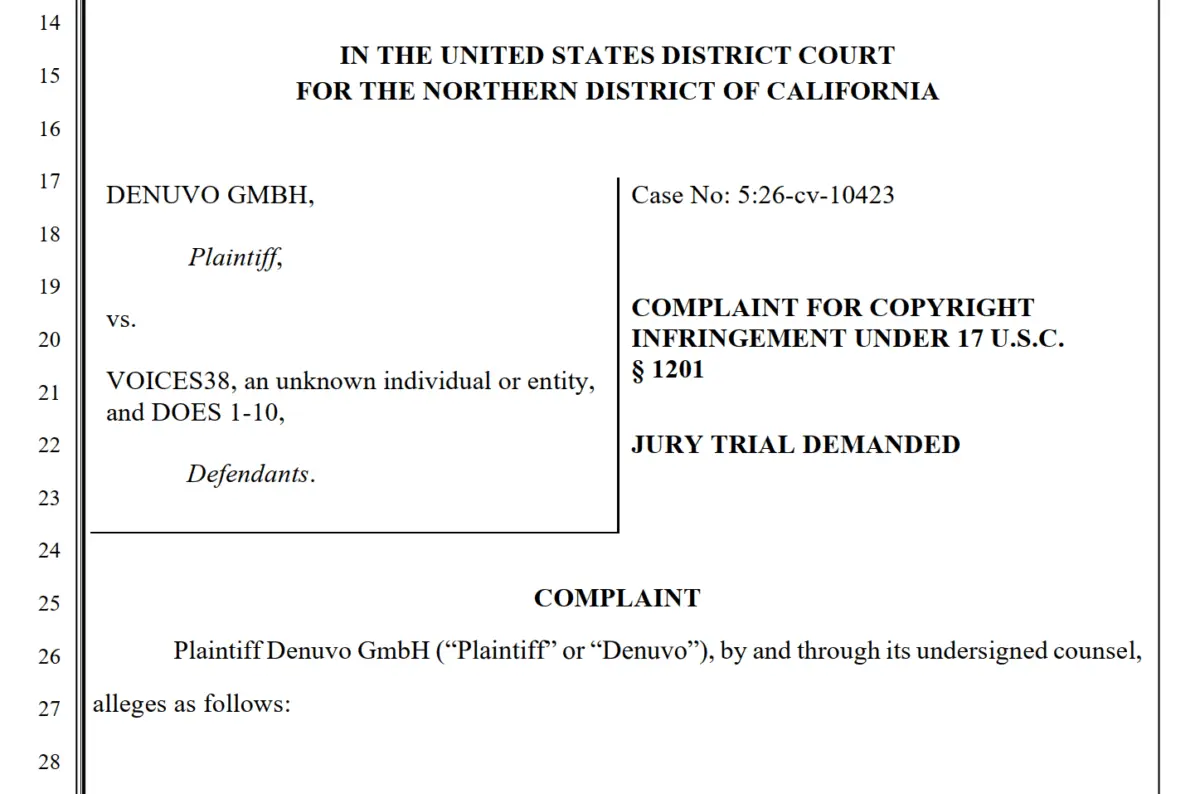
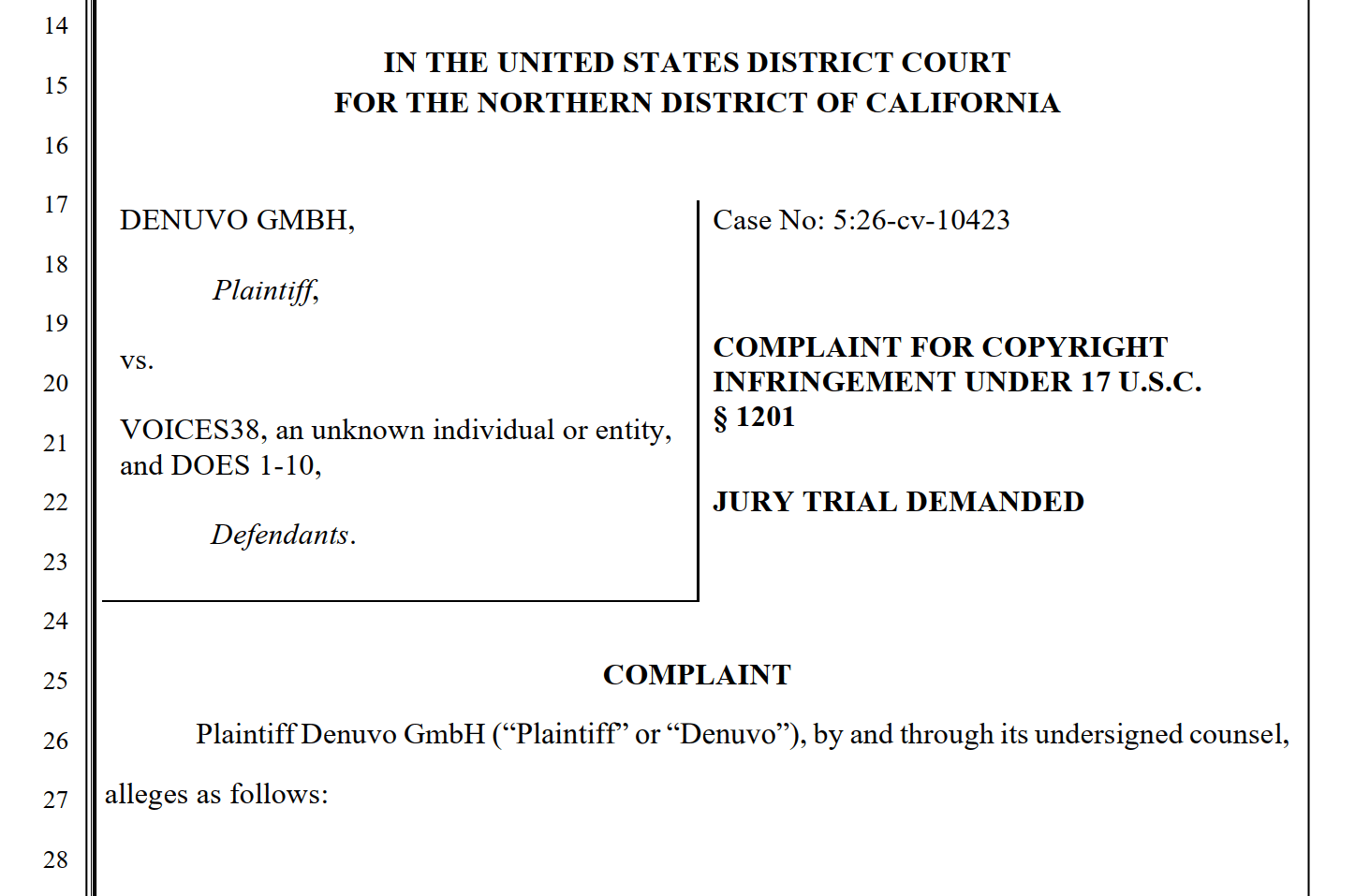
On Monday, Denuvo GmbH formally submitted its complaint to the U.S. District Court for the Northern District of California. Naming "voices38" as the primary defendant alongside ten unnamed "Doe" defendants, the lawsuit meticulously catalogues 26 individual video game titles whose security layers were allegedly compromised.
Rather than waiting for the dust to settle, the legal team behind Denuvo moved to leverage the subpoena powers granted under federal civil procedure. Because "voices38" operates entirely behind a digital veil, the primary objective of the initial filing is investigative unmasking. Armed with a docket number, Denuvo is positioned to compel tech giants to turn over transactional, IP, and communications data that could ultimately expose the real-world identity of the hacker.
Supporting Context & Metrics: The DMCA Strategy and Target Scope
To understand the mechanics of this lawsuit, one must examine the precise legal theory Denuvo is deploying. Because Denuvo GmbH licenses its software to publishers like Electronic Arts, Ubisoft, Capcom, and Sony rather than publishing the games themselves, the company lacks standing to sue for traditional copyright infringement. Copyright claims belong exclusively to the intellectual property rightsholders.
The DMCA Anti-Circumvention Framework
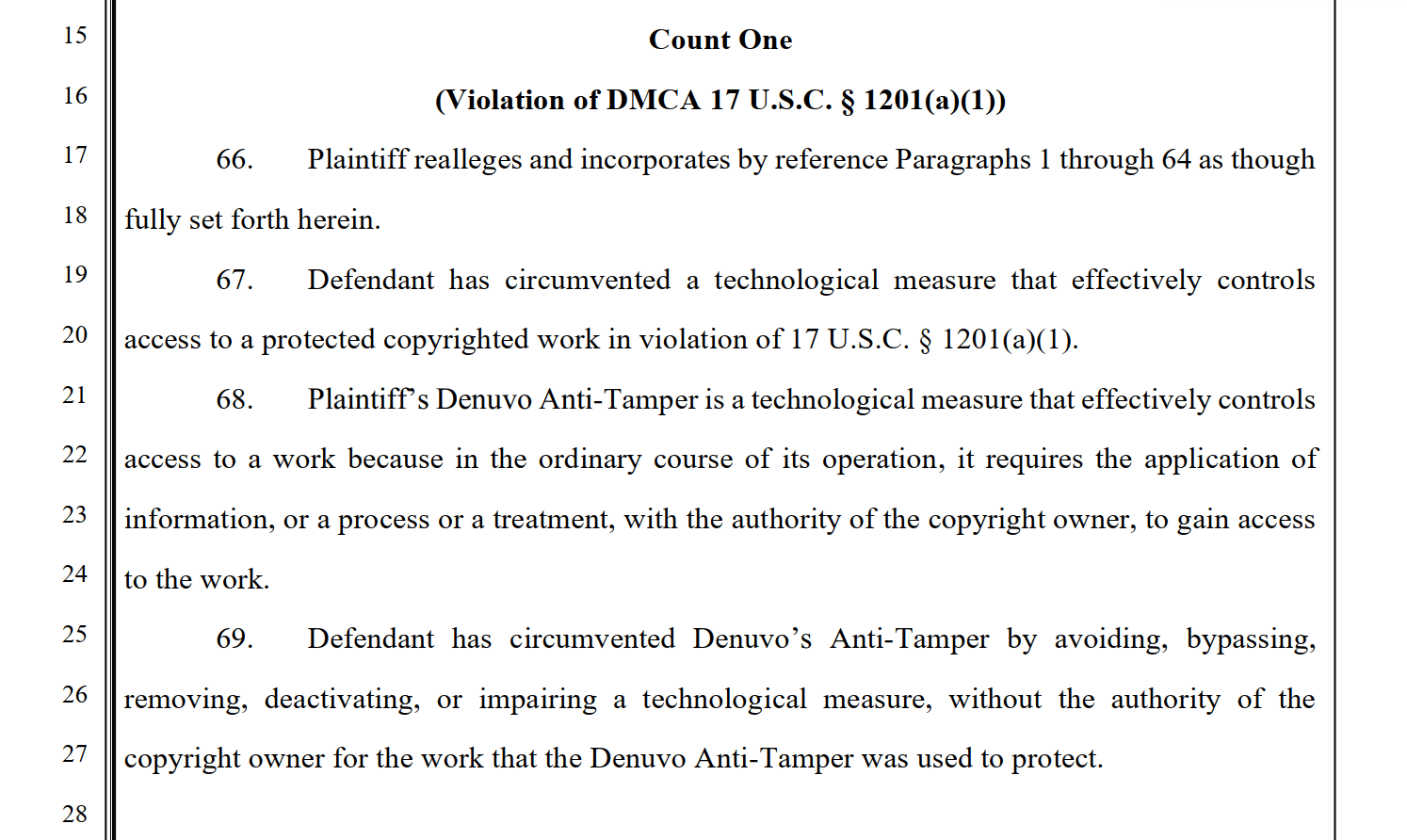
To circumvent this legal hurdle, Denuvo has structured its entire complaint around Section 1201 of the DMCA—the anti-circumvention provisions.
- The Prohibition: U.S. law strictly prohibits the unauthorized bypassing of technological measures that effectively control access to copyrighted works. Furthermore, it outlaws the distribution of tools, services, or modifications designed primarily to circumvent these digital locks.
- The Injury: To maintain a private right of action under the DMCA, a plaintiff must demonstrate that they have been injured by the violation. Denuvo successfully argues that its entire commercial valuation rests on the integrity of its Anti-Tamper product. When a cracker systematically strips away these safeguards, the perceived value of Denuvo’s software to current and prospective publishing clients plummets, causing direct economic harm.
The Scope of the Target List
The complaint identifies an extensive portfolio of 26 titles, highlighting the sheer scope of "voices38’s" reverse-engineering targets. The roster demonstrates that no publisher or genre was safe from the cracker’s scrutiny:
- Electronic Arts: Need for Speed Heat, EA Sports FIFA 20, Star Wars: Squadrons, Need for Speed: Hot Pursuit Remastered, EA Sports FIFA 21, F1 2021, Dead Space Remastered
- Bethesda: Hi-Fi Rush, Doom: The Dark Ages
- 2K Games: Mafia: The Old Country
- WB Games: LEGO Batman: Legacy of the Dark Knight, Hogwarts Legacy
- SEGA: Total War: Three Kingdoms, Shining Resonance Refrain, Shin Megami Tensei III Nocturne HD Remaster, Sonic Frontiers
- Ubisoft: Starlink: Battle for Atlas, Scott Pilgrim vs. The World, Anno 1800, Assassin’s Creed Mirage
- Konami: PES 2020
- Capcom: Pragmata, Resident Evil Requiem
- Game Science: Black Myth: Wukong
- Sony: Stellar Blade
- IO Interactive: 007 First Light
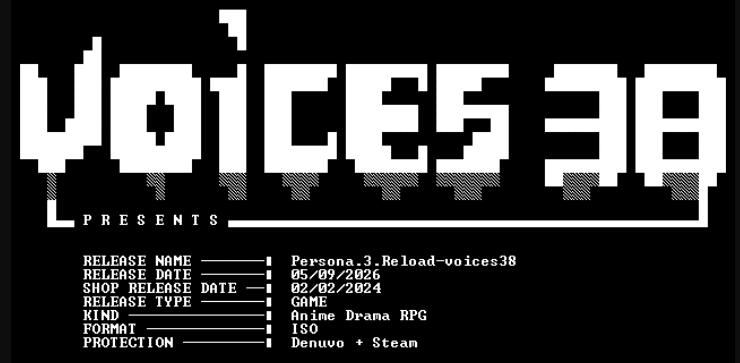
Notably, this list was already obsolete by the time the ink dried on the legal filing. "voices38" continued releasing cracks for high-profile titles—including Persona 3 Reload and Star Wars Outlaws—demonstrating a defiant disregard for the looming legal storm.
Official Statements and Digital Footprints
While the defendant remains legally anonymous on the court docket, Denuvo’s investigators have assembled a web of digital artifacts connecting the persona to specific online ecosystems.
The Digital Trail: Steam, Reddit, and Discord
In its evidentiary exhibits, Denuvo points to a cohesive digital footprint:
- Reddit: The primary vector for release announcements, community interaction, and distribution guidance, specifically centering around communities like the well-known CrackWatch ecosystem.
- Discord: A specific user ID utilized for private communications and coordination within underground distribution circles.
- Steam Profiles: Seven distinct Steam accounts believed to be utilized by the defendant. Because Denuvo-protected games typically require legitimate license verification to acquire initial executables, investigators note that these Steam accounts required real-world financial transactions. Payment details tied to these accounts could serve as the crucial thread that unravels the defendant’s anonymity.
The Defendant’s Public Reaction
Rather than shuttering operations or fleeing the digital public square, "voices38" offered a characteristically nonchalant response to the multi-million-dollar software protection firm’s legal maneuvers. Responding directly to news threads within Reddit communities, the pseudonymous cracker posted a brief, definitive statement:
"All is fine. Everything will continue as normal."
This defiant posture underscores a common sentiment among high-level reverse engineers who rely on operational security, VPNs, cryptocurrency masking, and decentralized communication channels to insulate themselves from international jurisdictions.
Future Outlook: Precedent, Deterrence, and the Road Ahead
As this landmark federal case progresses through the U.S. District Court for the Northern District of California, legal analysts and the gaming industry are closely monitoring several critical trajectories.
1. The Efficacy of Discovery and Subpoenas
The immediate test for Denuvo will be whether the court grants permission to issue formal subpoenas to Valve, Reddit, and Discord. While tech platforms frequently comply with lawful U.S. subpoenas for user data, sophisticated actors routinely utilize privacy-forward proxy networks, virtual credit cards, and burner accounts. If "voices38" maintained strict operational hygiene, the digital paper trail may lead only to dead ends or foreign intermediaries outside U.S. jurisdiction.
2. Default Judgments and Injunctions
Even if the true identity of "voices38" remains permanently obscured, a default judgment paired with a permanent federal injunction holds substantial tactical value for Denuvo. With a federal order in hand, Denuvo can drastically streamline the process of issuing takedown notices to search engines, file-hosting services, and social media platforms. Internet service providers and web hosts would face explicit legal mandates to strip away mirrors, download links, and community discussions tied to the defendant’s releases.
3. A Psychological Deterrent for the Scene
Historically, software crackers have operated under the assumption that anti-piracy firms view them as intangible ghosts across international borders. By bringing a direct, civil DMCA lawsuit to a U.S. court, Denuvo is attempting to rewrite the rules of engagement. Even if recovery of financial damages proves difficult against an anonymous defendant, the mere existence of a federal lawsuit serves as a profound psychological deterrent. It signals to the wider cracking ecosystem that corporate legal teams are willing to pursue individual engineers with the full weight of federal intellectual property law.
For now, the legal battle is in its infancy. Whether "voices38" will eventually secure legal representation to contest the claims, or whether the case will culminate in a sweeping default injunction that reshapes digital piracy enforcement, remains to be seen. One reality, however, is undisputed: the boundary between software engineering, corporate asset protection, and federal cyber law has officially shifted into uncharted territory.