Executive Overview
In an aggressive escalation of its ongoing anti-piracy crusade, Spanish professional football body LaLiga has set its sights on some of the biggest names in the digital privacy industry. Within its official 14-page submission for the European Commission’s upcoming 2027 Counterfeit and Piracy Watch List, LaLiga has petitioned regulators to include major Virtual Private Network (VPN) providers—specifically NordVPN, ProtonVPN, ExpressVPN, and Surfshark—alongside widely used streaming utilities like the AFTVnews "Downloader" app.
For years, the European Commission’s biennial watch list focused primarily on traditional vectors of copyright infringement: sprawling peer-to-peer torrent indexers, commercial cyberlockers, and unauthorized Internet Protocol Television (IPTV) broadcasting services. More recently, the scope expanded to include critical technical intermediaries, such as decentralized hosting companies and infrastructure providers like Cloudflare.
LaLiga’s latest maneuver, however, represents an unprecedented boundary push. The Spanish football organization is not directly challenging the underlying encryption technology or privacy protocols that define modern VPNs. Instead, it is launching a multifaceted legal and regulatory assault on the commercial ecosystem surrounding these services. Specifically, LaLiga takes aim at third-party affiliate marketing networks, promotional guides designed to help users bypass geo-restrictions, and the circumvention of court-ordered dynamic site blockades.
Simultaneously, the league has turned its regulatory crosshairs toward the Android TV and Fire TV ecosystem, targeting the Downloader app over its short-code cataloguing system, which LaLiga alleges facilitates direct access to illicit streaming applications. As this high-stakes battle unfolds across European courts and regulatory desks, it sets the stage for a monumental clash over digital neutrality, affiliate accountability, and the boundaries of online privacy.
Detailed Chronology of Events and Escalation
To understand how a premier sports league came to demand the EU-level blacklisting of mainstream consumer privacy tools, it is necessary to examine the escalating legal maneuvers that have characterized LaLiga’s anti-piracy strategy over recent years.

The Shift Toward Third-Party Intermediaries
Traditionally, sports leagues and copyright holders targeted the root sources of unauthorized streams—namely, the web hosts and streaming operators themselves. However, as dynamic DNS blocking and ISP-level injunctions became standard procedure across European jurisdictions, pirates adapted by utilizing VPNs and proxy services to bypass these network-layer restrictions.
Recognizing that users could effortlessly hop across international borders to evade blocks, rightsholders began looking upstream. While previous EU watch lists largely spared general-purpose privacy tools due to their legitimate, privacy-preserving applications, rightsholder lobby groups have increasingly argued that certain providers actively foster infringement through aggressive commercial marketing.
The Córdoba Court Orders and Legal Precedents
LaLiga’s European Commission submission does not emerge in a vacuum; it echoes battlefield tactics already being tested in Spanish courts. In February, a commercial court in Córdoba, Spain, issued a landmark ex parte site-blocking order targeting ProtonVPN and NordVPN.
In that case, the court concluded—without hearing initial defense arguments from the VPN providers—that both services actively promoted their capacity to circumvent geo-restrictions. The court pointed to promotional materials timed explicitly around major football match calendars, ultimately casting the VPN providers as active links in the digital piracy chain.
However, the legal landscape has proven deeply fractured. In May, the same Córdoba court declined to issue financial penalties against NordVPN for failing to immediately comply with the sweeping blocking demands. The judiciary acknowledged the operational reality that targeted IP addresses associated with illicit pirate streams change dynamically and rapidly, rendering blanket blocklists nearly impossible to enforce effectively. The main proceedings regarding these injunctions remain ongoing, leaving the legal status of VPN compliance in a state of deep uncertainty.

Expanding the Front: The AFTVnews Downloader Battle
Parallel to its campaign against VPNs, LaLiga has trained its sights on utility software designed for smart-television operating systems. Prominent among these is Downloader by AFTVnews, an immensely popular application deployed on tens of millions of Amazon Fire TV and Android TV devices worldwide. The app allows users to pull files and applications directly onto their streaming hardware via URLs or numeric short codes.
In its EU submission, LaLiga details an exhaustive cataloguing effort, claiming it tested 341 short codes generated by the platform and discovered that 262 of them directly directed users to pirate applications. LaLiga argues that this curation transforms the tool from a neutral browser utility into an editorially controlled gateway for mass infringement.
This is not the first time Downloader has faced existential threats. In 2023, Google temporarily removed the application from the official Android TV Play Store following complaints from Israeli television entities and a formal DMCA takedown notice filed by brand-protection firm Markscan. Although the app was subsequently reinstated, its vulnerability to rightsholder pressure highlights the growing regulatory scrutiny facing consumer-facing side-loading utilities.
Supporting Context, Affiliates, and Economic Mechanics
The crux of LaLiga’s argument against the four major VPN providers hinges not on code or encryption algorithms, but on affiliate marketing economics and the erosion of territorial licensing exclusivity.
Geo-Unblocking and Territorial Licensing
Modern sports broadcasting rights are packaged, sold, and monetized on a strictly territorial basis. Broadcasters pay astronomical sums for exclusive rights to air matches within specific national markets. When fans use VPNs to virtually relocate to jurisdictions offering free-to-air coverage or cheaper regional subscription tiers, those exclusive broadcasting models suffer severe devaluation.
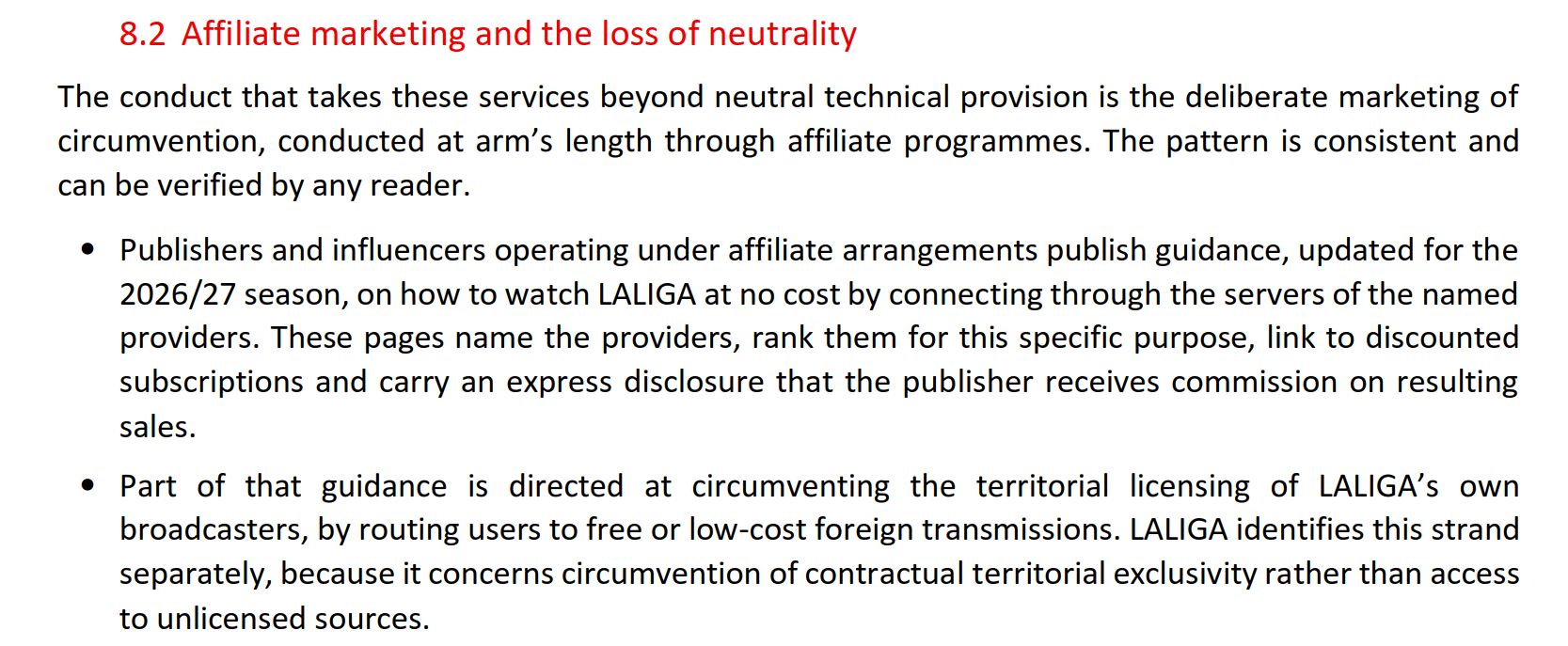
LaLiga’s submission highlights how publishers, media influencers, and review sites capitalize on this dynamic. Ahead of the 2026/27 football season, numerous digital guides have proliferated online, explicitly instructing users on how to deploy NordVPN, ProtonVPN, ExpressVPN, and Surfshark to access foreign free-to-air match broadcasts. These articles incorporate affiliate tracking links that reward the publishers with commissions for every successful subscription conversion.
While LaLiga acknowledges that the VPN providers do not author these guides themselves, the league argues that these commercial beneficiaries maintain corporate and financial incentives that strip them of technical neutrality.
Corporate Consolidation in VPN Review Ecosystems
Adding weight to its regulatory filing, LaLiga points to structural non-independence within the broader VPN review ecosystem. The submission explicitly highlights connections between prominent software review hubs—such as vpnMentor—and major corporate parent groups like Kape Technologies, which owns several competing VPN brands under a single corporate umbrella.
While such cross-ownership relationships are typically disclosed transparently by the publications themselves, LaLiga contends that the convergence of review platforms and product manufacturing creates a self-reinforcing commercial loop that actively promotes circumvention tools to sports fans seeking to bypass local blockades.
Official Statements and Industry Disclaimers
Recognizing the explosive nature of its demands, LaLiga’s submission is careful to frame its regulatory request within specific legal bounds.

- The Neutrality Disclaimer: The document opens with a clear disclaimer: "This submission does not assert any finding of legal liability against the entities named." Furthermore, LaLiga explicitly notes: "This request is based not on the provision of VPN services as such, but on the commercial exploitation and active promotion of their ability to circumvent court-ordered blocking measures."
- The Affiliate Angle: Emphasizing the distinction between passive tools and active marketing, LaLiga writes: "The conduct that takes these services beyond neutral technical provision is the deliberate marketing of circumvention, conducted at arm’s length through affiliate programmes."
- The Downloader Ecosystem: Regarding the AFTVnews utility, LaLiga argues that the ease of access provided by numeric codes demonstrates active facilitation: "The ease and simplicity with which applications can be discovered and installed through this catalogue is itself demonstrative of its nature as an editorially-curated platform, distinct from the underlying distribution infrastructure."
Industry stakeholders, including ProtonVPN, the VPN Trust Initiative, and AFTVnews developers, were approached for commentary prior to publication but declined or failed to respond before the deadline.
Future Outlook: Implications for Digital Privacy and Copyright Enforcement
As the European Commission evaluates submissions for its 2027 Counterfeit and Piracy Watch List, the inclusion of NordVPN, ProtonVPN, ExpressVPN, Surfshark, and the Downloader app marks a watershed moment in digital rights enforcement.
Historically, lawmakers across the United States and the European Union have fiercely protected general-purpose privacy tools, drawing a hard line between secure telecommunications infrastructure and platforms dedicated to mass copyright infringement. Even recent legislative packages—such as unified site-blocking bills targeting ISPs and DNS resolvers—have routinely spared consumer-grade VPNs from mandatory blocking obligations.
If the European Commission yields to LaLiga’s lobbying efforts and places mainstream privacy providers on its watch list, it could establish a dangerous regulatory precedent. Such a move would blur the legal boundaries between neutral technology providers and the third-party marketers who promote them, threatening the foundational principles of online privacy, freedom of expression, and user autonomy across the European digital single market.
For now, the legal battle lines are drawn. Whether Brussels chooses to validate LaLiga’s expansive interpretation of intermediary liability or chooses to protect the infrastructural integrity of consumer encryption will shape the future of internet governance for years to come.