Executive Overview
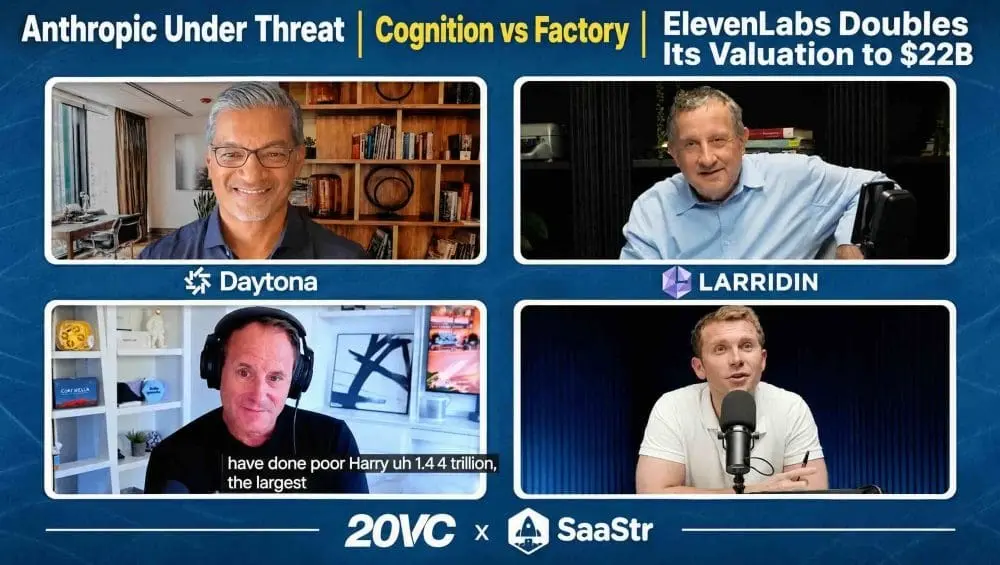
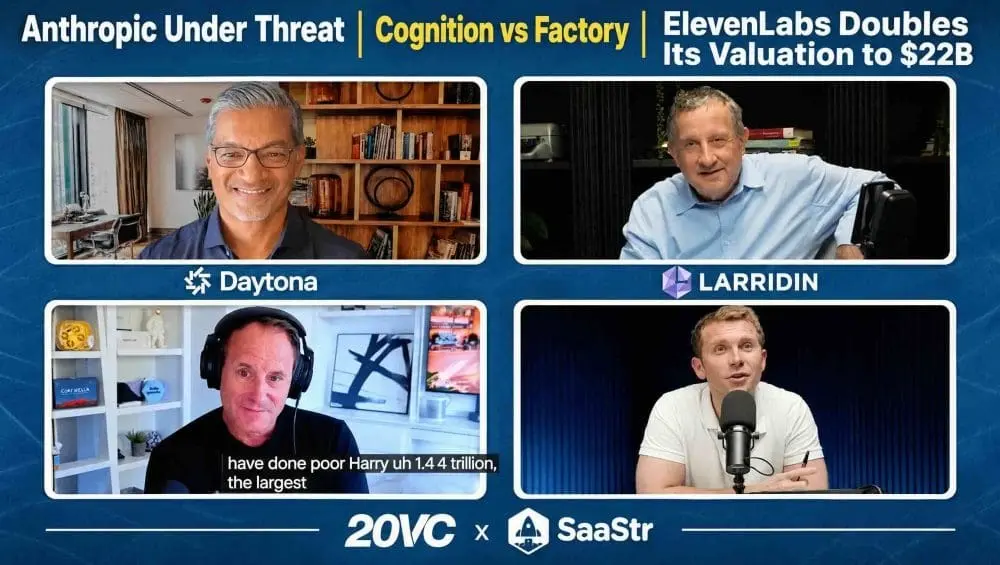
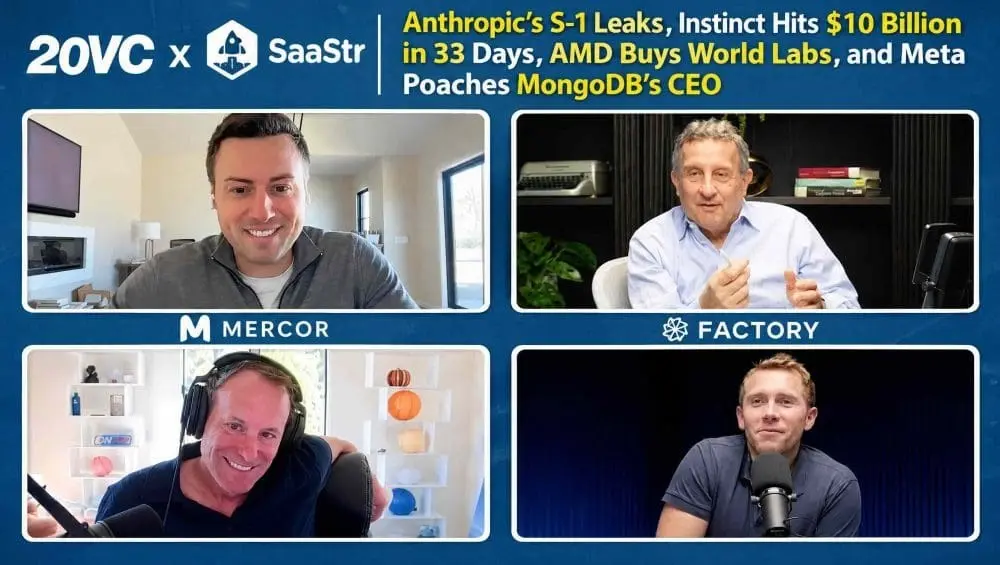
The venture capital and technology landscapes are hurtling through a period of unprecedented turbulence, defined by monumental capital deployments, soaring valuations, and structural shifts in how early-stage risk is underwritten. In a recent powerhouse collaboration between 20VC and SaaStr, host Harry Stebbings welcomed a heavyweight panel: Jack Altman (General Partner at Benchmark), Rory O’Driscoll (Partner at Scale Venture Partners), and Jason Lemkin (Founder of SaaStr).
Recorded against a backdrop of staggering market activity—featuring AMD’s $8.2 billion acquisition of World Labs, Meta poaching MongoDB’s CEO, and Oura pulling its highly anticipated IPO mere days before pricing—the panel dissected the new realities of the AI boom. From early-stage check sizes ballooning to ten-figure growth rounds, to the fading viability of the traditional seed round, the discussion laid bare a venture ecosystem operating at breakneck speed and maximum variance.
Detailed Chronology of Market-Shifting Events
1. Anthropic’s Leaked S-1 and the Weight of Exponential Infrastructure
The leaked draft of Anthropic’s S-1 prospectus sent shockwaves through the tech ecosystem, revealing a staggering financial profile for 2025: $4.6 billion in revenue against an $8 billion operating loss, paired with an eye-watering $518 billion in future cloud, compute, and infrastructure commitments.
While the headline losses initially rattled public perception, the panel offered a more nuanced structural breakdown. Rory O’Driscoll argued that the vast majority of the scary-looking net loss is non-cash accounting, with actual cash flows reflecting predictable scaling costs: $4.5 billion in revenue, $8 billion in compute, and $5 billion in overhead. The most revealing data point, according to O’Driscoll, was that just two customers accounted for 25% of Anthropic’s revenue, implying that a single entity invested roughly half a billion dollars into the platform last year.
However, optical risks remain a severe hurdle. Jason Lemkin highlighted potential public relations hazards, noting parallels to Facebook’s early public offering days—oversubscribed at pricing, only to drift downward as public anxiety regarding AI safety and data center power consumption grows. Furthermore, legal disclosures warning of existential risks provide state attorneys general with immediate hooks for regulatory scrutiny, setting the stage for what may be the most publicly participatory IPO in memory.
2. The Meteoric Rise of Instinct: $1 Billion at a $10 Billion Valuation
In one of the fastest funding trajectories in tech history, consumer AI agent platform Instinct secured a $1 billion financing round at a $10 billion valuation—a mere 33 days after raising at a $2.5 billion valuation. Co-led by Benchmark, Sequoia Capital, and Coatue, Instinct achieved this milestone despite only launching its invite-only service in August 2026. Founder Noah Shinn reported the platform is already nearing $1 billion in annual transactions, heavily anchored by travel use cases.
Benchmark’s Jack Altman framed the investment through a macro lens: consumer agents that act autonomously across the third-party internet represent a paradigm shift on par with chat and coding interfaces. AI is officially transitioning from a conversational novelty to a functional digital labor force. Jason Lemkin introduced a pragmatic litmus test for the category: utility is measured by whether users run the application all day long. Just as coding agents and legal tech embedded themselves into daily enterprise workflows, the long-term winners in the agentic space will be those that command eight-hour daily engagement.
3. AMD’s Acquisition of World Labs for $8.2 Billion
In the neolab sector’s first major liquidity event, semiconductor giant AMD announced the acquisition of Fei-Fei Li’s spatial intelligence startup, World Labs, for $8.2 billion in stock. Founded just two and a half years ago by the pioneer behind ImageNet, World Labs represents a monumental win for spatial world-model technology.
Jason Lemkin evaluated the transaction through a market-cap lens: with AMD’s stock surging nearly 279% over the past year to hover near the $1 trillion mark, spending roughly 0.8% of its market capitalization on world-class technical talent to fortify its position against Nvidia is a remarkably efficient strategic play. The acquisition underscores a broader industry shift: major incumbent technology players are increasingly willing to absorb multi-billion-dollar neolabs to secure elite R&D teams faster than an independent public market debut would allow.
4. Meta’s Poaching of MongoDB CEO Chirantan CJ Desai
The corporate world reeled when MongoDB CEO Chirantan CJ Desai abruptly stepped down after less than a year at the helm to lead Meta’s newly consolidated enterprise AI business. The division will spearhead the rollout of Meta’s full tech stack—including Muse, the Meta Business Agent, and Muse API—directly to enterprises and developers. In response, MongoDB shares plummeted nearly 20% in morning trading before the company reinstated former CEO Dev Ittycheria as interim chief.
The panel agreed that public company CEOs rarely abandon their posts unless incentivized by life-changing compensation packages. Jack Altman emphasized that beyond the financial upside, the cultural zeitgeist and the magnetic pull of building ubiquitous consumer-facing AI tools make mega-cap tech giants formidable poachers of top-tier executive talent.
5. Oura Pulls Its IPO Two Days Before Pricing
In a dramatic eleventh-hour reversal, smart-ring pioneer Oura halted its highly anticipated 50-million-share IPO just 48 hours before pricing. Marketed within a $40 to $44 range to raise $2.2 billion at a $15.62 billion valuation, the offering was reportedly fourfold oversubscribed. Citing broader market uncertainty, CEO Tom Hale opted to pull the plug.
Rory O’Driscoll suggested that heavy secondary selling—specifically from early backer Forerunner looking to clear its entire position—made public investors excessively price-sensitive, threatening to slash early returns. Jason Lemkin, however, pointed to strong broader macroeconomic indicators, noting that despite ample market liquidity, the reluctance of companies to cross the public threshold highlights deep-seated valuation anxiety within the tech sector.
Supporting Context & Metrics
The convergence of AI infrastructure demands and venture capital dynamics has fundamentally altered foundational financial metrics across the startup ecosystem:
- The S-1 Reality Check: Anthropic’s $518 billion in compute commitments underscores the staggering capital intensity required to remain competitive at the frontier model layer.
- The Death of the Traditional Seed Check: The classic $3–6 million seed round is rapidly being squeezed out of existence. Founders with strong networks are bypassing moderate seed rounds to raise $30–50 million right out of the gate, driven by infrastructure costs that make sub-$100 million rounds increasingly unviable for deep-tech ventures.
- Inference Cloud Valuations: While foundational labs commanded early investor attention, the last 18 months have established inference infrastructure—typified by Modal hitting a $15 billion valuation and Baseten eyeing $26 billion—as the definitive index bet on the broader AI economy.
Official Statements & Industry Perspectives
The discourse among Altman, O’Driscoll, Stebbings, and Lemkin illuminated the deep psychological and mathematical tension currently gripping venture capitalists:
- Jack Altman on Investment Velocity:
"We’re definitely not investing at the right speed. We are either investing way too fast or way too slow. When both sides of the equation are this out of whack, the odds of having it right are zero."
- Rory O’Driscoll on Early-Stage Risk with Growth-Stage Capital:
"In this cycle we’ve had investments with early-stage risk that require super late-stage capital, which is just definitionally a strange time to be playing."
- Jason Lemkin on Enterprise Utility:
"The ones that win are the ones we use all day long. Will we run Instinct or Muse eight hours a day? If we do, I guarantee it wins."
- Harry Stebbings on Round Inflation:
"My team said to me the other day, we can’t find anything under 100 million. I said, wow, seed prices are expensive. They said, no, no. $100 million round size."
Future Outlook
Looking ahead toward 2027, the venture capital and technology landscapes face a moment of reckoning. The traditional playbook of methodical, phased venture funding has been upended by exponential compute demands and astronomical capital injections.
While mega-funds like Bessemer—which recently closed a massive $5.75 billion pool, including a $1.75 billion seed allocation—continue to double down on scale, boutique firms and independent general partners are re-evaluating the merits of institutional capital altogether. As AI-native applications mature and edge toward public market readiness, the ultimate test will not be the velocity of capital deployment, but the enduring sustainability of enterprise unit economics in an increasingly crowded and capital-intensive digital economy.