Executive Overview
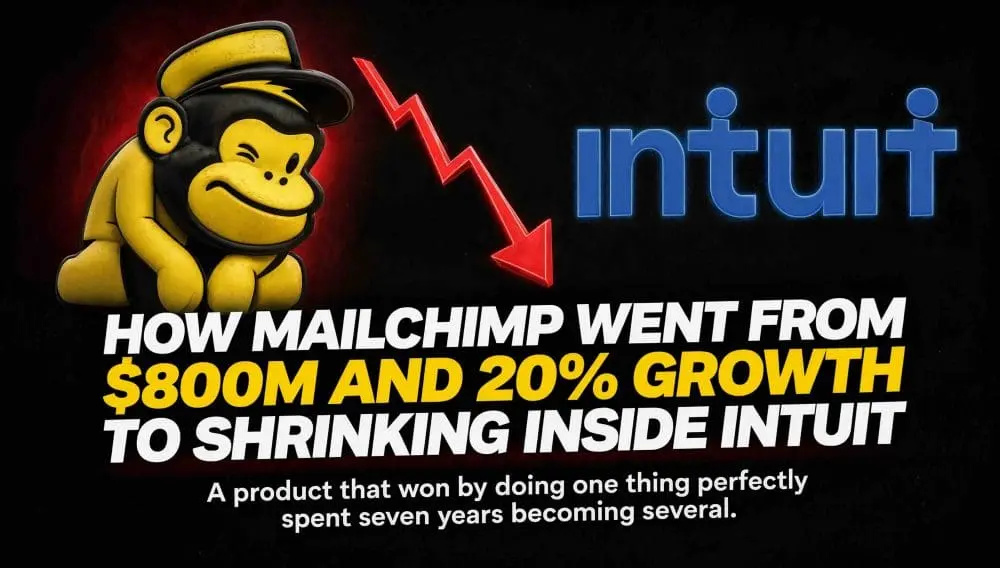
For nearly two decades, Mailchimp was the undisputed gold standard for small business email marketing. It won by doing one thing exceptionally well: making email creation simple, accessible, and remarkably fast. Yet, over a seven-year period, a quiet transformation took place. The single-minded focus that built its empire was systematically diluted into an unwieldy all-in-one suite of marketing tools.
Following Intuit’s eye-watering $12 billion acquisition of the company in 2021, the cracks widened from structural friction to acute financial erosion. By its Q3 FY26 earnings call on May 20, 2026, Intuit took the unprecedented step of publishing its growth figures twice—once with Mailchimp included, and once with the asset stripped out entirely.
What happened to Mailchimp is not merely a corporate cautionary tale about the perils of post-acquisition management. It is a profound structural lesson in what occurs when a product designed for simplicity is stretched across too many fronts, misses the paradigm shift toward developer-first architectures, and fails to adapt to an era dominated by autonomous AI agents. Today, Mailchimp is no longer a growth engine; it is being aggressively harvested for cash.
The Anatomy of a Decline: Four Quarters of Public Disclosures
The decline of Mailchimp did not happen in the shadows. For over a year, Intuit’s public filings and earnings calls mapped a steady erosion of value, signaling to the market that the crown jewel of its 2021 acquisition was becoming a persistent drag on performance.
From Growth Driver to Corporate Drag
When Intuit acquired Mailchimp in 2021, the transaction was partially funded by a $4.7 billion term loan, backed by a business generating roughly $800 million in annual revenue and growing at an impressive 20% clip. In the fourth quarter of fiscal year 2022—the single quarter Intuit broke out the segment’s numbers—Mailchimp posted $265 million, translating to an annualized run rate of approximately $1.06 billion.
Intuit has not disclosed a standalone Mailchimp revenue figure since. Instead, investors had to read between the lines of segment definitions shifting across consecutive periods. The divergence was undeniable: a half-point drag at Intuit’s September 2025 Investor Day widened to a four-point drag by December, culminating in May 2026 by an outright revenue decline and the complete removal of growth projections from executive commentary.
The Degenerating Guidance Curve
Leadership’s language decayed in lockstep with the financials. In August 2025, CFO Sandeep Aujla characterized Mailchimp as a "near-term drag" with turnaround initiatives underway, expressing confidence that the asset would be performing well by year-end. By February 2026, projected double-digit growth had been pushed out indefinitely, past fiscal 2026. By May 2026, the word "growth" had vanished entirely from executive commentary, replaced strictly by a focus on "profitability" and cash generation.
Ultimately, Intuit explored a potential sale of the asset. Failing to secure a valuation matching their internal expectations, leadership pivoted to running the platform for cash. Internal restructuring followed swiftly: within hours of the announcement, laid-off employees revealed severe cuts across email and SMS delivery operations, software engineering, and infrastructure management—cutting directly into the operational muscle required to keep an enterprise-grade messaging platform viable.
Eleven Million Users, Zero Growth: The Trap of Vanity Metrics
A surface-level review of Mailchimp’s marketing materials often points to a colossal installed base of 11 million users. However, in the realm of modern software-as-a-service (SaaS), denominator size can easily mask underlying stagnation.
The Stagnant Funnel
Data from independent analyses, such as EmailToolTester’s January 2026 update of self-reported Email Service Provider (ESP) customer counts, highlighted a stark divergence. While competitor platforms equipped with functioning growth engines expanded their active customer bases by double-digit percentages over an 18-month window, Mailchimp’s active growth flatlined.
Because Mailchimp’s headline 11 million user metric relies heavily on free-tier signups—most of whom never monetize—it ceased to be a reliable indicator of business health. When a company’s largest metric is a non-paying denominator, it offers zero insight into monetization velocity, retention strength, or net revenue retention (NRR).
The Klaviyo Benchmark
To understand how severely Mailchimp lagged, one only needs to examine competitors operating in the exact same market segment. Klaviyo’s Q1 2026 results reported revenue of $358 million (up 28% year-over-year) across more than 196,000 customers. Notably, customers generating over $50,000 in Annual Recurring Revenue (ARR) surged by 38%, while its NRR climbed to an exceptional 110%.
Small businesses are structurally prone to churn. Yet Klaviyo managed to expand its footprint inside that exact demographic because it maintained deep focus on a single core problem: B2C customer data and messaging for commerce brands. Conversely, Mailchimp’s leadership openly admitted that small businesses—its historical bread and butter—found the platform "a bit harder to use," directly damaging retention and expansion metrics.
Focus Was the Moat: How the "Suite Strategy" Diluted Value
Mailchimp’s original supremacy, spanning roughly from 2001 to 2019, was built on an uncompromising commitment to user experience. It was quite simply the best, fastest way for a small business owner to send an email campaign without friction.
The Weight of Feature Bloat
Then came the pivot to an "all-in-one" marketing platform. Mailchimp rushed to stack on websites, landing pages, social ads, physical postcards, CRM features, appointment-booking tools, and SMS suites. Following the acquisition, the thesis expanded further: integrating QuickBooks financial data with Mailchimp reach to promise closed-loop lifecycle marketing tied directly to revenue.
While a data-synergy thesis looks compelling in a PowerPoint deck, it fundamentally misunderstands how small-to-medium businesses (SMBs) consume software. A twelve-person operation does not buy marketing software for abstract data synergies; it buys a tool that allows them to "send my customers an email that gets opened, in under twenty minutes, without learning anything new." Every peripheral feature added to serve a broader platform narrative introduced cognitive friction, making the core job marginally harder. Over years, this complexity compounded into elevated churn and anemic expansion.
Specialized Competitors Take the Spoils
As Mailchimp widened its aperture, the competitive landscape specialized. Klaviyo captured commerce, Kit dominated the creator economy, Brevo optimized for volume-based pricing, and beehiiv captured the modern newsletter market. Each competitor systematically outperformed Mailchimp at a specific slice of the pie that Mailchimp was trying to hold all at once.
Furthermore, this strategic drift began years before Intuit stepped in, with the bulk of non-email features launched around 2019. Doug Dennison—founder of MailNinja and formerly the world’s top-ranked Mailchimp partner—watched high-value agency work dry up as Mailchimp shifted away from core marketing sophistication toward down-market volume. Intuit ultimately inherited a category-defining brand drifting downward, saddled with a product expanding faster than it was deepening.
Harvesting the Base: The Death of the Freemium Engine
For years, Mailchimp’s free tier acted as its primary growth engine, popularizing the freemium model across the email marketing industry and seeding its massive user base. Post-acquisition, those growth incentives were systematically inverted into harvest incentives.
- Erosion of Free Tier Value: By mid-2025, multi-step automations were stripped from the free tier. Contact counts began incorporating unsubscribed and non-subscribed records, causing lists to hit ceilings much faster than expected.
- Punitive Limits: Exceeding contact caps could instantly pause email sending entirely—including test sends.
- Legacy Price Hikes: In April 2026, legacy accounts created before May 2019 that had never migrated were hit with unexpected 11% to 13% price increases.
Compressing the free tier may provide an immediate, artificial bump to Average Revenue Per User (ARPU) by squeezing the current paid cohort, but it does so by cannibalizing the pipeline of future customers. As Intuit CFO Sandeep Aujla noted, the revised cash-flow strategy prioritized internal cash generation over external growth, effectively treating Mailchimp as a cash cow rather than a compounder.
The AI Revolution: Why Agents Aren’t Choosing Mailchimp
Beyond traditional software competition, the rise of autonomous AI agents and modern developer platforms has introduced an existential threat that legacy UI-driven products are ill-equipped to handle.
The Missing Developer-First Pipeline
Today, modern applications are increasingly built on platforms like Replit, Lovable, or Vercel. When developers or agents scaffold an app and require messaging infrastructure, they rely on developer-first APIs and built-in connectors. Mailchimp is absent from these ecosystems—neither listed as an out-of-the-box option nor natively integrated into modern app-building scaffolds.
While Mailchimp has introduced native AI features—such as conversational analytics and integrations with ChatGPT and Claude—these tools merely bring AI into Mailchimp’s proprietary dashboard. They do not make Mailchimp operable from inside external agent stacks.
The API and Credential Gap
The limitation runs deeper: programmatic access. While Mailchimp provides an official Model Context Protocol (MCP) server solely for its legacy transactional messaging product (Mandrill), its core marketing platform lacks official MCP support. Third-party community workarounds rely on legacy v3 APIs with rigid, static account-level bearer keys that lack modern scope limitations, per-user identities, or secure token revocation pathways.
When autonomous agents or modern developers evaluate infrastructure, platforms like Resend offer comprehensive CLI skills, official MCP servers, and robust API coverage. If an autonomous agent cannot seamlessly orchestrate an email marketing platform through secure, programmatic channels, it will build around the platform entirely—leading to quiet, permanent attrition.
Eight Essential Takeaways for B2B Founders
The Mailchimp saga offers vital architectural and strategic lessons for modern B2B SaaS leaders:
- Focus is a Moat with Ongoing Maintenance Costs: Adding peripheral features introduces a subtle tax on the core job your product was hired to perform.
- Ease of Use is a Retention Metric: Product complexity always materializes years later on the P&L as degraded net revenue retention and rising churn.
- Your Free Tier is Your Future Pipeline: Aggressively monetizing or shrinking your top-of-funnel free tier borrows revenue from tomorrow to pad today’s margins.
- Vanity Metrics Hide Business Reality: Millions of non-paying users mean little if active customer growth and ARPU expansion are stalling. Watch the denominator.
- Beware "Ex-Asset" Disclosures in Earnings Calls: When a public parent company repeatedly reports its growth metrics with a specific acquisition stripped out, that asset is officially on notice.
- Integration Synergy Must Benefit the Buyer: Architectural synergies mean nothing unless they translate directly into a faster, smoother user experience.
- Switching Costs are Evaporating: Modern migration tools and AI-driven onboarding make it easier than ever for customers to switch platforms. Incumbency no longer shields mediocre products.
- Agent-Operability is the New Evaluation Standard: If your product cannot be driven programmatically by modern AI agents through secure, scoped APIs, it risks becoming invisible to the next generation of builders.
Future Outlook: The Lag Between Decision and Disclosure
The story of Mailchimp’s trajectory offers a sobering lens through which to view the tech landscape of the 2010s. Many category-leading companies from that era now find themselves navigating the same perilous curve: an installed base large enough to mask slowing organic growth through price hikes, paired with corporate ownership incentivized to harvest cash rather than compound long-term value.
Mailchimp defined an entire category for two decades. Its ultimate undoing highlights a fundamental truth of modern technology markets: the lag between making a strategic roadmap error and seeing it quantified in quarterly disclosures can span seven years. No organization receives an explicit warning in the exact year they choose complexity over focus. For contemporary B2B founders, ensuring sustained relevance requires guarding product simplicity, embracing developer-first architectures, and remaining ruthlessly aligned with how customers—and the autonomous agents representing them—actually build and work today.