Executive Overview
In the contemporary corporate landscape, business automation has evolved into the invisible nervous system of enterprise operations. Spanning complex micro-services, low-code visual builders, and enterprise integration platforms, modern workflows orchestrate billions of dollars in capital, route sensitive customer data, and dictate operational pacing. Yet, a perilous disconnect persists between traditional application software development and workflow automation.
While application code undergoes rigorous Continuous Integration and Continuous Deployment (CI/CD) pipelines—complete with automated testing, static analysis, staging environments, and peer reviews—business automation frequently bypasses these safety protocols. A minor routing rule alteration, a shifted financial approval threshold, or an integration script writing to a nascent target database is often deployed directly into production with a few clicks in a visual interface.
The consequences of this operational laxity are severe. When an unvetted automation rule fails, its "blast radius" extends far beyond traditional code exceptions. Orders duplicate, sensitive customer data misroutes, financial transactions double-execute, and human operators lose the contextual awareness required to safely remediate errors.
To mitigate these enterprise-grade risks, organizations must adopt a foundational paradigm shift: every workflow modification must be treated as a formal software deployment. This does not necessitate imposing heavy, cumbersome software delivery toolchains onto lightweight automation platforms. Rather, it requires establishing a lightweight yet mandatory release contract before any new operational behavior touches live data. By defining deployable units, writing proactive rollback contracts, rolling out updates progressively, and enforcing strict post-execution reconciliation, businesses can transform fragile automation interfaces into resilient, predictable production assets.
Detailed Chronology: The Anatomy of an Automation Failure
To understand why enterprise automation requires rigorous release engineering, one must trace the lifecycle of a typical workflow modification and examine how informal management gives rise to cascading production incidents.
Phase 1: The Informal Edit
The lifecycle of an automation failure nearly always begins with perceived simplicity. A business analyst, operations manager, or integration engineer logs into a visual workflow builder. The task appears trivial: adjust an approval threshold from $5,000 to $10,000 to match a newly negotiated corporate policy, or redirect a webhook from a legacy CRM to a newly onboarded customer success platform.
Because the change interface is visual—composed of drag-and-drop nodes, conditional arrows, and simple text input fields—the creator perceives the action as configuration rather than code. Consequently, the change bypasses version control repositories, pull requests, and peer reviews. The editor clicks "Publish," and the new rule is immediately live.
Phase 2: The Silent Accumulation of State
Unlike a traditional software compilation error that halts deployment, an erroneous workflow modification rarely crashes immediately. Instead, it accepts inbound payloads while quietly corrupting operational state.
For the first few hours, metrics appear green. The API responds with HTTP 200 OK statuses, and execution dashboards show high throughput. However, the underlying logic is flawed. The new $10,000 threshold, for instance, lacks a corresponding currency conversion rule for international transactions. Alternatively, the new CRM integration is writing data using an unindexed schema, causing database write locks.
Phase 3: The Operational Threshold Breach
As transaction volume scales toward peak business hours, the downstream effects of the unvetted change manifest physically. Because the workflow lacked proper idempotency controls, delayed network retries cause the system to process identical financial transactions twice.
Customer support queues suddenly surge with inquiries regarding duplicate charges. Meanwhile, automated operational alerts begin firing, but the human operators on duty lack visibility into why the behavior shifted. They look at the visual builder, but because the interface lacks historical diffing or change attribution, they cannot discern what was modified, when it occurred, or which system dependencies were altered.
Phase 4: Scrambled Recovery and Tribal Knowledge
In the absence of a structured rollback contract, crisis management descends into chaotic improvisation. Engineers scramble to reverse-engineer the visual canvas from memory. Because no snapshot was exported prior to activation, recovery relies entirely on tribal knowledge—hoping the specialist who made the edit remembers the exact configuration state of the system twenty-four hours prior.
In worst-case scenarios, recovery requires manual database interventions, direct table edits, and hours of tedious transaction reconciliation. The incident highlights a stark operational reality: the automation intended to save labor hours has instead generated an exponential overhead of crisis management.
Defining the Deployable Unit and Configuration Governance
To prevent these systemic failures, organizations must apply rigorous software engineering principles to the components that drive business automation. A workflow is never merely a graphical diagram; it is a complex, distributed assembly of interconnected dependencies.
Deconstructing the Workflow Ecosystem
When defining a deployable unit within an automation context, engineering and operations teams must account for every element that influences execution behavior. A comprehensive deployable unit encompasses:
- Decision Rules: Conditional logic trees, routing matrices, and threshold configurations.
- Field Mappings: Data transformation schemas, payload parsers, and API payload definitions.
- Credentials & Secrets: OAuth tokens, API keys, database connection strings, and service accounts.
- Schedules & Triggers: Cron expressions, webhook listeners, and event-stream subscriptions.
- Permissions & Access Control: Role-based execution limits and security context boundaries.
- Retry Behaviors & Backoff Policies: Circuit breakers, exponential backoff timers, and dead-letter queue (DLQ) routings.
- Operator Screens & Human-in-the-Loop UIs: Forms, approval panels, and manual review dashboards.
- External Side Effects: Third-party API calls, file writes, message bus broadcasts, and physical system triggers.
Versioning and Immutable Identity
Every modification to these disparate elements must be captured under a unique version number and a stable change identifier. Teams must systematically record expected inputs, anticipated outputs, and documented side effects. Furthermore, the release record must explicitly classify system boundaries:
- Which external systems are authorized for read-only access?
- Which systems can be written to?
- Which executed actions are fundamentally irreversible (e.g., executing a wire transfer, dispatching physical mail, or permanently deleting customer records)?
By forcing these parameters into an inspectable, version-controlled format, organizations strip away the ambiguity of visual workflow builders. Changing a numeric threshold is no longer treated as a harmless text edit; it is documented as a systemic modification capable of altering thousands of automated decisions. Exportable configurations, version-controlled rule definitions, and explicit environment-specific values ensure that the exact state of an automation asset is fully visible and reproducible at any moment.
Writing the Rollback Contract Before Release
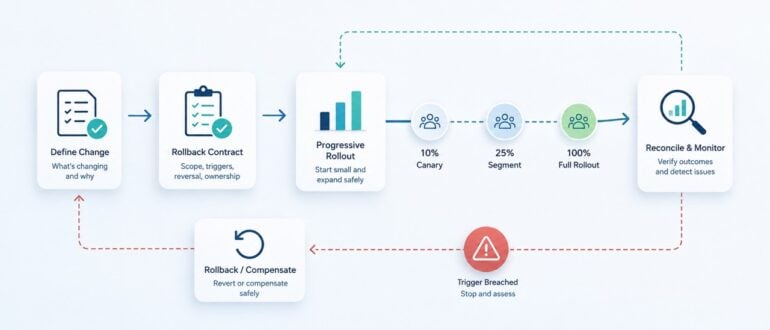
In high-reliability engineering, hoping that a deployment will succeed is never an acceptable strategy. True operational maturity is defined by how gracefully a system fails and how rapidly it can return to a known safe state. Every workflow deployment must be preceded by a written Rollback Contract—a binding technical agreement formulated while the engineering and operations teams are still thinking clearly, prior to touching live production data.
A robust rollback contract must definitively answer six foundational questions:
1. Scope
Which specific versions, rules, integrated endpoints, message queues, and record types does this operational change influence? The scope eliminates vague assumptions about what the deployment touches.
2. Preconditions
What exact system states must be verified as healthy before the new behavior is activated? This includes dependency health checks, database schema compatibility verifications, permission validations, and current message queue depth thresholds.
3. Repeat Safety (Idempotency)
Which idempotency keys, unique transaction IDs, or deduplication algorithms prevent system retries from executing the exact same side effect twice? In distributed systems, network timeouts frequently trigger automatic retries; the rollback contract must guarantee that duplicate execution does not result in duplicate business consequences.
4. Reversal vs. Compensation
Can the deployment be cleanly disabled via a switch, or must its operational side effects be actively compensated for via a secondary transactional action (such as executing an automated financial refund, posting a correction record, or restoring a previous queue assignment)?
Crucially, teams must never use the term "rollback" as a vague, comforting synonym for "compensation." A technical rollback reverts the system configuration to a prior state. Compensation applies a brand-new business transaction to offset the damage caused by a faulty state. Conflating the two leads directly to catastrophic accounting errors.
5. Trigger Thresholds
Which observable, quantitative metrics will immediately halt the rollout if breached? Examples include sudden spikes in error rates, unexpected duplicate processing rates, accumulating unresolved workflow exceptions, processing latency degradation, or automated reconciliation data mismatches.
6. Ownership and Control
Who holds explicit authorization to pause the workflow, who validates successful recovery, and who communicates operational impact to stakeholders? A technical kill switch that lacks an authorized, responsive human operator is nothing more than an ineffective control.
These six answers must be synthesized into a concise, one-page document. Its utility lies not in bureaucratic compliance, but in its testability. Engineering teams must routinely rehearse this stop path using production-like staging data, confirming without doubt that legacy workflow versions retain full capability to read, parse, and process state data generated by newer iterations.
Progressive Rollout Strategies for Business Automation
Just as modern web applications utilize canary deployments, blue-green architectures, and feature flags, business automation workflows should never transition instantaneously from zero percent to full production traffic. Progressive exposure minimizes the blast radius of unforeseen defects.
1. Dry-Run Execution
Before a workflow is permitted to execute real-world side effects, it should undergo a shadow or "dry-run" phase. During this stage, the automation evaluates incoming events, computes decisions, and logs proposed outcomes without actually triggering external APIs, writing to primary databases, or dispatching customer communications. Teams can then perform automated diffing between the proposed outcomes of the new workflow and the established behavior of the legacy process.
2. Segmented Production Exposure
Once dry-run validation is successful, the workflow should be released progressively to constrained operational segments:
- Geographic or Regional Segments: Deploying to a single regional office or localized market before global activation.
- Account-Class Segmentation: Restricting execution to internal testing accounts, sandbox environments, or low-tier customer classes.
- Percentage-Based Sharding: Routing a strictly controlled percentage (e.g., 1 percent, then 5 percent, then 25 percent) of eligible inbound events through the new workflow logic.
3. Holistic Observation Windows
Each progressive rollout stage must operate within a strictly defined observation window governed by hard stop-and-go thresholds. Crucially, teams must monitor both technical signals and operational realities.
A workflow can easily return pristine, lightning-fast HTTP 200 OK API responses while simultaneously generating severe downstream friction: an unmanaged surge in manual human rework, ballooning exception queues, or confusing operational handoffs. These represent critical release failures, regardless of whether infrastructure CPU utilization and server dashboards remain completely green.
Furthermore, previous workflow versions must remain accessible and warm throughout the entire observation window. If rules and configuration parameters reside exclusively inside a mutable graphical user interface, operators must export a cryptographically signed snapshot prior to activation. Operational recovery must never depend on an engineer’s fragile memory of what a visual configuration screen looked like yesterday.
Reconciliation and Post-Implementation Metrics
A common operational fallacy is assuming that a deployment is successfully completed the exact moment a new workflow begins executing. In enterprise automation, deployment is only the halfway mark; true closure requires exhaustive, automated reconciliation.
Comprehensive Reconciliation Protocols
Reconciliation is the systematic process of comparing intended operational effects with actually recorded effects across every system boundary. Simple volume counts—such as verifying that 10,000 events entered the pipeline and 10,000 events exited—are grossly insufficient.
Teams must perform randomized, deep-sample audits verifying unique identities, transaction amounts, processing statuses, exact timestamps, and ownership fields. This rigorous sampling detects partial writes, silent data truncation, and subtle mapping errors that evade macro-level metric tracking.
Key Performance Indicators for Workflow Reliability
To evaluate the true health and resilience of an automation release process, organizations should continuously measure and track specific operational metrics:
- Time-to-Detect (TTD): The duration elapsed between an automation failure occurring and the monitoring system or operator identifying it.
- Time-to-Pause (TTP): The duration required to successfully halt a misbehaving workflow or trigger an automated circuit breaker.
- Time-to-Restore Safe Processing (TTR): The duration required to return the workflow ecosystem to a stable, predictable state.
- Duplicate-Side-Effect Rate: The statistical frequency with which unintended duplicate actions (e.g., multiple emails, duplicate charges) are generated during execution.
- Compensation Volume: The total capital or labor expenditure required to manually or programmatically reverse faulty automation outputs.
- Exception Age: The average duration that unresolved workflow failures or items in dead-letter queues linger before human intervention or automated clearance.
These quantitative metrics act as an unvarnished mirror, revealing whether an organization’s rollback contracts and release controls genuinely hold up under production pressure. If restoring safe processing still depends on risky manual database edits or relies entirely on a single, overburdened subject matter expert, the organization’s release process remains fundamentally fragile.
Future Outlook: The Convergence of Automation and Software Engineering
As enterprises continue to accelerate their digital transformation initiatives—integrating advanced artificial intelligence, autonomous agentic workflows, and complex multi-cloud orchestration engines—the boundary between traditional software development and business automation will continue to dissolve.
Visual low-code and no-code builders are no longer isolated toys for departmental prototyping; they are core enterprise engines driving mission-critical financial transactions, regulatory compliance checks, and customer-facing interactions. Consequently, the informal "wild west" era of workflow automation is drawing to a close.
In the near future, enterprise automation platforms will natively enforce the release disciplines pioneered in software engineering. We will see the mandatory integration of:
- Automated Workflow Linting: Static analysis tools that inspect visual logic trees for infinite loops, unhandled exception paths, and insecure credential scopes before publication.
- Native Immutable Versioning: Systems where every visual workflow change automatically commits to a secure, auditable git-compatible repository.
- Autonomous Circuit Breakers: AI-driven monitoring agents capable of detecting anomalous operational behavior—such as unexpected spikes in manual rework or silent data mapping errors—and autonomously executing predefined rollback contracts within milliseconds.
By embracing this cultural and technical maturation today, forward-thinking enterprises can harness the immense speed and agility of business automation without sacrificing operational safety. Treating workflow changes like formal software deployments introduces a minimal amount of structural friction before release, while eliminating exponential uncertainty during production failures. Ultimately, automation becomes vastly easier and safer to operate because every modification arrives equipped with clear boundaries, empirical evidence, a guaranteed stop condition, and a thoroughly tested path back to safe, predictable work.