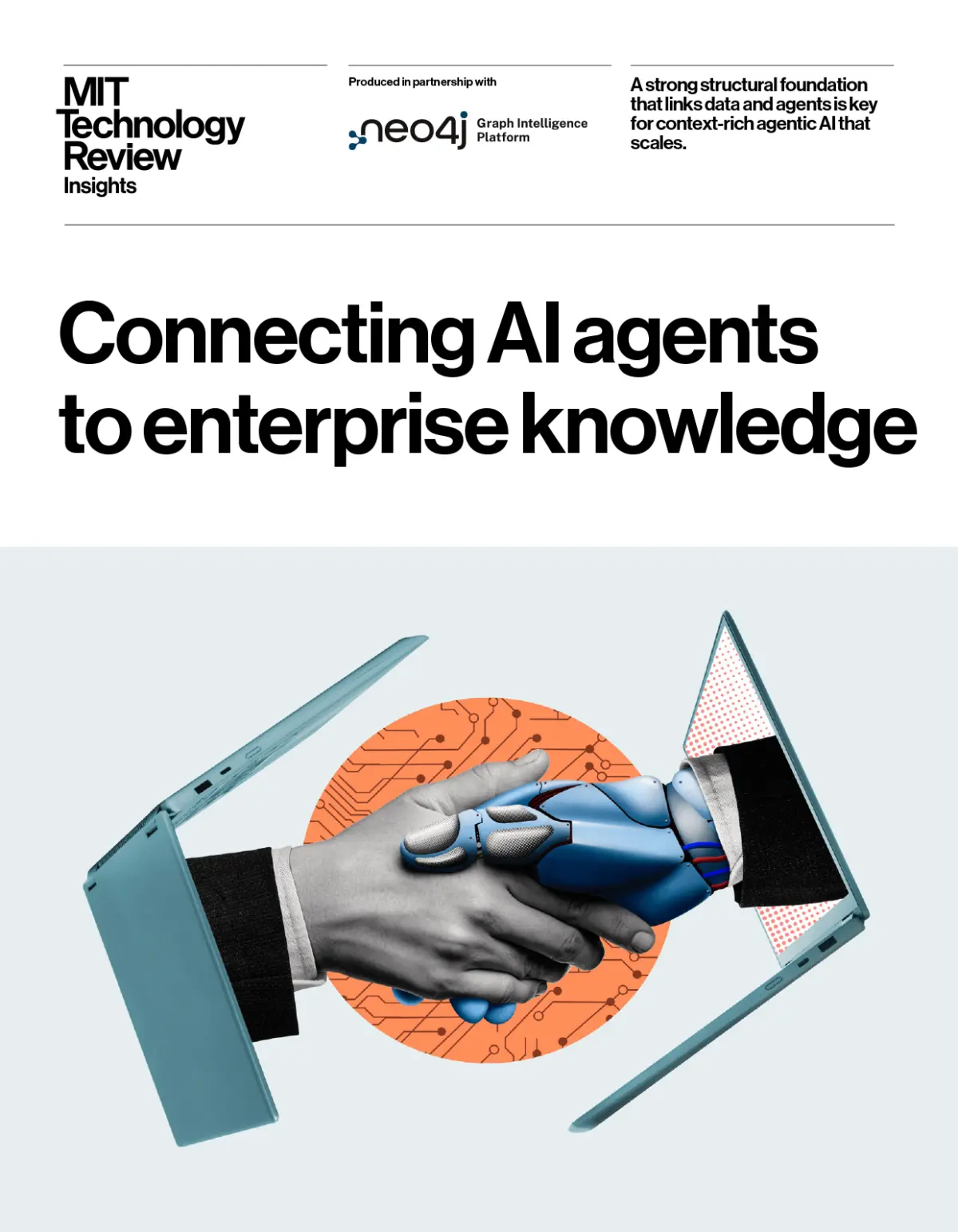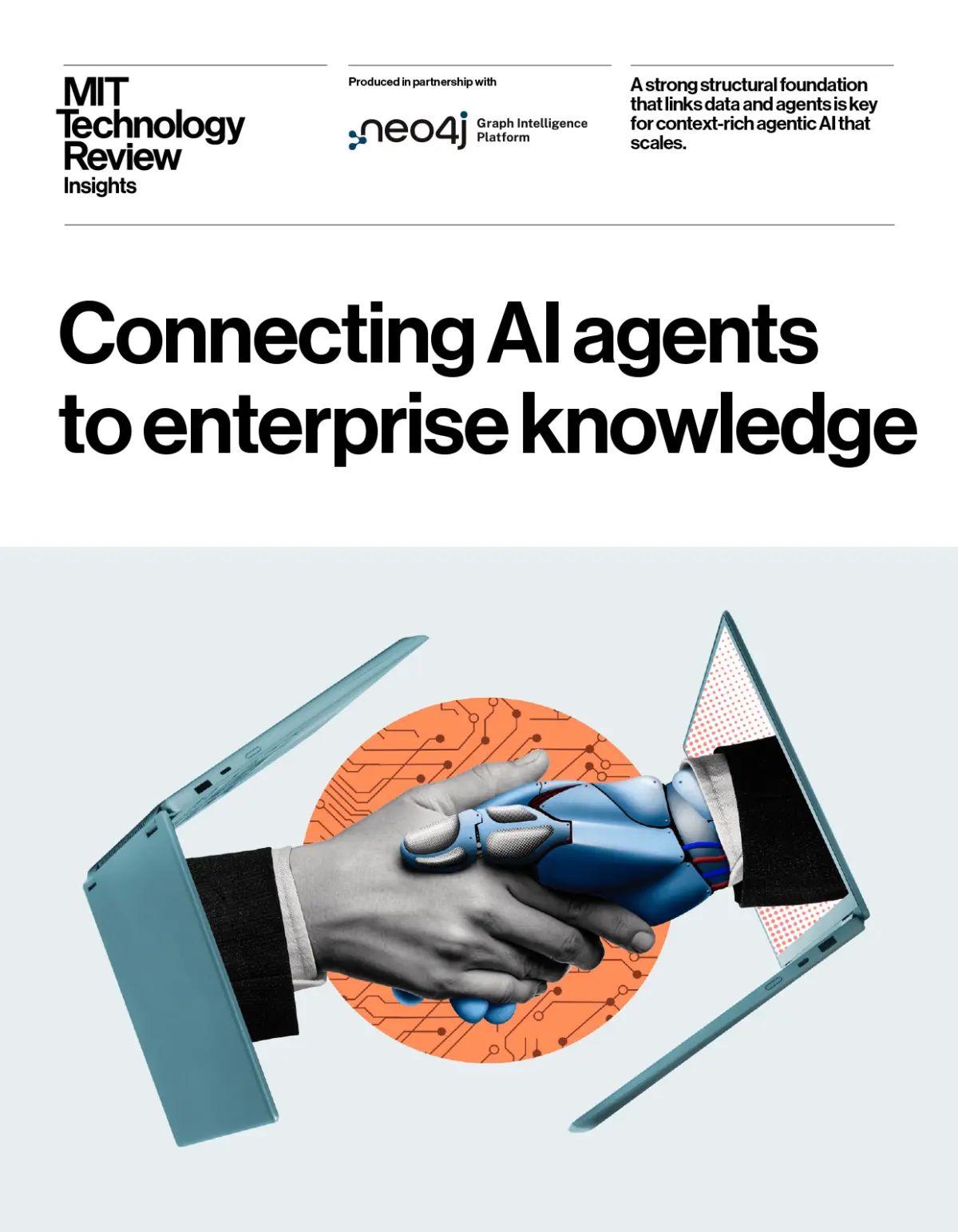
Executive Overview
For all the computational muscle, algorithmic sophistication, and petabytes of data continually amassed by modern enterprises, corporate artificial intelligence systems suffer from a surprisingly fundamental flaw: an acute lack of genuine understanding.
While enterprise AI can ingest data at lightning speeds, it frequently stalls when asked to reason about what that data actually means within the complex, nuanced ecosystem of an individual organization. In the realm of enterprise AI, data is merely raw material; knowledge is the contextual comprehension required to reason about operational situations, make high-stakes business decisions, and autonomously execute multi-step actions. Without this vital cognitive bridge, enterprise AI agents are prone to hallucination, flawed logic, and erratic reliability.
According to new research conducted by MIT Technology Review Insights in collaboration with Neo4j, this deficit of organizational knowledge is the single most critical bottleneck preventing agentic AI use cases from breaking out of sandbox environments and entering live production. surveyed across 300 data, AI, and technology executives reveal a sobering reality: on average, only 34% of enterprise agentic AI projects successfully make it to production.
The urgency to fix this is reaching a fever pitch. Driven by relentless competitive pressure, organizations realize that failing to deploy and scale agentic projects risks squandering millions in sunk capital while simultaneously ceding ground to more agile market rivals. To unlock the genuine efficiency and productivity gains promised by generative and agentic AI, enterprises must transition from merely feeding data to their models to equipping them with a robust "knowledge layer"—an architectural foundation built on semantic context, episodic memory, and procedural logic.
Detailed Chronology & Evolution: From Static LLMs to Autonomous Enterprise Agents
To understand why enterprise AI has hit this production wall, it is necessary to trace the rapid evolution of artificial intelligence in the corporate sector over the past half-decade.
Phase 1: The LLM Boom and the Illusion of Comprehension (2022–2023)
When foundational large language models (LLMs) first burst into the enterprise mainstream, organizations rushed to deploy them as general-purpose assistants. Companies pumped vast amounts of unstructured text—PDFs, internal wikis, customer service logs—into vector databases, assuming that sheer volume equaled comprehension.
However, enterprises quickly discovered that raw text generation was not enough. While LLMs could write poetry or summarize meeting notes, they lacked systemic awareness of enterprise workflows, data schemas, historical operational quirks, and cross-departmental dependencies. They knew the words, but they did not know the business.
Phase 2: The Rise of Agentic AI and Structural Failures (2024–2025)
Recognizing the limitations of passive chatbots, the industry pivoted toward agentic AI—autonomous or semi-autonomous systems designed not just to converse, but to act. These agents were given the ability to invoke APIs, query databases, execute software scripts, and orchestrate complex business workflows.
Yet, as enterprises attempted to deploy these agents into mission-critical environments (such as supply chain management, automated financial auditing, and customer onboarding), failure rates spiked. Without an explicit, structured understanding of corporate data ecosystems, agents made ruinous errors. They misinterpreted database relationships, triggered unauthorized transactions due to ambiguous contextual cues, or failed entirely because they lacked access to institutional memory.
Phase 3: The Quest for the Knowledge Layer (2026 and Beyond)
Today, the enterprise AI market has reached a critical inflection point. Organizations are no longer asking if they can build an AI agent, but why those agents cannot reliably perform in production.

The latest industry research makes it clear: closing the gap requires shifting investment away from raw compute and model parameter scaling, and toward structural knowledge engineering. Enterprises are actively racing to construct dedicated knowledge layers that integrate semantic frameworks, episodic memory, and procedural guidelines, allowing AI agents to navigate the enterprise landscape with human-like situational awareness.
Supporting Context & Metrics: Inside the MIT Technology Review Insights Study
To quantify the state of enterprise agentic AI capabilities, MIT Technology Review Insights surveyed 300 global data, AI, and technology executives. The resulting report evaluates how organizations manage agentic knowledge across three foundational pillars: semantic knowledge (the meaning of data concepts and relationships), episodic memory (historical context of past actions and outcomes), and procedural knowledge (rules, workflows, and how tasks are executed).
The study’s key findings paint a vivid picture of the current enterprise AI landscape:
1. The Production Bottleneck: A 34% Success Rate
The survey revealed that, on average, only 34% of organizational agentic AI projects ever make it into production. Even among high-tech firms—traditionally the most mature adopters of advanced software—friction remains high. The primary points of failure are not strictly algorithmic; rather, they stem from legacy data silos, stringent security and privacy regulations, and a fundamental lack of organizational context.
2. The Production Leaders vs. The Laggards
A vital insight from the research is the identification of a small, elite group of "production leaders"—organizations where an impressive 61% of agentic projects successfully advance beyond the pilot phase.
What separates these leaders from the pack? The study found that production leaders possess markedly superior knowledge capabilities, particularly in semantics. By maintaining a crystal-clear, structured understanding of what their data means, these organizations enable their agents to make reliable, context-aware decisions that scale safely across the enterprise.
3. Data Fragmentation as Public Enemy Number One
When asked about the greatest obstacles to expanding agents’ access to knowledge, 55% of mainstream executives pointed to data fragmentation—the inadequate sharing and isolation of data across disparate systems.
Interestingly, production leaders view the landscape differently. While they also grapple with fragmentation, 72% of production leaders cited security and privacy concerns as their primary hurdle. Having already solved basic data integration challenges, these advanced organizations are intensely focused on governance, access control, and ensuring that autonomous agents do not overstep data privacy boundaries.
4. Bridging the Gap: The Rise of the Knowledge Layer
Executives surveyed overwhelmingly agree that the most impactful step toward higher-quality agentic decisions is strengthening the structural foundation between corporate data and AI models. Rather than relying on fragile prompt engineering or brittle point-to-point integrations, industry experts advocate for a centralized knowledge layer. This architectural tier acts as an intelligent intermediary, translating raw data repositories into rich, queryable webs of meaning that agents can easily interpret.
5. Where the Money is Going: Investment Priorities
To overcome knowledge deficits, enterprise technology budgets are shifting toward specific infrastructure components. The top investment priorities identified in the report include:

- Retrieval Technologies: Advanced ingestion pipelines, AI-ready APIs, and sophisticated retrieval-augmented generation (RAG) frameworks.
- AI Evaluation Agents: Automated auditing systems designed to monitor, test, and validate agent behavior in real time.
- Knowledge Graphs: Dynamic, interconnected databases that map relationships between data points, providing the explicit semantic context agents need to reason effectively.
Official Insights & Industry Perspectives
The structural disconnect between data accumulation and organizational knowledge has caught the attention of leading technologists and enterprise architects.
Industry analysts emphasize that the traditional approach of simply feeding more data into larger models has hit a wall of diminishing returns. As one contributor to the MIT Technology Review Insights report noted:
"Data is static; knowledge is dynamic. You can give an AI agent access to every database in the Fortune 500, but if it doesn’t understand the proprietary business logic, regulatory constraints, and interpersonal workflows of your specific organization, it is essentially a brilliant intern with zero training."
Security and governance experts similarly highlight the tension between autonomy and control. As agents are granted the ability to take independent actions—such as modifying customer accounts, executing financial trades, or approving supply chain orders—the margin for error shrinks to near zero. Without a robust knowledge layer governing their boundaries, autonomous agents represent a severe operational risk.
Production leaders have recognized this early, treating data governance and semantic structuring not as an afterthought, but as the foundational bedrock of their AI strategy. By mapping out enterprise relationships via technologies like knowledge graphs, these organizations ensure that their AI agents operate within strict, understandable guardrails.
Future Outlook: The Road Ahead for Enterprise Agentic AI
As enterprises look toward the remainder of the decade, the trajectory of artificial intelligence will be defined less by raw model size and more by architectural maturity.
The era of throwing unconstrained large language models at business problems is coming to a close. In its place is the rise of knowledge-driven agentic systems. To survive and thrive in an increasingly competitive global marketplace, organizations must transition their AI strategies through several critical evolution points:
- De-siloing Enterprise Information: Organizations must dismantle legacy data silos, moving away from isolated data pools toward unified, accessible data architectures.
- Investing in Semantic Infrastructure: Enterprises will increasingly adopt knowledge graphs and semantic layers to give their AI agents a permanent, structured understanding of corporate relationships, compliance rules, and operational workflows.
- Balancing Autonomy with Rigorous Governance: As production rates climb, the focus will shift heavily toward AI evaluation agents and real-time monitoring systems that can autonomously verify the safety and correctness of agentic decisions.
- Redefining Return on Investment (ROI): Companies that successfully bridge the knowledge gap will capture unprecedented efficiency gains, transforming AI from an experimental cost center into a core engine of enterprise automation.
Organizations that fail to adapt—clinging to the belief that more data alone will solve their AI reliability problems—risk falling behind rivals who have already put intelligent, well-informed agents to work. The message from the research is unequivocal: the future belongs not to the companies with the most data, but to those with the deepest, most actionable knowledge layer.
For a deeper dive into the data, executive methodologies, and architectural frameworks required to build an enterprise knowledge layer, read the full report published by MIT Technology Review Insights in partnership with Neo4j.