Executive Overview
For decades, the math governing the B2B software sector was clean, reliable, and predictable. Growing at 30% or more annually was a badge of honor worn by dozens of public SaaS companies, signaling elite market capture and justifying lofty valuation multiples. But looking across the earnings releases of mid-2026, that traditional benchmark has effectively vanished.
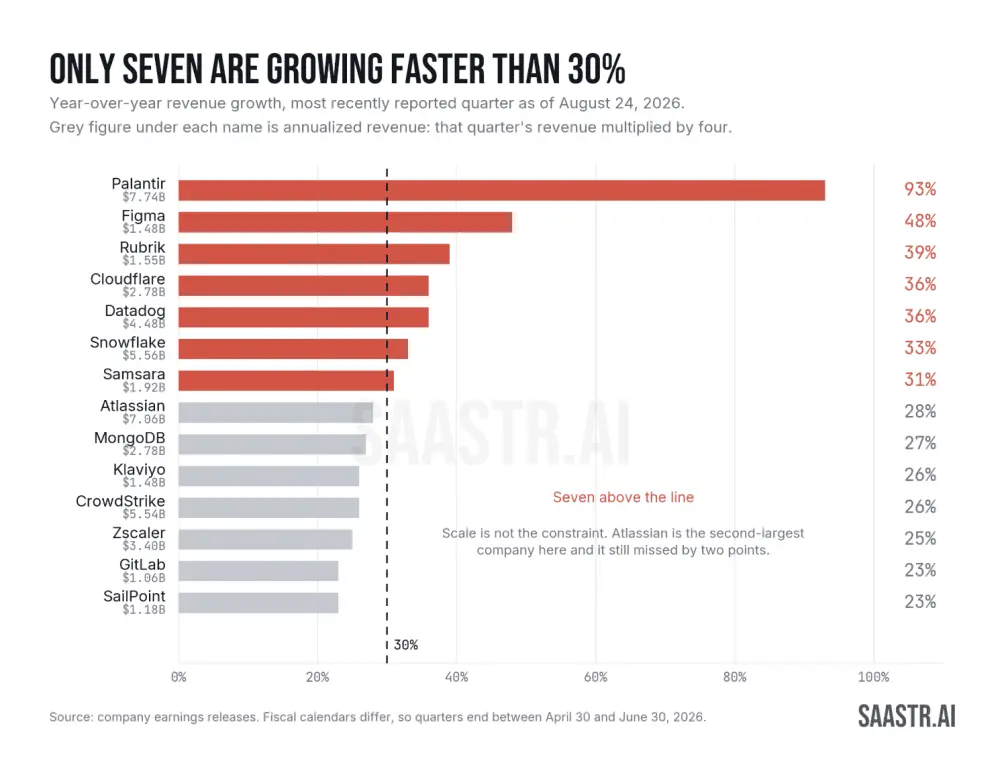
A rigorous review of current market data reveals a stark reality: exactly seven public B2B software companies are currently growing faster than 30% year-over-year. What was once the median growth expectation across the industry has shrunk into an exclusive, 90th-percentile territory. Today, if you are the CEO of a $200 million ARR B2B enterprise growing at 18%, you are not underperforming your peers—you are your peers.
The software market has officially split into two distinct universes. On one side sits a mature public cohort navigating single-digit to mid-twenty percent growth, rigidly stratified by valuation multiples that reward even minor percentage bumps with massive enterprise value expansion. On the other side sits a high-velocity, AI-native generation of private and hyper-growth giants—exemplified by Anthropic, Databricks, and Stripe—scaling at speeds that render traditional SaaS paradigms obsolete. For leaders navigating this landscape, the middle ground has evaporated. Survival now demands structural reinvention through consumption-based pricing, hybrid credit models, or capturing the underlying infrastructure of the artificial intelligence boom.
Detailed Chronology: The Evolution of the 30% Threshold
To understand how the B2B software market arrived at this juncture, one must trace the rapid compression of the median SaaS growth rate over a five-year timeline.
The 2021 Peak and the Post-Pandemic Correction
At the height of the post-pandemic tech boom in 2021, the SaaS Capital Index median growth rate peaked well above 30%. During this era, half of the index easily cleared a threshold that only a handful of enterprises can reach today. Capital was abundant, digital transformation budgets were boundless, and seat-based expansion occurred automatically as remote workforces scaled headcount.
As macroeconomic headwinds set in through 2022 and 2023, growth rates compressed. Yet, many industry veterans assumed this was a cyclical downturn—a temporary digestion period before historical growth rates returned.
The 2026 Reality Check
Independent reads of the SaaS Capital Index data file tell a sobering story. Across 58 constituents reporting both growth metrics and valuation multiples:
- 18 companies are growing under 10%
- 23 companies sit between 10% and 20%
- 11 companies record growth between 20% and 30%
- Only 6 companies clear the 30% mark
This data underscores a structural migration: the median growth rate of yesteryear has become the elite 90th percentile of today.
Scale vs. Growth: The Public Cluster
Examining the public companies sitting just below the 30% line provides critical insight into modern market dynamics. Scale is no longer the primary differentiator of hyper-growth. Atlassian, boasting roughly $7 billion in annualized revenue, missed the 30% line by a mere two points. Snowflake cleared the threshold at a staggering $5.6 billion scale, while CrowdShield/CrowdStrike hovered closely behind at $5.5 billion. Samsara secured a spot on the elite list at $1.9 billion.
These companies are undeniably well-run, yet they find themselves trapped in a valuation band that commands a median revenue multiple of roughly 5.5x. Meanwhile, companies in the sub-10% band languish at 1.9x, and those in the 10% to 20% band achieve 3.1x. In this environment, a variance of just four or five growth points can mean the difference between two entirely different valuation regimes.
Supporting Context & Metrics: The Mechanics of the Winners
What separates the elite seven public growers from the rest of the pack? A closer inspection of their financial architectures and go-to-market strategies reveals two distinct operational pillars: consumption-based pricing and structural market shifts.
1. The Death of the Seat-Based Model
Four of the seven public companies driving past the 30% threshold—Palantir, Datadog, Cloudflare, and Snowflake—do not primarily charge by the seat. Instead, they bill against usage.

When an enterprise customer scales up AI workloads or deploys autonomous agents, their bill increases automatically. There is no need for prolonged sales cycles, no requirement to convince a skeptical CFO that headcount has expanded, and no friction over seat allocations. The macroeconomic boom of artificial intelligence flows directly through their pricing architectures.
2. Figma: The Hybrid Masterclass
Figma stands out as the most instructive anomaly on the public list. As a design platform, Figma relies heavily on seat-based licensing. Yet, the company posted a remarkable 48% growth rate in the quarter ending June 30, marking its third consecutive quarter of accelerating growth alongside a Net Dollar Retention (NDR) rate of 136%.
Figma achieved this by layering consumption economics on top of traditional seats rather than replacing them. The rollout of AI credit monetization allowed customers to expand along two distinct vectors: traditional seats and AI credit add-ons. Data from the company indicates that roughly two-thirds of customers generating over $10,000 in ARR added full seats at renewal, while individual enterprise clients added tens of thousands of paid seats driven by AI credit utility.
This transition was not without friction. Figma’s gross margins compressed by five points year-over-year, driven by the inference costs of powering unpaid beta products. Nevertheless, it provides a blueprint for legacy SaaS platforms seeking to monetize AI without cannibalizing their core seat counts.
Official Statements and Industry Insights
Industry leaders across both the public markets and private hyper-growth spheres have been vocal about the underlying forces driving this bifurcation.
Cloudflare and Datadog on Machine-to-Machine Traffic
During recent earnings calls, Cloudflare’s executive leadership framed their explosive growth around the structural rewrite of the internet for machine-to-machine traffic, driven by AI answer engines and agentic commerce. As CEO commentary emphasized, Cloudflare’s revenue naturally scales upward when automated machines execute workloads.
Datadog echoed this sentiment, noting that enterprises are aggressively building, deploying, and securing AI applications, thereby driving continuous platform utilization. Snowflake sits directly beneath this data ecosystem, acting as the foundational repository that AI agents query.
Databricks and Stripe: The Almost-Public Giants
Looking beyond the public markets reveals private heavyweights operating at jaw-dropping velocities.
- Databricks: Reached an annualized revenue run rate of $6.9 billion in June 2026, growing at over 80% year-over-year. CEO Ali Ghodsi attributed this acceleration directly to consumption economics combined with agentic AI workloads, which generate exponential query volumes. Like Figma, Databricks noted compressing gross margins due to the high compute costs required to serve AI queries.
- Stripe: Proving that companies do not need to be AI-native to win, Stripe reported $6.8 billion in revenue for 2025—up 33%—with total payment volume surging to $1.9 trillion. By acting as the financial plumbing for the entire AI ecosystem (processing transactions for labs, developer tools, and code assistants like Cursor and Vidor), Stripe effectively taxes the boom.
Future Outlook: Navigating the Two-Market Reality
The software landscape has fractured into two non-overlapping realities. On one side exists a large, capable group of public companies compounding in the low-to-mid twenties, accompanied by a long tail of single-digit growers. On the other side exists a private generation of AI-native platforms—such as Anthropic, whose run rate multiplied fourteenfold year-over-year, and Higgsfield, which scaled from zero to a $700 million annualized run rate in less than 18 months while maintaining positive cash flow.
The Strategic Choices for Software Leaders
For executives and founders currently operating in the middle tier, the data points toward three challenging yet viable strategic paths:
- Transition to Usage-Based Pricing: Shift monetization models away from static headcount toward consumption metrics that automatically capture the value of automated workloads.
- Layer Consumption on Seats: Follow Figma’s playbook by introducing AI credits, utility tokens, or value-added modules that pull traditional seat expansions along with them.
- Become the Tollbooth: Position your product as the essential infrastructure or transactional layer that the hyper-growth disruptors must purchase to operate.
Failing to choose one of these paths means resigning oneself to the grueling battle for fractional growth points in a market segment increasingly penalized by compressed valuation multiples. The middle ground is gone; the era of structural transformation has begun.