Executive Overview
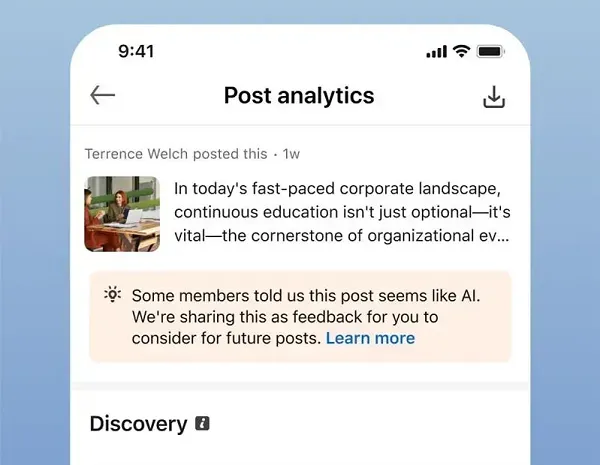
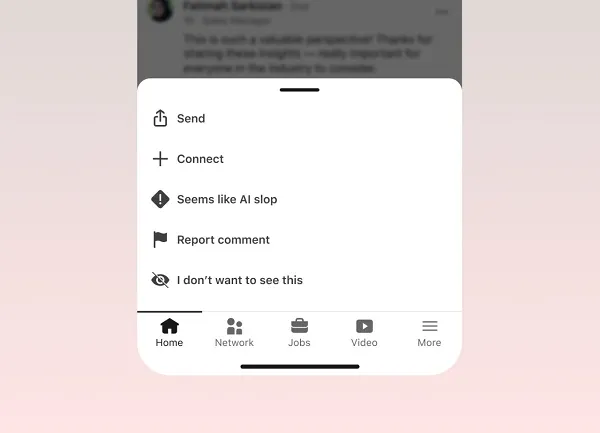
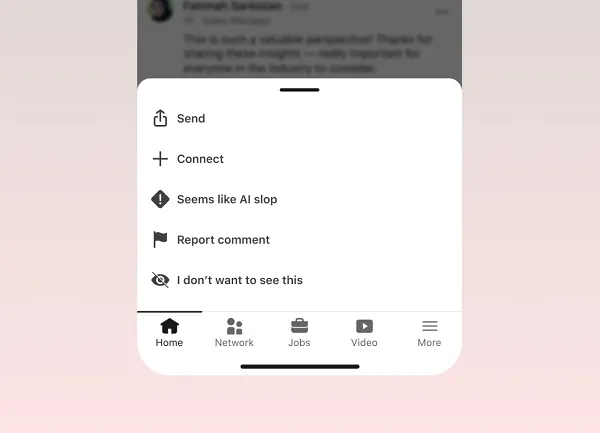
The modern professional digital landscape is increasingly dominated by a synthetic tide. As generative artificial intelligence tools have evolved from novelty text generators into sophisticated engines capable of churning out polished prose, platforms like LinkedIn have become ground zero for low-effort automated content. In response to mounting user frustration over superficial, algorithmically generated posts designed merely to game engagement metrics, LinkedIn launched a dedicated reporting feature earlier this month: the "Seems like AI slop" option.
Now, just two weeks after its initial rollout, LinkedIn executives have shared early utilization metrics, shedding light on how the professional networking platform intends to police the delicate boundary between helpful AI-assisted drafting and empty digital pollution. According to Chief Product Officer Hari Srinivasan, the feature has already been leveraged by over one million users. More impressively, the platform reports that overall content flagged under this definition has experienced a sharp 40% reduction in views over the same period.
Yet, LinkedIn’s approach is notably distinct from traditional platform moderation. Rather than serving as a heavy-handed penalty mechanism or a policy violation tracker, the "AI slop" button operates primarily as a personalized feed-curation tool and a diagnostic warning system. By prioritizing an informative rather than punitive strategy—coupled with user verification initiatives and algorithmic safeguards—LinkedIn is attempting to preserve the platform’s core value proposition: authentic human professional connection and lived experience.
This deep dive explores the motivations behind the feature, the mechanics of how it functions beneath the surface, leadership’s official stances, and what this pivotal move signals for the future of digital content consumption.
Detailed Chronology: From AI Boom to the "Slop" Backlash
To understand the rapid deployment and immediate adoption of LinkedIn’s new reporting tool, one must trace the arc of generative AI integration across social platforms over the past few years.
The Generative Surge and the Rise of "Empty Text"
When large language models (LLMs) became widely accessible to the public, professional networks were among the first ecosystems to feel the shockwaves. Initially, professionals experimented with AI to draft cover letters, optimize resumes, and polish weekly project updates. However, the temptation to scale personal branding through complete automation quickly took over.
Users began publishing volumes of automated posts characterized by predictable structures, hollow motivational platitudes, excessive emoji usage, and buzzword-heavy rhetoric. While syntactically correct and grammatically polished, these posts lacked a foundational requirement of professional networking: authentic human perspective. They were engineered solely to trigger algorithmic reach, capitalizing on the platform’s distribution mechanics without offering actionable insights, original research, or genuine personal stories.
The Tipping Point
As these synthetic posts multiplied, the user experience on LinkedIn began to degrade. Feeds that were once rich with industry analysis, peer-to-peer troubleshooting, and leadership insights became clogged with repetitive, low-effort discourse. Users expressed fatigue over scrolling through endless walls of generic text that sounded important yet said nothing.
Recognizing that traditional reporting options—which typically address hate speech, misinformation, or harassment—did not adequately cover the nuance of low-substance content, LinkedIn product teams developed a targeted solution. Earlier this month, the platform officially introduced the "Seems like AI slop" option, giving users a direct, frictionless method to flag content that feels devoid of human value.
The Milestone: One Million Uses in Two Weeks
The response from the LinkedIn community was instantaneous. Within just fourteen days of its launch, Srinivasan revealed that over one million users had utilized the option. This unprecedented volume of early engagement underscores just how acute the user base’s frustration had become regarding synthetic noise.
Crucially, rather than dismissing this surge as a temporary reaction to a new UI element, LinkedIn leadership has leaned into the data, using it to refine both user expectations and platform architecture. The reporting tool has transformed from a simple feedback mechanism into a cornerstone of LinkedIn’s broader strategy to safeguard its digital ecosystem.
Supporting Context & Metrics: Defining and Measuring "AI Slop"
To evaluate the success and mechanics of LinkedIn’s new tool, it is essential to examine how the platform defines the problem and the measurable impacts the feature has yielded thus far.
What Constitutes "AI Slop"?
A central challenge in moderating AI-generated content is distinguishing between constructive use and abusive saturation. LinkedIn Creator Product Lead Sam Corrao Clannon provided crucial clarity on how the company internally defines the term:
"We internally define AI slop as content that is potentially sophisticated or polished in its presentation, but lacks substance. So it doesn’t have any particular experience, perspective, or insight, but is sort of just empty text that’s posted to take up space and garner attention without effort on the other side."
Crucially, LinkedIn is not waging war against artificial intelligence as an assistant. Corrao Clannon emphasized that the platform has no issue with users leveraging AI tools to refine their grammar, check their spelling, or clarify their thoughts. The target is explicitly the mass production of "junk posts"—content generated end-to-end by algorithms with the sole intent of gaming visibility.
Measuring the Impact: A 40% Drop in Views
The most striking metric shared by LinkedIn leadership is the immediate behavioral shift observed across the platform. According to Srinivasan, overall content classified under the "AI slop" umbrella has seen a dramatic 40% reduction in views compared to figures from just weeks prior to the rollout.
This steep decline demonstrates that even subtle shifts in user feedback loops and algorithmic distribution can dramatically curb the economic incentive for creating synthetic noise. When low-effort posters realize their content is no longer reaching target audiences, the cost-benefit analysis of flooding the platform shifts rapidly.
The Verification Ecosystem
The "AI slop" reporting tool does not exist in a vacuum. It is part of a multi-pronged architectural defense that includes LinkedIn’s identity verification initiatives. Having recently surpassed 100 million verified profiles, LinkedIn is increasingly tying platform trust to real-world identity confirmation.
By integrating verification signals into the user experience—such as allowing users to filter replies and interactions exclusively by verified humans—LinkedIn is creating structural disincentives for anonymous or bot-driven content farms. The synergy between identity verification and subjective content reporting forms a comprehensive shield against automated manipulation.
Official Statements: Leadership Perspectives on the Nuanced Approach
LinkedIn’s executive team has been remarkably transparent regarding the design, limitations, and philosophy behind the new feature. By addressing common user misconceptions head-on, leadership has sought to prevent panic among creators while maintaining strict quality controls.
Feed Control vs. Global Censorship
One of the most persistent questions following the feature’s release concerned distribution: Does reporting a post as AI slop penalize the creator globally, or does it merely clean up the reporting user’s feed?
Corrao Clannon clarified that the feature is fundamentally designed as a user-empowerment tool rather than a global censorship hammer:
"This is a way that we’re giving viewers more control over their own feeds by allowing them to say this is not something that I’m interested in by virtue of it sounding like generic, empty, AI-generated content."
When an individual user flags a post as AI slop, the immediate consequence is localized: that specific user will see less content from that creator in the future. However, the global distribution of the post is not inherently altered by a single report.
Preventing Abuse and Unfair Targeting
To prevent bad actors from weaponizing the reporting tool against competitors or innocent creators, LinkedIn engineered complex algorithmic safeguards. Hari Srinivasan elaborated on these protective measures:
"We look at many signals together, and we’ve built safeguards to help prevent individual feedback from being used to unfairly target other members."
Under this system, a post’s overall performance is only impacted if a critical mass of multiple, independent users consistently flag the content for low substance. This multi-signal approach ensures that niche communication styles or unconventional professional voices are not mistakenly suppressed by isolated waves of negative sentiment.
An Informative, Not Punitive, Philosophy
Perhaps the most forward-thinking aspect of LinkedIn’s strategy is its decision to educate rather than instantly penalize. For users who accumulate a high volume of "AI slop" reports, LinkedIn is rolling out direct platform notifications.
Rather than shadowbanning accounts without explanation or issuing arbitrary bans, these alerts prompt creators to reconsider their content strategy. By informing posters that their content is routinely being rejected as empty synthetic noise, LinkedIn is providing an opportunity for self-correction. This shifts the platform’s role from an authoritarian moderator to an educational guide, encouraging a cultural shift back toward authentic human storytelling.
Future Outlook: The Ongoing War for Authenticity in Professional Networking
As generative AI tools become more powerful, accessible, and indistinguishable from human writing, the battle for digital authenticity will only intensify. LinkedIn’s early success with its "AI slop" reporting feature offers a promising blueprint for other social platforms grappling with similar existential challenges, but it also highlights the challenges that lie ahead.
The Escalation Arms Race
Generative AI developers are not standing still. As platforms implement semantic filters, pattern recognition, and user-driven reporting mechanisms, AI generators are simultaneously being trained to produce more nuanced, highly personalized, and seemingly "lived-in" narratives. The future of AI-generated junk will likely involve sophisticated simulations of personal anecdotes and tailored professional struggles designed specifically to bypass human detection and reporting thresholds.
Consequently, LinkedIn will need to continuously evolve its detection models, shifting from basic keyword and structure analysis to deeper behavioral signals, network integrity checks, and expanded verification protocols.
The Premium on Human Vulnerability and Insight
Paradoxically, the proliferation of artificial intelligence is likely to elevate the market value of genuine human vulnerability, messy real-world experiences, and unpolished expert insights. When perfection can be generated in three seconds by an algorithm, polished prose ceases to be a marker of professional competence.
Professionals who share raw, unvarnished case studies, failures, specific local market dynamics, and genuine personal reflections will stand out more sharply than ever against the background hum of synthetic noise. LinkedIn’s product strategy implicitly acknowledges this shift: by empowering users to filter out the noise, the platform is actively cultivating an environment where authentic expertise commands a premium.
Conclusion
LinkedIn’s initial two-week check-in on the "AI slop" reporting tool reveals a platform navigating a complex technological transition with calculated precision. By registering over one million uses in fourteen days and driving a 40% reduction in views on flagged content, the feature has proven its immediate utility. More importantly, by choosing an educational framework over a punitive one, and by coupling content reporting with robust identity verification, LinkedIn is striving to protect the human element at the core of professional networking.
As Hari Srinivasan aptly noted, "Despite the progress, we know we have more to do to ensure LinkedIn remains a place where you can find real people & real perspectives… this all remains very top of mind." The war against synthetic noise is far from over, but LinkedIn has drawn a clear line in the sand, signaling that on the modern professional web, human substance will always outweigh algorithmic volume.