Executive Overview
For years, the conversation surrounding post-quantum cryptography (PQC) has suffered from tunnel vision. Industry discourse inevitably races past complex integration challenges, homing in instead on a straightforward algorithm-replacement exercise. Stakeholders quickly pivot to debating the merits of RSA, Elliptic Curve Cryptography (ECC), ML-KEM, digital signatures, and hybrid key exchanges—obsessing over which mathematical formulas should supplant today’s aging public-key infrastructures.
Yet, for DevOps teams, selecting a replacement algorithm is merely a fraction of the challenge. The vastly harder, more operational task lies in answering fundamental questions that many organizations are wholly unprepared for: Where does vulnerable cryptography currently exist? Which applications and infrastructure depend on it? Who owns those dependencies, and how deeply embedded are they across the software development lifecycle (SDLC)?
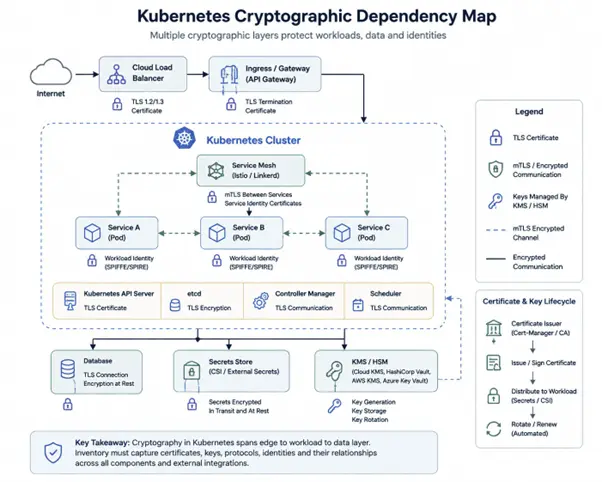
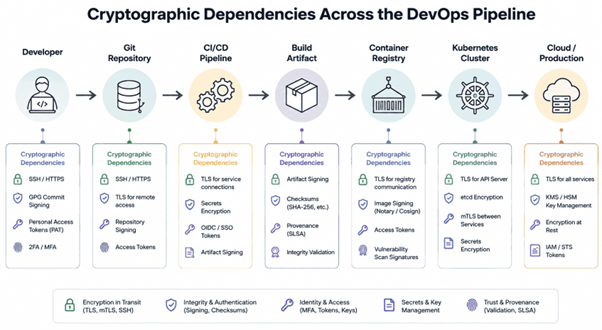
As global standards bodies—most notably the National Institute of Standards and Technology (NIST)—accelerate their PQC migration guidelines, cryptographic inventory has emerged as the definitive foundation of quantum readiness. Cryptography is not an isolated component; it is distributed across source code, third-party libraries, container runtimes, continuous integration and continuous deployment (CI/CD) pipelines, service meshes, cloud-managed key management services (KMS), and hardware security modules (HSMs).
Without comprehensive visibility, organizations cannot hope to achieve "crypto agility"—the capability to adapt and swap cryptographic mechanisms seamlessly without disrupting business continuity. For engineering leaders, the mandate is clear: before deploying a single post-quantum algorithm, enterprises must map their cryptographic landscape.
Detailed Chronology: The Evolution of Cryptographic Visibility and PQC Readiness
The realization that legacy encryption faces an expiration date has evolved through distinct phases, transforming cryptographic management from a niche compliance checklist into an urgent architectural imperative.
Phase 1: The Cryptographic Blind Spot (Pre-2020)
Historically, enterprise cryptography was treated as the exclusive domain of security architects and Public Key Infrastructure (PKI) teams. It lived in siloes. Applications utilized underlying operating system libraries or web server configurations, and certificates were tracked via spreadsheets or automated renewal tools focused solely on expiry dates. DevOps pipelines largely ignored the underlying mechanics of encryption, treating TLS certificates and SSH keys as static deployment assets rather than dynamic operational dependencies.

Phase 2: The Rise of Software Supply Chain Realities (2020–2023)
As supply chain attacks proliferated, the software industry recognized that static asset lists were insufficient. The emergence of Software Bills of Materials (SBOMs) revolutionized vulnerability management by forcing organizations to catalog third-party components, open-source packages, and transitive dependencies. However, these early SBOM frameworks largely overlooked cryptographic mechanisms, focusing instead on known software vulnerabilities (CVEs) rather than cryptographic exposure.
Phase 3: NIST Standards and the PQC Urgency (2024–Present)
With NIST finalizing its post-quantum cryptography standards—including ML-KEM for general encryption and ML-DSA for digital signatures—the focus shifted from theoretical quantum threats to actionable migration frameworks. NIST’s National Cybersecurity Center of Excellence (NCCoE) migration projects explicitly prioritized cryptographic asset discovery. Industry frameworks began recognizing that traditional certificate management is entirely inadequate for capturing the deep entanglement of encryption across modern, cloud-native architectures.
Today, organizations stand at a crossroads: transition from a passive, certificate-centric view of cryptography to an active, graph-based inventory model, or face catastrophic systemic failures when quantum capabilities mature.
Supporting Context & Metrics: Uncovering the Hidden Footprint
To understand why simple code searches or conventional certificate trackers fail, one must examine where cryptographic dependencies actually reside in a modern production environment.
The Anatomy of a Modern Cryptographic Dependency Graph
A simple source code search for strings like RSA, AES, ECDSA, or SHA256 will yield an incomplete and dangerously misleading picture. Modern applications inherit cryptographic behavior from multiple layers:
- The Application Layer: Direct calls to cryptographic libraries like OpenSSL or BoringSSL.
- The Framework & OS Layer: Default cipher suites baked into language runtimes and base container images.
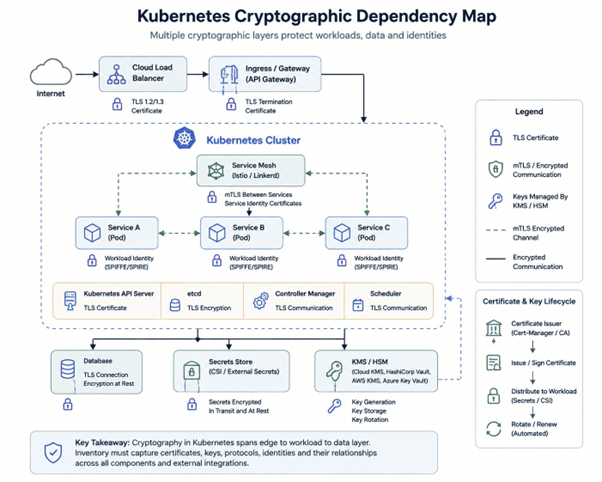
- The Infrastructure Layer: Kubernetes ingress controllers terminating TLS, and service meshes enforcing mutual TLS (mTLS).
- The Managed Service Layer: Cloud-native KMS and third-party SaaS integrations handling encryption-at-rest and transit.
Consequently, an organization’s true cryptographic footprint is best conceptualized as a dependency graph rather than a flat list of algorithms.
| Inventory Element | What to Capture | Why It Matters |
|---|---|---|
| Algorithms | RSA, ECC, AES, SHA family, PQC algorithms | Identifies cryptographic exposure |
| Libraries | OpenSSL, BoringSSL, language libraries and versions | Reveals implementation dependencies |
| Protocols | TLS, SSH, VPN, mTLS and application protocols | Shows where cryptography is negotiated |
| Certificates | Public key type, issuer, chain and expiration | Maps PKI dependencies |
| Keys | Type, owner, lifecycle and location | Supports rotation and migration |
| Applications | Services consuming cryptography | Establishes ownership |
| Data | Sensitivity, retention and protection requirements | Helps prioritize migration |
| Infrastructure | Kubernetes, load balancers, service meshes and gateways | Identifies operational dependencies |
| Vendors | Cloud and SaaS cryptographic dependencies | Reveals external migration blockers |
Beyond the SBOM: Enter the CBOM
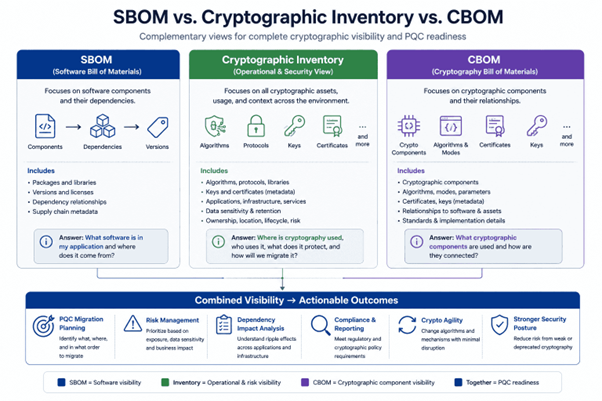
While Software Bills of Materials have transformed software supply chain transparency, they stop short of detailing cryptographic posture. An SBOM may list a package containing a crypto library, but it rarely details how keys are negotiated, which certificates authenticate services, or what cipher suites are actively enforced at runtime.
This gap has driven the adoption of Cryptographic Bills of Materials (CBOMs), championed by initiatives like CycloneDX. While an SBOM tracks software components, a CBOM maps out algorithms, keys, certificates, and their direct relationships to application workflows, providing the granularity required for PQC migration planning.
The Broader Risk Landscape: Third-Party Exposure and Breach Costs
The urgency of comprehensive cryptographic visibility is compounded by broader enterprise risk trends. According to Verizon’s 2025 Data Breach Investigations Report (DBIR)—which analyzed over 22,000 incidents and nearly 12,000 confirmed breaches—third-party involvement in security incidents doubled to 30%. Because many cloud-native architectures rely heavily on SaaS platforms, managed databases, and API gateways that handle encryption externally, an enterprise’s PQC migration schedule is frequently chained to its vendors’ roadmaps.
Furthermore, the financial motivation for proactive security remains stark. IBM’s 2025 Cost of a Data Breach report placed the global average cost of a breach at $4.4 million (with India-specific findings averaging INR 220 million). While these figures measure conventional breaches rather than quantum decryption events, they underscore the staggering business impact of delayed visibility and inadequate risk prioritization.
Official Statements and Industry Guidance
Recognizing the monumental shift required for quantum readiness, global cybersecurity authorities and standards bodies have updated their strategic guidance to emphasize discovery over immediate algorithm replacement.
The National Institute of Standards and Technology (NIST) has repeatedly stressed that organizations must not rush into PQC deployment without first laying the groundwork. In its migration documentation, NIST explicitly advises:
"Organizations should begin preparing for post-quantum cryptography now… [This includes] inventorying applications that use encryption, identifying systems that will need to transition, and establishing a comprehensive cryptographic inventory to guide migration."
Rather than focusing exclusively on certificates, NIST guidelines urge technology leaders to catalog algorithms, protocols, keys, systems, applications, components, and protected data flows.
Industry security architects echo this sentiment, emphasizing that visibility must be woven into the fabric of continuous delivery. Security cannot remain an isolated, gatekeeping exercise conducted right before production releases. As DevOps practices continually blur the lines between development, security, and operations (DevSecOps), cryptographic discovery must leverage existing automation tools—such as CI/CD pipelines, container scanners, and Infrastructure as Code (IaC) analyzers—to maintain an up-to-date, living inventory.
Future Outlook: The "Harvest Now, Decrypt Later" Threat and Crypto Agility
Looking toward the horizon, the most insidious threat facing encrypted data is not an immediate, real-time quantum cyberattack, but rather the "Harvest Now, Decrypt Later" paradigm. Nation-state actors and sophisticated cybercrime syndicates are actively intercepting and storing encrypted network traffic today. Even though current quantum computers lack the qubit count and error-correction capabilities to crack modern RSA or ECC encryption, threat actors anticipate the day fault-tolerant quantum hardware becomes a reality.
For enterprise data with long retention requirements—such as proprietary intellectual property, government secrets, healthcare records, and long-term financial transactions—the operational risk is immediate. If data encrypted today must remain confidential for the next decade, and quantum computers break current public-key cryptography within that timeframe, that data is already compromised.
The Roadmap to Crypto Agility
To counter this, organizations must build long-term operational resilience through crypto agility. Achieving true crypto agility requires a continuous lifecycle model:
$$textDiscovery longrightarrow textInventory longrightarrow textPrioritization longrightarrow textTesting longrightarrow textDeployment longrightarrow textMonitoring$$
- Discovery & Inventory: Continuously scan repositories, container images, Kubernetes clusters, and cloud environments to build a living CBOM.
- Prioritization: Evaluate dependencies based on data sensitivity, data lifetime, exposure level, and migration complexity. High-value, long-retention data protected by quantum-vulnerable public key algorithms must jump to the front of the queue.
- Testing & Deployment: Implement hybrid key exchanges (combining classical and post-quantum algorithms) within CI/CD pipelines to validate operational stability without sacrificing immediate security.
- Continuous Monitoring: Treat cryptographic inventories not as one-off documentation projects, but as automated, real-time assets that evolve alongside software releases and infrastructure changes.
Conclusion
The transition to post-quantum cryptography is often mischaracterized as a straightforward drop-in replacement of mathematical algorithms. In reality, it is a profound architectural transformation that tests the limits of enterprise visibility and software supply chain governance.
For DevOps teams navigating this complex landscape, the foundational truth remains unchanged: You cannot secure, migrate, or modernize what you cannot see. By breaking down siloes, automating cryptographic discovery, embracing CBOMs, and integrating visibility into the DevOps lifecycle, organizations can transform quantum readiness from an existential threat into an achievable, systematic engineering evolution.