Executive Overview
In the hyper-competitive landscape of social media, short-form video has established itself as the undisputed currency of user engagement. Among the giants of this ecosystem, Instagram continues to refine its platform to capture and retain user attention. With Reels consumption now accounting for roughly 50% of all time spent on the platform, lowering the barrier to entry for content creators has become an existential priority for Meta.
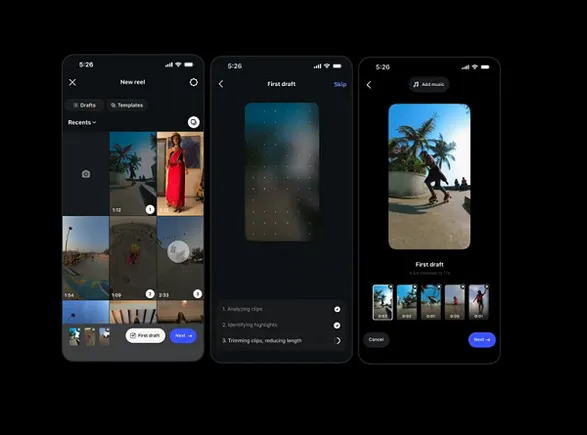
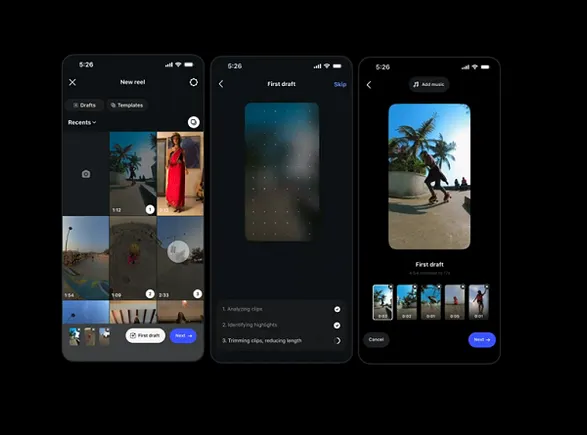
Enter "First Draft," Instagram’s newest native feature designed to radically streamline the video editing process. By leveraging automated curation, First Draft allows users to select a batch of raw video clips and—with a single tap—automatically stitches together the highlights, trims away dead air, and removes awkward pauses. The result is an instantaneous, cohesive foundational framework for a Reel.
Rather than functioning as a rigid, black-box automated editor, First Draft is engineered to serve as a collaborative launchpad. Every automated cut, sequence choice, and trim is completely reversible and customizable. By handling the tedious technical minutiae of early-stage video assembly, Instagram is shifting the creator’s focus away from production mechanics and back toward pure creativity.
This development arrives at a critical juncture in the digital content economy. As platforms race to integrate generative AI and intelligent automation into their toolkits, features like First Draft signal a broader industry shift: the democratization of video production. This comprehensive report explores the mechanics of Instagram’s First Draft, the broader context of the platform’s evolving creator economy, the implications for marketers and influencers, and what this means for the future of digital storytelling.
Detailed Chronology of the Feature’s Rollout and Integration
The journey toward fully automated, intuitive short-form video creation has been an iterative process for Instagram. Understanding how First Draft fits into the platform’s broader architectural evolution requires examining the timeline of Instagram’s recent creator-focused updates.
The Evolution of Instagram’s Editing Suite
For years, Instagram relied heavily on external third-party applications—such as CapCut, InShot, and Adobe Premiere Rush—for advanced video stitching and editing. While the platform gradually introduced native tools like multi-clip trimming, text-to-speech, and automated captioning, the initial assembly phase of video editing remained a manual, friction-heavy hurdle. Creators often spent hours reviewing raw footage, scrubbing through timelines, and cutting out pauses before even reaching the creative phase of adding music, filters, and text overlays.
Recognizing this bottleneck, Instagram began aggressively consolidating its editing ecosystem. The rollout of dedicated tools, paired with the ongoing refinement of Instagram’s standalone video editing features and project management capabilities within its broader app ecosystem, laid the groundwork for deeper automation.
The Introduction of First Draft
Instagram officially announced the rollout of First Draft to simplify the creation flow by centralizing key production tasks. Accessible directly through either the Reels gallery or the native Instagram camera, the feature acts as an intelligent intermediary between raw footage and a finished draft.
- The Selection Phase: Users upload or select multiple disparate video clips from their device library or in-app storage.
- The Automated Curation: With a single tap, the algorithm scans the footage, identifies structural highlights, eliminates prolonged pauses, and aligns the clips into a continuous, rhythmically sound sequence.
- The Customization Phase: The user is presented with a fully editable timeline where every automated decision can be manually overridden, reordered, adjusted, or deleted.
By ensuring that the AI’s work is entirely non-destructive and reversible, Instagram has carefully sidestepped the common pitfall of over-automation, wherein creators feel stripped of their editorial control. Instead, First Draft positions itself not as a finished product, but as an intelligent assistant designed to conquer the psychological dread of the blank canvas.
Supporting Context & Metrics: The Reels Economy
To fully grasp the strategic importance of First Draft, one must examine the macro-level metrics driving Instagram’s product roadmap. Video is no longer just a feature on Instagram; it is the core engine of the platform’s daily active usage (DAU) and advertising revenue models.
The 50% Milestone and the Attention Economy
Internal metrics consistently underscore the dominance of short-form video. Reels consumption currently accounts for roughly 50% of all time spent on Instagram. In a digital attention economy where every major platform—from TikTok to YouTube Shorts—competes for the same finite pool of human hours, retention is directly tied to content velocity.
The faster creators can conceptualize, produce, and publish engaging Reels, the richer and more diverse the platform’s content feed becomes. However, production friction remains a primary deterrent for casual users and micro-creators. While elite creators with dedicated editing teams can pump out polished content daily, casual users often abandon video projects due to the perceived time sink of post-production.
Overcoming "Blank Page Paralysis"
Behavioral psychology plays a significant role in content creation. "Blank page paralysis"—the hesitation and second-guessing that occurs when faced with hours of raw footage and no clear structural vision—is a major productivity killer.
First Draft directly targets this psychological barrier. By instantly generating a baseline narrative structure, the feature removes the friction of the initial cut. Even if a user ultimately decides to rearrange 80% of the AI’s suggested sequence, the mere existence of a pre-assembled timeline drastically reduces the cognitive load of getting started. This lowering of the barrier is expected to unlock a massive wave of user-generated content from casual creators who previously lacked the patience or technical know-how for video editing.
Official Statements and Product Philosophy
In rolling out First Draft, Instagram’s product communications have emphasized a distinct philosophy: technology should shoulder the burden of technical execution to elevate human creativity.
The Official Word from Instagram
In product documentation and public statements outlining the feature, Instagram noted:
"Simply select your clips, and with one tap, it cuts the pauses and trims down your clips, so you have a starting point to build from in seconds."
This functional description highlights the core value proposition: speed and efficiency. Furthermore, Instagram has placed heavy emphasis on user empowerment and editorial autonomy, stating:

"Everything First Draft does is reversible, you can adjust or reorder anything before moving on. It handles the early video trimming so you can focus less on technical production, and get to the creative part sooner."
A Shift Toward Integrated Workflows
Instagram’s broader product strategy aims to keep users within its proprietary ecosystem from inception to publication. By uniting advanced camera tools, automated drafting suites, and robust editing features into a seamless workflow, Meta is actively discouraging creators from exporting their content to external editing applications.
This cohesive ecosystem is designed to benefit both ends of the creator spectrum. For the casual user, it provides a frictionless path to posting vacation highlights or daily vlogs. For the professional marketer, it offers a rapid prototyping tool to test out different narrative angles for a campaign before committing to fine-tuned audio-visual syncs.
Future Outlook: The Next Wave of Intelligent Video Creation
As artificial intelligence and machine learning models continue to advance at an exponential rate, features like Instagram’s First Draft represent merely the tip of the iceberg for digital media production. Looking ahead, several key trends and evolutionary paths are likely to shape the future of short-form video creation on social platforms.
1. Context-Aware and Narrative-Driven AI Editing
While current iteration tools focus primarily on trimming silence and sequencing clips based on basic heuristics, future versions of automated drafting systems will likely incorporate advanced contextual awareness. Imagine an AI that can analyze the emotional tone of audio, recognize facial expressions, detect speech sentiment, and automatically sync video cuts to the emotional peaks of a narrative arc or the drop of a trending song’s beat.
2. Deeper Cross-Platform Ecosystem Integration
As Meta continues to unify its underlying technologies across Instagram, Facebook, and its broader family of applications, features developed for Reels will likely find cross-platform utility. Creators may soon be able to generate a First Draft on Instagram and seamlessly port that intelligent foundational framework into cross-platform ad manager tools or long-form video archives.
3. The Democratization of Professional-Grade Content
The ultimate trajectory of tools like First Draft is the total eradication of technical skill as a prerequisite for high-engagement storytelling. When editing mechanics are completely automated, the competitive differentiator on social media will no longer be who has the best technical grasp of timeline scrubbing or keyframing. Instead, success will return to its purest roots: authentic storytelling, creative vision, and deep audience resonance.
Conclusion
Instagram’s introduction of First Draft is much more than a minor quality-of-life update; it is a calculated strategic maneuver designed to grease the wheels of the platform’s most vital content engine. By neutralizing the friction of initial video assembly and conquering blank page paralysis, Instagram is empowering millions of users to transform raw moments into polished Reels with unprecedented speed. As short-form video continues to command the lion’s share of global digital attention, tools that bridge the gap between imagination and execution will define the next era of digital culture.