What began years ago as a novel legal mechanism in France has now evolved into a heavily institutionalized, highly streamlined annual ritual. Ahead of each new football season, media giant Canal+ marches into the Paris Judicial Court, armed with legal petitions designed to choke off the lifeblood of pirate streaming sites and digital IPTV services. However, the legal landscape surrounding online sports piracy has transformed radically since these blocking efforts first began.
Rather than settling for simple, easily circumvented domain name system (DNS) blocks targeting domestic Internet Service Providers (ISP), French rightsholders have steadily expanded their crosshairs. Today, a single coordinated legal sweep encompasses virtually every layer of modern internet infrastructure.
A newly uncovered batch of fourteen sweeping legal orders, signed quietly on July 17 by Vice-President Irène Benac at the Tribunal Judiciaire de Paris, illustrates the sheer breadth of this modern anti-piracy strategy. Split evenly between the upcoming 2026/2027 UEFA Champions League and English Premier League seasons, these orders represent a totalizing offensive. They compel cooperation not only from standard telecommunication providers, but also from cloud infrastructure giants, major public DNS resolvers, prominent virtual private network (VPN) services, and the world’s leading search engines.
As copyright enforcement increasingly shifts from reactive measures to systemic network manipulation, this latest judicial intervention highlights the legal friction between expanding intellectual property rights and the foundational architecture of the open internet. Furthermore, the timing of these orders—issued mere days before the French Parliament passed legislation introducing automated, real-time blocking—suggests that this manual multi-layered approach may soon be eclipsed by even faster, algorithmically driven enforcement mechanisms.
Detailed Chronology & Legal Breakdown
The anatomy of the July 17 rulings reveals a meticulously organized choreography between private media capital and the French judicial apparatus. The fourteen orders are bifurcated precisely: seven target infringement networks associated with the English Premier League (EPL), while the remaining seven focus on the UEFA Champions League (UCL).
While the measures share a common objective—eradicating unauthorized streams of premium sports content—they operate across distinctly different tiers of internet infrastructure:
Tier 1: Telecommunications Operators. The bedrock of the ruling relies on traditional ISP-level domain blocks. Major French telecommunications providers, including Orange, SFR, Free, and Bouygues Telecom—alongside various overseas operators (such as SPM, Telco OI, UTS Caraïbe, and Zeop)—are legally mandated to block subscriber access to a combined total of 73 distinct domains (47 for the Premier League, 26 for the Champions League).
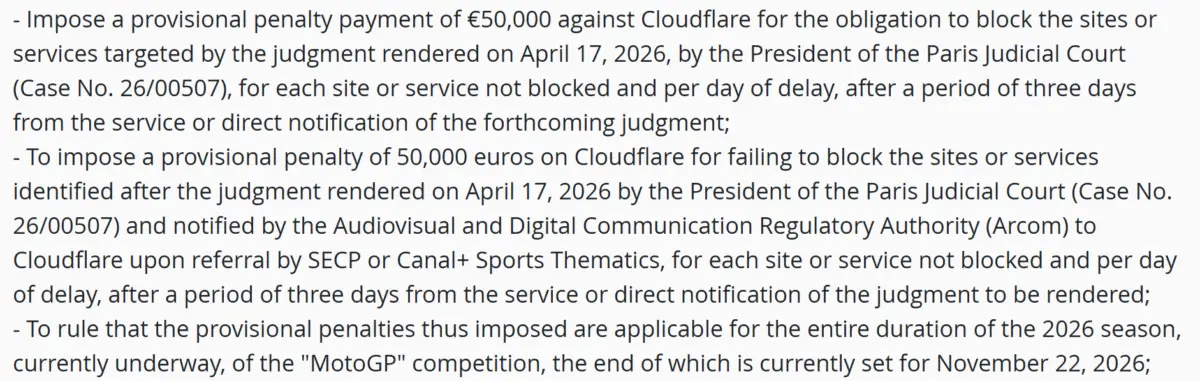
Tier 2: Infrastructure and DNS Resolvers. Recognizing that tech-savvy users routinely bypass ISP blocks by altering their DNS settings, Canal+ successfully dragged core infrastructure providers into the courtroom. Global services such as Google Public DNS, Cloudflare (encompassing its DNS resolver, content delivery network, and reverse proxy services), Quad9, and Whalebone (DNS4EU) were ordered to halt resolution of the targeted domains. Notably, Quad9 and DNS4EU mounted no legal defense, resulting in default judgments against them.
Tier 3: Virtual Private Networks (VPNs). In what has become a fiercely contested battleground, Canal+ targeted three major commercial VPN providers: Proton VPN, CyberGhost, and ExpressVPN. By forcing VPNs to block access to pirate infrastructure—or risk liability—the courts are attempting to close the ultimate privacy loop-hole used by persistent streamers.
Tier 4: Search Engine De-Indexing. To cut off accidental or search-driven traffic, Google Search and Microsoft Bing were ordered to completely de-index (déréférencement) the listed domains for users browsing within France, effectively erasing the illicit sites from mainstream discovery.
The enforcement timelines embedded within the rulings are strict. Most operators must implement the required network modifications within three days of notification, with exceptions extended up to five days for certain overseas territories. The blocks remain provisionally active through the duration of the respective sports seasons—expiring on May 30, 2027, for the Premier League, and June 5, 2027, for the Champions League. Crucially, these lists are dynamic, allowing ARCOM, France’s official audiovisual regulator, to append new domain targets seamlessly as pirate operations inevitably spawn mirror sites.
Supporting Context & Metrics
To appreciate the scale of these legal actions, one must examine the specific targets and the technical scope of the domains involved. The July 17 orders explicitly name dozens of high-traffic streaming hubs and IPTV aggregators that have long plagued commercial broadcasters.
Targeted Domain Metrics and Categories
Category
Targeted Entities / Services
Scope of Action
Legal Reference Numbers
ISPs & Telecoms
Orange, Free, SFR, Bouygues, Zeop, UTS Caraïbe, etc.
Domain/subdomain blocking for French subscribers.
EPL: 26/08401 UCL: 26/08386
Cloud & CDN
Cloudflare
Multi-service blocking across DNS, CDN, and reverse proxy.
EPL: 26/08356 UCL: 26/08361
Public DNS
Google Public DNS
Halt domain name resolution for French end-users.
EPL: 26/08379 UCL: 26/08380
Public DNS
Quad9 & Whalebone (DNS4EU)
Halt domain resolution (Default judgments issued).
EPL: 26/08377 UCL: 26/08378
VPN Providers
Proton VPN
Access blocking via provisional default order.
EPL: 26/08364 UCL: 26/08366
VPN Providers
CyberGhost & ExpressVPN
Access blocking following contested hearings.
EPL: 26/08368 UCL: 26/08371
Search Engines
Google Search & Microsoft Bing
Complete de-indexing within French territory.
EPL: 26/08382 UCL: 26/08383
Prominent Domain Targets
Among the 73 specific domains cited across the two primary batches are well-known aggregator brands that attract millions of unique visitors globally. The Premier League order specifically targets portals such as:
totalsporteki.com and associated mirrors (totalsportek.wales, totalsportek.company)
streamonsport.art
kevinsport.org (alongside numerous top-level variants like .lat, .mom, .best)
livetv880.me, livetv882.me, and successive iterative subdomains
Various commercial IPTV gateways including ott-premium.tv and smartippon.com
The Champions League batch heavily overlaps with these targets while incorporating distinct regional streaming infrastructure, such as sportsonline.vc, empire-sport.live, and dynamic proxy nodes hosted across obscure dynamic DNS networks.
Official Statements and Legal Arguments
While several tech companies chose not to appear in court—resulting in swift default rulings—others mounted vigorous defenses that pushed back against the encroaching liability placed upon digital intermediaries.
The VPN Defense and the EU Law Battle
The most robust legal resistance came from CyberGhost and ExpressVPN. Ahead of the Paris rulings, the providers attempted to secure a stay of proceedings pending a ruling from the Court of Justice of the European Union (CJEU) regarding the Anne Frank Stichting case. That landmark European decision ultimately shielded VPN providers from direct copyright liability in cases involving lawful publications.
However, the Paris Judicial Court summarily dismissed the request for a stay. Vice-President Benac’s bench reasoned that the Anne Frank precedent applied to an entirely different legal directive governing content that was inherently lawful at its source—a stark contrast to pirate streaming sites dedicated entirely to commercial copyright infringement.
Furthermore, the VPN providers argued that Article L. 333-10 of the French Sports Code fundamentally conflicted with the European Union’s E-Commerce Directive and should consequently be set aside. The court rejected this structural challenge as well, emphasizing a crucial nuance of EU jurisprudence: because this was a civil dispute between private commercial entities, the doctrine of "horizontal direct effect" prevented national courts from disapplying domestic statutes based purely on directives that lack direct applicability between private parties.
Defining the "Mere Conduit" Fallacy
To justify ordering neutral technology companies to block traffic, the court leaned heavily on an expansive interpretation of transmission mechanics. Addressing arguments that VPNs and CDNs act merely as passive, neutral bridges, the court ruled:
"The mere act of serving as a bridge enabling access to the infringing sites fulfills the transmission function."
The judiciary articulated that even if an intermediary exercises no editorial control over the content and maintains a purely automated, passive technical posture, it nevertheless constitutes an indispensable link in the digital chain of transmission. By facilitating data flow to illicit streams, these intermediaries render themselves legally vulnerable to targeted injunctions.
Google also challenged the petitions, questioning whether Canal+ had adequately proven exclusive licensing rights in France and demanding rigorous proof of repeated infringements across every single disputed channel. The court dismissed these objections, validating the sufficiency of the broadcaster’s evidentiary submissions.
Future Outlook: The Dawn of Automated Real-Time Blocking
Despite the exhaustive nature of these July 17 rulings, legal experts note that they represent the culmination of an outgoing administrative era. Just four days after Vice-President Benac signed the fourteen orders, the French Parliament adopted a landmark sports law fundamentally rewriting the mechanics of online piracy enforcement.
Under the traditional framework utilized by Canal+, rightsholders have relied on a cumbersome manual process: ARCOM agents must manually verify individual domains, followed by formal court petitions and subsequent judicial sign-offs. While effective, this process remains inherently reactive and slow-moving compared to live broadcasting schedules.
The newly minted sports legislation—expected to take full regulatory effect later this year—completely automates this pipeline. It introduces real-time blocking capabilities that empower authorities to inject new target domains into network filters dynamically during live matches, shifting ARCOM’s review role to a post-hoc auditing process rather than a pre-requisite bottleneck.
For media conglomerates like Canal+, the transition to automated, real-time network filtering is the logical next evolution in the perpetual digital arms race. Until those automated systems are fully operational, however, these multi-layered, court-mandated infrastructure sweeps serve as the heavy artillery protecting broadcast revenues across France.