Executive Overview
The rapid, aggressive buildout of artificial intelligence (AI) infrastructure has introduced an unprecedented operational challenge for modern data centers: extreme, volatile power fluctuations. Unlike traditional cloud computing and steady-state enterprise workloads—which draw a predictable, uniform current—AI training and inference cycles create razor-sharp load swings. These sudden demands produce hard power spikes that traditional power architectures, legacy Uninterruptible Power Supply (UPS) systems, and conventional battery banks struggle to absorb instantaneously.
To bridge this critical engineering gap, data center operators are increasingly looking toward an established yet underutilized technology: supercapacitors, also known as ultracapacitors. Sitting technologically between conventional electrostatic capacitors and chemical batteries, supercapacitors store energy as an electrostatic surface charge rather than relying on slow chemical reactions. This fundamental physical difference endows them with exceptional power density, enabling them to charge and discharge in mere milliseconds.
While they cannot replace traditional batteries or UPS systems for sustained, long-term runtime, industry experts predict they will become indispensable for voltage stabilization, peak shaving, and short-term backup power. According to market intelligence firm IDTechEx, the data center supercapacitor market is projected to surge to $950 million by 2037, registering a striking compound annual growth rate (CAGR) of 40.9% from 2026.
However, the path from pilot projects to mainstream commercial deployment is paved with technical hurdles, supply chain constraints, and architectural debates. Industry leaders remain divided over whether supercapacitors are a necessary architectural addition for next-generation multi-megawatt racks or if optimized DC-to-DC conversion and direct battery integration will ultimately win the day.
Detailed Chronology of the AI Power Crisis
To understand why data centers are suddenly scrambling to adopt supercapacitors, it is necessary to examine the rapid escalation of power demands driven by generative AI workloads.
The Shift from Steady-State to Dynamic Compute
For decades, data centers operated on predictable power curves. Servers hummed along at relatively consistent utilization rates, allowing facility engineers to provision power capacity with comfortable safety margins. Even during peak web traffic hours, load increases were gradual enough for standard UPS systems and backup generators to ramp up smoothly.
The advent of massive Large Language Models (LLMs) shattered this steady-state paradigm. AI training cycles—characterized by massive parallel processing across thousands of GPUs and accelerators—are inherently dynamic. As models shift between executing different layers of neural networks, power demands can fluctuate wildly within fractions of a second.
The Emergence of Sub-Second Power Transients
By late 2024 and through 2025, data center operators began reporting severe operational headaches caused by instantaneous load transients. Industry stakeholders noted that power spikes during intense AI compute events could momentarily surge to more than 150% of a standard power shelf’s rated capacity.
Conventional architectures, which rely heavily on lithium-ion or valve-regulated lead-acid (VRLA) batteries coupled with standard UPS units, suffer from chemical latency. Because batteries rely on chemical reactions to release or absorb energy, they are too slow to react to microsecond-level transients. This mismatch causes micro-sags in voltage, stresses power distribution units (PDUs), risks hardware degradation, and can ultimately trigger catastrophic data corruption or system shutdowns.
The Pivot to Experimental Deployments (2025–2026)
Recognizing that standard battery backups were insufficient for smoothing out ultra-sharp high-frequency transients, pioneering data center designers began evaluating supercapacitors in laboratory and edge-computing environments.
By September 2025, broader industry interest in supercapacitors for high-drain applications began to crystallize, spurred by an IDTechEx market report highlighting total global supercapacitor revenues reaching $4.86 billion across automotive, grid, and industrial sectors.
By September 2026, specialized research tailored directly to the data center sector validated these early field trials. Analysts formally categorized supercapacitors into three distinct operational roles: voltage stabilization, peak shaving, and short-term backup power. Rather than serving as standalone energy storage, they were positioned as high-speed shock absorbers designed to protect delicate IT gear from the violent electricity swings characteristic of modern AI clusters.
Supporting Context & Metrics: The Numbers Behind the Surge
The economic and technical metrics surrounding the adoption of data center supercapacitors illustrate a niche technology on the cusp of explosive growth.
Market Trajectory and Valuation
While the broader supercapacitor market—encompassing electric vehicles, renewable energy grids, and consumer electronics—grows at a respectable 15.3% annual rate, the data center sub-segment is experiencing hyper-growth.
- 2026 Baseline: The data center supercapacitor market enters a critical commercialization window, transitioning rapidly from isolated proof-of-concept tests to structured OEM integration.
- 2037 Projection: IDTechEx forecasts the market will expand to $950 million by 2037, achieving an aggressive 40.9% CAGR starting from 2026. This exponential curve directly mirrors the projected multi-fold scaling of global AI data center capacity over the next decade.
Operational Performance Trade-offs: Supercapacitors vs. Batteries
To appreciate how supercapacitors fit into the modern data center floor, facility engineers must navigate a distinct set of physical trade-offs:
| Metric / Feature | Supercapacitors (Ultracapacitors) | Conventional Batteries (Li-ion / VRLA) |
|---|---|---|
| Energy Storage Mechanism | Electrostatic surface charge (no chemical reaction) | Electrochemical reactions |
| Power Density | Extremely High (delivers massive bursts instantly) | Moderate to Low (slower discharge rate) |
| Energy Density | Lower (cannot sustain long runtimes) | High (designed for hours of sustained output) |
| Response Time | Milliseconds to seconds (tracks AI training cycles) | Seconds to minutes (requires UPS handoff) |
| Cycle Life | Millions of charge/discharge cycles without degradation | Thousands of cycles before chemical degradation |
| Typical Data Center Backup Window | ~2 minutes (EDLCs) up to ~10 minutes (Hybrids) | Hours (when paired with generators) |
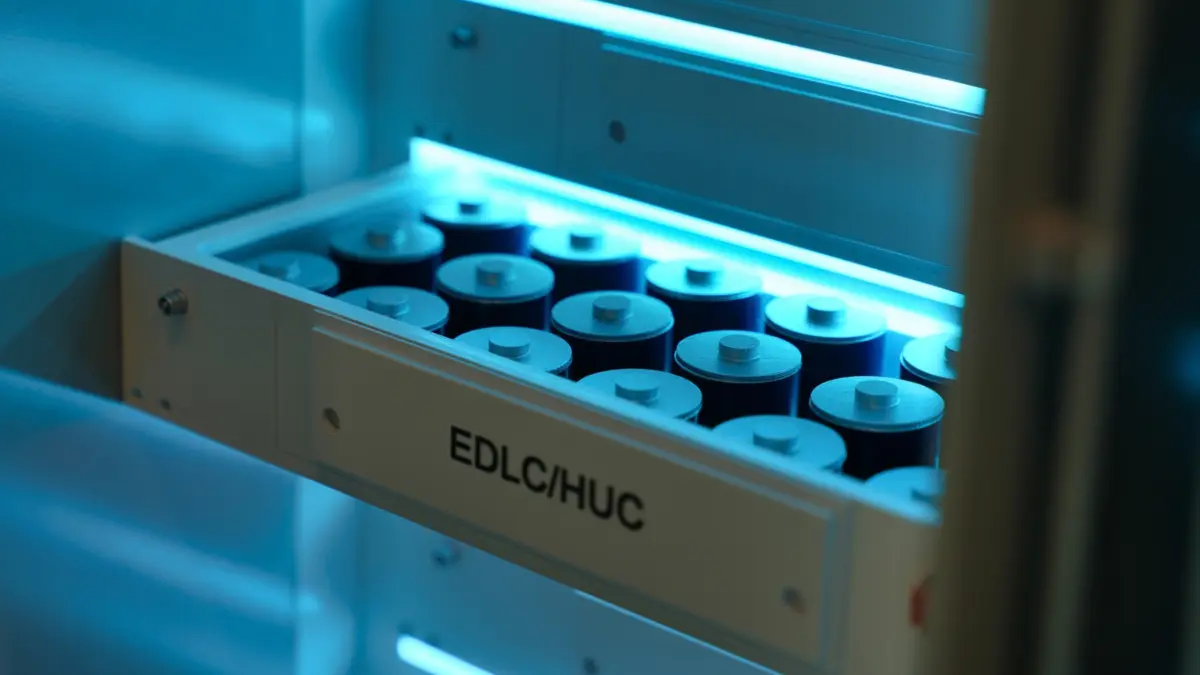
As highlighted by these metrics, supercapacitors are fundamentally unsuited to replace batteries or generators for long-duration outages. Instead, typical Electric Double-Layer Capacitor (EDLC) deployments are engineered to sustain output for roughly two minutes, while advanced hybrid capacitors can stretch that window to ten minutes. This duration is more than adequate to prevent data corruption during micro-outages or to bridge the gap while auxiliary power systems spin up, but their primary superpower lies in their ability to handle millions of rapid, high-frequency charge-and-discharge cycles without thermal or structural wear.
Official Statements and Industry Perspectives
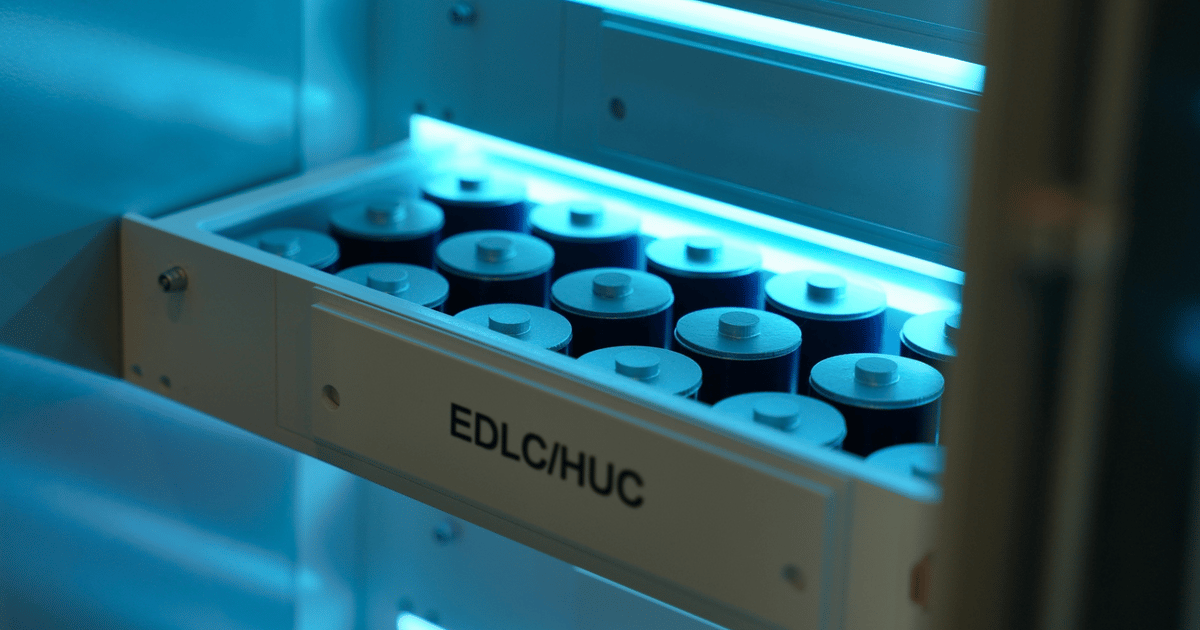
The integration of capacitor backup units (CBUs) alongside battery backup units (BBUs) has sparked a lively debate among power electronics experts, critical infrastructure architects, and energy market analysts.
The Infrastructure Provider Perspective: Flexibility is Key
Flex, a major global manufacturing and technology solutions provider, has been closely monitoring how power shelves react to AI workloads. Chris Butler, President of Embedded and Critical Power at Flex, emphasizes that modern AI hardware pushes power distribution systems past their historical limits.
"The market is transitioning from early evaluation to meaningful deployment, although adoption rates vary by technology type and supply chain maturity," Butler explained in an interview with Data Center Knowledge. "Instantaneous load transients can reach more than 150% of a power shelf’s rated capacity during certain AI compute events."
To accommodate this volatility without forcing operators into rigid, single-vendor power paths, rack manufacturers are altering physical designs.
"Rack designs typically include dedicated slots that can accommodate BBUs (battery backup units), CBUs (capacitor backup units), or mixed configurations, providing deployment flexibility," Butler noted. However, he cautioned that supply chain bottlenecks remain a formidable barrier: "Supply chain concerns remain a major hurdle, particularly for newer hybrid supercapacitor technologies with limited qualified suppliers."
The Energy Market Perspective: Meeting the 99.999% Reliability Standard
Data centers operate under the unforgiving standard of "five nines" (99.999%) reliability. Any experimental technology must prove it can maintain this extreme uptime threshold before mission-critical facilities will entrust it with enterprise workloads.
Parag Nathaney, Principal Quantitative Engineer for Energy Policy and Power Markets at Exelon, points out that while supercapacitors have a long, proven track record in heavy industrial and transportation applications, their novel implementation in hyperscale data centers keeps the industry in a cautious holding pattern.
"Supercapacitors are advancing toward greater deployment, but the current state is characterized by pilot and early commercialization," Nathaney observed.
Nevertheless, Nathaney remains optimistic that the technology’s proven pedigree outside the data center world will ultimately lower the psychological and operational barrier to entry for risk-averse data center operators. "I think the application of supercapacitors for data centers is novel, but the long track record of the technology in other applications could lower the barrier for adoption by data centers," he added.
The Skeptic’s View: The Bottleneck is in the DC-to-DC Conversion
Not all engineers agree that supercapacitors are the ultimate remedy for AI power spikes. Ian Wright, Chief Technology Officer at DIMAAG—a firm specializing in advanced battery systems designed to operate without supercapacitors—argues that hardware enthusiasts often misattribute response speeds to the energy storage medium rather than the intervening electronics.
Wright contends that the efficiency and speed of the power delivery system are ultimately dictated by the DC-to-DC conversion stage, not the storage device itself.
"The response speed to load changes is then determined by the DC/DC, which will be slower than either caps or batteries," Wright told Data Center Knowledge. Furthermore, he expressed skepticism regarding thermal management claims: "If supercaps have been tried and not observed to get hot, that’s probably because they are not actually absorbing the cyclic loads."
Wright maintains that directly connected, highly optimized battery architectures will prove more practical and cost-effective than adding supercapacitors into the rack ecosystem.
Future Outlook: Architectural Convergence in Next-Gen AI Racks
As artificial intelligence models continue to scale—pushing individual rack power densities from tens of kilowatts toward multi-megawatt configurations—facility designers can no longer rely on legacy power topologies. The question facing the industry is no longer if power systems must evolve, but how the delicate ecosystem of grid power, UPS, batteries, and capacitors will be balanced.
Three Competing Rack-Level Designs
IDTechEx’s framework outlines how different storage configurations are currently vying for valuable rack space:
- Standalone Battery Dominance: Retaining traditional lithium-ion BBUs while relying on advanced software algorithms and oversized power shelves to absorb transients. This minimizes new component qualification but strains battery lifespans through accelerated micro-cycling.
- Capacitor-Assisted Hybrid Racks: Integrating dedicated Capacitor Backup Units (CBUs) directly into modular rack slots alongside batteries. In this setup, supercapacitors absorb the sub-second transient spikes and high-frequency ripples, shielding the chemical batteries from wear and tear.
- Fully Integrated DC Microgrids with Direct Storage: Moving toward advanced direct-current (DC) architectures where energy storage elements are tightly coupled with solid-state transformers and high-efficiency DC-to-DC converters, eliminating multiple AC-DC conversion losses entirely.
The Verdict on Mainstream Adoption
The trajectory of data center supercapacitors will likely be dictated by the sheer physics of extreme AI hardware scaling. While skeptics like Ian Wright raise valid concerns regarding DC-to-DC conversion latency and thermal limits, market momentum leans toward adoption.
Chris Butler of Flex anticipates that as power loads escalate, capacitor-based energy storage will cease to be an exotic luxury and become a foundational element of enterprise infrastructure. Over the coming years, workload-driven optimization software will dynamically dictate the precise mix of batteries and capacitors deployed within a rack.
Ultimately, supercapacitors are shedding their label as an experimental novelty. By acting as high-speed shock absorbers for the data center world, they are poised to safeguard the fragile grid-to-GPU power chain, ensuring that the relentless march of artificial intelligence does not outpace the physical limits of electricity itself.