Executive Overview
In an era defined by mounting regulatory scrutiny over the mental health impacts of digital technologies on minors, Pinterest has released a comprehensive new report that positions the visual discovery platform as a safe haven from traditional social media. Published on Tuesday, the "Teen Wellbeing Edit" explores shifting generational dynamics, highlighting how Gen Z users engage with the application not as a mindless scroll-hole, but as an intentional utility for offline creation and self-expression.
The report underscores a broader strategic pivot by Pinterest: distinguishing its business model from conventional social networking giants. While competitors like Meta continue to navigate severe public relations and legal crises regarding youth safety, algorithmic addiction, and the proliferation of harmful content, Pinterest is aggressively branding itself as an antidote to digital burnout. Central to this strategy is the ethos that "the best thing you can find online is a reason to go offline."
This positioning is backed by deliberate product interventions, including the expansion of school-hour distraction alerts to over 30 countries, the scaling of digital literacy hubs, and a targeted focus on trauma-informed mental health resources. However, this unique brand identity—promoting a platform where users intentionally spend less time—presents a fascinating commercial paradox. For a publicly traded, ad-driven enterprise, celebrating reduced screen time requires a delicate balancing act between corporate social responsibility and monetization. This report, therefore, serves as both a sociological study of modern youth culture and a calculated market differentiation maneuver in an increasingly toxic digital ecosystem.
Detailed Chronology: The Evolution of Pinterest’s Youth Safety Initiative
To fully understand the gravity of Pinterest’s latest findings, it is necessary to examine the systematic trajectory the company has taken over recent years to build trust among educators, parents, and adolescent users.
Laying the Groundwork: Online Discovery vs. Offline Engagement
For years, Pinterest has sought to distance itself from the "social media" moniker. Unlike platforms built around peer-to-peer validation, likes, comments, and status updates, Pinterest was architected as a digital corkboard. Users curate visual concepts for tangible projects—ranging from home renovations and recipes to artistic endeavors and fashion design. Recognizing that the broader tech industry was coming under fire for exacerbating anxiety and depression among teens, Pinterest began leaning heavily into its intrinsic design advantages as early as 2023 and 2024, rolling out brand campaigns that explicitly encouraged users to log off and engage with the physical world.
April 2025: The Introduction of School-Hours Nudges
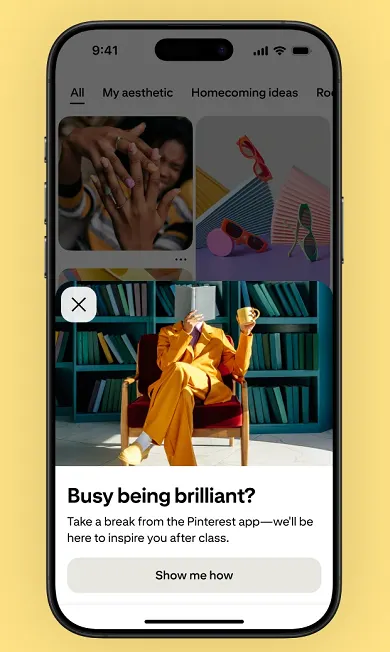
A major milestone in this journey occurred in April 2025, when Pinterest introduced its pioneering distraction-free school nudges. Recognizing that teens often struggle with impulse control during academic hours, the platform began testing and deploying gentle, in-app alerts designed to remind young users to put down their devices while at school.
Unlike hard parental controls that lock users out, these nudges operate on a principle of mindfulness, encouraging self-regulation. The reception was cautiously optimistic, prompting leadership to scale the feature rapidly.
The Present Expansion: Scaling Global Protection and Wellbeing Spaces
Building upon the initial success of the school-hours alerts—which have now been displayed to an estimated 4.5 million teens across the United States, Canada, France, the United Kingdom, Germany, and Brazil—Pinterest announced a massive international rollout. The distraction-free school nudge is now expanding to more than 30 countries worldwide.
Concurrently, the platform is scaling its educational and emotional support infrastructure. The "(Me)dia Mindfulness" resource hub, built to cultivate digital literacy, is expanding to reach a broader demographic of teens and adults. Furthermore, Pinterest is launching a novel, trauma-informed digital wellbeing space titled "Protect Your Energy." This initiative is specifically designed to bridge the gap between digital consumption habits and holistic mental, emotional, and physical health, proving that the platform’s commitment to youth wellbeing extends far beyond basic screen-time limits.
Supporting Context & Metrics: How Teens Use Pinterest
The data compiled in the Teen Wellbeing Edit paints a fascinating picture of Gen Z engagement. Contrary to the prevailing narrative that teens are passive, zombie-like scrollers paralyzed by short-form video algorithms, Pinterest’s internal metrics suggest a user base characterized by high agency and intentionality.
Proactive Search and Feed Control
According to the report, more than 77% of active teen users utilize the Pinterest search bar as a primary mechanism to proactively explore their evolving interests. Rather than surrendering entirely to a black-box recommendation algorithm, young users are actively curating their digital environments.
The data indicates that teens access their account settings and home feed controls at nearly twice the rate of other demographic cohorts. Because Pinterest has streamlined the process of refining recommendations, its younger users are able to shape and reshape their digital feeds as quickly as their personal tastes and hobbies shift.
Artistic Exploration and Creative Intent
When it comes to specific search trends, the report highlights a distinct lean toward creative, hands-on pursuits. Teen users over-index in art-related searches by 1.26 times compared to the rest of the platform’s user base.

Key search categories dominating the teen demographic include:
- Drawing references and sketch tutorials
- Anime and illustration styles
- Digital and physical wallpaper aesthetics
- Personalized bedroom decor and DIY room transformations
These search parameters underscore the core thesis of Pinterest’s report: teens are using the app to source inspiration for real-world projects. The digital search acts merely as a catalyst for physical creation, whether that involves sketching in a physical notebook, redecorating a bedroom, or mastering a new artistic medium.
Official Statements and Industry Implications
Pinterest’s leadership has not shied away from using this data to draw a sharp contrast between its operational philosophy and the prevailing industry standard.
The Anti-Rabbit Hole Philosophy
In its official release materials, the company drew a definitive line in the sand regarding its structural design:
"At Pinterest, we believe that the best thing you can find online is a reason to go offline. As a visual search and discovery platform, people come to find ideas for what they want to do, make and try next. And no one embodies that more than the teens who use Pinterest every day."
The company went further, explicitly critiquing the engagement-at-all-costs loops engineered by competitors:
"Pinterest is not a social media platform where users get trapped in an endless rabbit hole. Instead, teens tell us that they save Pins with a purpose. They log on, find what they’re looking for and log off to go and make it happen. Because of this, they spend less time on Pinterest per week than in other digital spaces."
Implicit Commentary on the Broader Tech Landscape
Industry analysts have been quick to note that the timing and tone of Pinterest’s report function as a thinly veiled critique of Meta and other major social conglomerates. As Meta faces fierce regulatory reckonings, Congressional hearings, and massive litigation settlements over allegations of ignoring internal research regarding the harmful effects of its products on adolescents, Pinterest has seized the moral high ground.
By proactively marketing its platform as a low-stress, health-conscious alternative, Pinterest is effectively positioning itself as the "good actor" of the social tech sphere. This differentiation strategy aims to capture not only the trust of privacy-conscious and safety-minded teens, but also the peace of mind of anxious parents and educators who are increasingly restricting youth access to traditional social media apps.
Future Outlook: The Commercial Paradox and Next Steps
As Pinterest looks toward the horizon, it must navigate a unique commercial paradox. For the past two decades, the foundational economic engine of the internet has been user attention. Platforms monetize by maximizing time-on-site, serving a higher volume of advertisements, and harvesting behavioral data to optimize ad targeting.
By actively encouraging users to spend less time on the app—boasting that teens log on, find inspiration, and log off quickly—Pinterest is championing a user experience that runs counter to traditional digital advertising metrics. Highlighting lower engagement times could theoretically give traditional brand advertisers pause, forcing the platform to prove that intentional engagement yields higher conversion value than mindless scrolling.
Nevertheless, Pinterest is doubling down on this contrarian bet. Beyond digital adjustments, the company is solidifying its real-world impact by increasing philanthropic donations to youth mental health organizations. Furthermore, Pinterest has announced plans to help students in the United States connect directly with essential mental health resources through their educational institutions.
Conclusion
Pinterest’s Teen Wellbeing Edit is much more than a routine corporate transparency report; it is a strategic manifesto for a kinder internet. By aligning its product design, global school nudges, digital literacy initiatives, and mental health partnerships with the genuine psychological needs of Gen Z, Pinterest is attempting to rewrite the social media playbook. Whether this mindful approach can successfully harmonize with the relentless demands of digital advertising remains to be seen. However, in an era where youth mental health crises dominate the public discourse, Pinterest’s refusal to build another digital rabbit hole may ultimately prove to be its most valuable competitive advantage.