Executive Overview
As artificial intelligence rapidly transitions from a novelty assistive layer to an autonomous, active participant in the software development lifecycle (SDLC), the attack surface of the modern enterprise is undergoing a fundamental transformation. At its flagship swampUP 2026 conference, JFrog made a sweeping series of product announcements designed to address this seismic shift. Centered around autonomous security, hands-off healing, and rigorous governance, the company’s new capabilities aim to preemptively safeguard software supply chains against an oncoming tide of AI-enabled threats.
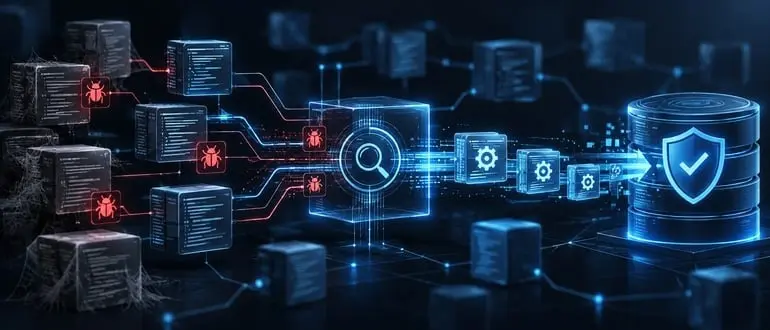
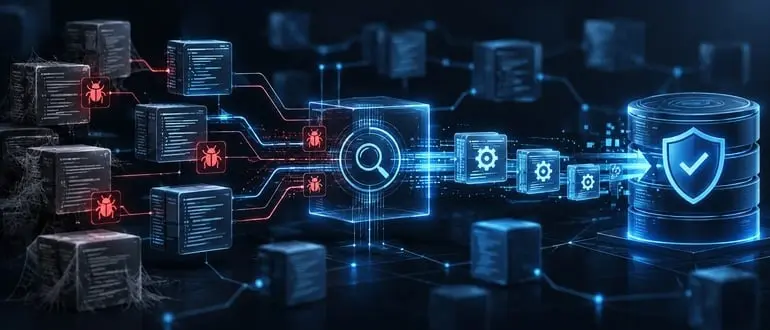
The centerpiece of JFrog’s announcements is a groundbreaking zero-touch remediation capability. This system automatically overrides application developer requests for vulnerable software binaries, injecting the most secure, patched version available without breaking builds or requiring human intervention. Complementing this is a comprehensive suite of tools designed to secure autonomous AI agents embedded within DevOps pipelines. From semantic vulnerability scanners and the innovative Agent Guard to native support for Microsoft’s Agent Package Manager (APM) and an aggressive network-layer traffic controller backed by infrastructure giants like Cloudflare, Netskope, and Zscaler, JFrog is drawing a hard line around how AI interacts with enterprise codebases.
Furthermore, JFrog announced a high-profile strategic alliance with Wiz (a Google Cloud unit), extended its AppTrust framework to support natural-language policy creation (DevGovOps-as-code), and detailed an end-to-end automation pipeline that spans from asset ingestion to runtime enforcement.
According to JFrog CTO Yoav Landman, these cohesive features allow organizations to "immunize artifacts" by systematically restricting what AI agents can touch, autonomously healing vulnerabilities the moment patches emerge, and strictly governing the deployment of final binaries. This comprehensive reporting dives deep into the architecture, strategic implications, and technical mechanics of JFrog’s swampUP 2026 disclosures.
Detailed Chronology of Announcements at swampUP 2026
The announcements rolled out across the opening keynotes of swampUP 2026 reflect an aggressive, multi-layered strategy to secure software supply chains where human oversight is increasingly bypassed by automated systems.
1. Zero-Touch Remediation and Compliant Version Selection
Software supply chain security has long suffered from a friction-heavy paradigm: security teams flag a vulnerability, create a ticket, assign it to a developer, wait for the developer to test a patch, and eventually merge the fix. In complex, fast-moving environments, this cycle leaves windows of vulnerability wide open for days or weeks.
JFrog’s newly introduced zero-touch remediation fundamentally flips this workflow. Integrated directly into JFrog Curation with Compliant Version Selection, the system intercepts developer requests for third-party packages, IDE extensions, and open-source components. If a developer explicitly requests a library version carrying known vulnerabilities, the platform automatically halts the request, substitutes the vulnerable binary with the most secure, compatible version available, and routes the clean build forward without human intervention. This ensures that vulnerable code never even enters the staging pipeline.
2. Securing the AI Agent Workforce
As organizations increasingly deploy autonomous AI coding assistants, multi-agent frameworks, and Model Context Protocol (MCP) servers, these intelligent agents have been granted unprecedented access to internal repositories, registries, and build pipelines. Unfortunately, malicious actors have quickly pivoted to targeting these agents via prompt injection, malicious skill scripts, and poisoned dependencies.
To neutralize these vectors, JFrog introduced a robust suite of AI agent security mechanisms:
- AI Asset Scanning: Utilizing advanced semantic scanning, this tool inspects markdown files, instruction sets, script files, plugins, and MCP servers associated with AI models to proactively intercept and block malicious behavior before execution.
- Agent Guard: Extending the core Artifactory registry, Agent Guard applies granular governance policies directly to plugins and assets consumed by AI coding agents. It natively enforces project-scoped allow and deny policies originating from the centralized AI Catalog, ensuring that autonomous coding agents cannot bypass organizational compliance standards.
- Agent Package Manager (APM) Support: JFrog announced native integration for Microsoft’s Agent Package Manager, a dependency manager built specifically for AI agents. APM securely authenticates autonomous agents, establishing an encrypted and verified path for resolving package dependencies strictly through JFrog Artifactory. This guarantees that only audited, trusted components are pulled into AI-generated application builds.
- JFrog Traffic Controller: To prevent shadow registries and unauthorized public calls, JFrog launched the Traffic Controller, which blocks public registry calls directly at the network layer and reroutes all outbound traffic through Artifactory. Major network and security leaders—including Cloudflare, Netskope, and Zscaler—announced immediate support for the Traffic Controller, cementing its place as an industry-standard choke point for malicious data exfiltration.
3. Strategic Alliance with Wiz
In one of the most significant ecosystem plays of the conference, JFrog revealed a deep technological partnership with Wiz, the cloud-native application protection platform (CNAPP) unit of Google Cloud.
This alliance bridges the traditionally siloed worlds of static code analysis and runtime cloud security. DevSecOps teams will now have a unified, end-to-end view of software artifacts: tracking code from its exact origin repository in Artifactory, verifying its integrity through Xray scans, monitoring its transport through pipelines, and observing its live execution state inside Wiz-secured cloud environments. This eliminates blind spots, allowing security teams to instantly trace a production runtime vulnerability back to its precise source file and remediation path.
4. DevGovOps-as-Code via AppTrust Extensions
Compliance has historically been a manual, error-prone paperwork exercise performed just before software releases. JFrog is automating this friction away through major extensions to JFrog AppTrust.
- Natural Language Policy-as-Code: Utilizing embedded AI models, developers and compliance officers can now define complex SDLC security policies using plain English prompts, which the system translates into executable policies-as-code.
- Prompt-to-Release Traceability: Every approval, build event, vulnerability scan, and promotion step is now automatically logged and tracked in an immutable audit trail, removing the need for manual compliance logging.
- One-Click Compliance Templates: JFrog introduced pre-built rules aligned with major regulatory frameworks (such as SOC 2, HIPAA, and EU cyber regulations) that can be enforced across pipelines with a single click.
- Post-Deployment Monitoring: Continuous monitoring capabilities now surface compliance drift or unexpected asset changes after an application has been pushed to production.
Supporting Context & Metrics: The Mechanics of Automated Defense
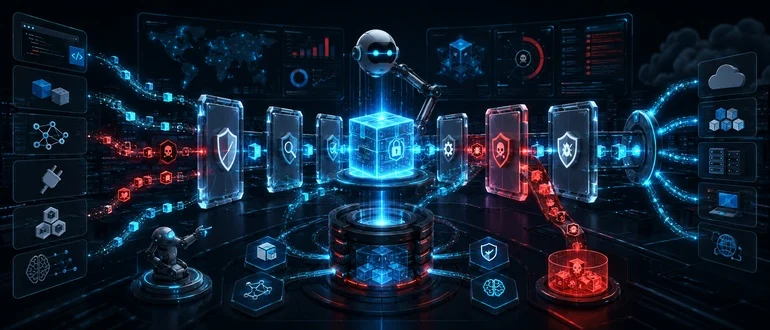
To understand why JFrog’s announcements represent a pivotal architectural shift, one must examine how its various security engines interlock to form an end-to-end automated immune system for software development.
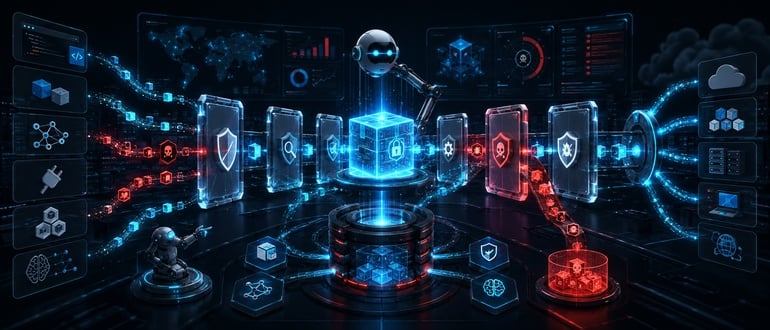
The Unified Pipeline Defense Architecture
[ Developer / AI Agent Request ]
         │
         ▼
[ JFrog Curation / Traffic Controller ] ──(Blocks risky assets / Reroutes network calls)
         │
         ▼
[ Artifactory + Agent Guard / APM ] ──────(Authenticates agent & enforces allow/deny policies)
         │
         ▼
[ JFrog Xray & Advanced Security ] ───────(Scans code patterns & exposes hardcoded credentials)
         │
         ▼
[ Contextual Analysis & Runtime ] ────────(Evaluates exploitability & narrows production load)
         │
         ▼
[ Zero-Touch Remediation ] ───────────────(Substitutes secure binary automatically)
         │
         ▼
[ AppTrust & Wiz Integration ] ───────────(Enforces compliance & provides runtime visibility)- Intake and Interception: When a human developer or an AI agent attempts to pull an external library, JFrog Curation with Compliant Version Selection immediately evaluates the request. If the package contains known vulnerabilities or malicious indicators, it is blocked or swapped out via zero-touch remediation.
- Deep Static Analysis: Once inside the registry, JFrog Xray and JFrog Advanced Security perform exhaustive recursive scans of release artifacts. They inspect every dependency layer to uncover vulnerable code patterns, hidden logic bombs, and accidentally exposed credentials across all file types.
- Exploitability Triage: Rather than overwhelming teams with thousands of theoretical Common Vulnerabilities and Exposures (CVEs), JFrog Contextual Analysis evaluates whether a flagged vulnerability is actually reachable and exploitable within the specific context of the application’s code execution path.
- Runtime Minimization: JFrog Runtime analyzes what binaries are actually loaded into memory during production execution, stripping out dead code and unused dependencies to shrink the potential attack surface.
The Macro Threat Landscape
The urgency behind JFrog’s product rollouts is underscored by staggering industry metrics regarding the rise of software supply chain attacks. According to recent cybersecurity research, supply chain attacks have surged by over 300% year-over-year, with threat actors increasingly weaponizing public package repositories (such as npm, PyPy, and Maven) by injecting typosquatted libraries, malicious installation scripts, and AI-poisoned modules.
Compounding this threat vector is the mass enterprise adoption of generative AI coding assistants (such as GitHub Copilot, Cursor, and custom enterprise LLM agents). While these tools dramatically accelerate velocity, they also introduce unprecedented risks. Autonomous agents frequently fetch dependencies, write infrastructure-as-code files, and pull open-source packages without human vetting. Without guardrails like those introduced in JFrog’s APM integration and Agent Guard, enterprise repositories face a "tsunami" of unvetted, potentially malicious code introduced at machine speed.
Official Statements and Industry Perspectives
The announcements at swampUP 2026 drew praise from enterprise leaders and security partners alike, highlighting the collaborative nature required to defend modern cloud environments.
Yoav Landman, Co-Founder and Chief Technology Officer at JFrog:
"We have reached an inflection point where human speed is simply no longer sufficient to combat the velocity of automated and AI-driven cyber threats. By bringing together zero-touch remediation, rigorous agentic governance, and unified runtime visibility through our alliance with Wiz, we are effectively giving enterprises an automated immune system. Our goal is simple: identify vulnerabilities, immunize artifacts, heal issues instantly without breaking builds, and govern deployment—all without requiring manual human intervention."
The partnership with Wiz was similarly lauded as a crucial step toward breaking down traditional organizational silos between code repositories and cloud infrastructure. Executives from Google Cloud and Wiz emphasized that modern DevSecOps teams can no longer treat build-time security and runtime security as separate disciplines. Knowing where a vulnerable binary came from in Artifactory is just as important as knowing how it is behaving inside a Kubernetes cluster managed by Wiz.
Furthermore, network infrastructure partners underscored the importance of network-layer defense. With the launch of the JFrog Traffic Controller, companies like Cloudflare, Netskope, and Zscaler highlighted how network security controls can be natively integrated into application delivery pipelines, cutting off unauthorized public registry calls before data exfiltration can occur.
Future Outlook: The Road Ahead for DevGovOps and AI Governance
As enterprises look toward the remainder of 2026 and beyond, the paradigms established at swampUP 2026 signal a permanent evolution in software engineering and security. The traditional boundaries between development, security, operations, and compliance are dissolving into an automated discipline increasingly referred to as DevGovOps (Development, Governance, and Operations).
1. The Autonomous SDLC Becomes Standard
The deployment of AI agents in software engineering is no longer experimental; it is core infrastructure. As these agents become more autonomous—capable not just of writing snippets, but of architecting entire microservices, managing CI/CD pipelines, and deploying code—governance frameworks like JFrog’s Agent Guard and APM integration will transition from nice-to-have tools to mandatory compliance baselines. Organizations that fail to strictly govern AI agent asset consumption risk wholesale system compromises originating from poisoned model instructions or malicious plugin hooks.
2. Zero-Touch as the Baseline for Vulnerability Management
The manual patching treadmill is rapidly becoming obsolete. As software complexity scales exponentially, security teams can no longer afford the lag time between vulnerability disclosure and developer remediation. JFrog’s pioneering step toward zero-touch remediation points to a future where software supply chains heal themselves autonomously. When a zero-day vulnerability is discovered in an open-source library, automated curation engines will instantly patch, test, and promote secure binaries across enterprise registries before human engineers even arrive at their desks.
3. Convergence of Code and Cloud Security
The alliance between JFrog and Wiz exemplifies a broader industry movement toward holistic, end-to-end security observability. In the future, security tooling will not distinguish between static source code, registry artifacts, and dynamic cloud runtimes. Instead, security telemetry will flow continuously in a closed loop—where runtime anomalies detected in production instantly trigger policy updates in the source repository, and build-time compliance guarantees inform cloud-native risk scores.
Conclusion
JFrog’s announcements at swampUP 2026 mark a watershed moment for enterprise software development. By confronting the dual challenges of accelerating AI adoption and increasingly sophisticated supply chain attacks with automated, zero-touch defenses, JFrog is equipping organizations not just to survive the coming wave of application vulnerabilities, but to thrive in an era where software builds and secures itself.