Executive Overview
In the ongoing digital battleground between major entertainment conglomerates and online piracy operations, a significant legal escalation has quietly taken root in the United Kingdom. Earlier this year, the Motion Picture Association (MPA)—acting on behalf of Hollywood’s premier studios—secured a landmark intellectual property ruling from the UK High Court. Dubbed an "omnibus" blocking order, this legal instrument fundamentally reshapes how internet censorship and copyright enforcement are deployed across British networks.
Traditionally, copyright holders were required to clear a high procedural hurdle: every time a pirate streaming site changed its domain name, adopted a new brand, or spawned a mirror site, rightsholders had to file a fresh application with the courts. This cumbersome process allowed illicit operators to stay one step ahead of the law by playing an endless game of digital whack-a-mole. The new omnibus order, however, short-circuits this bureaucratic delay. It empowers major studios to unilaterally expand their internet blocklists without returning to court for judicial approval for every individual infraction.
Despite its profound implications for digital freedom, internet infrastructure, and the open web, the order remained shrouded in secrecy for months. It was absent from legal databases like BAILII and the UK National Archives, known only through brief mentions in international trade bodies and foreign court filings. The veil of secrecy was only recently lifted thanks to an unexpected source: a corporate transparency filing published by infrastructure giant Cloudflare.
This deep-dive investigation examines the anatomy of the UK’s omnibus blocking order, exploring its expansive powers, the mechanisms behind its execution, its ripples across international jurisdictions, and the growing concerns regarding transparency, accountability, and digital oversight.
Detailed Chronology: From Courtroom Shadows to Accidental Transparency
The May 2026 Ruling
The story of the omnibus order begins on May 7, 2026, when Mr. Justice Mellor of the UK High Court handed down a judgment following an application spearheaded by a formidable coalition of major American film and television studios: Columbia Pictures, Disney, Netflix, Paramount, Universal, and Warner Bros. The primary respondents to the legal action were the United Kingdom’s six dominant internet service providers (ISPs): BT, EE, Plusnet, Sky, TalkTalk, and Virgin Media.
When the MPA first presented the order to the World Intellectual Property Organization (WIPO) later that month, it was touted as an indispensable weapon to combat the fragmentation of online piracy. Yet, outside of the immediate legal teams and the corporate boardrooms of Hollywood, the actual text of the order remained invisible to the public, journalists, and civil liberties watchdogs.

International Ripples: The Canadian Connection
Although the UK judgment remained hidden from public archives, its ideological footprint quickly spread across the globe. Last month, Canada’s Federal Court cited the UK omnibus order as a direct blueprint for its own expanded-scope site-blocking mandate.
Canadian federal judges noted that digital piracy has evolved into a hyper-fragmented ecosystem where users instantly migrate from blocked domains to unblocked alternatives. By pointing to the UK precedent, international entertainment lobbies successfully argued that modern enforcement mechanisms must evolve past traditional, site-by-site judicial reviews to effectively neutralize structural copyright infringement.
The Cloudflare Disclosure
The cloak of secrecy surrounding the UK High Court’s ruling finally slipped when a new transparency filing surfaced in the Lumen Database, uploaded by content delivery network and cloud provider Cloudflare.
While Cloudflare was not a formal party to the original High Court litigation, the American tech giant voluntarily complies with certain UK blocking mandates when targeted domains utilize its services. Attached to Cloudflare’s filing was the elusive "Public Version" of the omnibus order—redacted to protect confidential schedules, but offering the public its very first unvarnished look at the unprecedented powers granted to Hollywood.
Deconstructing the Omnibus Order: Mechanics and Scope
The newly unveiled public document exposes a meticulously structured legal framework designed to streamline copyright enforcement at an industrial scale.
The ‘Seed’ Domains and Part 2 Targets
The order is divided into distinct operational schedules. Part 1 of Schedule 1 explicitly targets a foundational batch of "seed" websites and domains. Among the initial names explicitly flagged for immediate blocking are notorious streaming hubs such as 345movie.nl, 456movie.nl, cineby.app, movies2watch.watch, and streamm4u.com.co.

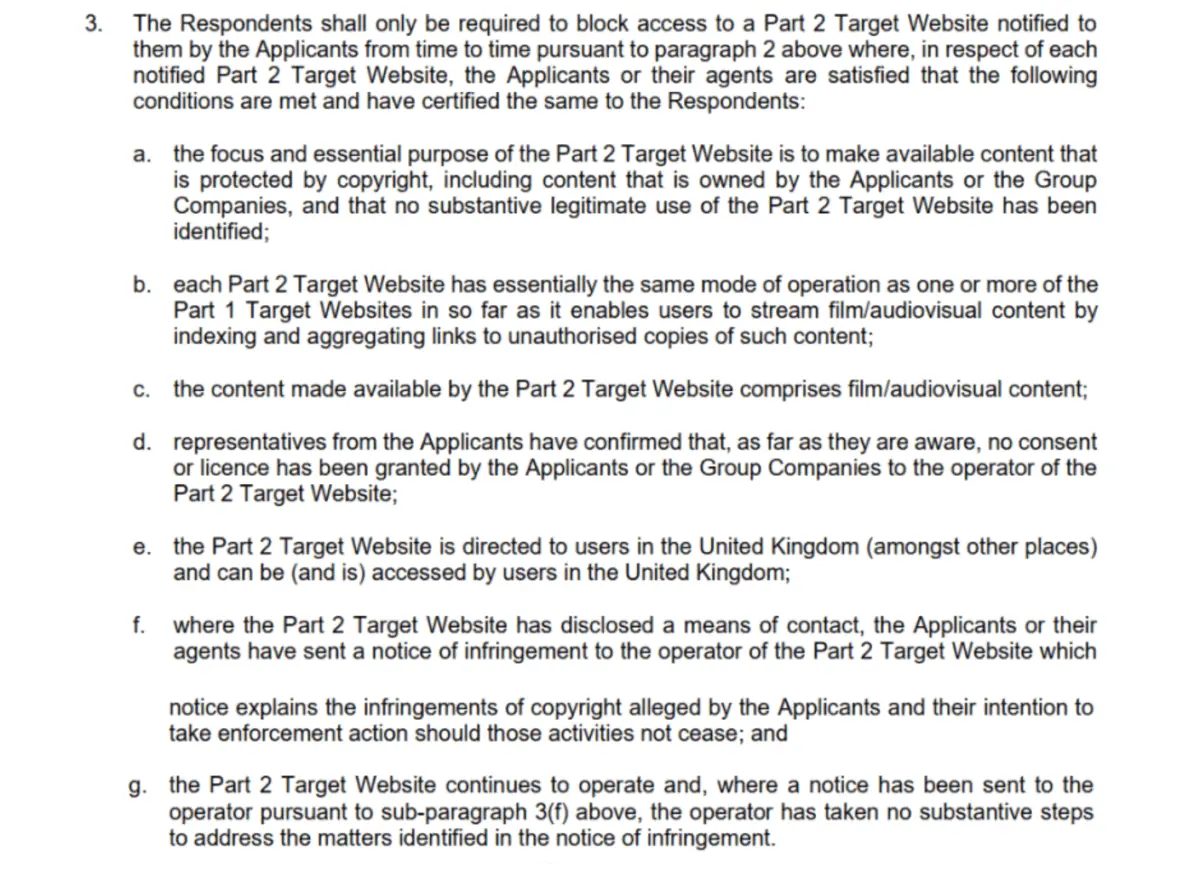
However, the true power of the order lies in Part 2 of the schedule. While Part 1 deals with specific, named domains, Part 2 establishes an open-ended, criteria-based category. Under this provision, rightsholders are legally authorized to target any subsequent website that shares the "essentially the same mode of operation" as the seed domains—specifically, platforms that enable users to stream audiovisual content by indexing and aggregating unauthorized links.
Eliminating the Judge: Self-Enforcing Expansion
The most controversial aspect of the omnibus order is the complete removal of judicial oversight from the day-to-day expansion of the blocklist.
Historically, adding a new pirate domain to an ISP blocklist required rightsholders to demonstrate infringement before a judge. Under the new framework, no court hearing or independent regulatory review is required to expand the censorship list. When Hollywood studios identify a new site meeting the predefined criteria, they simply notify the participating ISPs, which are legally mandated to implement the block.
Crucially, the court order explicitly absolves the ISPs of any investigative responsibility. The text notes that the telecommunications companies are "wholly reliant on the Applicants accurately identifying" the offending URLs and possess "no obligation to verify whether the Applicants’ or their agents’ determination is correct." In effect, major Hollywood studios have been handed the pen to write and amend the UK’s internet censorship registry.
The Voluntary Reach of Cloudflare
The impact of the order extends far beyond traditional consumer ISPs. Cloudflare’s inclusion of the document in the Lumen Database highlights how private infrastructure providers are increasingly co-opted into national enforcement regimes.
When UK users attempt to access blocked portals like movies2watch.watch via Cloudflare-protected networks, they are no longer met with a standard DNS error. Instead, they encounter an HTTP 451 Error—the designated web standard indicating that access to a resource has been legally denied for censorship or copyright reasons. Cloudflare’s voluntary adoption demonstrates how private content delivery networks are enforcing localized court orders on a global infrastructure level.

Supporting Context, Guardrails, and Limitations
While the omnibus order grants sweeping, unilateral powers to entertainment conglomerates, legal drafters included several specific guardrails designed to prevent complete regulatory overreach and collateral damage.
Preventing Overblocking and Collateral Damage
One of the most significant technical risks associated with blanket domain and IP blocking is "overblocking"—a phenomenon where legitimate, non-infringing websites sharing an IP address or server infrastructure with a pirate site are accidentally rendered inaccessible to the public.
To mitigate this risk, the High Court order explicitly prohibits rightsholders from demanding the blocking of any IP address if the underlying server hosts legitimate, non-infringing web services. This safeguard is intended to protect innocent third-party publishers, small businesses, and community forums from being collateral damage in Hollywood’s war on piracy.
Right of Objection
Furthermore, the legal framework includes a formal dispute mechanism. Website operators, domain owners, or other entities mistakenly caught up in the dragnet retain the legal right to object to their inclusion on the blocklist, offering a theoretical avenue for appeal outside of immediate courtroom litigation.
The Six-Month Sunset Clause
To ensure that these sweeping powers are not granted in perpetuity without periodic review, the order features a strict temporal limitation. According to the text, the decree "shall cease to have effect at 23:59pm on the date 6 months from the date of this Order, unless the Court orders otherwise."
In practical terms, however, this does not mean Hollywood’s blocking powers will automatically expire and vanish into thin air. Rather, it establishes a mandatory renewal cycle. Every six months, the major studios must return to the High Court to seek an extension. While this provides a periodic window for interested parties or ISPs to raise concerns, industry analysts note that renewals of established blocking orders are rarely contested and typically granted as a matter of administrative routine.

Official Statements and Industry Reactions
The silence from official legal repositories stands in sharp contrast to the vocal advocacy of the entertainment industry. The MPA has consistently framed these structural blocking orders as a vital modernization of intellectual property law.
As digital media consumption shifts decisively away from traditional cable and toward decentralized web streaming, copyright holders argue that traditional legal mechanisms are too slow to keep pace with agile, anonymous piracy syndicates. By securing omnibus powers in the UK—and exporting the legal philosophy to Commonwealth allies like Canada—Hollywood is attempting to establish a global standard for proactive, automated network filtering.
Conversely, digital rights advocates, open-internet champions, and privacy researchers have expressed profound unease over the growing trend of privatized censorship. Critics point out several glaring systemic issues with the UK’s approach:
- The Transparency Deficit: Because the order lacks a mandatory public transparency clause, there is no official, publicly accessible registry of every domain currently blocked under the omnibus mandate. Journalists, researchers, and consumers are left largely in the dark regarding the total scope of internet filtering occurring behind closed doors.
- Delegation of Judicial Authority: Handing private corporations the unilateral power to expand internet blocklists—without independent judicial oversight or verification by neutral third parties—blurs the line between civil enforcement and state-sanctioned censorship.
- The Precedent of Secret Law: The fact that a major High Court precedent affecting millions of internet users remained entirely absent from public legal archives like BAILII for months raises serious questions about open justice and the accessibility of legal norms in the digital age.
Future Outlook: The Global Trajectory of Site-Blocking
As the dust settles on the revelation of the UK High Court’s May 2026 omnibus order, its legacy is already reshaping the international copyright landscape.
The successful replication of these legal principles in Canadian federal courts signals that entertainment conglomerates will continue to push for expanded-scope, self-enforcing blocking mechanisms across Western democracies. For ISPs and cloud infrastructure providers like Cloudflare, the pressure to act as frontline enforcers for intellectual property holders will only intensify.
At the same time, the accidental exposure of the order via corporate transparency filings underscores the ongoing friction between closed legal maneuvers and the demands of an open digital society. As technical workarounds—such as decentralized domains, encrypted DNS, and advanced proxy networks—continue to evolve on the pirate frontier, Hollywood’s legal machinery is responding with increasingly aggressive, automated, and sweeping administrative controls.

Whether these heavy-handed structural blocks will achieve long-term success in shifting consumer behavior back toward legal streaming platforms remains fiercely debated. What is indisputable, however, is that the legal architecture of the internet is being fundamentally rewritten—often in the shadows, far from public scrutiny.