Executive Overview
For decades, the standard playbook for scaling a software-as-a-service (SaaS) company has relied on a predictable formula: hire more talent, expand feature sets through traditional product management, refine the human-facing user interface (UI), and guide customers through complex, multi-step onboarding processes.
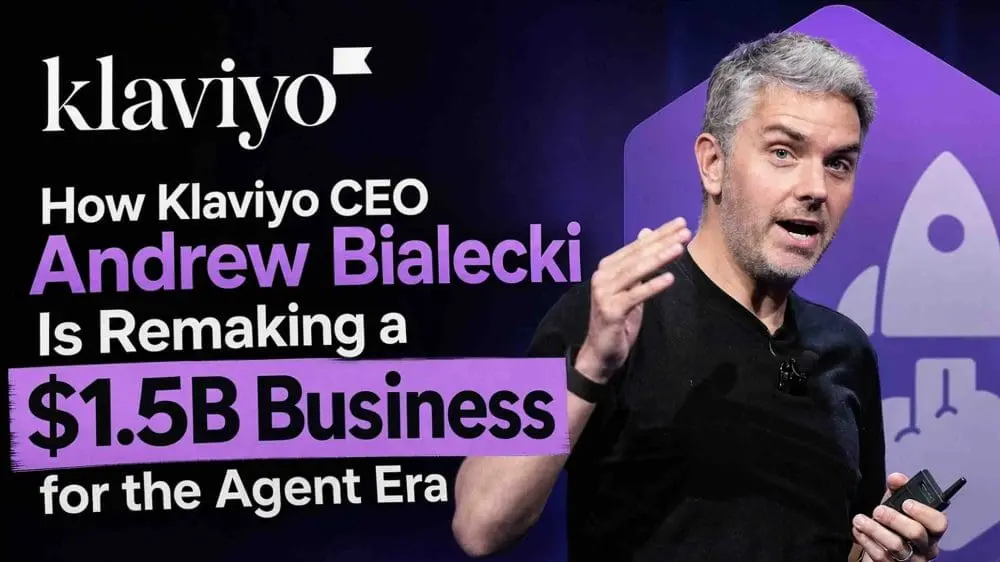
However, at the recent SaaStr AI conference, Andrew Bialecki, co-founder and co-CEO of Klaviyo, outlined a radically different reality. Rather than presenting a high-level vision deck or theoretical concepts about the future of automation, Bialecki pulled back the curtain on how a 2,300-person, publicly traded technology titan is completely rewriting its operational DNA, engineering systems, and product architectures for an agent-driven world.
Klaviyo’s dominance in the B2B e-commerce space was originally forged on a single, transformative realization: merchants do not care about vanity metrics like email open rates; they care about revenue attribution. By tying its platform directly into shopping carts and platforms like Shopify to show merchants the precise dollar value of their marketing campaigns, Klaviyo captured roughly 80% of the Shopify ecosystem. This strategy fueled one of the few successful tech IPOs of the 2023 cohort and earned the company intense customer loyalty.
Today, that entire edifice is being systematically rebuilt. Driven by strong financial momentum—including $370.6 million in Q2 2026 revenue (up 26 year-over-year) and full-year guidance raised to over $1.5 billion across more than 205,000 customers—Klaviyo is aggressively deploying autonomous agents. Its new marketing agent, Composer, onboarded over 95,000 users in its first month, with a quarter returning weekly and credit consumption compounding by 30% week-over-week. Notably, the first working prototype of Composer was built entirely by other agents over a single weekend.
This article explores Bialecki’s blueprint for transitioning an entire enterprise into an agent-first organization, detailing the frameworks, technical hurdles, and strategic shifts required to survive and thrive in the next era of software.
Detailed Chronology: The Evolution of Klaviyo’s Agentic Strategy
The path from a traditional e-commerce marketing platform to an agent-driven enterprise did not happen overnight. It required a deliberate, step-by-step re-engineering of internal workflows, development pipelines, and customer interaction models.
Phase 1: Identifying the Limitations of Legacy Prompting
Last fall, as Klaviyo began experimenting with generative AI, engineering leadership encountered a familiar bottleneck. Early agent code mirrored the broader industry standard: a chaotic, unmaintainable stack of prompts piled on top of one another. As applications scaled, these workflows collapsed under their own weight. This realization catalyzed the development of "Dark Factory"—Klaviyo’s internal system for agents that build agents.
Phase 2: Internal Adoption and the L1/L2/L3 Mandate
Rather than treating AI as a background R&D project, Klaviyo introduced a strict operational framework borrowed from the autonomous driving industry. The company mandated that all 2,300 employees reach Level 3 (L3) autonomy in their respective functions by the end of June.
- L1 & L2: Manual execution or basic tool-assisted workflows.
- L3: The ability to decompose complex problems, deploy teams of agents to execute tasks, and rigorously validate the output.
This mandate redefined job descriptions overnight. Product managers who previously spent their days drafting wireframes and static specifications were now tasked with supervising agentic workflows.
Phase 3: The Birth of Composer and Accelerated Prototyping
With the "Dark Factory" infrastructure running, Klaviyo tackled the development of Composer, an advanced multi-modal marketing agent. The system was broken down into specialized sub-agents:
- The Creative and Design Agent: Pulls assets dynamically from Figma, Canva, and proprietary brand libraries.
- The Orchestration Agent: Determines optimal customer segmentation, messaging timing, and channel delivery.
- The Analysis Agent: Predicts campaign performance and ROI before deployment.
The first working prototype of Composer was engineered entirely by AI sub-agents over a single weekend, proving that automated software development loops could drastically compress time-to-market.
Supporting Context & Metrics: Navigating Scale and Performance
To understand the weight of Klaviyo’s transformation, one must examine the scale of its operations and the metrics guiding its transition.
Financial and Customer Metrics (Q2 2026)
- Quarterly Revenue: $370.6 million (representing a 26% year-over-year growth rate).
- Full-Year Guidance: Projected between $1.526 billion and $1.534 billion.
- Customer Base: Over 205,000 active accounts, ranging from small and medium-sized businesses (SMBs) to high-volume enterprise brands.
- Composer Adoption: 95,000+ active users in its inaugural month, with weekly recurring usage holding strong at approximately 25% of its user base and a 30% week-over-week expansion in credit utilization.
The "Tom Brady" Mental Model: Adding the Coaching Layer
Bialecki warns against treating foundational AI models as turnkey solutions. A raw LLM, in his estimation, is like a highly athletic middle or high schooler: exceptionally capable across many domains, but lacking specialized, elite performance.
Just as Tom Brady achieved greatness not merely through innate athleticism, but through decades of rigorous film study, tailored drills, and expert coaching, enterprise agents require a dedicated coaching layer. Klaviyo achieved this by embedding two critical elements on top of their harnesses:
- Domain-Specific Feedback Loops: Continuous scoring mechanisms that evaluate agent output against historical campaign successes.
- Codified Taste Databases: Compilations of years of product critiques, Zoom meeting notes, and qualitative feedback that act as a strict pre-review gatekeeper before any agent-generated feature reaches human eyes.
Official Statements and Core Insights from Andrew Bialecki
During his presentation at SaaStr AI, Bialecki shared several counter-intuitive principles that challenge conventional wisdom in the SaaS sector.
1. Agents Are Your Most Advanced Users
In traditional software, power users represent a tiny fraction of the user base, while a long tail of novices struggles to unlock advanced features. Agents completely invert this distribution.
"Whatever you do to gather customer feedback, do the same thing with your agents. They’ll ask for what’s hard, and for what they want to do thousands of times instead of ten."
As an example, when Klaviyo introduced support for the complex AMP for email specification—a format most human customers found too difficult to code—Composer immediately leveraged it. The agent recognized how carousels and dynamic JavaScript calls could drive conversions, successfully diagnosing missing APIs and requesting them autonomously on day one.
2. Agents Training Agents on the Customer Side
One of the most persistent failure points for enterprise AI is onboarding. SMB customers cannot afford forward-deployed engineers (FDEs) to configure custom workflows. Klaviyo’s solution is recursive training: agents pre-train on a customer’s existing data, delivering an agent that arrives at a 50% to 70% resolution rate out of the box.
"If an agent product can’t be tried out of the gate and requires a big implementation, it’s dead on arrival. The demo-then-decide-then-implement motion is going away."
3. Great APIs Rescue Dated Software
For B2B founders managing legacy codebases, Bialecki offers an encouraging paradigm shift: treat software infrastructure as an API-first ecosystem meant for developers and agents. By building state-of-the-art, agent-friendly APIs, companies can bypass the need for human users to navigate cluttered, legacy user interfaces. Klaviyo is actively moving toward a future where a merchant can sign up with an email address, launch a business, and run marketing operations entirely through agentic interaction without ever touching a traditional dashboard.
The 5 Major Mistakes Enterprise Teams Are Making
Bialecki outlined five critical pitfalls that organizations frequently fall into when attempting to operationalize AI:
- Letting Agents Touch Production Systems Unchecked: Failing to build robust sandboxes and strict tool access limits, leading to catastrophic database or infrastructure errors.
- Stopping at the Demo: Confusing a successful 2-minute prototype with enterprise-grade readiness. Agents must be stress-tested for load, scale, and edge cases across thousands of diverse customer profiles.
- Shipping the Raw Model: Deploying foundation models without a coaching layer, domain-specific scoring, or proprietary feedback loops.
- Maintaining Fuzzy Interfaces: Relying on human ambiguity and impromptu meetings instead of establishing rigorous, contractual boundaries between organizational roles and system modules.
- Building Exclusively for Human Logins: Continuing to design software solely around human-facing screens rather than headless, API-driven infrastructure optimized for autonomous agents.
Future Outlook: The Next Era of Autonomous Enterprise
Klaviyo’s aggressive pivot highlights a broader structural shift across the technology landscape. The competitive advantage no longer belongs simply to companies with the largest proprietary datasets or the most polished graphical interfaces. Instead, it belongs to organizations that master decomposition, rigorous system contracts, and automated development loops.
As agents evolve from simple chat-based assistants into proto-web servers capable of executing complex business workflows end-to-end, the boundary between software provider and customer will continue to blur. For enterprise leaders watching Klaviyo’s trajectory, the mandate is clear: adapt the organizational structure, harden internal APIs, and embrace the Dark Factory model—or risk being disrupted by competitors who already have.