Executive Overview
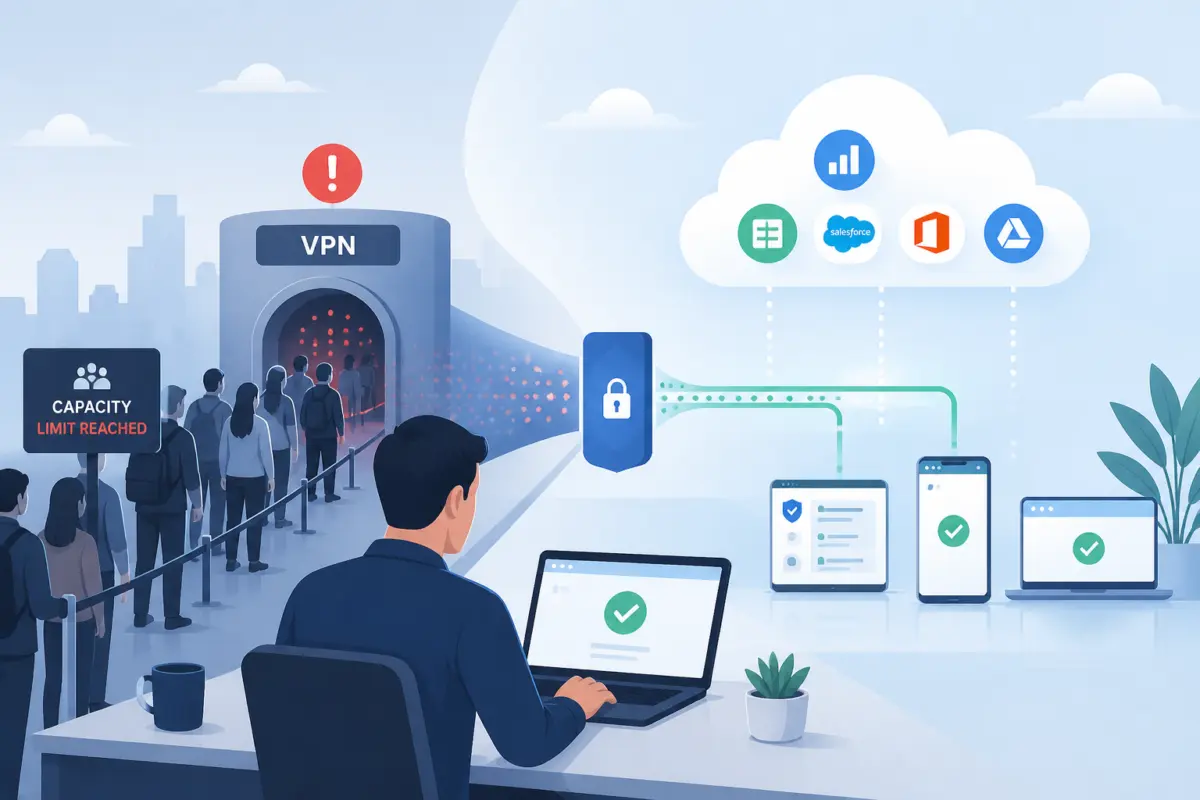
As modern organizations continue to navigate the complexities of decentralized workforces, rapid expansions, and corporate restructuring, the traditional corporate Virtual Private Network (VPN) is increasingly hitting a structural wall. Originally designed for sporadic, supplemental remote access, enterprise VPNs are now being pushed past their operational limits. When sudden remote work mandates, major merger and acquisition activities, or aggressive workforce scaling occur, these legacy gateways frequently bottleneck.
The immediate corporate reaction is often to purchase additional gateway licenses or attempt to scale bandwidth. However, IT leaders are discovering that throwing more hardware at the problem fails to address the root issue: network architecture. Granting full network access through a traditional VPN tunnel when employees merely need access to specific software creates unnecessary security risks and exacerbates capacity constraints.
To maintain business continuity, enterprises are pivoting toward advanced remote access alternatives. By decoupling application delivery from traditional network tunnels—utilizing modern application publishing, desktop virtualization, and secure browser-based access—organizations can bypass gateway choke points entirely. Aligned with the National Institute of Standards and Technology (NIST) principle of protecting individual resources rather than broad network segments, this strategic shift treats remote access not as a blanket network extension, but as a precise, application-driven delivery mechanism. This comprehensive report explores the methodologies, technical architectures, and strategic deployment frameworks required to successfully transition enterprises away from overloaded VPN environments.
Detailed Chronology: The Evolution and Breakdown of Enterprise VPN Infrastructure
Phase 1: The Legacy Paradigm and the Root of the Bottleneck
For decades, the enterprise VPN served as the gold standard for secure remote connectivity. By establishing an encrypted tunnel from an external endpoint directly into the corporate Local Area Network (LAN), employees could operate as though they were physically seated at their office desks.
However, this model was built on an implicit trust architecture. Once authenticated and inside the tunnel, a user’s device often enjoyed broad access across internal network segments. As remote work evolved from a perk into a standard operational requirement, the sheer volume of concurrent sessions began to overwhelm legacy gateways.
Phase 2: Identifying the Breaking Point
Organizations experiencing sudden workforce expansions quickly realized that VPN capacity is not infinite. The failure manifests in distinct ways:
- Concurrent-Session Ceilings: Hardware gateways possess strict limits on active tunnels. Once reached, incoming connection requests are outright rejected, locking out employees even if total bandwidth utilization appears normal.
- Authentication Server Congestion: During peak morning login windows, centralized authentication servers (such as Active Directory or RADIUS) become choke points, processing thousands of simultaneous verification requests and causing cascading timeouts.
- The "All-Traffic" Penalty: Forcing all remote traffic—including non-essential web browsing and resource-heavy media streams—through a single corporate gateway creates severe bandwidth bottlenecks.
Phase 3: The Strategic Shift to Application-Centric Delivery
Recognizing that patching legacy infrastructure is no longer viable, enterprise IT architectures have begun shifting toward targeted access models. Instead of extending the corporate perimeter to the user’s device via a full tunnel, organizations are moving application sessions outside the VPN entirely. By delivering specific software programs directly to remote users while the execution remains on centralized, secure servers, organizations preserve gateway capacity, enhance security postures, and eliminate the friction of managing heavy client-side software.
Supporting Context & Metrics: Auditing, Selecting, and Deploying Alternatives
Transitioning away from a legacy VPN strategy requires a rigorous, data-driven approach. Organizations cannot simply pull the plug on existing infrastructure; they must audit usage, evaluate delivery models, and meticulously plan their migrations.
[Traditional VPN Model]
User Device ---> Full Network Tunnel ---> Corporate LAN ---> All Applications (High Bottleneck Risk)

[Modern Application Publishing]
User Device ---> Encrypted Stream (HTML5/Client) ---> Centralized Server ---> Specific Target App Only (Optimized & Secure)
1. Auditing Current VPN Usage
Before implementing alternatives, IT teams must establish where capacity is actually being consumed. An effective audit must look beyond daily averages and focus on peak utilization periods by answering three critical operational questions:
- Which specific applications generate the highest volume of concurrent traffic during peak business hours?
- Where do authentication bottlenecks occur during morning login surges?
- What percentage of connected users are utilizing resource-heavy tools versus lightweight web applications?
The applications that surface at the top of this audit become the primary candidates for delivery outside the VPN tunnel. Their pre-migration traffic metrics serve as the baseline for evaluating whether a chosen alternative successfully relieves gateway pressure.
2. Evaluating Delivery Models: Application Publishing vs. Browser Access
When removing workloads from the VPN, organizations typically choose between targeted application publishing and browser-based access:
- Application Publishing: Platforms such as TSplus, Citrix, and various remote desktop solutions publish specific software programs rather than granting full network access. Users interact seamlessly with application windows while execution occurs on centralized servers. When testing these solutions, administrators must compare bandwidth consumption under identical workloads, accounting for auxiliary tasks like local printing and large file transfers.
- HTML5 Browser Access: Moving users to browser-based delivery eliminates client software installation hurdles. Employees authenticate via standard web browsers using existing corporate credentials. This approach is invaluable for onboarding temporary contractors without provisioning dedicated client devices. However, compatibility must be strictly verified; modern enterprise frameworks (such as Microsoft’s Windows App requirements) frequently mandate modern browsers (typically no more than 12 months old) and may exclude mobile environments, proving that "clientless" does not automatically mean universal endpoint compatibility.
3. Infrastructure Architecture: On-Premises, Cloud, and Hybrid Deployment
Choosing the underlying hosting infrastructure dictates long-term scalability and management overhead:
- On-Premises Infrastructure: Keeps hosted software and data within corporate-owned facilities. IT departments maintain direct control over hardware, security policies, and network configurations, though this model lacks elastic scalability.
- Cloud-Hosted Solutions: Platforms like Microsoft Azure Virtual Desktop provide elastic scaling, offering full-desktop and individual-application delivery with automated scaling capabilities. However, internal teams must still properly size virtual machines and configure ongoing deployments.
- Hybrid Strategies: Combines in-house resources with cloud capacity, routing overflow demand to the cloud during peak operational windows. Rigorous testing is mandatory to ensure that database and authentication dependencies remain accessible from the cloud under heavy loads.
4. Matching Licensing Models to Workforce Fluctuations
Licensing structures can quietly sabotage remote work scalability. If a VPN contract charges strictly per user or device, doubling remote staff can instantly double software licensing costs. Furthermore, approval bureaucracy can block access even when gateway capacity remains available.
- Organizations must evaluate whether licensing models utilize named-user or concurrent-user structures.
- Analyzing these costs over a multi-year horizon reveals stark differences in total cost of ownership (TCO), making it essential to align software agreements with anticipated headcount volatility rather than relying solely on upfront list prices.
Official Standards and Technical Guidance
To ensure compliance, security, and optimal user experience, enterprise architects look to established regulatory frameworks and industry benchmarks:
- NIST SP 800-207 (Zero Trust Architecture): The National Institute of Standards and Technology emphasizes protecting individual resources rather than trusting entire network segments. Modern application publishing directly supports this paradigm by restricting user access strictly to authorized software titles.
- Microsoft Azure Connection Quality Benchmarks: For organizations deploying cloud-based virtual desktops or application streaming, Microsoft technical documentation indicates that network latency up to 150 milliseconds should not noticeably degrade ordinary, non-video enterprise workloads. IT teams use this threshold as a baseline network health check during pilot rollouts.
- Browser Lifecycle Standards: Modern enterprise application delivery mechanisms require up-to-date endpoint infrastructure. Current deployment guidelines dictate that client-facing web browsers must be maintained within a 12-month currency window to ensure security compliance and seamless rendering of HTML5-streamed applications.
Future Outlook: The Death of the Perimeter and the Rise of Adaptive Access
As enterprise infrastructure continues its migration toward decentralized, cloud-native paradigms, the traditional corporate VPN is rapidly becoming obsolete. The future of remote work does not lie in securing a bigger pipe into a centralized office, but in intelligent, identity-driven, and context-aware application delivery.
Looking ahead over the next three to five years, several key trends will define enterprise remote access:
- The Acceleration of Zero Trust Network Access (ZTNA): Enterprises will fully replace legacy VPNs with ZTNA solutions that verify every user and device continuously, granting access solely to authorized applications on a session-by-session basis.
- AI-Driven Capacity Management: Predictive analytics will automatically spin up cloud-based application instances and scale bandwidth before capacity bottlenecks manifest, entirely eliminating reactive emergency scaling.
- Pervasive Browser-Centric Workspaces: With the maturation of WebAssembly and high-performance HTML5 streaming, the desktop operating system will matter less and less. Secure enterprise browsers will serve as the universal workspace, rendering client-side installations entirely optional.
Organizations that proactively audit their current usage, phase out brittle VPN dependencies, and embrace flexible application delivery models will not only secure their operational continuity against sudden disruptions—they will build a leaner, more resilient, and inherently more secure enterprise for the future.