Executive Overview
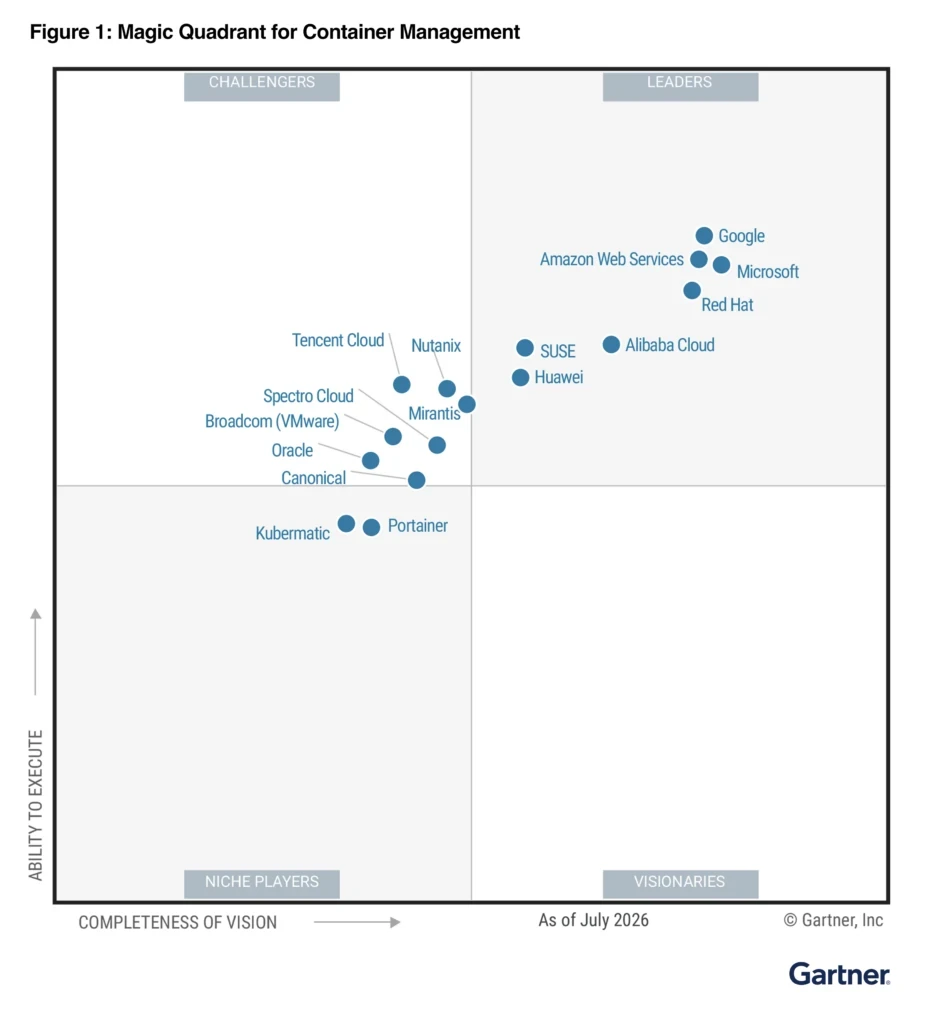
In a landmark recognition that highlights the shifting dynamics of enterprise infrastructure, Microsoft has been named a Leader in the 2026 Gartner® Magic Quadrant™ for Container Management. Notably, the tech giant was positioned furthest to the right on the "Completeness of Vision" axis, a metric evaluating a vendor’s strategic foresight, innovation pipeline, and alignment with emerging market demands.
       2026 GARTNER® MAGIC QUADRANT™ FOR CONTAINER MANAGEMENT
  +-----------------------------------------------------------------+
  |                                 |  LEADERS                      |
  |  CHALLENGERS                    |                               |
  |                                 |             [Microsoft]       |
  |                                 |             * (Furthest Right |
  |                                 |                on Vision)     |
  |                                 |                               |
  +---------------------------------+-------------------------------+
  |                                 |  VISIONARIES                  |
  |  NICHE PLAYERS                  |                               |
  |                                 |                               |
  |                                 |                               |
  +-----------------------------------------------------------------+
                    COMPLETENESS OF VISION --->
The recognition arrives at a critical inflection point for the cloud computing industry. Container platforms—once utilized primarily for lightweight, microservice-based web applications—are now tasked with orchestrating highly demanding, heterogeneous workloads across hybrid, edge, and sovereign environments. Chief among these pressures is the exponential explosion of enterprise Artificial Intelligence (AI), which has fundamentally altered compute density, latency demands, and operational governance requirements.
Industry analysts attribute Microsoft’s top-tier ranking to its unified product architecture across the cloud-to-edge continuum. Anchored by Azure Kubernetes Service (AKS), Azure Container Apps, Azure Arc, and Azure Kubernetes Fleet Manager, Microsoft’s portfolio addresses a core enterprise dilemma: modernizing legacy software while simultaneously deploying real-time generative AI and agentic systems, all without multiplying operational friction.
Detailed Chronology: The Decade-Long Evolution of Container Management
To understand the platform mechanics driving today’s enterprise architecture, it is necessary to examine how container orchestration evolved over the past decade from a niche scheduler into the foundational engine of modern computing.
+-----------------------------------------------------------------------------+
|                        EVOLUTION OF CONTAINER PLATFORMS                     |
+-----------------------------------------------------------------------------+
| 2014-2017: EARLY ADOPTION                                                   |
| * Narrow scope: Orchestration & abstraction of distributed systems.         |
| * Focus on workload dynamic scheduling over physical placement.             |
+-----------------------------------------------------------------------------+
| 2018-2022: ENTERPRISE HYBRID EXTENSION                                      |
| * Proliferation of multi-cloud and hybrid environments.                     |
| * Launch of Azure Arc & Fleet Manager to address cluster sprawl & drift.    |
+-----------------------------------------------------------------------------+
| 2023-2026+: THE AI INFRASTRUCTURE REVOLUTION                                |
| * Emergence of dual-model AI architectures (Persistent vs. Serverless).     |
| * Agentic SRE operations and hardware-isolated sandboxing at the edge.      |
+-----------------------------------------------------------------------------+
2014–2017: The Abstraction Paradigm
When Kubernetes work began in earnest over ten years ago, the primary goal was straightfoward: democratize distributed systems engineering so developers could build reliable services without suffering infrastructure lock-in. Early design choices emphasized workload abstractions—describing what an application required in terms of memory, CPU, and networking rather than explicitly defining where it must physically reside. This agnostic approach allowed schedulers maximum flexibility, laying the groundwork for platforms to later absorb workloads that did not yet exist.
2018–2022: Hybrid Sprawl and Fleet Coordination
As enterprise container adoption surged, organizations faced a secondary challenge: environment fragmentation. Workloads spread from central cloud regions into private datacenters, branch offices, and regional hubs. Microsoft responded by building operational fabric layers—introducing Azure Arc to extend Azure management controls to third-party clusters and launching Azure Kubernetes Fleet Manager to mitigate cross-cluster configuration drift and patch management delays.
2023–2026: The AI Infrastructure Acceleration
The mainstream rise of Large Language Models (LLMs), small language models (SLMs), and autonomous agent frameworks placed unprecedented demands on underlying platforms. Container platforms suddenly had to manage specialized hardware resources like High-Bandwidth Memory (HBM) and InfiniBand networking alongside traditional CPU workloads. Furthermore, stringent sovereignty laws forced AI workloads to run locally near data sources. Container platforms transitioned from simple compute schedulers into full-stack infrastructure managers capable of dynamically allocating GPU capacity across cloud, edge, and sovereign boundaries.
Supporting Context & Metrics: Architectural Paradigm Shifts and Ecosystem Influence
The Dual Architectural Engine for Enterprise AI
According to technical analysis of customer deployments, enterprise AI architecture has consolidated into two distinct operational patterns. Microsoft’s top vision score reflects a platform designed to seamlessly bridge both models using shared identity, security policies, networking rules, and container images.
                  ENTERPRISE AI ARCHITECTURAL DUALITY

       +-------------------------------------------------------+
       |                  SHARED PLATFORM BASE                 |
       |  (Unified Identity, Network Policies, Container Images)|
       +---------------------------+---------------------------+
                                   |
         +-------------------------+-------------------------+
         |                                                   |
         v                                                   v
+-------------------------------+   +-------------------------------+
|     MODEL 1: PERSISTENT       |   |      MODEL 2: ELASTIC         |
|     SERVING LAYER             |   |      AGENTIC INFERENCE        |
+-------------------------------+   +-------------------------------+
| * Target: Predictable volume  |   | * Target: Burst/Dynamic tasks |
| * Managed by: Platform Teams  |   | * Managed by: App Developers  |
| * Platform: AKS               |   | * Platform: Azure Container   |
| * Features: GPU Scheduling,   |   |   Apps                        |
|   CNCF AI Conformance,        |   | * Features: Serverless GPUs,  |
|   AI Toolchain Operator       |   |   Hardware Sandboxing         |
+-------------------------------+   +-------------------------------+
1. The Persistent Infrastructure Model
Used for high-volume, predictable model inference and continuous training pipelines. In this framework:
- A central platform engineering team owns persistent serving layers, complex GPU scheduling topologies, model lifecycles, and strict governance boundaries.
- Tools such as the open-source AI toolchain operator on Azure Kubernetes Service (AKS) automate GPU provisioning and model deployment.
- Full adherence to CNCF AI Conformance standards ensures that the surrounding open-source ecosystem remains compatible as underlying frameworks mature.
2. The Elastic Agentic Model
Optimized for unpredictable workloads, event-driven inference, and autonomous AI agents:
- Applications invoke model inference on-demand, run dynamic user-generated or model-generated code, and instantly release capacity upon completion.
- Azure Container Apps serves this requirement by offering serverless GPU access and hardware-isolated sandboxes. These sandboxes maintain security boundaries during code execution while preserving session state across interactions, allowing developers to deploy agentic workflows without needing to directly configure Kubernetes primitives.
Mitigating Fleet Sprawl and Hybrid Coordination Failures
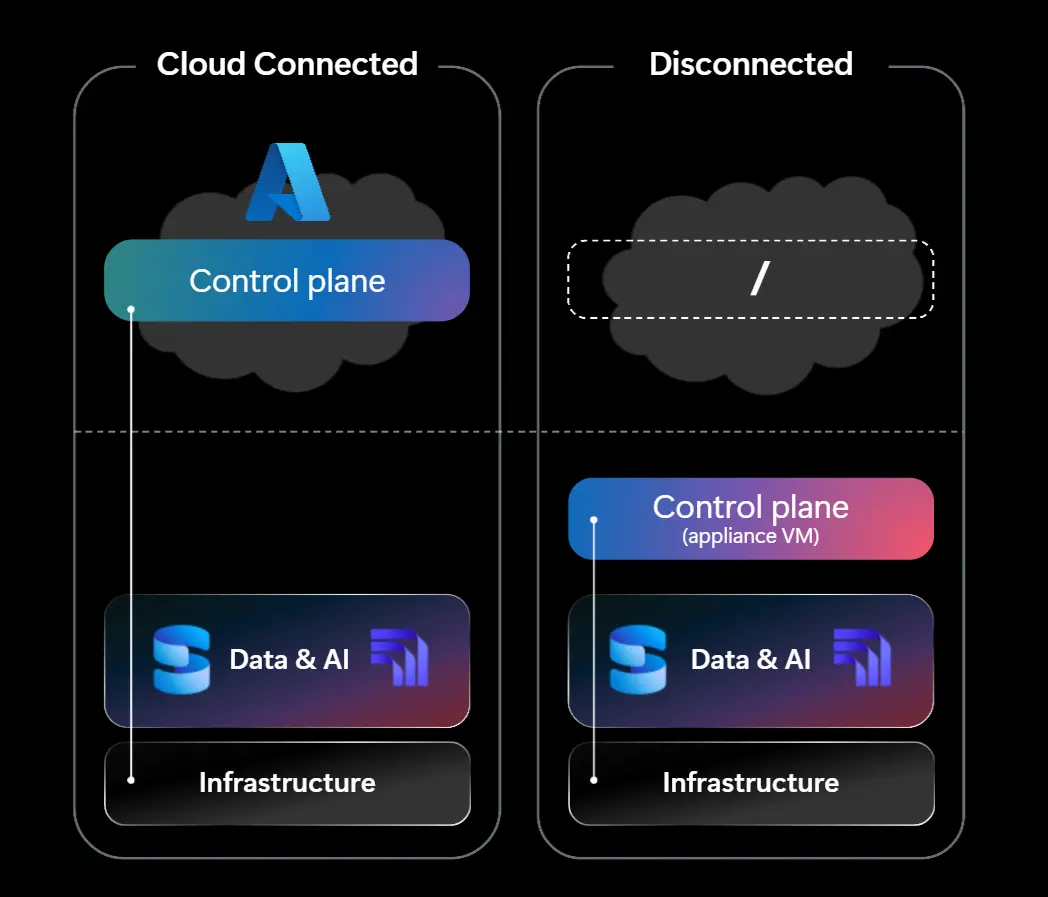
As AI capabilities expand to edge environments—such as manufacturing smelters, retail points of sale, and regional healthcare sites—enterprises frequently encounter multi-cluster coordination failures. These issues typically manifest as configuration drift, inconsistent policy enforcement, and staggered software upgrades.
| Platform Layer | Strategic Functionality | Primary Enterprise Benefit |
|---|---|---|
| AKS Everywhere | Delivers an Azure-built, standardized Kubernetes footprint from cloud to edge environments. | Guarantees operational consistency regardless of local deployment constraints. |
| Azure Arc for Kubernetes | Projects Azure security policies, identity frameworks, and monitoring onto any CNCF-conformant cluster. | Unifies governance across multi-cloud (AWS, GCP) and on-premises environments. |
| Azure Kubernetes Fleet Manager | Handles centralized update orchestration, multi-cluster traffic routing, and policy placement. | Prevents operational drift and automates rolling upgrades across thousands of clusters. |
| AKS Automatic | Applies automated operational defaults based on Microsoft’s internal operating practices. | Ensures optimal performance and security posture without removing Kubernetes API access. |
Open-Source Contributions & Upstream Fidelity
A key factor in Microsoft’s leadership assessment is its strict commitment to upstream open-source purity. Rather than creating a customized, proprietary fork of Kubernetes that risks vendor lock-in, AKS maintains direct compatibility with community releases.
       CNCF TOTAL CONTRIBUTIONS BY CLOUD PROVIDER (LAST 3 YEARS)
       +-------------------------------------------------------+
       | MICROSOFT           ======================== (Rank #1) |
       | Provider B          ==============                    |
       | Provider C          ==========                        |
       +-------------------------------------------------------+
       * Note: Microsoft ranks #2 overall across all global tech contributors.
According to contribution metrics tracked by the Cloud Native Computing Foundation (CNCF):

- Microsoft ranks as the #1 overall cloud provider contributor to CNCF projects over the past three years.
- Across all global tech organizations (including non-cloud entities), Microsoft ranks #2 overall in total CNCF contributions.
- This engineering investment ensures that APIs built in Azure remain portable across localized edge hardware, competing public clouds, and private datacenters.
Autonomous SRE and Agentic Operations
As cluster counts grow faster than IT staff size, operational models must evolve. Microsoft is integrating AI directly into platform management via Azure SRE Agent and the AKS Model Context Protocol (MCP) Server.
These platforms leverage agentic AI to analyze telemetry, run contextual diagnostics, and suggest or execute remediation steps within predefined security boundaries. This shift targets a major industry pain point: reducing time spent on routine operational troubleshooting so SRE teams can focus on platform capability engineering.
Official Statements and Industry Feedback
In response to the placement in the 2026 Gartner Magic Quadrant, Microsoft engineering leadership pointed to the broader industry shift toward AI integration and decentralized computing:
"When we started working on Kubernetes over a decade ago, the problem was narrow: democratize distributed systems so that reliable services were easier to build… AI has reshaped the requirements for container management. While Kubernetes has proved well suited for AI workloads, the bigger shift is that applications and AI now need to run closer to data and users, and increasingly inside specific sovereign and regulatory boundaries."
Highlighting the balance between developer speed and platform control, engineering leaders emphasized the core architectural strategy:
"Platform teams want the control… for the models the business depends on. Application teams and agent frameworks want elasticity… and they often want it without learning Kubernetes. Almost every enterprise we work with needs both, and the interesting engineering problem is making the boundary between them easy to cross."
Enterprise adoption underscores the impact of these architectural capabilities across diverse business domains. Brian Sutliffe, Vice President of Engineering at automotive intelligence firm CallRevu, emphasized the financial and operational benefits of this unified management layer:
"Azure Kubernetes Service gives us the control and cost efficiency we need. We can scale GPU resources based on call volume and test new models without touching production."
Future Outlook: Autonomous Operations, Sovereign Compute, and Enterprise Roadmap
Looking ahead through the end of the decade, container management platforms will continue to adapt to three major technological trends:
                  FUTURE CONTAINMENT LANDSCAPE (2026+)

 +--------------------+    +--------------------+    +--------------------+
 | DECENTRALIZED EDGE |    | AUTONOMOUS AGENTS  |    | ZERO-TRUST REGULATORY |
 |    SOVEREIGNTY     |    |   OPERATIONS       |    |     COMPLIANCE     |
 +--------------------+    +--------------------+    +--------------------+
 | Compute moves to   |    | SRE workflows shift|    | Governance policy  |
 | local data, strictly|   | from reactive alerts|   | compiled directly  |
 | governed by region.|    | to self-healing.   |    | into platform code.|
 +--------------------+    +--------------------+    +--------------------+
1. Decentralized Edge Sovereignty
As global privacy standards and data residency laws become more stringent, enterprise applications can no longer rely purely on centralized public cloud data centers. Workload execution must increasingly occur locally at the data source—whether inside a regional sovereign boundary, a factory floor, or an offline site. Container management platforms will need to seamlessly bridge remote edge environments with core cloud governance.
2. Deep Integration of Autonomous Operations
The role of SRE teams will continue to shift from manual intervention to high-level system supervision. As tools like the Azure SRE Agent advance, routine operational tasks—such as triage, logs correlation, and capacity balancing—will be handled by autonomous systems. Human intervention will focus primarily on policy definition, security auditing, and architectural design.
3. Unified Developer Abstraction Layers
The barrier between low-level container management and application delivery will continue to soften. Modern platforms will obscure infrastructure complexity through serverless abstractions, hardware-isolated sandboxes, and automated control loops. Developers will build against unified interfaces, leaving the platform to dynamically determine whether a workload requires dedicated GPU clusters, multi-region failover, or serverless execution.
Strategic Conclusion
Microsoft’s positioning in the 2026 Gartner Magic Quadrant reflects an industry truth: modern container management is no longer just about packaging code. It is about operating a cohesive platform that can balance complex AI workloads, cloud-to-edge deployments, and operational simplicity. Organizations that standardize on flexible, open-source-aligned architectures will be best equipped to navigate the next decade of digital transformation.
Reference and Citations
- Report: Gartner® Magic Quadrant™ for Container Management
- Publication Date: 2 September 2026
- Authors: Dennis Smith, Tony Iams, Wataru Katsurashima, Lucas Albuquerque
- Disclaimer: Gartner does not endorse any vendor, product or service depicted in its research publications, and does not advise technology users to select only those vendors with the highest ratings or other designation. Gartner research publications consist of the opinions of Gartner’s research organization and should not be construed as statements of fact. Gartner disclaims all warranties, expressed or implied, with respect to this research, including any warranties of merchantability or fitness for a particular purpose.