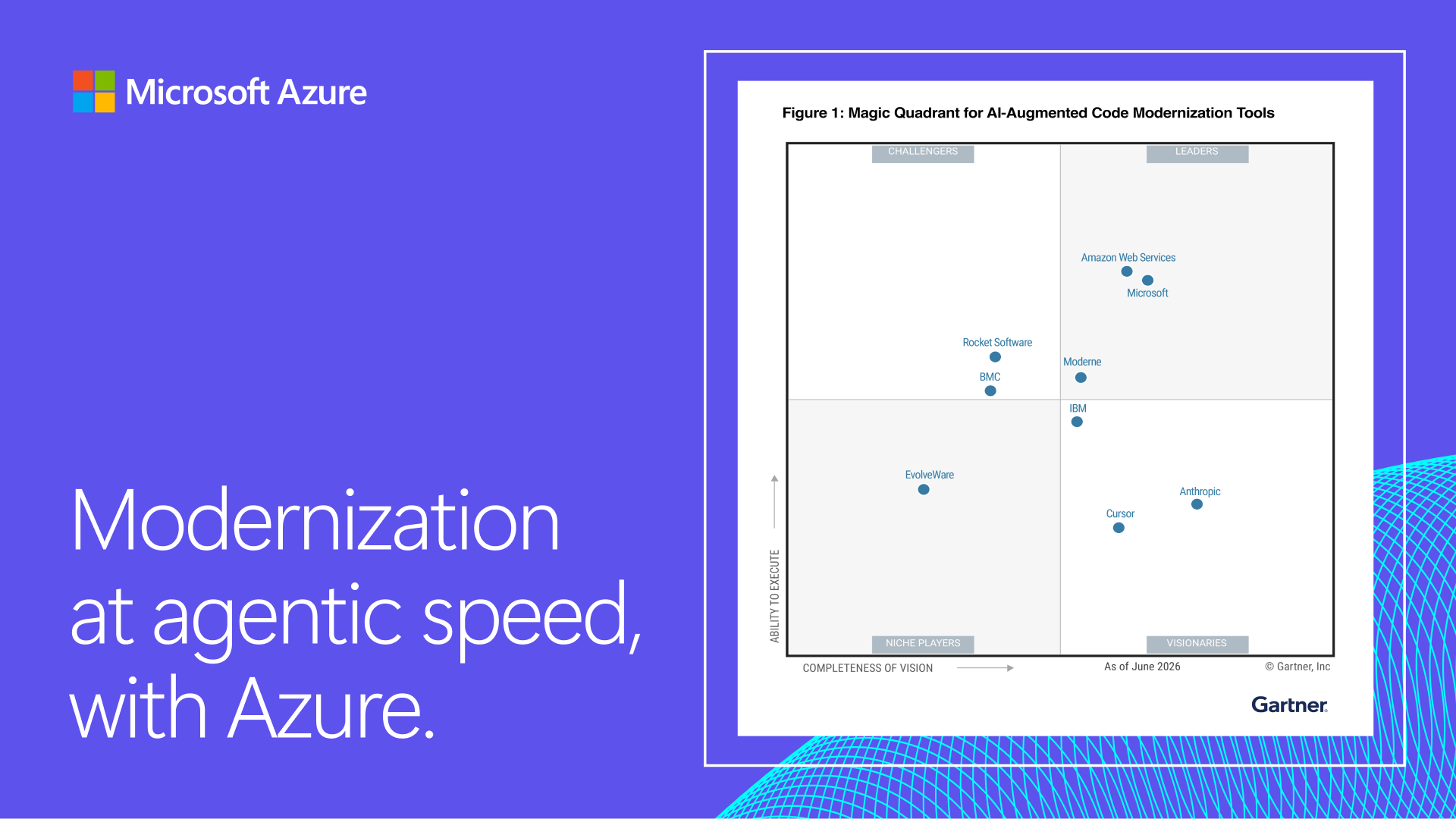
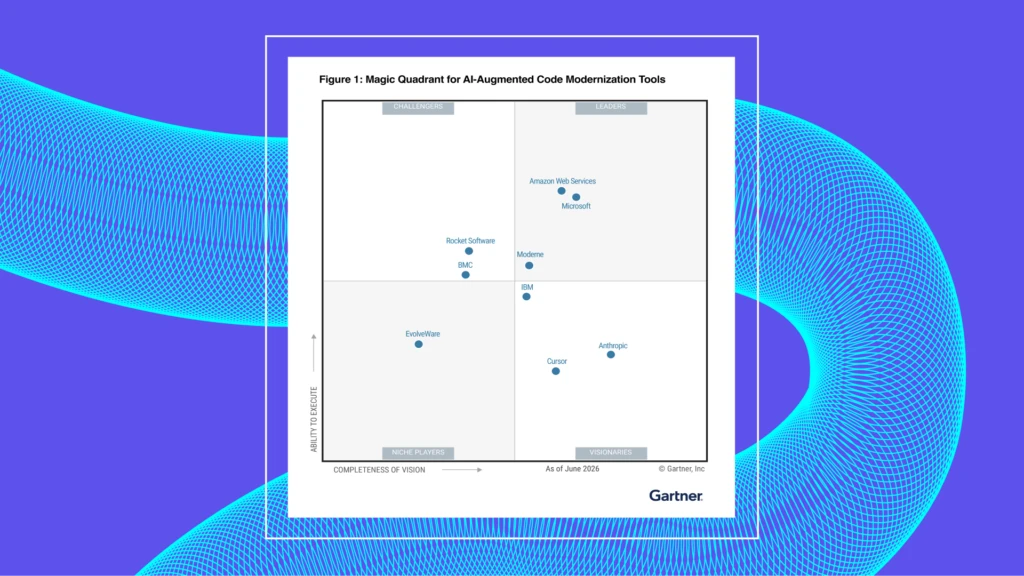
In a milestone recognition of how artificial intelligence is reshaping software engineering and enterprise IT architecture, Gartner® has officially named Microsoft a Leader in its inaugural 2026 Magic Quadrant™ for AI-Augmented Code Modernization Tools. Published on August 3, 2026, by analysts Prasanna Lakshmi Narasimha, Erin Khoo, Deacon D.K. Wan, and Wei Jin, the report marks the formal establishment of a new enterprise software category dedicated to solutions that blend specialized AI agents, generative AI models, and deterministic code analysis to accelerate the refactoring and cloud migration of legacy software systems.
For decades, enterprise IT organizations have been constrained by accumulated technical debt—sprawling codebases composed of legacy .NET Framework applications, aging Java runtimes, unmaintained third-party dependencies, and obsolete security protocols. Historically, modernizing these mission-critical systems required multi-year capital expenditures, massive developer headcounts, and significant operational risks of system failure.
Gartner’s market evaluation highlights a structural shift: software engineering leadership can now systematically compress modernization cycles from years down to days or weeks. By leveraging agentic AI workflows integrated directly into cloud infrastructure and developer environments, organizations are treating modernization not as an overhead cost, but as an essential prerequisite for artificial intelligence readiness.
According to enterprise field data highlighted by Microsoft, organizations deploying these AI-augmented modernization pipelines have documented up to a 70% reduction in migration timelines and a 50% decrease in overall developer effort. With more than 1.4 million developers already adopting these modernizing extensions in their integrated development environments (IDEs), agentic software transformation has transitioned from an experimental capability into a core enterprise strategy.
The Historical Bottleneck: Decades of Accumulated Technical Debt
Enterprise computing ecosystems rely heavily on software built 10 to 20 years ago. While these core applications continue to power high-value financial transactions, supply chains, and administrative workflows, their underlying runtimes have become liabilities. Organizations routinely face a dilemma:
The Cost of Standing Still: Outdated runtime frameworks expose enterprises to severe security vulnerabilities, compliance failures, and rising maintenance expenses.
The Risk of Rewrite: Traditional manual re-platforming demands manual line-by-line refactoring, mapping complex logic, generating updated infrastructure-as-code (IaC), and rewriting test suites.
Historically, when internal budgets were evaluated, modernizing legacy systems consistently lost funding to new feature development and customer-facing software innovations. As a result, technical debt compounded, widening the gap between legacy on-premises codebases and cloud-native services.
The Agentic AI Shift
The emergence of agentic AI—artificial intelligence systems capable of autonomous planning, multi-step execution, contextual reasoning, and tool interaction—fundamentally alters this economic equation. Rather than relying solely on simple auto-complete code suggestions, agentic modernization platforms analyze entire application structures, understand deep dependency trees, evaluate architectural constraints, and generate multi-step modernization pipelines.
Microsoft’s solution architecture bridges high-level portfolio planning with low-level code transformation through a dual-layer ecosystem:
1. The Portfolio Orchestration Layer (Modernize CLI)
Designed for enterprise architects and IT leaders, the Modernize CLI operates at the application portfolio level. It automatically scans legacy codebases, uncovers hidden architectural dependencies, flags deprecated APIs, assesses security vulnerabilities, and builds structured transformation blueprints. By evaluating hundreds of microservices or monolithic applications simultaneously, it removes the manual audit phase that used to consume quarters of enterprise planning.
2. The IDE Execution Layer (GitHub Copilot & Azure Copilot)
Once the Modernize CLI produces an application-specific modernization blueprint, the developer takes over within the integrated development environment (IDE). Powered by GitHub Copilot and Azure Copilot, the AI agent executes the blueprint directly inside the developer’s workspace:
Runtime & Framework Upgrades: Converting legacy .NET Framework applications to modern, cross-platform .NET runtimes or migrating legacy Java EE configurations to modern Spring Boot or cloud-optimized containers.
Dependency & API Refactoring: Automatically replacing deprecated APIs, updating third-party libraries, and refactoring relational database access layers.
Infrastructure-as-Code (IaC) Provisioning: Generating deployment scripts, Bicep templates, or Terraform configurations tailored specifically for target runtime environments on Microsoft Azure.
Automated Test Generation: Creating unit and integration tests to verify that refactored components preserve functional parity with legacy systems.
The Deterministic Analysis Guardrail
A core design principle of Microsoft’s modernization framework is the integration of deterministic static analysis with probabilistic generative AI models. Pure generative AI runs the risk of introducing subtle runtime bugs or hallucinating non-existent APIs.
To prevent these issues, Microsoft’s modernization pipeline validates every generative code conversion against strict deterministic rules, syntax parsers, and static code analyzers. Human developers retain ultimate control over the pull request: every refactored line of code, framework update, and infrastructure template is fully transparent, reviewable, and testable before deployment to production.
Supporting Context & Performance Metrics
Gartner’s decision to launch a dedicated Magic Quadrant for AI-Augmented Code Modernization Tools reflects rapid enterprise adoption and measurable returns on investment. Modernization is no longer evaluated as a cost center; it is treated as a strategic catalyst for cloud migration and enterprise AI integration.
Industry Performance Benchmarks
Quantitative data gathered across global enterprise deployments demonstrates how agentic modernization alters enterprise software economics:
Metric Indicator
Historical Baseline (Manual Refactoring)
Modern Standard (Agentic AI-Augmented)
Measured Impact
Migration Timeline
Multi-quarter to multi-year projects
Days to weeks per application
Up to 70% reduction in time-to-production
Developer Effort
Hundreds of manual engineering hours
Automated refactoring with human review
50% reduction in total engineering effort
Developer Adoption
Niche, specialized migration teams
Broad developer adoption
Over 1.4 million IDE extension installs
Refactoring Throughput
Small microservices per sprint
Over 500,000 lines of code transformed
Multi-year efforts completed in weeks
Why Modernization Is the Gateway to AI
Modern enterprise AI applications—such as Retrieval-Augmented Generation (RAG) platforms, custom copilots, and autonomous operational agents—require clean data, scalable APIs, and modern cloud infrastructure. Legacy monolithic applications running on deprecated runtimes often lack the containerization, API abstraction, and identity governance needed to securely connect to modern AI engines.
By converting legacy monoliths into cloud-native microservices running on Microsoft Azure, enterprises simultaneously eliminate operational debt and prepare their business systems to ingest, process, and act upon real-time generative AI intelligence.
The real-world impact of agentic code modernization is visible in large enterprise environments where software complexity and scale present significant operational hurdles.
In one cited deployment, SAP Labs China used GitHub Copilot’s specialized modernization capabilities to overhaul legacy Java runtimes across complex software components.
"GitHub Copilot’s modernization agent significantly saved time on our Java modernization effort from days down to mere hours at SAP Labs. It runs seamlessly at scale, significantly reducing manual complications for our developers. The modernization agent is now an essential pillar of our modernization effort."
— Dr. Richard Cai, Managing Director, SAP Labs China
Dr. Cai’s perspective reflects a broader industry pattern: compressed conversion timelines allow enterprise engineering teams to reallocate thousands of developer hours from routine codebase maintenance toward core feature development and customer-facing innovation.
Analytical Foundation: Gartner Research Framework
The Gartner Magic Quadrant evaluation provides an independent market assessment of software vendors competing in the AI-Augmented Code Modernization space. Evaluated on both Completeness of Vision and Ability to Execute, Leaders in this category demonstrate an end-to-end framework capable of handling deep code analysis, enterprise-grade governance, multi-language support, and seamless cloud integrations.
The underlying research document (Gartner Magic Quadrant for AI-Augmented Code Modernization Tools, August 3, 2026, authored by Prasanna Lakshmi Narasimha, Erin Khoo, Deacon D.K. Wan, and Wei Jin) serves as an industry standard for corporate CIOs and enterprise architects selecting transformation platforms.
Future Outlook & Strategic Implications
The Competitive Divergence
As AI-augmented code modernization tools mature, a strategic gap is widening between early enterprise adopters and organizations reliant on manual refactoring:
ENTERPRISE STRATEGIC TIMELINE (2026 & BEYOND)

Early Adopters (AI-Augmented Modernization)
├─ Modernize legacy codebases in weeks
├─ Lower security vulnerabilities and runtime costs
└─ Embed enterprise AI (RAG, Agents) into cloud-native applications

Lagging Organizations (Manual Modernization)
├─ Stuck in multi-year re-platforming cycles
├─ High operational maintenance & technical debt taxes
└─ Unable to integrate modern AI tools due to legacy architectural constraints
Early Adopters: Organizations using agentic modernization to convert technical debt into modern infrastructure in weeks are expanding their lead. They run containerized, cloud-native microservices with low operational risk and embed AI capabilities into their systems.
Lagging Organizations: Enterprises caught in manual re-platforming cycles risk spending their IT budgets on routine codebase maintenance. These organizations face rising maintenance costs and growing security exposure while falling behind in AI implementation.
Microsoft’s Engineering Roadmap
Microsoft’s commitment to widening its leadership position in AI-augmented code modernization focuses on four primary engineering areas:
Expanded Language & Framework Coverage: Extending deep agentic refactoring tools to legacy languages such as COBOL, C++, legacy framework versions, and proprietary enterprise database stored procedures.
Deeper Agentic Context Windows: Expanding LLM context processing to map entire enterprise application portfolios simultaneously, enabling cross-repository dependency tracing and global refactoring.
Automated Security and Compliance Remediations: Integrating live security compliance analysis directly into modernizing agents to fix zero-day vulnerabilities and ensure regulatory compliance during code upgrades.
Tighter Integration with Native Azure Services: Direct automated provisioning of modern cloud architectures—such as Azure App Service, Azure Container Apps, Azure Kubernetes Service (AKS), and Azure SQL Managed Instance—directly from legacy code parsing.
Strategic Summary for Technology Leaders
The emergence of Gartner’s AI-Augmented Code Modernization market category confirms that legacy software modernization has fundamentally evolved. It is no longer a costly multi-year IT project, but a fast, predictable, and automated process driven by agentic AI.
By combining automated architectural planning via the Modernize CLI, inline IDE refactoring with GitHub Copilot, and deployment capabilities on Microsoft Azure, enterprise technology leaders can turn legacy codebases into modern cloud platforms built for the next generation of artificial intelligence.
Gartner does not endorse any vendor, product or service depicted in its research publications, and does not advise technology users to select only those vendors with the highest ratings or other designation. Gartner research publications consist of the opinions of Gartner’s research organization and should not be construed as statements of fact. Gartner disclaims all warranties, expressed or implied, with respect to this research, including any warranties of merchantability or fitness for a particular purpose. Gartner and Magic Quadrant are registered trademarks and service marks of Gartner, Inc. and/or its affiliates in the U.S. and internationally and are used herein with permission. All rights reserved.