Executive Overview: The Shift to Agentic Architecture
Microsoft has officially broadened its flagship artificial intelligence portfolio with the General Availability (GA) of GPT-6 Sol and GPT-6 Luna within Microsoft Foundry. Building upon the operational momentum established by the frontier reasoning model GPT-6 Astra and the enterprise workhorse GPT-5.6 Sol, this latest release completes a targeted, tri-tier ecosystem designed explicitly for scalable, agent-driven operations.
As enterprise AI matures from simple conversational interfaces toward fully autonomous agentic workflows, organizations face an urgent dual challenge: achieving precise multi-step reasoning while maintaining strict computational cost controls. The general availability of GPT-6 Sol and Luna directly addresses this dilemma. Rather than forcing enterprises into a one-size-fits-all deployment model, Microsoft Foundry now delivers a spectrum of intelligence optimized for specialized operational roles:
GPT-6 Sol: Balanced, high-throughput model engineered for production-grade AI agents, tool integration, and structured workflows.
GPT-6 Luna: Compact, low-latency engine tailored for repetitive, high-volume operations like request routing, data extraction, and preliminary summarization.
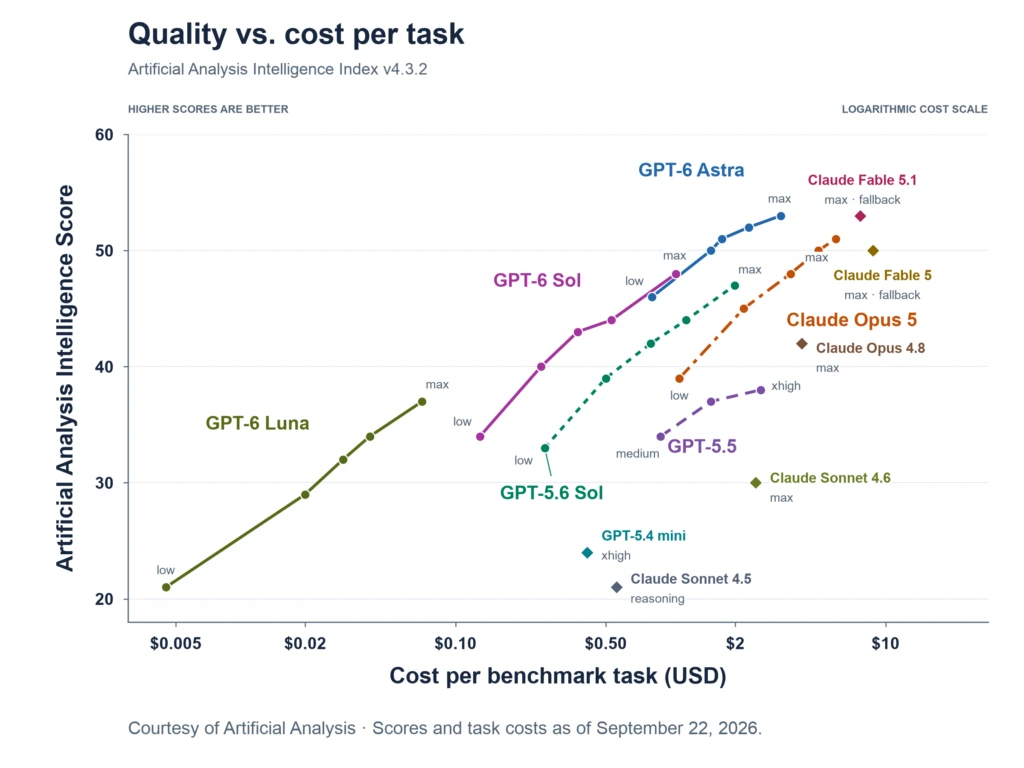
By introducing this specialized matrix, Microsoft is shifting the industry’s economic focus away from raw "price-per-token" metrics toward a holistic "cost-per-task" ROI model. Supported by standard, provisioned, and priority deployment options across 28 global regions and compliant Data Zones in the United States and European Union, Microsoft Foundry aims to establish a default operational plane for production-ready enterprise agents.
Detailed Chronology: The Road to the GPT-6 Tri-Tier Suite
The launch of GPT-6 Sol and Luna represents a deliberate evolution in Microsoft’s enterprise AI deployment roadmap, reflecting rapid changes in how global corporations consume and deploy large language models.
The Monolithic Era (GPT-4 / Legacy Models): Early enterprise adoption focused on foundational language generation and basic conversational workflows. While powerful, these legacy architectures presented high latency, token bloat, and challenging economics when deployed inside agentic loops requiring continuous tool execution.
The Intermediate Pivot (GPT-5.6 Sol & GPT-6 Astra Preview): Recognizing that autonomous agents require deterministic execution and reduced output "noise," Microsoft introduced GPT-5.6 Sol and GPT-6 Astra. Astra established new benchmarks in software engineering, multi-step logic, and direct computer interaction, while GPT-5.6 Sol proved that optimized context processing could drastically reduce execution overhead.
The Tri-Tier Realization (GPT-6 GA Release): With today’s release, Microsoft has codified a clear model tiering structure in Microsoft Foundry. GPT-6 Sol emerges as the refined successor for enterprise workflows, while GPT-6 Luna enters as a dedicated, low-cost micro-tier. Together with Astra, the suite allows system architects to orchestrate heterogeneous agent networks—reserving deep reasoning for critical checkpoints while routing routine context through lightweight endpoints.
Supporting Context & Metrics: Architecture, Economics, and Security
Tiered Intelligence: Astra, Sol, and Luna Defined
To deploy agentic systems efficiently, developers must align model capabilities with specific sub-tasks inside an operational pipeline.
GPT-6 Astra (Frontier Judgment & Execution): Positioned at the apex of the series, Astra is designed for complex tasks requiring high autonomy, such as writing software systems, executing multi-application UI navigation ("computer use"), and executing regulatory analysis. It utilizes fewer overall tokens to arrive at solutions, compensating for its higher token-unit price point by minimizing repetitive reasoning loops.
GPT-6 Sol (Production Workflows & Agent Core): Engineered as the workhorse for enterprise applications, GPT-6 Sol delivers mid-tier pricing with high-tier agent capabilities. It features long-context comprehension, robust tool-calling mechanics, and multi-step reasoning tailored for routine software development, complex customer support, and system integration.
GPT-6 Luna (High-Volume Processing): Designed for scale, Luna operates at a fraction of the cost of larger models. It handles high-frequency tasks where speed and low cost are prioritized over deep reasoning—such as intent classification, preliminary data extraction, request routing, and real-time interactive triage.
The Paradigm Shift: From "Cost Per Token" to "Cost Per Task"
Traditional cloud AI economics focused almost exclusively on raw input and output token pricing. However, agentic workflows execute loop-based operations: an agent accepts a user goal, queries databases, parses responses, attempts tool calls, handles errors, and refines results over multiple iterations.
In this paradigm, an inexpensive model that hallucinates tool inputs or outputs redundant context can consume dozens of reasoning loops, driving up the aggregate cost. Conversely, a higher-performing model that accomplishes the objective cleanly in two steps yields a dramatically lower Cost Per Task.
Microsoft Foundry’s telemetry reveals that by combining GPT-6 Astra for heavy reasoning with Sol and Luna for sub-tasks, enterprises can drastically lower total operational costs while improving accuracy and execution speed.
Exhaustive Pricing and Regional Deployment Matrix
Microsoft Foundry offers flexible deployment models suited to different business requirements:
Standard Deployment: Pay-as-you-go processing across Global regions and isolated Data Zones.
Priority Processing: A fast-lane pay-as-you-go model optimized for lower latency variability.
Below is the standard pricing structure (in USD per million tokens) across models, context lengths, and regional deployment boundaries:
Model
Deployment Tier
Context Tier
Input ($/1M)
Cached Input ($/1M)
Cached Writes ($/1M)
Output ($/1M)
GPT-6 Astra
Global Standard
Short Context
$10.00
$1.00
$12.50
$50.00
Global Standard
Long Context
$20.00
$2.00
$25.00
$75.00
US Data Zone
Short Context
$11.00
$1.10
$13.75
$55.00
US Data Zone
Long Context
$22.00
$2.20
$27.50
$82.50
EU Data Zone
Short Context
$12.00
$1.20
$15.00
$60.00
EU Data Zone
Long Context
$24.00
$2.40
$30.00
$90.00
GPT-6 Sol
Global Standard
Short Context
$2.00
$0.20
$2.50
$10.00
Global Standard
Long Context
$4.00
$0.40
$5.00
$15.00
US Data Zone
Short Context
$2.20
$0.22
$2.75
$11.00
US Data Zone
Long Context
$4.40
$0.44
$5.50
$16.50
EU Data Zone
Short Context
$2.40
$0.24
$3.00
$12.00
EU Data Zone
Long Context
$4.80
$0.48
$6.00
$18.00
GPT-6 Luna
Global Standard
Short Context
$0.10
$0.01
$0.125
$0.50
Global Standard
Long Context
$0.20
$0.02
$0.25
$0.75
US Data Zone
Short Context
$0.11
$0.011
$0.1375
$0.55
US Data Zone
Long Context
$0.22
$0.022
$0.275
$0.825
EU Data Zone
Short Context
$0.12
$0.012
$0.15
$0.60
EU Data Zone
Long Context
$0.24
$0.024
$0.30
$0.90
Note: US Data Zone deployments carry a 10% premium over Global rates to support localized compute residency obligations, while EU Data Zone deployments carry a 20% premium. Provisioned Throughput and Priority Processing rates vary by tier and region.
Enterprise Safety & Guardrails: A Four-Layer Defense Architecture
Deploying autonomous agents into corporate software ecosystems introduces complex threat vectors, including prompt injection, data exfiltration, and unintended function execution. Microsoft Foundry protects GPT-6 deployments using a integrated four-layer defense framework:
+-----------------------------------------------------------------------------------+
|                        FOUR-LAYER ENTERPRISE DEFENSE MATRIX                       |
+-----------------------------------------------------------------------------------+
|                                                                                   |
|  [ Layer 1: Core Alignment ]                                                      |
|  Inherent safety & safety training built directly into the base GPT-6 models.     |
|                                                                                   |
|  [ Layer 2: Input / Output Guardrails ]                                           |
|  Real-time content filtering, safety evaluations, and output validation.          |
|                                                                                   |
|  [ Layer 3: Tool & Execution Protection ]                                         |
|  Prompt injection mitigation, secure tool call sandboxing, and API validation.    |
|                                                                                   |
|  [ Layer 4: Enterprise Identity & Governance ]                                    |
|  Role-Based Access Control (RBAC), Microsoft Purview data residency, audit logging.|
|                                                                                   |
+-----------------------------------------------------------------------------------+
Core Model Alignment: Inherent post-training alignment strategies applied during model pre-training and fine-tuning to discourage harmful outputs and reduce hallucinations.
Prompt & Output Guardrails: Context-aware content filters that run alongside the inference engine to intercept inappropriate content, corporate policy violations, or unsafe language prior to generation.
Tool Execution Protections: Advanced Prompt Shields that evaluate functional API requests and external tool responses, preventing malicious third-party content from hijacking agent permissions via indirect prompt injections.
Enterprise Identity & Policy Controls: Full integration with Azure Role-Based Access Control (RBAC) and Microsoft Purview, enforcing data sovereignty, tenant isolation, and strict regulatory compliance across all agent activities.
Official Statements: Industry Leaders Validate Agentic Workflows
Early corporate adopters of Microsoft Foundry’s GPT-6 ecosystem emphasize that production scalability depends on balancing raw intelligence with governance and reliability.
Autonomous Workflow Execution at Manus
Manus, an enterprise pioneer in building fully autonomous AI agent networks, relies on Azure’s infrastructure to run multi-step execution workflows at scale.
"Azure OpenAI models provide a core layer of intelligence powering Manus. Through Azure, we reliably integrate advanced models into our agentic workflows, enabling Manus to understand user intent, plan tasks, and execute complex work. Responsive Microsoft technical support and rapid access to new model capabilities help us iterate quickly and deliver a leading, reliable AI experience for our users."
— Tao Zhang, Co-Founder & Product Partner, Manus
Rigorous Compliance and Explainability at Wolters Kluwer
In sectors like professional accounting and corporate tax, zero-tolerance policies for errors mean AI agents must offer complete auditability and step-by-step reasoning.
"Our customers work in domains where getting an answer isn’t enough, it has to be the right answer, and it has to hold up to scrutiny. The latest Azure OpenAI frontier models reason through a problem in steps we can follow, which is what makes it viable for the research and compliance workflows our professionals depend on. Building on Microsoft Foundry lets us take those agentic workflows into production on infrastructure and services that already meet our governance, data residency, and security obligations."
Future Outlook: The Next Phase of Enterprise AI Integration
The full availability of GPT-6 Sol and Luna marks an important milestone in enterprise AI. By breaking the monolithic model structure into specialized, workload-aligned tiers, Microsoft is setting a template for how multi-agent enterprise networks will be constructed moving forward.
Looking ahead, enterprise AI architects should anticipate three core operational trends:
The Dominance of Orchestrated Multi-Agent Architectures: Single-prompt interfaces are increasingly giving way to agent networks. Lightweight routers like GPT-6 Luna will triage inbound traffic, delegating domain tasks to GPT-6 Sol, and calling on GPT-6 Astra only when handling deep logical edge cases or high-value decisions.
Data Zone Governance as a Baseline Requirement: As global regulatory oversight around data residency tightens (such as EU AI Act mandates), the ability to deploy specialized models like Sol and Luna inside dedicated Data Zones with guaranteed latency profiles will move from a feature preference to a regulatory necessity.
Legacy Migration Accelerates: With GPT-6 Sol offering higher operational efficiency at lower net execution costs, enterprises still running legacy GPT-4 or early GPT-5 class models face strong economic incentives to migrate their workloads.
Microsoft Foundry’s expanded GPT-6 portfolio offers a compelling answer to the primary enterprise AI question of this decade: how to transform experimental autonomous agents into reliable, secure, and cost-effective members of the digital workforce.