The software development lifecycle (SDLC) stands at a defining precipice. For the past two years, artificial intelligence has acted primarily as an incremental assistant—autocomplete on steroids, generating localized snippets of code or summarizing pull requests. However, the paradigm is rapidly shifting from code-assistance tools to autonomous "agentic engineering," where teams of AI coding agents operate collaboratively to build, test, and deploy production-ready applications.
Recognizing this critical evolution, Atlassian has announced a sweeping expansion of its enterprise ecosystem, designed specifically to feed artificial intelligence agents the deep organizational and technical context they require to operate effectively at scale.
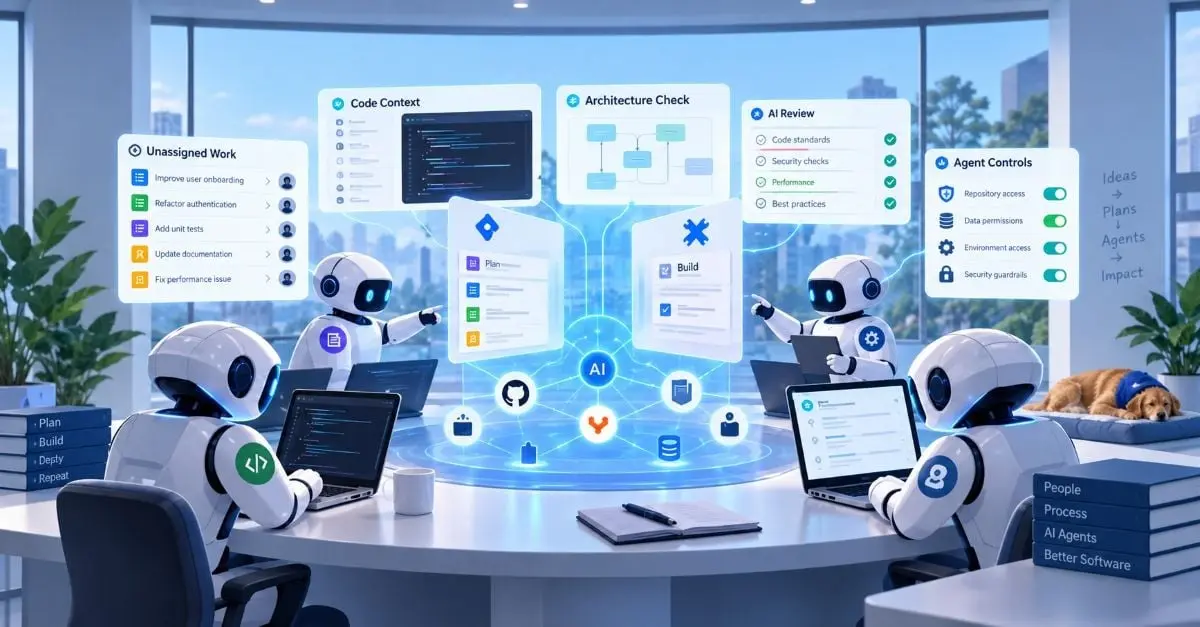
At the heart of this announcement are two foundational capabilities: Code Context, built upon Atlassian’s proprietary Teamwork Graph, and Agent Context Controls. Together, these tools aim to resolve one of the most stubborn bottlenecks in modern artificial intelligence integration: the "context gap." While foundation models have grown exponentially more powerful, the environments in which they operate remain siloed, lacking the broader organizational awareness, historical architectural decisions, and security guardrails necessary to safely construct enterprise-grade software.
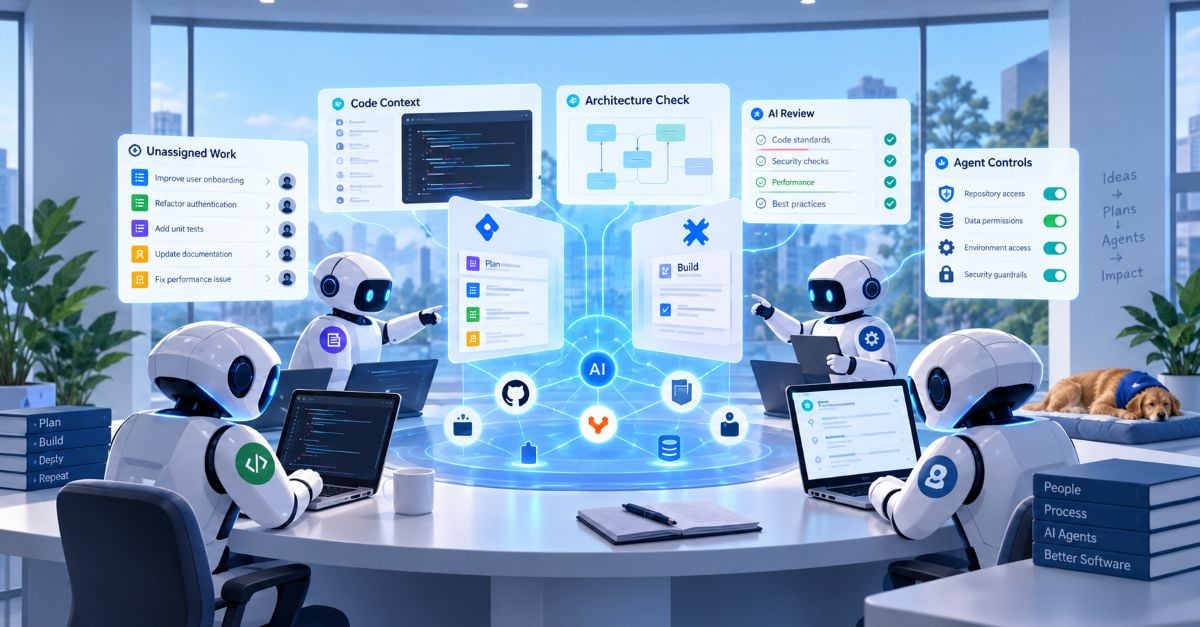
Simultaneously, Atlassian is weaving automation directly into its core Jira and Confluence platforms. By empowering Jira to continuously scan for unassigned, well-defined work items and delegate them to a dedicated Jira Coding Agent—which subsequently files a pull request for human oversight—Atlassian is introducing a systemic restructuring of how tasks flow from conception to code. Furthermore, new AI Review capabilities enforce compliance by mapping DevSecOps coding standards directly to repositories, ensuring that both human engineers and autonomous agents are held to uniform quality metrics.
According to Ming Wu, head of engineering for the DevAI organization at Atlassian, while developer adoption of AI tools is widespread, most teams have failed to integrate them deeply across the entire SDLC. Achieving the next phase of software delivery requires platforms that explicitly surface the hidden metadata, cross-functional dependencies, and historical team decisions that AI agents need to function as collaborative digital teammates.
Industry analysts, however, urge caution. While the promise of agentic engineering is immense, questions remain regarding cross-vendor interoperability, token economy optimization, and the fundamental re-skilling required for human developers, who are rapidly pivoting from task executors to managers of autonomous systems.
Detailed Chronology: The Evolution of Atlassian’s Agentic Ecosystem
To understand the weight of Atlassian’s latest release, one must trace the trajectory of how development tooling has adapted to the generative AI boom.
Phase 1: Localized Assistance and the Context Problem
When large language models (LLMs) first infiltrated the software engineering space, their utility was largely confined to Integrated Development Environments (IDEs). Tools like GitHub Copilot transformed how developers wrote individual lines of code, dramatically accelerating syntax generation and boilerplate creation. Yet, these early systems suffered from severe myopia. An AI assistant could write a function, but it had no idea why that function was needed, what business requirements dictated its parameters, or whether it violated overarching architectural principles agreed upon in Jira tickets or Confluence documentation weeks prior.
This limitation led to the emergence of "gray areas"—scenarios where the visibility afforded to AI agents was simply insufficient to complete complex, multi-step tasks without constant human intervention. Engineers found themselves spending significant time acting as prompt wranglers, feeding manual context into chat windows to prevent AI models from hallucinating solutions that collided with existing codebase architecture.
Phase 2: Atlassian’s Strategic Pivot to the Teamwork Graph
Recognizing that code does not exist in a vacuum, Atlassian began consolidating enterprise workflows around its Teamwork Graph—a relational data layer mapping how people, projects, code repositories, and documentation connect across an organization.
Building upon this infrastructure, Atlassian’s new Code Context feature bridges the gap between organizational intent and technical execution. Rather than merely scanning a repository line-by-line, Code Context allows AI coding agents to vet ideas for architectural feasibility before a single line of code is written. By cross-referencing proposed changes against Confluence specs and historical Jira issues, the agent gains a holistic understanding of the application’s ecosystem.
Phase 3: Governance, Automation, and the Jira Coding Agent
As autonomous agents transition from experimental toys to active participants in production environments, governance has emerged as a paramount concern. Enterprises cannot risk autonomous scripts modifying critical security protocols or exposing sensitive telemetry data.
To mitigate this, Atlassian introduced Agent Context Controls. This capability grants DevSecOps teams granular administrative oversight, dictating precisely which agents are authorized to operate within specific spaces and establishing hard boundaries around what data those agents are permitted to observe.
Complementing these guardrails is the rollout of end-to-end workflow automation within Jira and Confluence. The system now actively scans backlog items to identify well-defined, unassigned tasks. Once flagged, these tasks can be automatically handed off to the newly minted Jira Coding Agent. This agent writes the necessary code, executes local tests, and opens a pull request for human review.
To ensure quality control remains uncompromised, Atlassian also deployed an AI Review capability. Operating as a dedicated agent on every pull request, this system checks incoming code against predefined DevSecOps standards mapped directly to the repository, applying uniform quality gates across both human and artificial contributors.
Supporting Context & Metrics: Navigating the Agentic SDLC
The transition from human-centric coding to agent-driven orchestration introduces profound structural shifts in how organizations budget resources, manage technical debt, and structure engineering teams.
The Token Economy and Architectural Efficiency
As DevSecOps teams scale their deployment of AI agents, they face a new economic reality: the consumption of API tokens. Every time an LLM navigates a massive codebase to find relevant context, it consumes thousands—sometimes millions—of tokens, driving up operational costs and increasing latency.
Atlassian’s strategy relies on offloading context discovery from the raw LLM to structured enterprise platforms like Jira. By utilizing metadata, structured tickets, and relational graphs to hand the agent pre-digested context, organizations can drastically reduce the number of tokens wasted during codebase navigation.
Striking the right balance between the raw capabilities of frontier AI models and the structural harnesses applied via platforms like Atlassian is rapidly becoming a core competency for modern engineering leadership.
Redefining the Role of the Software Engineer
The proliferation of AI coding agents fundamentally alters the day-to-day responsibilities of human developers. The traditional workflow—where an engineer picks up a ticket, writes the code, handles unit tests, and submits a pull request—is increasingly being automated.
[Traditional SDLC]
Human Engineer -> Writes Code -> Tests Locally -> Submits PR -> Manual Review

[Agentic SDLC]
Jira Backlog -> AI Coding Agent -> Automated PR -> AI Review Guardrails -> Human Architect (Manager)
In this new agentic paradigm, software engineers are evolving into project managers of AI systems. Instead of focusing on individual code syntax or repetitive boilerplate generation, developers must direct, review, and orchestrate fleets of autonomous agents. Success is no longer measured purely by lines of code written, but by the architectural clarity of requirements provided to the agents and the rigorousness of the governance models established by the team.
Official Statements and Industry Perspectives
Atlassian’s leadership emphasizes that the industry has only scratched the surface of what is possible when AI is embedded across the entire software development lifecycle.
Ming Wu, head of engineering for the DevAI organization at Atlassian, points out that while individual developer tools have saturated the market, their application remains fragmented:
"While AI coding tools have been widely adopted, most DevOps teams are not using them extensively across the software development lifecycle (SDLC). Achieving the next level of agentic engineering will require tools and platforms that surface the context that AI agents will require to work as a team… Right now, there are simply too many gray areas where the level of visibility being given to AI coding agents isn’t sufficient to complete tasks assigned."
Wu’s assessment highlights the core thesis of Atlassian’s update: isolated AI utilities are no longer enough. To achieve true autonomy, agents must share a unified operational reality.
Offering an external market perspective, Mitch Ashley, vice president and practice lead for software lifecycle engineering at the Futurum Group, notes that Atlassian is addressing a critical blind spot in current AI implementations—namely, permissions and observability.
"Atlassian is focusing on where agents get context and permissions, a different context than coding assistance. Agent deployment is limited by what teams can observe, control, and prove, and that ceiling sits in the systems where work is defined."
However, Ashley also raises a vital strategic question regarding vendor ecosystems:
"The open question is whether context and controls scoped to one vendor’s graph hold up when agents from three other vendors touch the same repository."
As enterprises increasingly adopt multi-vendor AI stacks—combining models and agents from OpenAI, Anthropic, Google, and open-source communities—the ability of a single platform’s governance graph to maintain sovereignty over mixed agent environments remains an open challenge for the enterprise software market.
Future Outlook: Re-Engineering for the Agentic Era
The rollout of Code Context and Agent Context Controls marks an important milestone, but it also serves as a warning shot to engineering leaders. Simply bolting AI agents onto existing workflows—which are historically rife with manual handoffs, unclear requirements, and communication silos—will only accelerate dysfunction.
1. The Death of Ambiguous Backlogs
In an agentic future, vague Jira tickets like "fix the login bug" or "improve database performance" will become catastrophic liabilities. Because AI agents rely entirely on structured context to execute tasks, organizations must invest heavily in rigorous backlog grooming and precise specification writing. If the human-defined parameters are muddy, the autonomous output will be disastrously flawed.
2. Multi-Agent Orchestration as a Core Competency
As platforms evolve, we will move past single-agent interactions toward multi-agent collaboration—where a planning agent, a coding agent, a security agent, and a testing agent negotiate tasks autonomously within a shared workspace. Enterprises that master the governance, observability, and permission frameworks required to safely herd these digital agents will achieve unprecedented velocity.
3. Workflow Re-Engineering Before Scale
Ultimately, DevSecOps teams would be well-advised to start re-engineering their workflows for the agentic AI era today. Waiting for AI models to magically solve process bottlenecks is a losing strategy. By embracing platform-driven context graphs, establishing strict guardrails, and shifting human labor toward architectural oversight and management, organizations can successfully cross the chasm from experimental AI assistance to true agentic production engineering.