Executive Overview
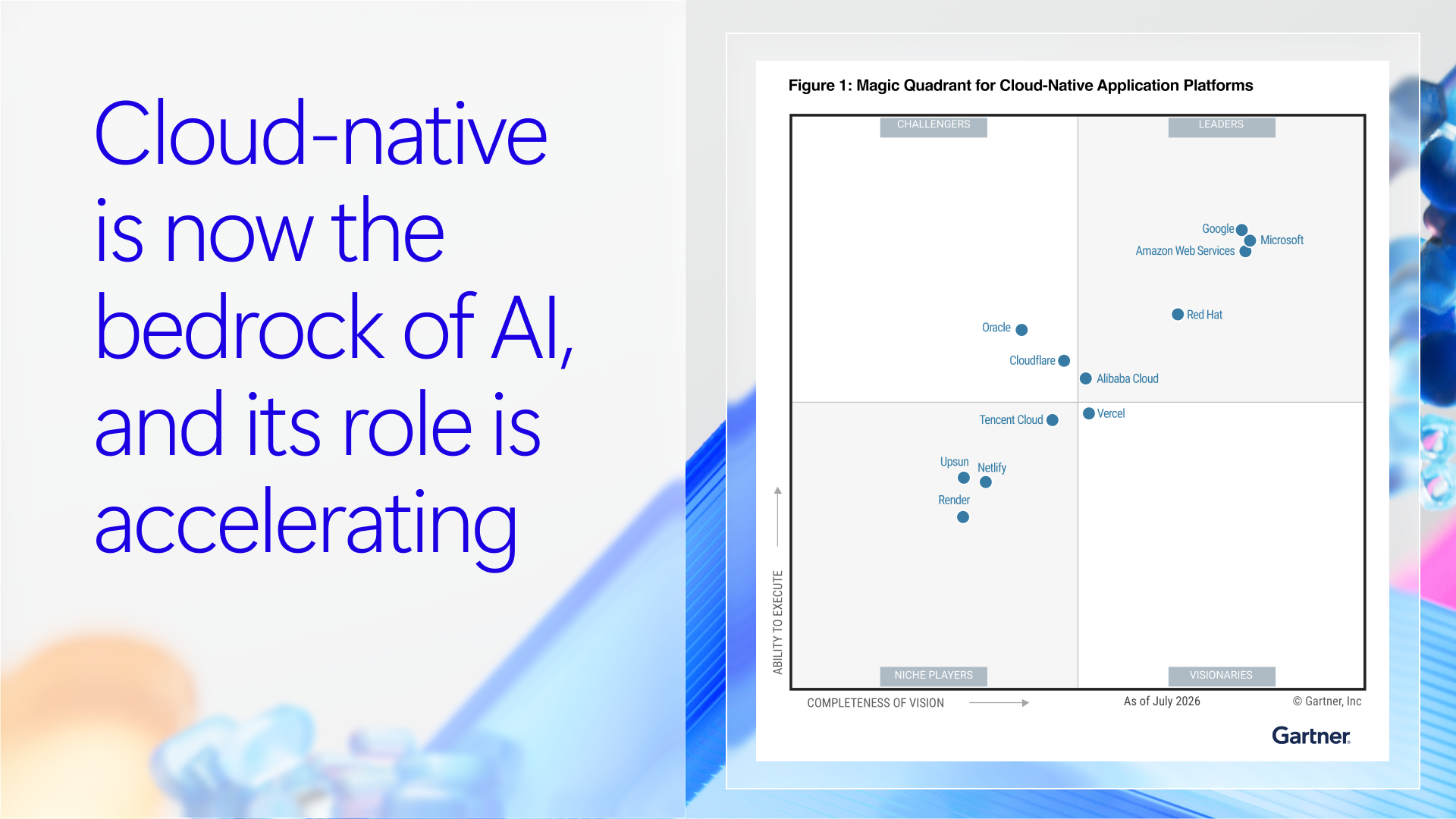
In an evaluation of enterprise infrastructure capabilities, Gartner® has named Microsoft a Leader in its 2026 Magic Quadrant™ for Cloud-Native Application Platforms (CNAPs). The report—authored by analysts Mukul Saha, Alex Coqueiro, Prasanna Lakshmi Narasimha, and Richard Watson, and published on August 3, 2026—marks Microsoft’s third consecutive year in the Leaders quadrant.
While vendor recognition in analyst frameworks is a recurring tech industry milestone, this third annual designation reflects a structural shift across the enterprise software landscape. Cloud-native platforms are no longer evaluated merely on their ability to host microservices, scale web traffic, or orchestrate Kubernetes clusters. Instead, these platforms have become the operational foundation for enterprise Artificial Intelligence (AI) transformation.
       +-------------------------------------------------------------+
       |   ENTEPRISE AI TRANSFORMATION VIA CLOUD-NATIVE PLATFORMS    |
       +-------------------------------------------------------------+
                                      |
         +----------------------------+----------------------------+
         |                                                         |
         v                                                         v
+----------------------------------+     +----------------------------------+
|      Modern Application Estate   |     |      Autonomous AI & Agents      |
|  - Azure App Service             |     |  - Microsoft Foundry             |
|  - App Service Managed Instance  |     |  - Container Apps Sandboxes      |
|  - Legacy .NET / Windows Apps    |     |  - Model Context Protocol (MCP)  |
+----------------------------------+     +----------------------------------+
         |                                                         |
         +----------------------------+----------------------------+
                                      |
                                      v
       +-------------------------------------------------------------+
       |         UNIFIED GOVERNANCE, SECURITY & OPERATIONS           |
       |  - Azure API Management (AI Gateway)                        |
       |  - Managed Connectors (>1,400 Integrations)                |
       |  - Azure SRE Agent & Application Insights                   |
       +-------------------------------------------------------------+
As organizations push beyond experimental generative AI pilots, they face systemic engineering bottlenecks. The chief obstacle for enterprise technology teams is moving proof-of-concept AI models into production environments that require real-time integration with legacy data, continuous reliability at global scale, and strict adherence to corporate security and compliance governance. Microsoft’s strategy addresses this challenge by consolidating application modernization, AI orchestration, developer toolchains, and zero-trust security into a unified operational layer centered around Microsoft Azure.
Detailed Chronology: The Three-Year Evolution of Cloud-Native Infrastructure
The enterprise cloud ecosystem has evolved rapidly over the past three years. The requirements for cloud-native dominance have shifted from basic resource virtualization to complex, autonomous application execution.
         2024: INFRASTRUCTURE FOUNDATIONS
         - Focus: Container orchestration, basic PaaS, and serverless scaling.
         - Platform Objective: Lift-and-shift modernization and web app hosting.
                        │
                        ▼
         2025: THE HYBRID AI EXPERIMENTATION PHASE
         - Focus: Standalone LLM integration via REST APIs and early prompt pipelines.
         - Platform Objective: Connecting application runtimes to external AI endpoints.
                        │
                        ▼
         2026: THE AGENTIC ENTERPRISE PLATFORM (CURRENT ERA)
         - Focus: Deep integration of AI agents, hardware-isolated microVMs, and MCP servers.
         - Platform Objective: Unified runtime for application code, autonomous agents, and real-time governance.
Phase 1: Infrastructure Isolation and Container Standardization (2024)
Three years ago, the cloud-native conversation was dominated by container orchestration standards, basic Platform-as-a-Service (PaaS) migrations, and event-driven serverless functions. Microsoft established its initial leadership position by expanding Azure App Service and refining Azure Container Apps, offering developers abstract abstractions over Kubernetes operational overhead. The focus during this period was helping enterprise teams migrate monolithic architectures into scalable microservices without incurring massive platform management costs.
Phase 2: The Integration of Generative Model Pipelines (2025)
As enterprise generative AI interest accelerated, a disconnect emerged between application development teams and data science groups. Organizations routinely struggled to bridge standalone Large Language Models (LLMs) with core business logic. Microsoft responded by tightly linking its cloud-native application stack with developer tools like GitHub Copilot and early iterations of Microsoft Foundry. During this phase, Azure API Management was adapted to handle basic model routing, laying the groundwork for standardized governance of enterprise AI endpoints.
Phase 3: The Emergence of the Agentic Infrastructure Stack (2026)
By mid-2026, enterprise application development transitioned from passive conversational interfaces to autonomous AI agents capable of executing multi-step workflows across disparate business systems. This shift required a fundamental rethink of cloud primitives.
To run autonomous agents safely, cloud platforms had to introduce dynamic execution sandboxes, standardized tool protocols, and unified operational control planes. Gartner’s 2026 assessment reflects this reality: Microsoft secured its third consecutive Leader designation by unifying application runtime services (Azure Container Apps, Azure Functions, Azure App Service) with specialized agent infrastructure (Azure Container Apps Sandboxes, Microsoft Foundry Agent Service, and Model Context Protocol integration).
Supporting Context & Technical Metrics: Deconstructing Azure’s Unified Architecture
Microsoft’s position as a Leader rests on an integrated stack of cloud-native and AI-specific services designed to support both existing codebases and newly engineered agentic systems.
+-----------------------------------------------------------------------------------+
|                        MICROSOFT CLOUD-NATIVE APP PLATFORM                        |
+-----------------------------------------------------------------------------------+
|  DEVELOPER LAYER   | GitHub Copilot  │  Microsoft Foundry  │ Azure Container Apps  |
|                    |                 │                     │ Express               |
+--------------------+--------------------------------------------------------------+
|  RUNTIME & AGENT   | Azure App       │ Azure Container     │ Azure Container Apps  |
|  EXECUTION         | Service         │ Apps                │ Sandboxes (microVMs)  |
+--------------------+--------------------------------------------------------------+
|  INTEGRATION &     | Azure Functions │ Model Context       │ Managed Connectors    |
|  CONNECTIVITY      | (Event-Driven)  │ Protocol (MCP)      │ (1,400+ Pre-built)    |
+--------------------+--------------------------------------------------------------+
|  GOVERNANCE &      | Azure API Management  │ AI Gateway      │ Microsoft Defender  |
|  OPERATIONS        | (Policies/Quotas)     │ Controls        │ & Confidential Compute|
+-----------------------------------------------------------------------------------+
Core Compute and Modernization Runtimes
Microsoft’s application platform accommodates legacy, modern, and emerging workload types through specialized compute tiers:
- Azure App Service & App Service Managed Instance: Serves as the backbone for traditional enterprise web applications. The introduction of App Service Managed Instance allows organizations to migrate complex, legacy Windows and .NET applications into a fully managed cloud context without rewriting underlying codebases, while retaining access to modern identity, networking, and governance layers.
- Azure Container Apps & Container Apps Express: Designed for microservices, API hosting, and high-density container workloads. Container Apps abstracts Kubernetes operations while offering zero-to-N autoscaling. The new Express deployment pattern enables developers to push code from local environments directly to production endpoints with minimal configuration.
Agentic Compute: MicroVM Isolation and Sandboxing
Autonomous AI agents present novel operational risks because they generate and execute dynamic code, call external APIs, and run tools in response to non-deterministic model outputs. To contain these risks, Microsoft introduced Azure Container Apps Sandboxes.
+-----------------------------------------------------------------------------+
|                     AZURE CONTAINER APPS SANDBOX ARCHITECTURE               |
|                                                                             |
|  +-----------------------------------------------------------------------+  |
|  |                           AGENT SERVICE                               |  |
|  +-----------------------------------------------------------------------+  |
|                                     |                                       |
|            +------------------------+------------------------+              |
|            v                                                 v              |
|  +-----------------------------------+   +-------------------------------+  |
|  |           microVM Boundary        |   |        microVM Boundary       |  |
|  |  +-----------------------------+  |   |  +-------------------------+  |  |
|  |  |   Agent Logic / Tool Execution |  |   |  | MCP Server & Generated  |  |  |
|  |  |   (Hardware-Level Isolated) |  |   |  | Code Execution          |  |  |
|  |  +-----------------------------+  |   |  +-------------------------+  |  |
|  |  | State Persistence Layer     |  |   |  | State Persistence Layer |  |  |
|  |  +-----------------------------+  |   |  +-------------------------+  |  |
|  +-----------------------------------+   +-------------------------------+  |
+-----------------------------------------------------------------------------+- Hardware-Level Isolation: Sandboxes rely on lightweight microVM boundaries to isolate agent execution, host Model Context Protocol (MCP) servers, and safely execute untrusted, dynamic code.
- Persistent State Management: Unlike standard ephemeral container runtimes, these microVM environments support state persistence, allowing agent execution contexts to survive when an agent pauses to await external input or human-in-the-loop approval.
- Foundry Integration: This sandboxed compute engine acts as the underlying execution primitive for the Microsoft Foundry Agent Service, while remaining directly accessible to developers building proprietary agent platforms natively on Azure.
Event-Driven Integration and Governance
Connecting modern agentic workflows with existing software systems requires event-driven capabilities and standardized protocol translation:
- Azure Functions & Model Context Protocol (MCP): Azure Functions provides event-driven serverless processing. Microsoft extended Functions to expose traditional enterprise business logic to AI models using the open Model Context Protocol (MCP).
- Managed Ecosystem Connectors: The platform includes more than 1,400 pre-built managed connectors. These enable AI agents to execute actions across enterprise systems (e.g., ERP, CRM, database layers) without forcing developers to manually implement complex authentication, retry policies, or data serialization logic for every integration target.
- Azure API Management & AI Gateway: Offers a centralized operational control plane for managing traditional microservice APIs, MCP servers, and external LLM endpoints. The platform’s AI Gateway feature set enables security teams to enforce granular token limits and quotas, balance traffic across multi-model deployments, execute semantic caching to lower operational costs, and audit AI consumption across the enterprise.
+-----------------------------------------------------------------------------------+
|                      AZURE API MANAGEMENT: AI GATEWAY CONTROL                     |
+-----------------------------------------------------------------------------------+
|  Incoming Request ──► [ Authentication & Entra ID Security Controls ]              |
|                              │                                                    |
|                              ▼                                                    |
|                       [ Semantic Caching Layer ] ──(Cache Hit)──► Return Response |
|                              │                                                    |
|                              ▼ (Cache Miss)                                       |
|                       [ Rate Limiting & Token Quotas ]                            |
|                              │                                                    |
|                              ▼                                                    |
|                       [ Dynamic Model Load Balancing ]                            |
|                              │                                                    |
|          +-------------------+-------------------+                                |
|          ▼                                       ▼                                |
|  [ Model Endpoint A ]                     [ Model Endpoint B ]                    |
+-----------------------------------------------------------------------------------+
Operational Intelligence: SRE Automation
Modern cloud applications operating alongside autonomous AI agents produce telemetric data volume that strains traditional IT operations. Microsoft integrates telemetry with Azure Monitor and Application Insights, while deploying the Azure SRE Agent. The SRE Agent applies agentic capabilities directly to site reliability engineering—automatically analyzing telemetry, triaging operational incidents, isolating root causes, and proposing or executing auditable remediation actions within approved governance parameters.
Enterprise Case Studies & Operational Impact
Across financial services, retail, healthcare, IT services, and manufacturing, enterprises are unifying legacy software modernization and AI execution on Microsoft’s platform.
+-----------------------------------------------------------------------------------------+
|                              ENTERPRISE ADOPTION METRICS                                |
+-----------------------------------------------------------------------------------------+
| Enterprise       | Azure Services Applied             | Quantified Metric / Outcome     |
+------------------+------------------------------------+---------------------------------+
| Planet DDS       | Azure App Service                  | Provisioning time reduced from  |
|                  |                                    | 6 weeks to 1 day (97.6% drop)   |
+------------------+------------------------------------+---------------------------------+
| Commerzbank AG   | Azure Container Apps &             | Autonomous 'Ava' agent resolves |
|                  | Foundry Agent Service              | 75% of 30k+ monthly chats       |
+------------------+------------------------------------+---------------------------------+
| Ghassan Aboud    | Azure Container Apps               | Deployed enterprise 'Ragin AI'  |
| Group            |                                    | across diverse business verticals|
+------------------+------------------------------------+---------------------------------+
| Levi Strauss     | Microsoft Foundry                  | Accelerated cross-departmental  |
| & Co.            |                                    | enterprise decision-making      |
+------------------+------------------------------------+---------------------------------+
Financial Services: Commerzbank AG
German banking giant Commerzbank AG built its enterprise agentic AI architecture on Azure Container Apps to support its customer-facing operations.
- Implementation: The bank launched its intelligent assistant, "Ava," integrated into core operational databases via secure containerized endpoints.
- Scale and Impact: Ava handles over 30,000 customer interactions per month. Supported by Azure’s scaling and safety primitives, the autonomous system resolves 75% of customer inquiries without human intervention, significantly lowering customer service operating costs while maintaining banking compliance standards.
Healthcare Software: Planet DDS
Dental practice management software provider Planet DDS modernized its cloud infrastructure to handle high-concurrency healthcare data environments.
- Implementation: Planet DDS transitioned its core software architecture onto managed Azure App Service environments.
- Scale and Impact: Platform deployment and infrastructure provisioning cycles were reduced from six weeks down to a single day—a 97.6% drop in deployment latency. This operational shift allowed engineering teams to redirect development cycles away from infrastructure maintenance toward product innovation and predictive feature development.
Global Conglomerates & Retail: Ghassan Aboud Group and Levi Strauss & Co.
- Ghassan Aboud Group: Built its enterprise-wide "Ragin AI" platform on Azure Container Apps. The multi-business conglomerate leverages containerized agent runtimes to deliver real-time automated customer interactions across automotive, retail, hospitality, and logistics operations.
- Levi Strauss & Co.: Integrated Microsoft Foundry and GitHub Copilot directly into its digital business units. The company uses the unified stack to streamline corporate workflows, automate internal analytics, and accelerate cross-departmental operational planning.
Official Statements & Expert Commentary
The inclusion of Microsoft in the Leaders quadrant highlights an evolving consensus among technology analysts: enterprise AI strategies fail when disconnected from fundamental platform engineering.
"A clean cloud architecture is a prerequisite for AI.
 You can’t build on top of a weak foundation."

   — Mike Gibson, Chief Technology Officer, Planet DDS
Architectural Pragmatism
Mike Gibson’s perspective reflects a common reality facing Chief Information Officers (CIOs) and Chief Technology Officers (CTOs). Organizations that attempted to bolt complex AI agents onto fragmented legacy infrastructure faced compounding technical debt, latency bottlenecks, and governance failures.
By prioritizing cloud modernization alongside AI deployment, enterprise technology groups construct a resilient baseline where shared identity (Microsoft Entra ID), unified networking, and standardized telemetry apply equally to legacy web forms and autonomous AI workflows.
The Analyst Perspective
Gartner’s research methodology evaluates vendors based on their Ability to Execute and Completeness of Vision. Microsoft’s three-year streak in the Leaders quadrant underlines the vendor’s success in aligning developer tooling (GitHub Copilot), enterprise PaaS (Azure App Service), dynamic container management (Azure Container Apps), and AI governance layers (Microsoft Foundry and API Management).
However, analyst evaluations also come with standard operational caveats. Gartner maintains explicit policy disclaimers regarding market research evaluations:
"Gartner does not endorse any company, vendor, product or service depicted in its publications, and does not advise technology users to select only those vendors with the highest ratings or other designation. Gartner publications consist of the opinions of Gartner’s business and technology insights organization and should not be construed as statements of fact. Gartner disclaims all warranties, expressed or implied… including any warranties of merchantability or fitness for a particular purpose."
Future Outlook: The Agentic Enterprise and Next-Gen Platform Engineering
As cloud platforms mature through 2026 and beyond, the criteria for enterprise platform selection are shifting. The convergence of cloud-native abstractions and AI orchestration is driving several industry developments:
               FUTURE TRAJECTORY OF CLOUD-NATIVE AI PLATFORMS
                                     │
    ┌────────────────────────────────┼────────────────────────────────┐
    │                                │                                │
    ▼                                ▼                                ▼
+───────────────────────+  +───────────────────────+  +───────────────────────+
| MicroVM Sandboxing    |  | Standardized Protocol |  | Agentic Site          |
| Standard              |  | Ecosystem (MCP)       |  | Reliability (SRE)     |
| Dynamic, hardware-    |  | Ubiquitous adoption   |  | Self-healing app      |
| isolated compute for  |  | of open protocols     |  | estates managed by    |
| generated code.       |  | connecting LLMs/apps. |  | autonomous agents.    |
+───────────────────────+  +───────────────────────+  +───────────────────────+
1. Ubiquitous MicroVM Sandboxing
As enterprise apps incorporate code generated dynamically by AI agents, traditional process-level isolation within standard Linux containers will no longer satisfy enterprise risk tolerances. Hardware-isolated microVMs—such as those powering Azure Container Apps Sandboxes—will become standard requirements for running agentic workloads, securing third-party tools, and isolating synthetic execution threads.
2. Deep Protocol Standardization (MCP Adoption)
The rapid rise of the Model Context Protocol (MCP) marks a transition away from custom, ad-hoc REST API wrappers for model integrations. As cloud providers natively embed MCP server hosting, tool discovery, and policy enforcement directly into their serverless and API management layers, enterprise developer teams will be able to plug AI agents into enterprise data pipelines with minimal manual engineering overhead.
3. Transition to Autonomous Platform Engineering
The emergence of operational AI infrastructure, such as the Azure SRE Agent, indicates a shift in cloud management patterns. Operational platforms will increasingly move from static dashboard alerting to closed-loop, autonomous remediation ecosystems. In these environments, operational software continuously monitors application behavior, diagnoses performance bottlenecks, applies runtime patches, and balances model consumption without requiring manual human oversight.
Conclusion
Microsoft’s placement as a Leader in the 2026 Gartner Magic Quadrant for Cloud-Native Application Platforms highlights an industry baseline: the next generation of software applications will be cloud-native, AI-driven, and embedded within legacy core infrastructure. By establishing a unified environment that bridges established applications with autonomous agent execution, Microsoft offers enterprise organizations a standardized path to modernize existing technology investments while building next-generation digital capabilities.
Reference Information
- Report Gartner® Magic Quadrant™ for Cloud-Native Application Platforms
- Authors: Mukul Saha, Alex Coqueiro, Prasanna Lakshmi Narasimha, Richard Watson
- Publication Date: August 3, 2026
- Evaluation Context: Third consecutive year of Microsoft’s placement in the Leaders quadrant.